Types of Elasticity
Elasticity isn't the same as a derivative — here's why, plus a breakdown of price elasticity of demand and why the value can differ at every single point on the curve.
OK, I’m going to skip shifting demand and supply curves for now. If you’ve taken in the endogenous/exogenous-variable discussion from before, you’ve got the starting point for those shifts. Moving on.
Wait, no. If you’re thinking, “I HAVE to see this explained!”, leave a comment. If people want it, I’ll write it up properly.
Anyway, onward to elasticity.
Elasticity asks how sensitively one “something” responds when another “something” changes. The key is that we compare percentage changes.
Depending on those two somethings, we get price elasticity of demand, income elasticity of demand, cross-price elasticity of demand, price elasticity of supply… and so on. Easy mistake incoming: you might confuse elasticity with a derivative, the slope. But they aren’t the same measure.
Why isn’t it just a derivative?
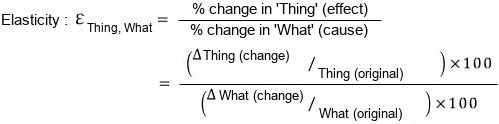
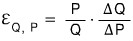
Because of how elasticity is defined. Let me throw down the definition first:
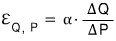
Compare that with the derivative:

See the difference? A derivative compares changes in the variables themselves. Elasticity compares their percentage changes.
Price elasticity of demand
Let’s start with price elasticity of demand: the percentage change in quantity demanded divided by the percentage change in price, holding the other influences on demand fixed.
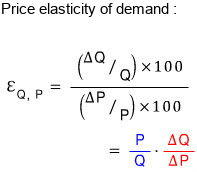
For point elasticity, we let those changes become infinitesimal. Then the red change quotient becomes the derivative, while the blue multiplier is still $P/Q$.
So point elasticity is $\varepsilon=(P/Q)(dQ/dP)$. We’ll keep its sign here: downward-sloping demand normally gives a negative value. Some books report its positive magnitude instead.
That extra multiplier makes a difference. What kind?
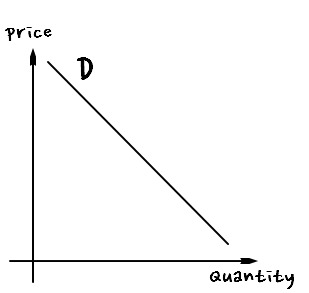
A straight line has the same derivative at every point: its slope is constant. But its elasticity can differ from point to point.
I said can, not must!
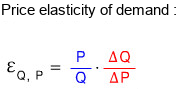
The red derivative can stay constant while the blue ratio changes with the point. That’s the whole trick. Let’s use that observation to introduce a few concepts, starting with the choke price.
Choke price
Here’s our elasticity formula again:
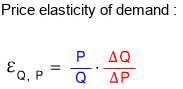
First, a graphing annoyance. For this demand relation, we can write quantity as a function of price. In math class the independent variable goes on the x-axis and the dependent one on the y-axis, but the usual economics diagram puts price on the vertical axis and quantity on the horizontal one. Flipped! It’s a convention, not a rule about which variable causes which.
Pretty much everywhere else, the cause goes on the x-axis… except econ. Supposedly whoever first brought math into economics drew it this way, and everyone just kept the convention. Ugh, so annoying -- ;; We’ll work with it.
For our downward-sloping straight line, the slope is nonzero, so we can invert the relation and rewrite the formula using the reciprocal slope:
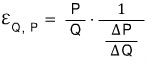
Here’s the line, with positive intercepts a and b:
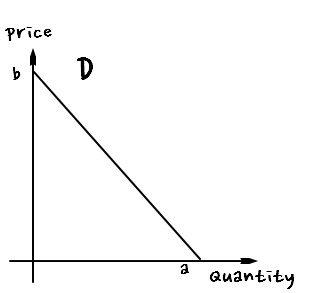
Its slope is  . So:
. So:
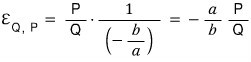
The line’s slope stays the same. The point-to-point part we need to watch is  :
:
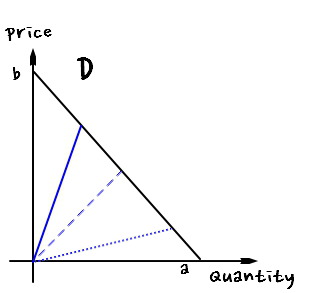
That’s the slope of the ray from the origin to the chosen point, because price is vertical and quantity is horizontal.
Where’s the choke price?
Right here, at the price intercept b, where quantity demanded reaches zero:
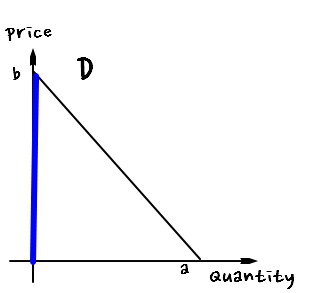
As we approach it from below, the ratio grows without bound. Multiply by the negative reciprocal slope, and the signed elasticity approaches $-\infty$.
Small but important catch: at the exact choke price, $Q=0$, so percentage elasticity is undefined. It’s the limit near that point that has unbounded magnitude, not a literal infinite percentage response from a zero base.
At or above that choke price, nobody buys in this demand model. Make sense? So we’ve got price elasticity, and we’ve seen that it can vary along one curve.
Now, will it jump around discontinuously? On the positive interior of this straight-line demand curve, no. Here’s the expression:
Because the relation is linear,  is constant. We can write the elasticity as
  .
.
Here $\alpha=P/Q$ varies with the point; it isn’t another constant. For this line, elasticity varies continuously while price and quantity are positive. That’s a statement about our example, not a guarantee for every possible demand curve.
Why am I hammering on that? So I can comfortably ask you to find the point where  !
!
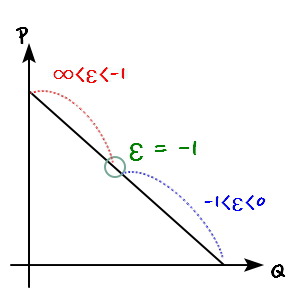
Once we’ve found it, the line divides into these regions:
Reading the elasticity
Why do humans sort things around an elasticity of -1?
Because it lets us interpret the relative percentage responses like this. These are local responses to small price changes, using the signed convention:
 |
 |
 |
|---|---|---|
 |
 |
Quantity demanded does not respond to price. |
 |
 |
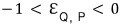
The percentage change in quantity is smaller in magnitude than the percentage change in price. |
 |
 |
The percentage rise in quantity equals the percentage fall in price, locally. |
 |
 |
The percentage change in quantity is larger in magnitude than the percentage change in price. |
 |
 |
At the going price, the idealized demand can absorb any quantity; raise price above it and quantity demanded falls to zero. |
The last row is the perfectly elastic limiting case, pictured as horizontal demand. “Unlimited quantity” is the model’s idealization, not a claim that real humans buy literally infinitely many goods. It is different from approaching the choke-price endpoint of our sloping line.
So knowing roughly which elasticity region we’re in can be useful when a firm makes pricing decisions. Heh.
Constant-elasticity demand
A quick side note: constant-elasticity demand has this form,  . Here a and b are positive constants, and price is positive. Let’s check that this form really has the same elasticity everywhere:
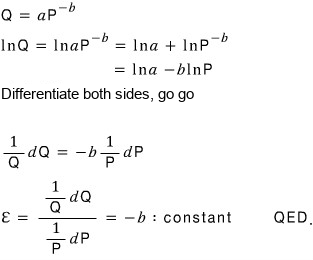
It comes out to $-b$, a constant. Ridiculously simple, heh.
Other elasticities
Let’s hit the other elasticities too!
We’ll look at income elasticity and cross-price elasticity. First, remember our price-elasticity question: “If this good’s price changes by so many percent, by how many percent does its quantity demanded change?” Now swap the thing that changes, holding the other influences fixed.
1. Income elasticity of demand
“If income changes by so many percent, by how many percent does quantity demanded change?”
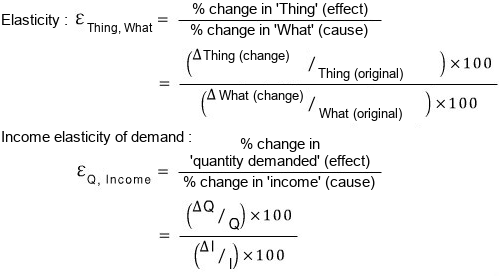
That definition seems reasonable enough. Write it straight into a formula:
One more!
2. Cross-price elasticity of demand
“If the price of another good changes by so many percent, by how many percent does the quantity demanded of our good change?”
Again, write the formula straight from that meaning:
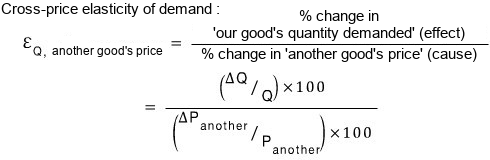
Let’s think about its economic meaning. When  , the other good’s price rising goes with a rise in the quantity demanded of our good.
“Ugh, that one’s getting expensive! I’ll substitute this one!”
Yep: substitutes have positive cross-price elasticity. On the other hand, when  , the other good’s price rising goes with a fall in the quantity demanded of our good.
“Ugh… if that one gets expensive, I don’t need this one either. I’m not buying either of them!”
Those are complements. Maybe starting with a price rise makes that feel a bit gloomy. Flip it around: the other good gets cheaper, and demand for our good rises.
“Yesss, that one’s cheaper! Then I’ll grab this one with it!”
Beer and peanuts, basically. If they’re complements, cheaper beer raises peanut demand too, other things equal.
Soju and jokbal, pork trotters. Soju and bossam, boiled pork wraps. Beer and chicken. Soju and samgyeopsal, pork belly, or galbi, ribs. Soju and stir-fried baby octopus. Soju and raw fish. Soju and bossam again…
OK, fine. I’m just listing things I want to eat right now. Sigh. Complementary goods. Hungry humans.
Heads-up. The figures here are the original notes, slips and all. A few things to watch for:
- In the picture that splits the demand line into regions, the red label should read $-\infty < \varepsilon < -1$; the minus sign on $\infty$ is missing (the table row for elastic demand has it right).
Comments
Discussion happens via GitHub Discussions. You'll need a GitHub account to comment.