Long-Run and Short-Run Elasticity
Elasticity isn't a fixed number — oil demand can be inelastic short-term but flip elastic long-run, and durable goods like airplanes can do the exact opposite.
OK so back to elasticity.
Whether you look at it over the long run~
or whether you look at it over the short run~~~~
No wait, what I’m trying to say is —
the elasticity of some good X isn’t this fixed-in-stone number~~
It can shift depending on which angle you’re looking from.
That’s basically the deal here.
So let’s set up a scenario.
From here on, picture yourself as the owner of a company that grows and sells flowers.
But then —
EEK!!!!!!!!
Let’s say oil prices suddenly shoot through the roof!!!
Ugh… and oil is absolutely, utterly essential for growing flowers — temperature control, you know.
Even if the price goes up, there’s literally nothing you can do. (crying)
You just gotta buy it and use it. (crying)
So the point is, in the short term, people’s quantity demanded barely budges in response to price. Inelastic.
But now look at it from a long-term angle.
Would the flower farm owner just shrug and accept the oil price hike and keep~~~ chugging along
doing exactly the same thing as before?!?!?!??!?????
Probably not.
First off, they could throw resources at all kinds of efficiency improvements — push tech forward, squeeze oil consumption down.
Or maybe they figure out how to run production on something other than oil entirely.
Which means!!!
Demand that’s inelastic in the short term
can totally become elastic in the long term.
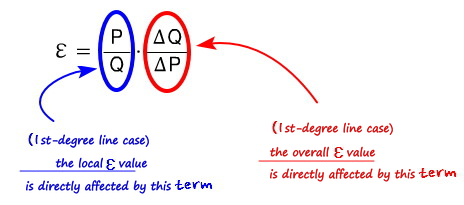
The way you read “quantity demanded changes inelastically with price” through ε looks like this,
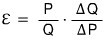
and I’ll lay it out like so.
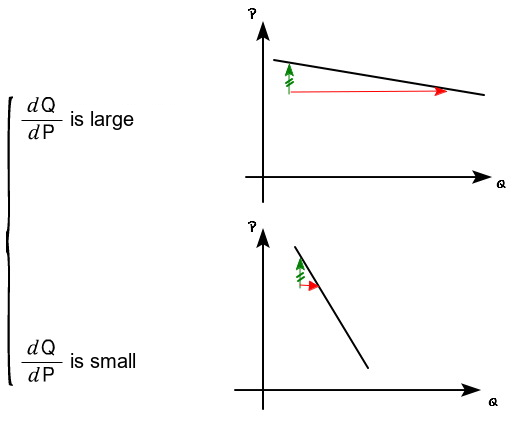
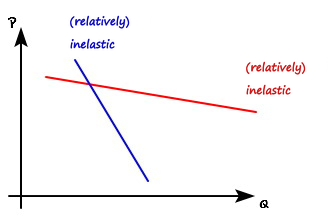
So the blue is the short-term view
and the red is the long-term view!!!
Same good, two totally different angles!!!! heh
Does short-term always look like that??
Does long-term always look like that??
Nope. There are flipped cases too.
Like an airline’s demand for airplanes, or a firm’s demand for machinery and equipment — those can run the opposite way.
Say Boeing (the airplane maker) suddenly announces a price hike on its planes.
KAL (Korean Air) would be FREAKING out, right????
“Ha(annoyed face) you little X’s..(crying)”
So KAL’s move might be:
“Hey(annoyed face) we’re not buying right now(annoyed face) let’s just keep flying the ones we’ve already got for a bit longer!!!!!!!!!!!!!!! (Classic durable-goods behavior.)”
That is — a huge change in demand from a price change.
But take the long view —
other than Boeing, where on earth are you sourcing planes from?
It’s not like KAL can just whip up its own planes in the back… heh.
That’s a hard no, and you can’t fly the same fleet forever either~
So in the long run, KAL caves.
(crying) “Guess we gotta buy them after all.(crying)”
Which gives us,
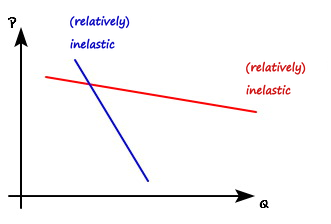
This time blue is the long-term demand curve
and red is the short-term demand curve.
So with short-term and long-term elasticity pulling in opposite directions like this between the two cases,
what’s the underlying factor that decides the behavior of a given good?
i) Flower farmer’s demand for oil:
-
Oil is consumed “on its own” (as in, it gets used up by itself).
-
There’s the possibility that other energy goods besides oil exist.
ii) KAL’s demand for airplanes:
-
Airplanes are bought and used “as-is.”
-
The possibility that some other good could play the role of passenger-carrier — something that flies people through the air — other than airplanes, at least in the 21st century, is straight-up nonexistent. lol
Comments
Discussion happens via GitHub Discussions. You'll need a GitHub account to comment.