Estimating Demand and Supply Curves
Using elasticity plus a few starred averages pulled from real data, we cook up an approximate linear demand (or supply) curve without having to derive it from scratch.
So we learned about elasticity.
And the cool thing is — using this elasticity idea, we can approximately derive the demand curve (or the supply curve).
Up until now, the demand curve has just been handed to us. Curve given → check elasticity → predict how demand moves when price moves. Done.
What made all that possible????
Yep. “Because the demand curve was already given.”
But realistically? Deriving a demand curve out in the wild is… a stretch.
Why? Because it’s complicated.
Like, so complicated we don’t even want to try.
So instead, what we actually do is — we lean on statistical data,

we compute that value, then we cook up a demand curve that fits that value, and we go “yeah, that’s our approximate equation.”
“Approximate” meaning: only kinda right. Error is not zero.
And also!!! It only holds for changes in $P$ that aren’t too big.
OK with that framing, let’s go derive the approximate equation.
First!!! From statistical data,

we can estimate this thing.
Why????????????
Because we can chop the data however we want, basically.
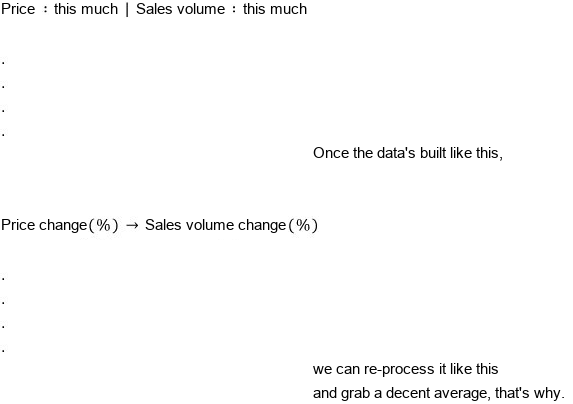
OK now let’s switch hats and think about it as math.
What we want is some kind of straight line — a first-degree thing.
Big disclaimer about econ vs math:
In literally every field except economics, the independent variable (the cause) goes on the x-axis, and the dependent variable (the effect) goes on the y-axis.
Econ flips it!!! Just keep that in the back of your head.
But — since the approximate equation we’re after is assumed to be a straight line, the inverse function exists, so we honestly don’t need to stress about which is which.
What we want is:
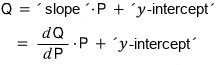
That’s the target.
Now, from the statistical data,

we can pull a reasonable average value out — and same for sales volume and price, we get reasonable averages too.
These extracted

, sales volume, and price averages — we’ll slap a star on them and call them

,

,

.
Then from the definition of elasticity, we can estimate $dQ/dP$.

and plugging the starred estimates in,
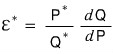
we can write it like that, so
the estimate of $dQ/dP$ is
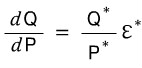
and boom — at this point we’ve nailed down most of the first-degree approximate equation:
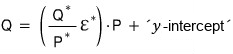
And now, how do we get the leftover y-intercept?
We just need one mildly-obvious assumption, heh heh heh.
“This approximate demand curve we’re building? It’s gotta pass through

.”
If it passes through that point, then plugging the point into the equation has to satisfy it,
i.e.,
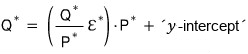
this has to hold too, so
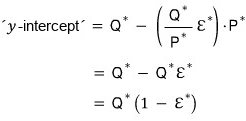
that’s what it works out to. And the approximate equation is done:
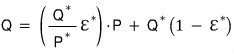
OK shall we run an example through this thing.
“In 1990, per capita chicken consumption in the United States was about 70 pounds, while the inflation-adjusted average retail price was about $0.7 per pound. The estimated elasticity of demand for chicken was −0.55.”
What’s the approximate demand curve?
→

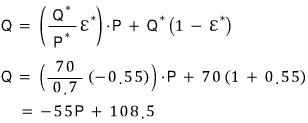
Done.
Can we pull the same trick for the supply curve????
Process the supply data, spit out

,

,

and with the definition
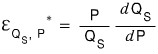
we build
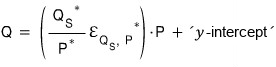
and the y-intercept follows the same reasoning — assume the curve passes through

and once you finish it off,
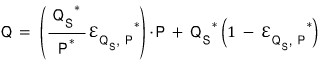
it’s just…. the same thing…. (obviously,….)
Only the data swapped out — now it’s about supply instead of demand.
The algebraic skeleton? Identical, heh heh heh heh heh heh.
Comments
Discussion happens via GitHub Discussions. You'll need a GitHub account to comment.