Preferences
A casual intro to consumer choice theory — breaking down what a 'basket' is, why we pretend only two goods exist, and the 'more is better' axiom.
This time we’re kicking off with ‘preference’.
I prefer women who are diligent, have guts, and feel like a friend. lol lol lol
OK that was nonsense, moving on.
We start from the concept of a basket.
Doesn’t matter if it’s econ, physics, math, whatever — in any science, the assumptions are the single most important part of the assumptions (lol), so you’ve gotta think hard about what is being assumed and how the logic gets pulled out of those assumptions…
So let’s nail down this ‘basket’ concept — it’s the first button on the shirt — and move on.
I made it sound dramatic but honestly there’s nothing to it.
First — a basket.
What kind of basket are we talking about?
“A collection of goods and services an individual wants to consume.”
That’s the kind of basket.
Now we’re gonna make a kind of extreme assumption.
Just to keep the model simple. And it goes like this —
“Let’s say there are only 2 kinds of goods in the entire world.” — stuff to eat & stuff to wear.
Then each person, in their own way, decides how they wanna consume.
And we define a basket as the bundle each person collects, sorted by type.
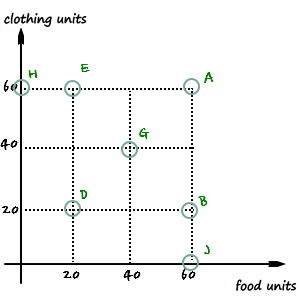
We name the various baskets A, B, … , J,
and we’ll try expressing each one’s identity on a coordinate plane.
Depending on each person’s means,
they’ll decide which goods to buy more of and which to buy less of.
And depending on what they like more, they’ll decide what to load up on and what to skimp on.
Basket H has 60 (units) of clothing and 0 (units) of food,
and whoever picks this one is just straight-up “die for style” energy. lol lol lol lol lol
Not a fan, heh.
Basket J — no clothes, all in on 60 units of food.
What’s even going on here —
just eating, nothing else…… (you pig lol)
I hate this one even more. Like, with a passion.
Here’s something important though.
In real life, when you actually consume stuff, things like income, time, cost, hassle, etc. all come into play, but
a basket assumes none of those costs exist and takes into account only “people’s preferences”!!!!
And ‘consumer choice theory’, built on people’s preferences, apparently rolls forward by treating the following two things as basically self-evident.

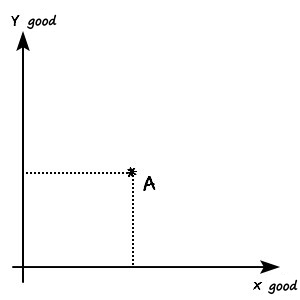
“More is better” — meaning, say a person can pick some amount of good X and good Y within their means,
like that.
But that’s only because their means are tight — if their budget bumped up a bit, they’d either grab more X or more Y —
so which point do they pick?????
Honestly, I don’t really know,
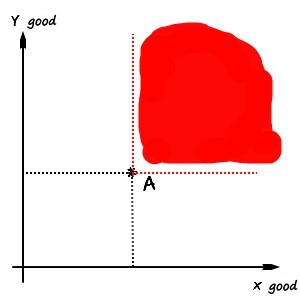
but at the very least, if someone picks a point in that red region, it wouldn’t be weird. That’s the claim.
Because no matter what good it is — more is better~~~ <3 <3
I think you can buy that much.
That said, there are plenty of real-world cases where the above assumption flat-out doesn’t hold.
But park that for now. First, get the assumption. Then, under that assumption,
zero in on how the logic flows — that’s what we’re focused on!!!
Third — this isn’t an assumption, but there’s some notation —
the notation goes like this.

We only really need three pieces of notation,
but the reason I painted the last one red is because that’s the one we’re gonna obsess over from here on.
So what we’re about to talk about is the ‘indifference curve’ —
but to get there, we need a little side-talk about utility first.
So I’m gonna cut it off here.
Next post: utility and the indifference curve.
Comments
Discussion happens via GitHub Discussions. You'll need a GitHub account to comment.