Special Utility Functions
We dive into the 'special cases' where diminishing marginal utility just doesn't apply — perfect substitutes and perfect complements, with all their quirks!
Like I teased at the end of last post —
there really are goods where the law of diminishing marginal utility just… doesn’t hold.
I think of these as the “special cases,” and that’s what we’re tackling today!!!!
The first example is
perfect substitutes,
and actually I already tossed this one out last post — Pepsi vs. Coca-Cola is the textbook case of perfect substitutes.
So basically the diminishing-marginal-utility effect doesn’t kick in at all,
and the way it doesn’t kick in is
that the marginal rate of substitution stays pinned at a constant value. It just doesn’t diminish. Period.
Which means the utility function gets defined differently too.
It’s not the product of the individual utility functions. (It has to look different — otherwise the MRS wouldn’t stay constant, you see.)
Instead of a product, it’s a linear sum^^
So this researcher ‘Elzinga’ — who actually studied the American beer industry — concluded that
when one brand jacks up its price by a lot, consumers happily switch to (= substitute with) another brand’s beer.
(Of course he wasn’t claiming this holds for all beers, so I don’t think we should run with it as some universal truth.)
The utility function for perfect substitutes is just a linear function.
So,
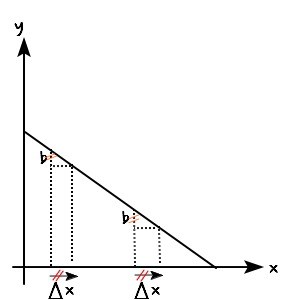
it has this kind of shape, and like the graph is screaming at you,
whether you’ve got a ton of x or barely any x, the rate at which you give it up and swap something else in for it is always constant.
So whether you’ve got a mountain of Pepsi or just a single can, the sadness of losing some
and the way Coca-Cola steps in to cancel out that sadness — always the same!!@@
Kinda makes sense, right?!?!?!?!
Now there’s another good with a totally different flavor.
The ‘perfect complement.’
The name sounds like something incredible, but it’s really not~~~
Alright, hands up time again.
Who here has two shoes, i.e. 1 pair, and would be happier if just the right shoes started multiplying while you ignore the lefts entirely????? Raise your hand lol lol

When you’ve got shoes like this,
and then out of nowhere you somehow find only the right ones lol lol

Is there anyone who’d actually prefer this setup???/
lol lol lol lol lol lol lol lol lol lol lol lol lol lol lol
No crazy people here, right?? lol lol lol
So for goods like this, the utility function gets drawn like this.
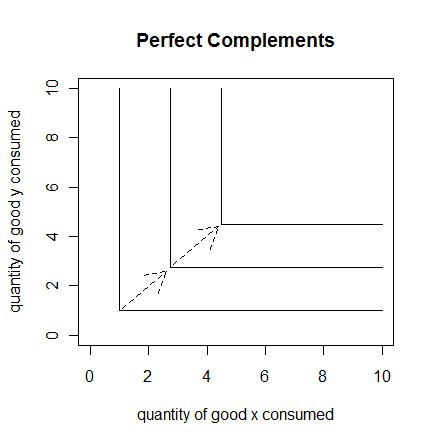
(Source: Statistical Consultants: utility functions)
For shoes of the same kind, there’s literally zero extra utility from having more right shoes@@@@
As a formula,
$U(R, L) = \min(R, L)$.
OK so quickly — we’ve now looked at goods where the law of diminishing MRS doesn’t really hold.
We’ve also looked at utility functions that thumb their nose at the great principles of economics.
Which means in these cases we’re stuck doing things case-by-case,
and now there’s a real need to define something like a general utility function.
The one we’d been waving our hands at before,

that wasn’t something that represented every~~~ single good out there, right???
OK.
So the general utility function is
the Cobb-Douglas utility function, cooked up by Charles (math prof) and Paul Douglas (econ prof)@@
For goods that you want more and more of, where diminishing marginal utility actually holds,

this form does the job!!!!!
This thing… yeah, it shows up not just in microeconomics —
I also learned that the production function uses this same Cobb-Douglas thing….
It’s all over macroeconomics too. lol lol
(That’s why they ended up with the Nobel in Economics, apparently)
The Cobb-Douglas Production Function (Macroeconomics I Studied #12)
So for ordinary, run-of-the-mill goods, just slap this model on it.
You’re going to run into a flood of case-by-case examples in practice problems anyway, so don’t sweat it too much.
The plan is, once I’m done with all the concept posts, I’ll come back and write up detailed problem walkthroughs too :) heh
But!!!
There’s one more thing we’ve gotta know.
It’s
the ‘quasilinear utility function,’
and the definition first goes like this.
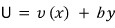
The x-term and the y-term get separated and added together,
and it’s a utility function with this funny constraint that the y part is first-degree (linear).
OK so what’s the difference from the Cobb-Douglas function we just had, the very general one?
First let me show you a feature of the Cobb-Douglas function.
(Source: University of York microeconomics lecture notes)
I’ll use this picture to explain.
Pick a point x and check out the slope, heh
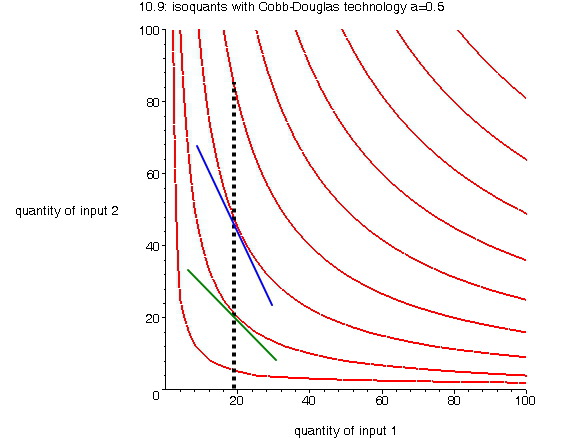
The slopes are different!@@@@@@
And what did we say the slope means??!?!?!

Since it’s this,
it meant that when x changes by this much~~~~ dx — i.e. you lose dx of x —
the dy is the amount of y you’d need to cancel out that sadness!!!!
BUT — depending on what utility level you’re sitting on, the amount of dy you can swap in for losing the same dx is different!!!!
But!!@@
the quasilinear utility function looks like this.
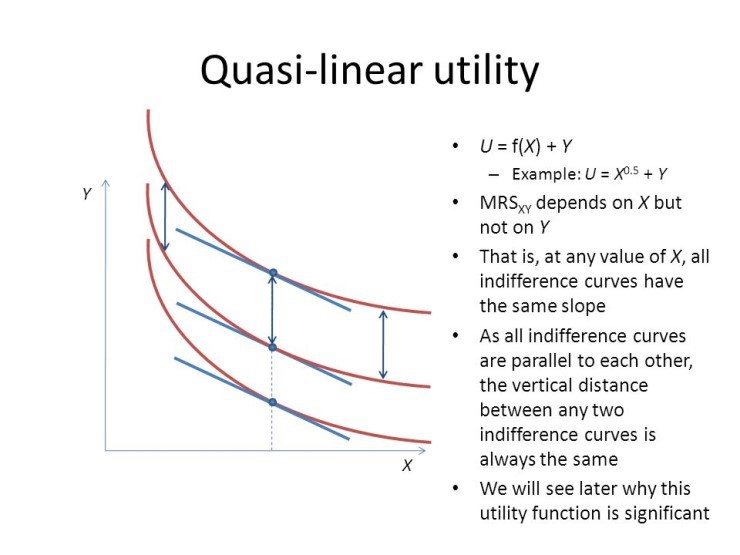
(Source: a SlidePlayer slide deck)
They’ve kindly marked everything to show the slope is constant at every utility level^^
No matter what utility level you’re sitting on, the x you have always carries the same “importance” at any given quantity of x.
No, OK well…… in a way it’s natural.
Because the way it’s designed,
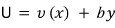
is set up so that the derivative with respect to one variable spits out a constant…
So what does this actually mean….
There is exactly!!! such a good.
There’s a thing that has constant importance any time, any place, whether your utility is 100 or 1000 or 10000000.
That’s “money.”
People understand and use money as having exactly this characteristic.
Why???? Because money can be instantly exchanged for something of the same fixed ’equal value,’
and this quasilinear utility function is the kind that, in macroeconomics — if you don’t use a utility function like this — you can’t crack puzzles related to money, apparently. That’s what they said anyway.
Comments
Discussion happens via GitHub Discussions. You'll need a GitHub account to comment.