Utility Maximization with Special Utility Functions
We knock out utility maximization for two funky non-Cobb-Douglas functions — one with a surprising shape and one for perfect substitutes — and spoiler: both consumers go all-in on x!
Last time we knocked out utility maximization with the Cobb-Douglas utility function.
So this time? Let’s tackle utility maximization when the utility function is a little… funky.
First contender:

There it is.
Right off the bat — this is NOT Cobb-Douglas. Why? Because the exponents don’t satisfy $0 < \alpha < 1$.
But here’s the funny part:
it still says “the more x I have the happier I am, and the more y I have the happier I am too,”
AND marginal utility is still diminishing!!! heh heh heh heh
hahaha hahaha hahaha but the reason it’s funky —
is that the graph ends up looking like this.
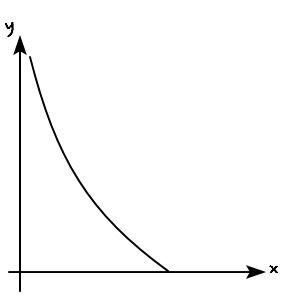
A liiittle surprising, right??? Yeah, I thought so too.
But it’d be a stretch to say no real goods have a utility function like this.
Because all this is saying is that the importance of x doesn’t keep shrinking forever (relative to y) —
think of someone who overwhelmingly, fanatically prefers butter to margarine. No matter how cheap margarine gets,
(because they’re hopelessly attached to butter) the importance of butter just refuses to drop!!@@@
OK so let’s slap this person’s budget line onto the x,y axes@@@@
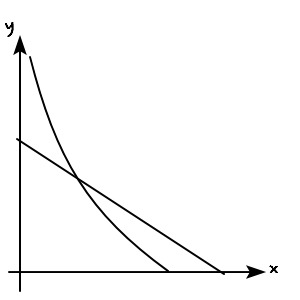
Say when we draw the utility function together with the budget line, it looks like this.
This person is rational too, so they’ll max out their utility within what their budget allows.
How far can they push it, and what (x, y) combo do they end up with?
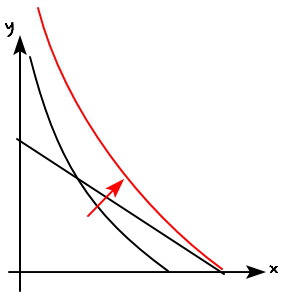
(Quick note — I really want to stress this is clearly not a parallel shift.)
Yep — push it out like that, and in the end this person goes all-in on x.
Going all-in on x is how this person maximizes utility@@@@
Now let’s look at another funky funky utility function.
Remember the linear utility function we dealt with earlier?
Yeah — when x and y are perfect substitutes,
we already saw the utility function looks like this.
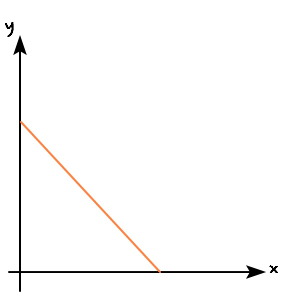
And now toss the budget line on top of this thing,
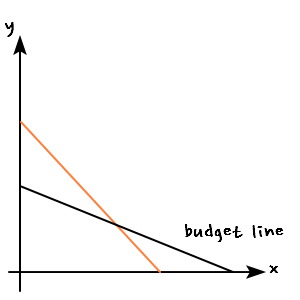
Say it looks like this.
This person is also rational,
so they’ll push utility as far as their budget will let them,
cranking the utility function all the way up to here.
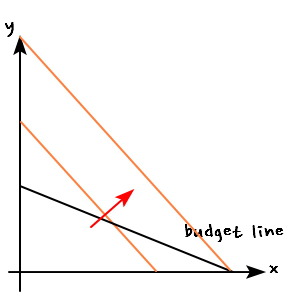
That is — this person also goes all-in on x.
OK now let’s talk this one through in words instead of math.
Doesn’t matter how much x this person has — the amount of y they have to give up to grab one more unit of x is always the same. Constant.
But in the market, x is cheap.
(The budget line has a bigger x-intercept than y-intercept, right? That means x is cheaper.)
But, since you can keep scoring tons of the cheap thing by giving up the same amount of the expensive thing,
it just makes sense to dump all of the expensive thing and go all-in on the cheap one!!!!!!
And that’s the deal. heh heh
Comments
Discussion happens via GitHub Discussions. You'll need a GitHub account to comment.