Utility Maximization with Coupons and Subsidies
Walking through how government housing subsidies mess with your budget line — turns out it's not as scary as it sounds, just a little funky shaped.
Alright, utility maximization again — but this time with some weird wrinkles thrown in. Let’s see how it works when the setup gets a little funky.
First wrinkle:
coupons — not bond coupons, the discount kind. Or the case where there’s a subsidy.
Whoa, lol, I had a mini meltdown the second I heard about this — like, what?? T_T who in their right mind decides to throw this in as a variable??!! T_T
That’s what I thought at first. But it turns out — not hard at all. heh heh heh
It’s easy!!!!
Probably the most common real-life case where you get a subsidy is cell phones, right???? But using phones as the example feels a little awkward, so I’ll roll with the textbook and use housing subsidies instead.
So: with your own income, you buy housing plus $y$, a composite good that covers everything else.
(The whole point is we want to zoom in on number of housing units.)
OK so.
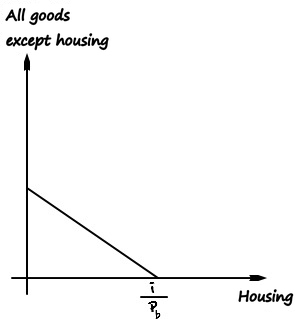
Say this is what you can afford — your budget line. With just your own income, you could buy housing anywhere from 0 units,

up to this many units.
Or maybe it’s cleaner to talk square footage (pyeong). Price per pyeong is $p_b$, and this person can afford from 0 pyeong all the way up to

pyeong.
But then????????
Say the government suddenly drops a subsidy of $S$ on everyone trying to buy a house. That’s basically the same as your income jumping from $I$ to $I+S$, right?!!
So the budget line after the subsidy would look like —
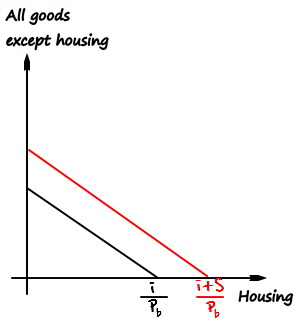
Ohhh~~~~ no-no-no~~~~~
Nope~~ this is not it!!~~~~
Because the government only hands out the subsidy if you’re actually buying a house. Taking that extra $S$ and blowing it on non-housing stuff? Government’s not paying for that.
So from that red bit, this part needs to get erased:
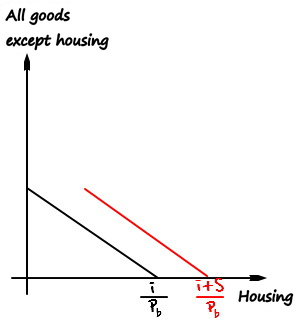
Then — may I fill in the empty gap like this?
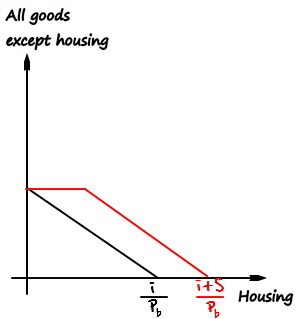
Why is that OK?!?!!!
Instead of grabbing the full $S$, you grab $S'$ (less than $S$), use $S'$ to bump your housing square footage, and still go all-in on non-housing stuff with $i$ — so yeah, as drawn above, connecting that empty gap and calling it a ‘budget line’ is fine. heh heh
Now, if the government were strict and said only exactly $S$, not $S'$, not $S''$ — then connecting them wouldn’t fly. lol
Anyway, that’s not the important part.
The reason we’re treating ‘coupon & subsidy’ as a special topic right now is to look at cases where the budget line is weird, like above. Everyone’s got a feel for it now, right??!!
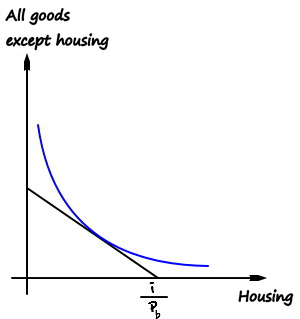
So someone who was maxing out utility at this point —
when they get hit with the government subsidy,
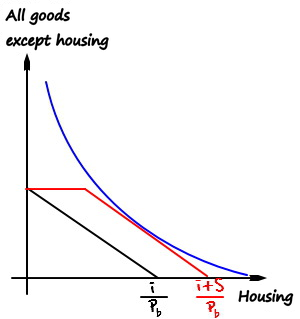
— can now max out utility like this. That’s the whole story…
One more thing worth flagging:
sometimes the utility function comes out with a flatter shape.
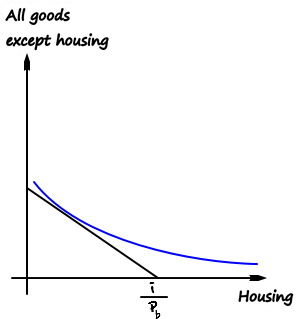
Some people have a utility function that looks like this. And for someone maxing out utility on a curve like that, when the subsidy lands —
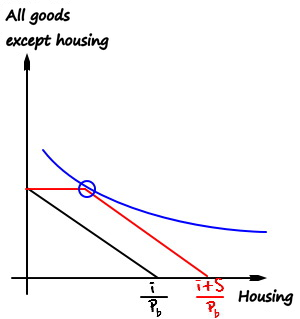
— only the corner of the trapezoid is the solution.
But wait. What does it actually mean for the utility function to be lying down flat like that?
One picture and you’ll get it completely.
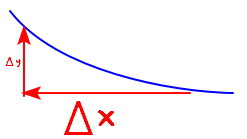
This is someone who, to keep the same utility level, is willing to give up a huge $\Delta x$ for a small $\Delta y$, right??? In other words — this person basically has housing square footage / number of houses completely off their radar.
They just don’t care much about housing. lol
But since the government says they’ll only fork over $S$ if you buy a house, they take it — and since they can’t actually use it on $y$ (the thing they actually care about more), they just use it for exactly what it’s earmarked for. A house.
So that’s why, on that trapezoid, the corner ends up being the solution!!!!
Wow, kinda interesting. heh heh heh
Comments
Discussion happens via GitHub Discussions. You'll need a GitHub account to comment.