Utility Maximization Under a Membership Scheme
A fun walkthrough of how a membership fee shifts your budget line — and why some people are actually better off never joining in the first place.
Today I’m gonna talk about the case where you join a membership (yes, there’s a membership fee — think Costco) and in exchange you get to buy stuff at an even bigger discount. Let’s say the store is a music CD shop. We’ve got CDs and everything else (point being, we wanna focus on the number of CDs).
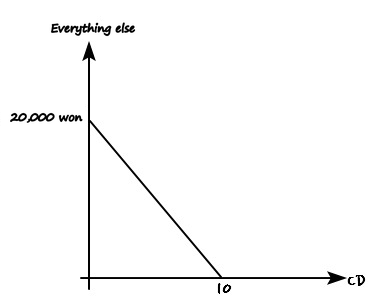
So first thing, let’s set up the budget line. Income $(i)$ = 20,000 won, and let’s say CDs cost 2,000 won each. That means the x-intercept starts at 10.
Now — let’s say if you sign up for the membership, you get to buy CDs at 1,000 won each!!! Oh, then on the graph above, only the price of CDs changes, so…!?
Can we just draw it like this?!
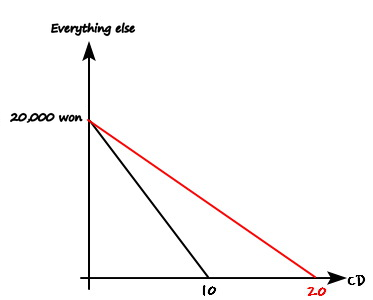
Yeah, sure, you can draw it like that. BUT — that’s the situation where there’s no membership fee. So let’s say the membership fee is 5,000 won. That has the effect of just straight-up shaving 5,000 won off your income, so we shift the red budget line down by 5,000 won.
(Parallel shift in the y-direction by $-5{,}000$ won.)
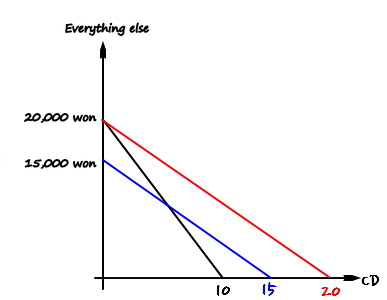
This blue budget line is the new budget line that accounts for the membership fee. So the red line is now useless — let me erase it heh heh heh.
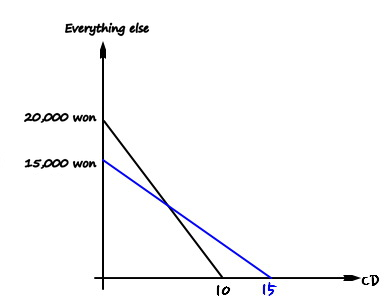
Ha… there’s a ton to unpack from this picture, so let me walk through it step by step.
First, say some random person’s indifference curve and budget line look like this.
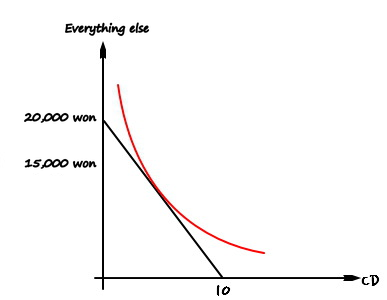
Now they find out the store has a membership program, so let’s say they sign up. Then this person can push their utility all the way up to what the new budget line allows, and they end up bumping it up to something like this.
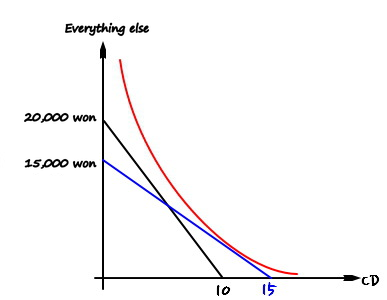
(For what it’s worth, the fact that the indifference curve stands up a little tall means this person valued CDs a lot from the very beginning.)
But — there’s also a person like this.
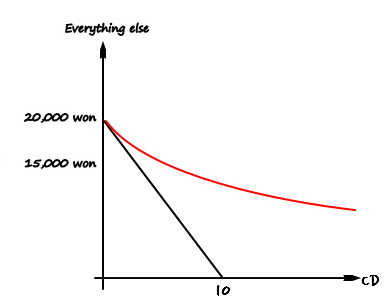
There’s a person like that. And let’s say this person also finds out about the membership program and signs up. And when they try to maximize utility within the range the new budget line allows, the most utility they can get is…
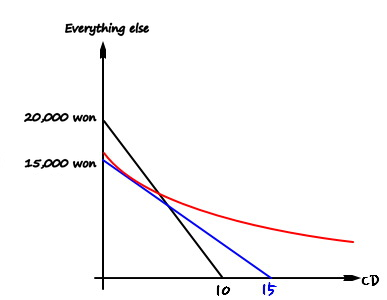
…this.
Wait — the utility went down?! What is this…
This means this person would’ve had higher utility if they had never joined the membership in the first place.
In other words — this person is not gonna join the membership!!!
So here’s the punchline.
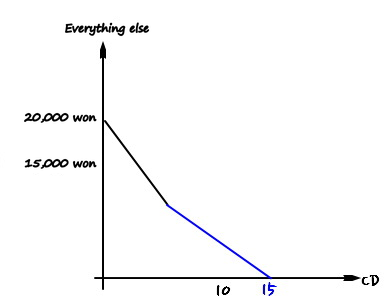
When there’s a membership, we treat the budget line as looking like this.
Then we stretch and squish the indifference curve around this way and that, and we figure out at the same time whether the person actually decides to join the membership or not!
That’s the takeaway@@@
Hmm… so my last comment is that this whole “thinking about the membership” thing was really just a case of thinking about the weird-shaped budget line.
Wait@@@ The case where the budget line bends inward like that — that’s not just memberships.
You see this kind of thing at the supermarket too.
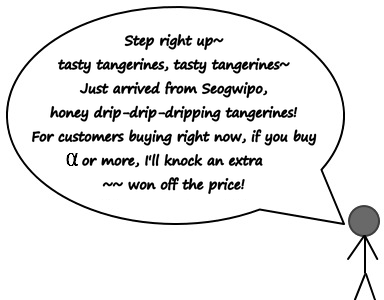
(This is an actual promo line that 21-year-old GD Park proposed back when he was working the produce section at Lotte Mart hahaha)
When this happens, the budget line ends up looking like this.
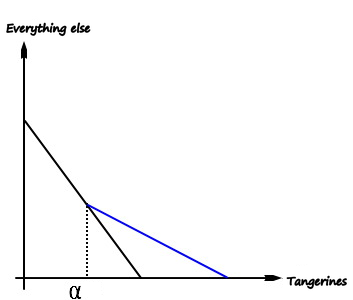
So — the case that gives you a budget line bending inward is also the case of “quantity discounts”, and that’s about as much as we can conclude@@@
Comments
Discussion happens via GitHub Discussions. You'll need a GitHub account to comment.