Compensating Variation and Equivalent Variation
We dig into compensating and equivalent variation — two ways to pin down how much a price change is worth by pretending it was an income change instead.
So far we’ve been focused on the good $x$ we choose. But now I want to put more of the focus on utility. Let me start with something we already know as common sense.
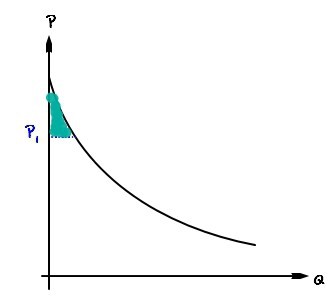
When the demand curve looks like this, the area under it (above the price) is the consumers’ “utility”. We call this guy consumer surplus. So when the price is $P_1$, the consumer surplus (a.k.a. utility) is exactly that shaded chunk up there.
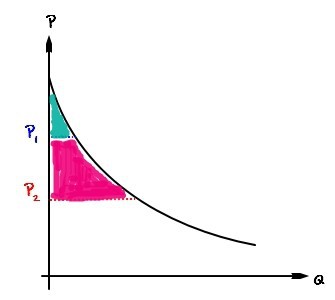
Now drop the price down to $P_2$ — consumer surplus grows by the red bit. In other words: price falls from $P_1$ to $P_2$, and the increase in consumer surplus (utility) is the red region. Which means total consumer surplus at $P_2$ is blue + red.
This is the kind of thing they hit you with around Intro to Econ, right????? Mankiw’s Economics sums it up easily.
OK — now this ‘increase / decrease’ in utility — this time around,
we want to look at it on a coordinate-axes graph like this one.
Obviously, when the price of $x$ drops from $P_1$ to $P_2$, utility
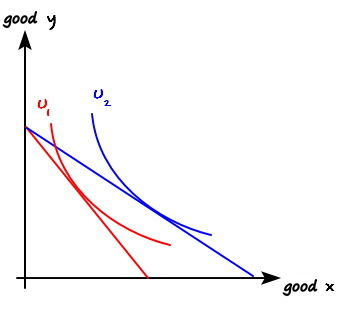
clearly jumps from $U_1$ to $U_2$, right?@??@@?@!!!!
So here’s the question: when it goes from $U_1$ to $U_2$, is that increase the same as
this guy right here from the demand curve~~~~ That’s what we’re gonna check.
Using what?????
Specifically, compensating variation & equivalent variation — those are the concepts we’ll lean on.
Before we get into it, we gotta nail down some definitions first. Let me just slam them down and we’ll move on.
Equivalent variation: The change in utility caused by a price change — pretend the price didn’t actually change (keep it at the pre-change price), and pretend instead that income changed — how much would income have had to go up to give you that same utility change? That amount of Δincome.
Compensating variation: The change in utility caused by a price change — now pretend the price is at the post-change price, and pretend income changed — how much would income have had to go up to give you that same utility change? That amount of Δincome.
OK, what on earth is this even saying right now…..
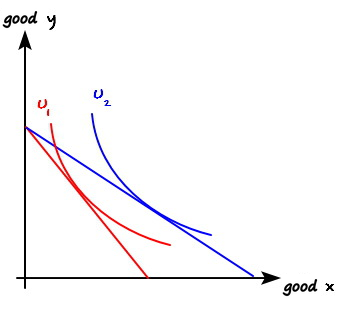
Look — since the price of $x$ fell, the human’s utility went $U_1 \to U_2$, right??? To get that same amount of utility at the original (pre-change) price — how much would income have had to bump up? In other words: pin the price at the pre-change level, and ask how much income needs to grow so that utility goes $U_1 \to U_2$… For that to happen,
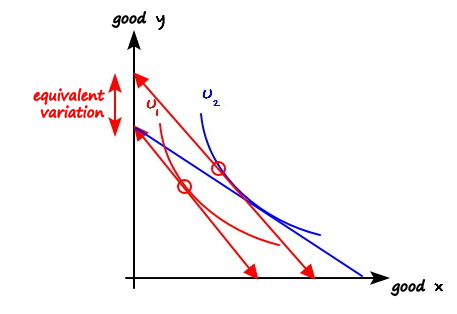
we’d have needed an income jump this big. That income amount? That’s what we call equivalent variation@@@
We’re going to measure a change in utility as a change in income!! That’s the whole point.
(After all, the unit of area under the demand curve is money [₩] too.)
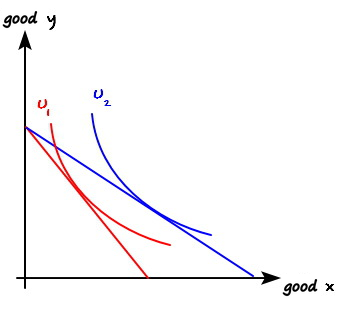
Same deal for the utility change $U_1 \to U_2$, but this time pin the price at the post-change price of $x$, and let’s measure that utility change as income.
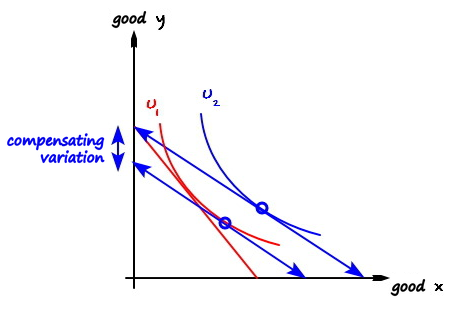
We do that by drawing the blue auxiliary line (locking in the post-change price), and the income change of that size — the amount of income that drags utility from $U_1 \to U_2$ — that’s what we call compensating variation.
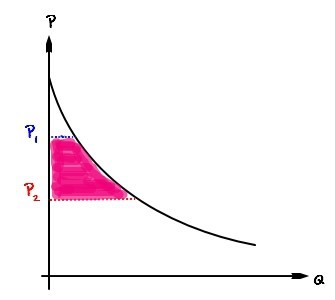
And now we compare that colored Δconsumer surplus over there with the CV and EV from above, and the relationship that’s said to hold is the following.

Conclusion: apparently, when there’s an income effect, consumer surplus can’t measure the utility change exactly.
(Exception: apparently the inequality signs can flip for inferior goods, or when the price goes up.)
Chapter 5 Practice Problems (Microeconomics I Studied #47)
Heads-up. The figures here are the original notes, slips and all. A few things to watch for:
- In the last picture, the middle term is the change in consumer surplus, $\Delta CS$ (the colored area): compensating variation $\le \Delta CS \le$ equivalent variation, for a price fall of a normal good.
Comments
Discussion happens via GitHub Discussions. You'll need a GitHub account to comment.