Types of Isoquants: Linear, L-Shaped, and Cobb-Douglas
A chill rundown of linear, L-shaped, and Cobb-Douglas isoquants — and why their shapes directly tell you everything about σ, the elasticity of substitution.
OK so this time, let’s run through the various isoquants.
Not hard at all, because we already dealt with a bunch of utility functions back in demand theory. Compared to that, literally nothing’s different — except the variables are now just $L$ and $K$.
Back when we did utility functions, the shapes basically broke down into 4 types.
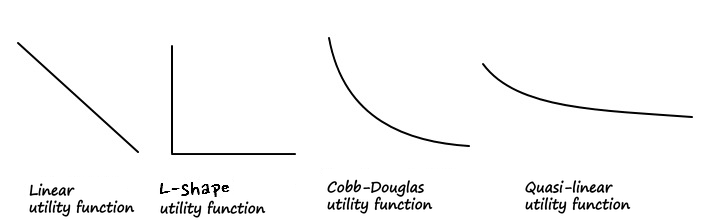
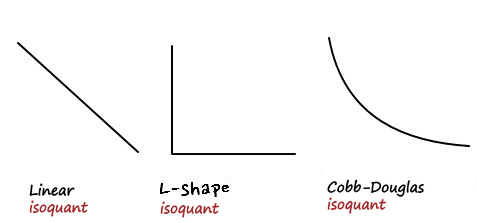
That’s how isoquants get classified.
(There’s no quasi-linear isoquant in this lineup T_T)
Ehhh~~~~ so let’s just keep it short and simple.
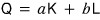
Linear isoquant….. If the production function is linear, the isoquant is gonna be drawn as a straight line, so we’re good as long as the production function looks like this.
OK so, in the linear utility function, um… where was the solution that maximized utility again?????
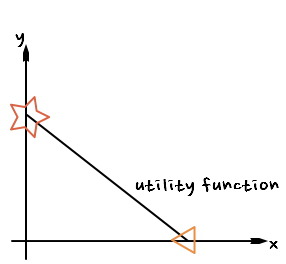
Either the star point or the triangle point.
(The thing that maxes out utility within whatever the budget line lets you do.)
That’s what we call a corner solution,
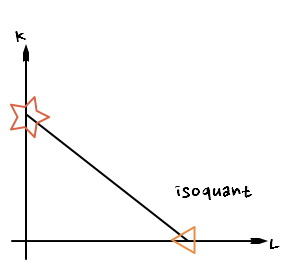
so if the isoquant looks like this (we’ll get to it later, but: within whatever the cost-line allows, the combo that maxes out output), the solution is also a corner solution. The firm has no choice but to go to one of the extremes — star or triangle (saving the details for later).
The fact that the firm’s choice is one of two extremes means that when you tweak the $(K, L)$ combination, it doesn’t shift little by little — it flips all at once…. in this case $\sigma$ (elasticity of substitution) is $\infty$, you feel me????
Why does that make sense?
Well, the definition of $\sigma$ is
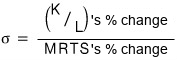
and for a linear function, the rate of change of MRTS is zero.
So $\sigma = \infty$. Not wrong^^
Now let’s look at the L-shape isoquant. This one’s also gonna run on the “same logic as before~~~” rails.
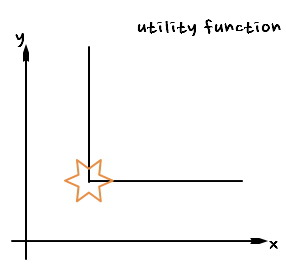
When we had a utility function like this, where was the solution always???!?
Yep — always the star.
(Because nobody wants mismatched shoes.)
Same deal here.
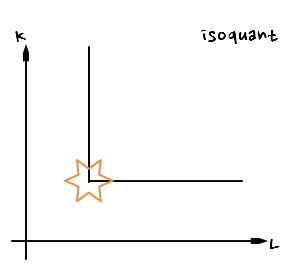
If the isoquant looks like that, the solution is always the star. The firm’s choice is only the $(L, K)$ combo at that point. Meaning the firm has no reason to go messing with things like the $K/L$ ratio.
Therefore@@@
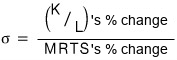
The numerator is 0, so $\sigma = 0$.
So far we’ve covered $\sigma = \infty$ and $\sigma = 0$. Which means we’ve seen the two extremes that sigma can hit.
So,
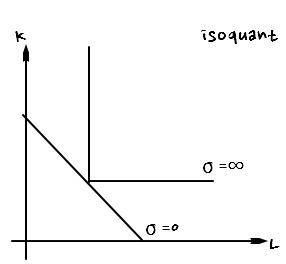
the two extremes look like this, and so, an isoquant with a value of $0 < \sigma < \infty$ — something landing in the middle of the two —
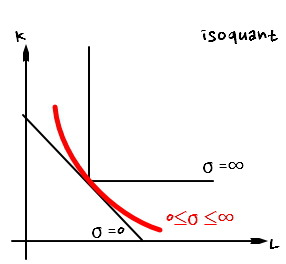
couldn’t you kinda guess it’d look like this??????
Alright, let’s check out the case where $\sigma = 1$.
(Now here’s where it diverges from utility functions. Well — no, since the definition itself is different, of course it diverges: the $\sigma$ of these isoquants is the same at every point, at all times.
Meaning, we’re about to look at the case where $\sigma = 1$, and that means $\sigma = 1$ at every single point, at all times….. heh heh heh that’s just how econ definitions roll, apparently. Same deal for linear and L-shape — $\sigma = \infty$ and $\sigma = 0$ at every point, respectively.)
The case where $\sigma = 1$ is exactly@@@@@
The production function that has $\sigma = 1$ everywhere, all the time, is called the “Cobb-Douglas production function”.
The Cobb-Douglas production function

is defined like this, !!!!!
So first, let me prove that $\sigma = 1$ at every $(L, K)$@@@@@
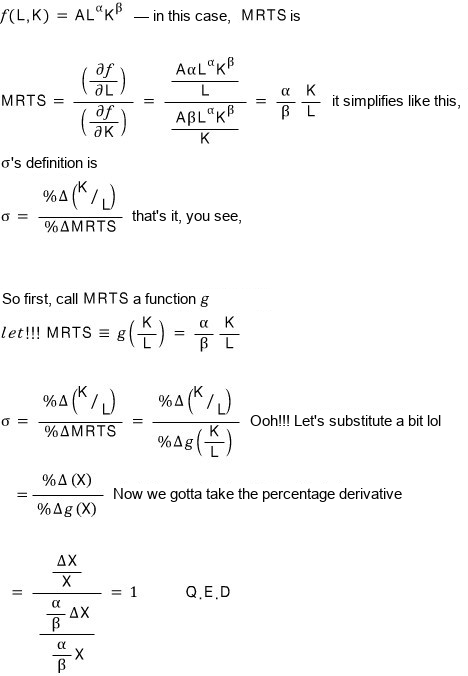
So so so so so so so,
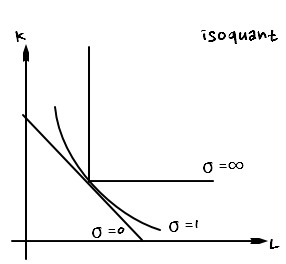
we can wrap it up like this — the shape is set by sigma@@@@
(I don’t even need to spell out that if you draw an isoquant from the Cobb-Douglas production function, it curves~~~??)
And of course, in between those, there exist isoquants with $0 < \sigma < \infty$@@@@@@@
Heads-up. The figures here are the original notes, slips and all. A few things to watch for:
- In the isoquant drawings labelled with $\sigma$ (the two extremes, the same drawing with the red curve, and the summary at the end), $\sigma = \infty$ and $\sigma = 0$ sit beside the wrong shapes: $\sigma = \infty$ belongs to the straight line and $\sigma = 0$ to the L shape, as the text says. The red curve’s label should read $0 < \sigma < \infty$.
Comments
Discussion happens via GitHub Discussions. You'll need a GitHub account to comment.