Cost and Cost Minimization
We dig into the cost minimization problem — and spoiler, it's basically the same deal as utility maximization, just swap the budget line for an isocost line.
OK so now let’s actually get into the ‘cost minimization’ problem — out of the infinitely many (L, K) combos sitting on an isoquant, which one costs the least?
But honestly, while working through the previous part, I already had a hunch about where the cost is going to be minimized. Actually, scratch “hunch.” It’s basically a certainty. A certainty.
Because the principle is going to be EXACTLY the same as “utility maximization.”
So part of me kinda wants to just skip this whole thing, but whatever — let’s just gogo lol
In cost minimization problems, people usually split things into the long run and the short run. And the trick is — long run vs short run isn’t really about literal time being long or short. It’s about the flexibility of decision-making.
From the long-run point of view, who knows what Samsung is going to be doing in the distant future. Like, these days there’s chatter that Samsung might ditch everything it’s been doing and pivot into Bio, right?
So is Samsung going to be all-in on Bio in a few years???
Come on — “we don’t know!!” Nobody on Earth can know all of that. And that’s exactly the point — from a long-run perspective, a firm’s decision-making flexibility is extremely flexible.
Now flip it — let’s think about tomorrow lol. Tomorrow! lol Is that too aggressive an example??
Could Samsung just suddenly, tomorrow, abandon everything and go all-Bio??
lol. I mean, hard to call it 0%, but… it converges to 0% lol
In other words, from a short-run perspective, a firm’s decision-making flexibility is NOT flexible. Because@@@!!!
This difference in flexibility is exactly what determines whether or not “fixed costs” exist on the cost side.
Short run, no flexibility → fixed costs exist!!!! (because you can’t just get rid of them right now…) Long run, flexibility is huge → the thing called fixed costs straight up cannot exist. Because, like, you can just get rid of them right????
We’ll get into the details later, but for now let’s argue the ’long run’ case where there are no fixed costs.
In demand theory the utility function has a job, and on the production side the isoquant does that same job… we covered that earlier, right. So this time we’re going to derive the isocost line, which is the production-side counterpart to the budget line from demand theory.
It’s almost weird to even call it a “derivation”… it’s that simple and obvious… heh
OK! We said L and K are what determine output. And in order to use this L and K, the user has to pay a price. The price paid for using L is the wage.
But — hold on, let’s be careful with units before moving on. We’ll write the wage as $w$, and the unit of $w$ is not the monetary unit $\text{\textdollar}$ or ₩…….. It’s something more like [$\text{\textdollar}$/person·hour] or [₩/person·hour]. So the unit of $w \times L$ ends up being

— and that is a monetary unit, [$\text{\textdollar}$, ₩].
Same idea with K — what the user pays for using K, we’ll call $r$. And again, the unit of $r$ isn’t a monetary unit, it’s “price per unit of capital service used.” So $r \times K$ comes out in [$\text{\textdollar}$].
So the ’total’ cost the user incurs from using labor L and capital K is

There it is.
Wait, what?!?! Total cost just falls out that easy?!?!
We drew the isoquant on
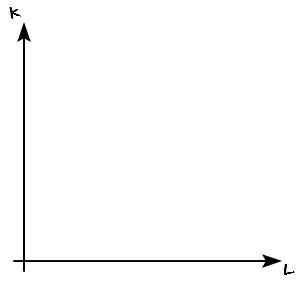
this set of axes, right???? So TC (total cost) can also be drawn on these same axes. Just,
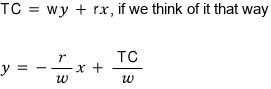
draw the line with slope $-w/r$ and y-intercept $TC/r$.
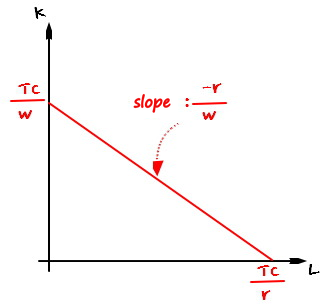
Yop@@@ Isocost line derivation: done!!!!!
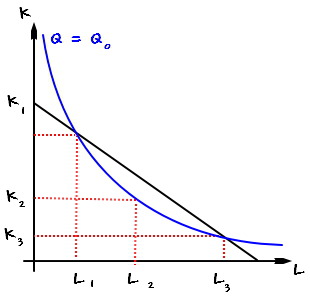
Reading that graph one more time — on this line, you’ve got points like, for example, these guys:
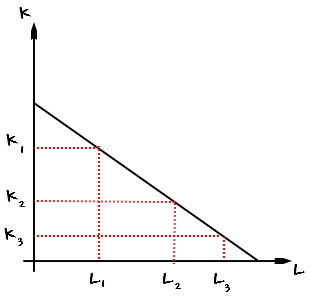
The fact that these points all sit on the same isocost line means that when the user uses L and K like this — the cost when using $K_1$ of K and $L_1$ of L, and the cost when using $K_2$ & $L_2$, and the cost when using $K_3$ & $L_3$, are all the same TC. Same exact deal as the budget line, right????
Now, suppose some company’s tech level pins down the set of (L, K) combos needed to produce output $Q_0$ as
So given  , how much K and L should be used to actually produce ?????
Obviously, you’d want to produce with the smallest TC possible, right?!?!?!?!
For instance — using  to make — let’s say the total cost that comes out is
  .
.
The (L, K) combos you can actually pick at are sitting over there too. So that’s saying that, at a cost of , there’s a way to make output .
Meaning — even using  incurs the same cost, and the resulting output when you use it that way also comes out to . That’s what it’s telling us.
But — let’s say we instead use  . With that, you can still produce the same quantity , right????
Now here’s the thing — the combo is not on the same isocost line. Meaning — the cost of using is not, for the moment, . That’s the point.
Let’s call it  . So let’s check whether is bigger or smaller than .
The isocost line for comes out like this: it has the same slope as the black isocost line, because both slopes are  .
.
Since

it follows that  .
.
So even thinking about the same output $Q_0$ — instead of using or , using costs less.
OK so to recap the logic one more time:
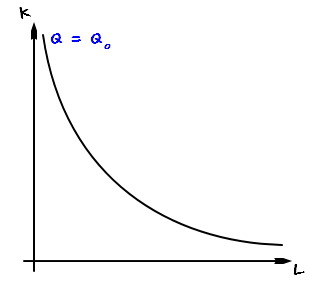
1. Firm: “Oh!! I’m gonna produce !!!” Then how much K and L should I use?@?@?@ Right now the wage rate is $w$, and the price of capital is $r$, so the isocost line gets pinned down like this@@
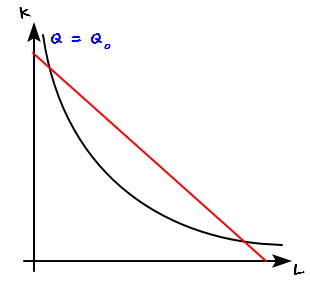
2. Firm: “The minimum cost of producing is not on this line. It’s gonna be on a line like this~~~”
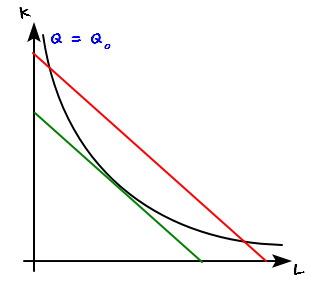
3. Firm: “Yo!!! Let’s use exactly the (L, K) those dots are pointing at and squeeze out the output @@@@” That’s the play.
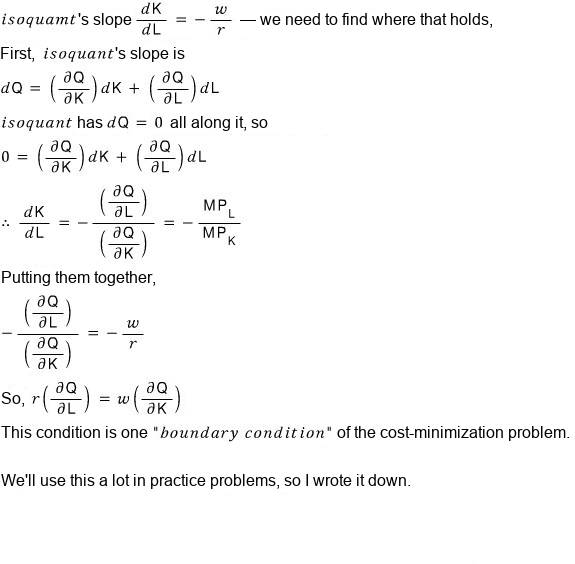
And as the graph above is telling us, if we now write the cost-minimizing (L, K) point down in math (it’s just finding the point of tangency between the isoquant and the isocost line!!), all we have to do is find where the slope of the isoquant equals $-w/r$,
Ha.// But — in the example above I just casually drew the isoquant as Cobb-Douglas without saying anything about it.
Is the isoquant always going to come out that nicely shaped though?
Let’s go through the cases where the isoquant is wonky, all at once.
(Well, not really “wonky” — let’s just say the non-Cobb-Douglas cases, hehehe)
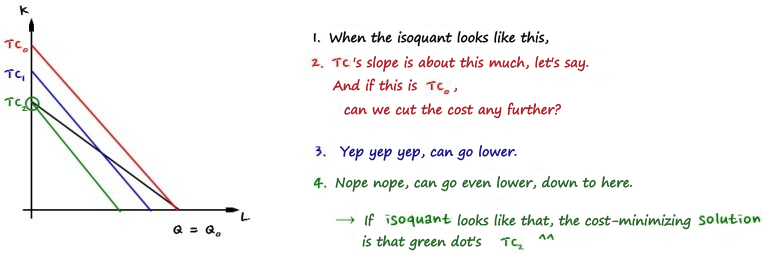
(We covered the case where the isoquant is linear.)
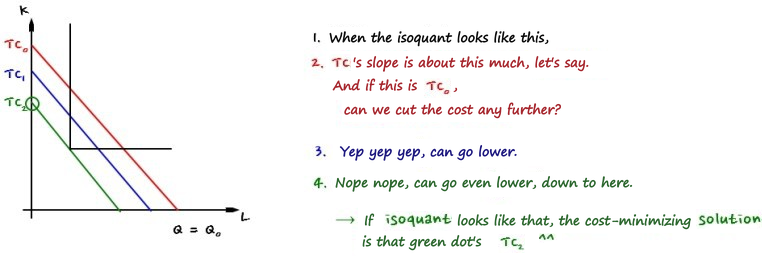
And we looked at the case where the isoquant is L-shaped.
Heads-up. The figures here are the original notes, slips and all. A few things to watch for:
- In the first isocost pictures (the rearranged equation, the graph and the small slope symbol), $w$ and $r$ sit on the wrong axes: with $K$ on the vertical axis, $TC = wL + rK$ gives $K = \frac{TC}{r} - \frac{w}{r}L$, so the slope is $-\frac{w}{r}$, the $K$-intercept $\frac{TC}{r}$ and the $L$-intercept $\frac{TC}{w}$, as the text and the later pictures have it.
Comments
Discussion happens via GitHub Discussions. You'll need a GitHub account to comment.