Expansion Path
Unlike demand theory, firms chasing a fixed output level have zero income effect — just pure substitution — and tracing those cost-minimizing combos as output rises draws out the expansion path.
Last time around, we kept the input prices $w$ and $r$ frozen the whole way through. Just held them still and reasoned from there.
So this time —
let’s think about what happens when those input prices actually move.
OK but before we dive in, let me pull demand theory back out for a sec.
Remember what happened in demand theory when the price of a good changed?
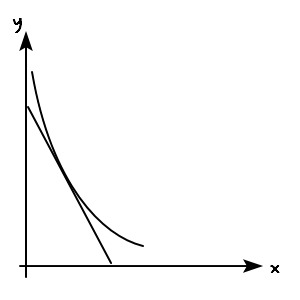
Some person was happily maximizing utility right here, and then —
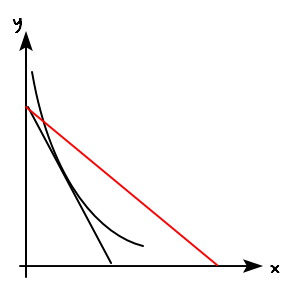
good $x$ got cheaper, the budget line swung out like this,
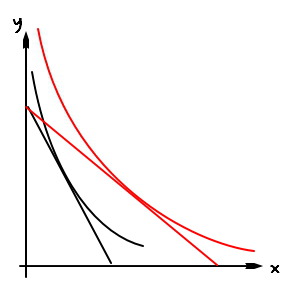
new equilibrium settled in over here,
and out of all the extra $x$ they ended up buying,
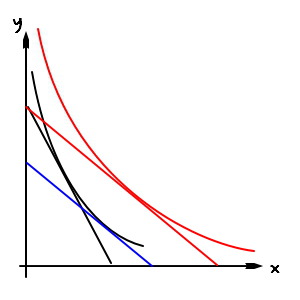
this much of it was the income effect.
You remember, right???
OK so the reason I dragged demand theory back out for a hot second —
it’s to hammer in this one thing: in production theory, there is no income effect.
Let’s see why. The firm wants to produce some output level —

let’s call it that.
And the per-unit price for labor and capital — the wage per unit of labor and the rental per unit of capital — those are $w$ and $r$, right.
So the firm is sitting there
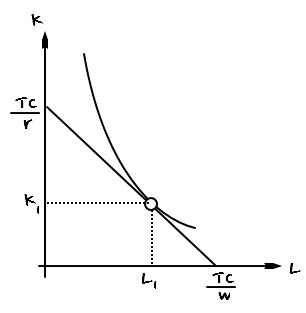
using this much of stuff,

and pumping out

let’s say.
But — suppose the government bumps up the minimum wage, or some hardcore union absolutely cooks at the bargaining table,
and the wage that used to be $w$ jumps up to $w'$.
Since $w < w'$,
the slope of the isocost line —

gets even smaller — that is, more negative, so its magnitude grows.
(It gets steeper.)
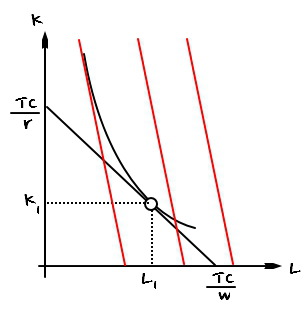
Now the firm has to pick its TC from this family of isocost lines,
and
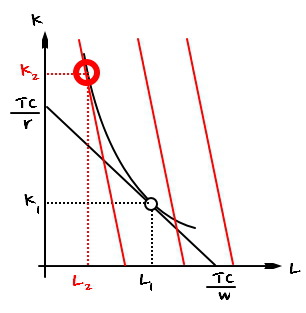
obviously it’s gonna grab this one and

end up using this combo.
So — only the substitution effect shows up. As the cost $w$ of using $L$ goes up, the firm uses less $L$. That’s it.
No income effect. Nada.
Why??
Because the firm — for a fixed

is just agonizing over “how do I make this as cheap as possible?” That’s the whole job.
The idea of going past

isn’t even on the table right now.
Output, unlike utility, is not a “more is always better” kind of thing.
It’s purely about efficiency. That’s the whole lens.
OK so now let’s freeze everything else — everythiiing — and let the firm crank up its output instead.
Crank up output… well, on the $L$-$K$ plane,
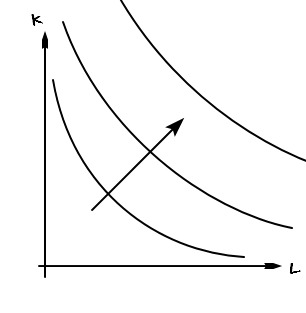
it looks something like this, right???
Now, as the firm bumps up $Q$ step by step, let me mark the cost-minimizing point at each level.
Wait — before that. Since we said everything except output is being held constant,
$r$ and $w$ stay put too. Which means the isocost lines tangent to each isoquant are all going to come out parallel.
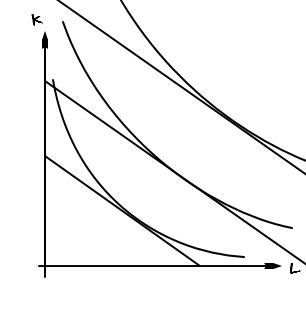
So the isocost lines look like this~
And you can spot the cost-minimizing dots, yeah?
Now I’m gonna connect those dots with a curve —
but before I do — when we let $Q$ vary continuously and connect the cost-min points all along the way,
what we get is a smooth line.
So those points sweep out a ’line’, and that line —
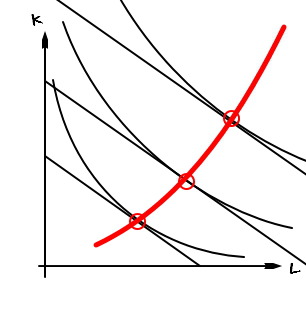
ends up looking roughly like this.
In econ, this thing is called the “expansion path."
OK now look at the direction of the expansion path.
The direction matters, because it tells you whether each input is a normal input or an inferior input.
The expansion path above heads off in the direction where both $L$ and $K$ are increasing.
So for this firm, both $L$ and $K$ are normal inputs. Cool.
But — there are firms where it doesn’t go like that.
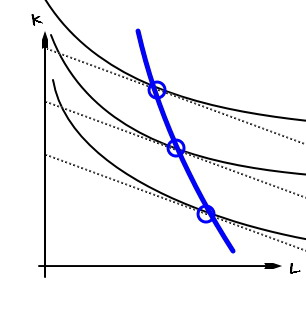
A firm whose isoquants look like this.
Draw the expansion path here and — yeah, it goes like this:
$K$ goes up, $L$ goes down.
For this firm, $K$ is a normal input but $L$ is an inferior input.
And of course — I didn’t draw it, but you could totally have the flip: $K$ inferior, $L$ normal. Sure.
Then — pop quiz.
Could both be inferior inputs?!?!
Answer: nope. No way.
Think about it. If the way to bump up output is to lower both $L$ and $K$, then… you should’ve already done that. Why are you sitting there producing the same amount while burning extra inputs you don’t even need?
Doesn’t make sense.
That’s the whole point — this is about efficiency.
Both can’t be inferior. Period.
Comments
Discussion happens via GitHub Discussions. You'll need a GitHub account to comment.