Labor Demand Curve
We derive the labor demand curve by tracing how a firm's optimal labor choice shifts each time the wage ticks up — first with graphs, then with a Cobb-Douglas proof.
Today let’s derive the labor demand curve.
Same principle as deriving the demand curve for good $x$ in demand theory. Should feel familiar.
OK let’s go lol.
So labor demand — from the firm’s side — is basically “how badly does the firm want labor?”
<And of course, the firm will want the $L$ that minimizes cost.>
But there’s a premise hiding in there: “the cost $r$ of capital $K$ is constant.”
And then, depending on the level of $w$, we trace out how the firm’s want-for-labor changes!!!
That’s the labor demand curve!!!
OK OK OK, let me draw the isoquant and isocost first.
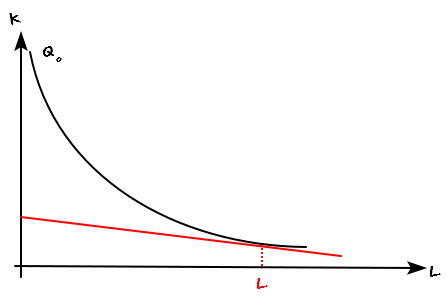
Say the initially-fixed $r$ and $w$ give the isocost line this slope.
Find the $L$ that minimizes cost right now,
and jot the pair down as $(L, w)$.
Now say the wage bumps up a little — call it $w'$.
With $r$ held fixed and $w \to w'$, the isocost slope becomes

which is smaller than the previous slope. Steeper, in other words.
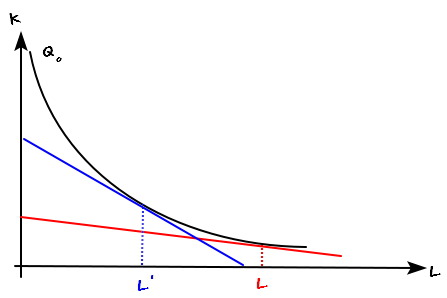
So the isocost tilts to this new slope, and we look for the $L'$ that minimizes cost while still producing

and write down $(L', w')$.
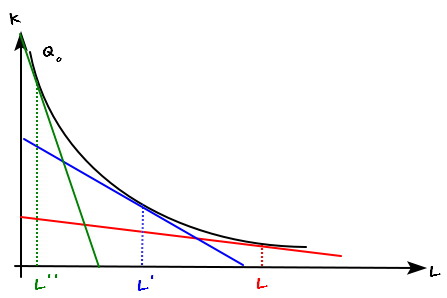
Bump the wage again, $w' \to w''$, isocost gets even steeper, find the labor $L''$ that minimizes cost at that point, jot down $(L'', w'')$ too.
Now imagine we repeated this infinitely many times. For an ever~~~so tiny change $dw$, we figure out what the tiny corresponding $dL$ is.
Take all that extracted info and —
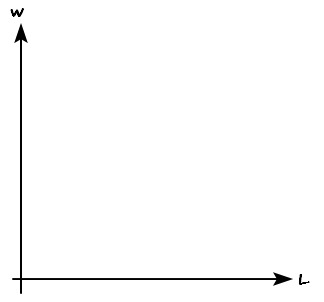
— plot it on this $w$-$L$ axis, in the direction where as $w$ goes up, $L$ goes down.
Hmm…..
Saying “as $w$ goes down, $L$ goes up” is the exact same thing anyway, so on the axis above, let’s just draw it that way — $w$ falling, $L$ rising.
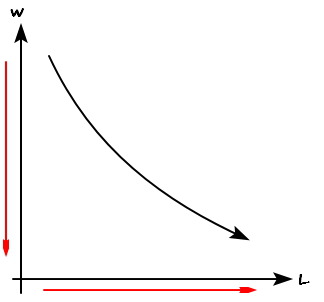
There. That’s how you’d draw it.
Don’t believe me?
OK fine, let me derive it properly with math too.
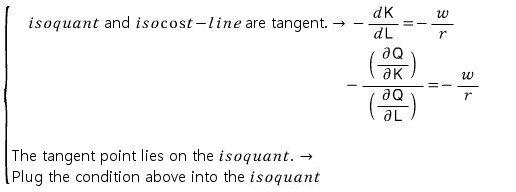
I want to derive it from these two pieces of logic, but I don’t have a convenient production function lying around.
So let’s just assume the isoquant comes from a generic Cobb-Douglas, and follow the logic above:
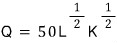
Cool. Then condition 1 above becomes —
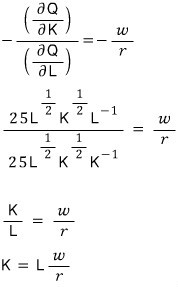
And condition 2 applied to condition 1 means plugging condition 1’s equation into the isoquant. That is,
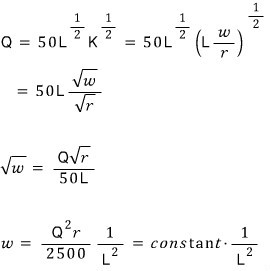
We already agreed $Q$, $r$, all that — they’re constants. So the final form pops out looking like that.
And see? Just like that, we’ve got a relationship between $w$ and $L$.
So now,
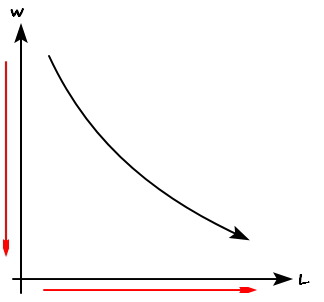
you’ve got a rough feel for why the labor demand curve gets drawn like this, right~~~
OK then —
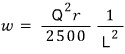
— eyeballing this shape: if the firm decides to crank $Q$ up, how does the labor demand curve change???
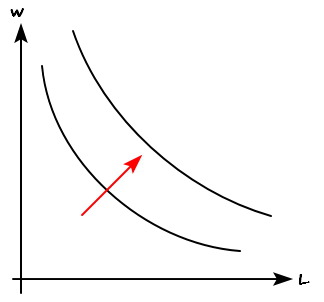
Something like this, right??? (and it will absolutely not be a parallel shift)
At least under Cobb-Douglas, that’s how the labor demand curve responds to changes in $Q$.
Oh@ — one more thing to watch for.
Like, when some firm tries to ramp up its output, does it necessarily want more labor?????
Nope. Not always.
For firms where “labor” as a factor of production is a normal input, sure, yeah.
But for firms where labor is an inferior input, cranking $Q$ up can actually decrease $L$.
That is,
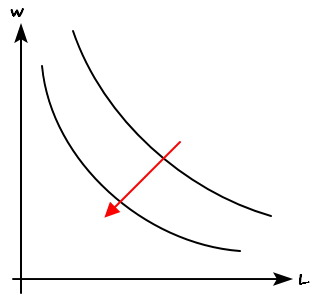
if you see a labor demand curve shift like this when output goes up — nothing weird about it at all, is what I’m saying.
We just shrug and go “ah right, so for you guys, labor’s an inferior input^^*”
Comments
Discussion happens via GitHub Discussions. You'll need a GitHub account to comment.