Short-Run Total, Average, and Marginal Cost Curves (STC, SAC, SMC)
We flip from long-run to short-run, lock K down as a constant, and split total cost into TFC + TVC to build the STC curve — which, unlike long-run TC, doesn't pass through (0,0)!
Up to last time we covered TC, AC, and MC — and through that whole conversation we casually let L and K roam over any range we liked, no constraints. Yeah. That whole discussion basically assumed the firm could make its L and K decisions flexibly, which makes it the long-run perspective.
So now we flip the camera and look at things from the short-run perspective.
As I mentioned waaay back, the difference between long-run and short-run isn’t really about how much time has passed — it’s about whether you have flexibility in your decision-making. So looking at things from the short run means no flexibility in decisions: one of L and K is locked down.
OK so, like before, let’s lock K. This locked-down K is now a constant,  . And this
  costs $r$ per unit, so the cost coming from
  is
is  .
.
Oho — so the cost  is a constant too, it doesn’t budge (as long as $r$ doesn’t change)!!!! In other words,
  is what we can call the Fixed Cost. Taking the initials of Total Fixed Cost, I’ll write TFC =
  .
.
Then there’s the cost burned by L, the variable that can change:  . This cost is a variable (because L changes). Taking the initials of Total Variable Cost, I’ll write TVC =
  .
.
Add ’em up and you get the Total Cost (TC)!!! But to keep it apart from the long-run TC, we’ll call TFC + TVC the STC (Short-run Total Cost).
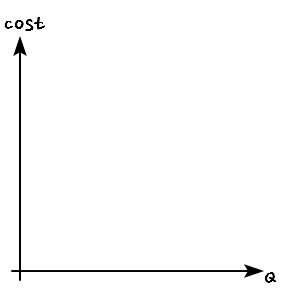
Now we’re going to draw a curve for this one too, on axes like these:
The logic is the same as before.
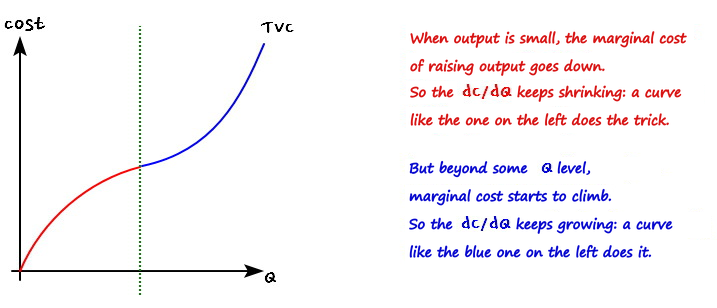
I’m not going to go through that logic in detail here. Honestly, you can just think of it as a cost with only the variable L in it. And if you had to pick one main reason it’s drawn this shape, you’d pick “efficiency.” For the details, check out #36, pleeease~~~~
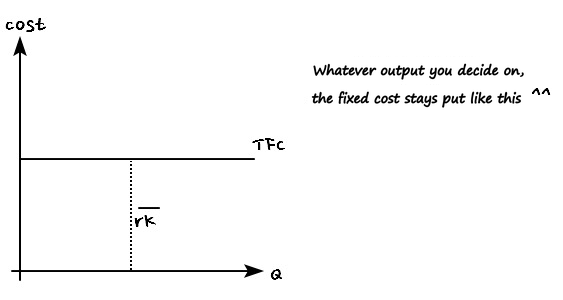
We also need to draw TFC, so we can mash TVC + TFC together into STC. So let’s draw TFC!!!~ TFC’s easy lol, it’s a constant. Just draw one constant function.
Now let’s lump the two functions together.
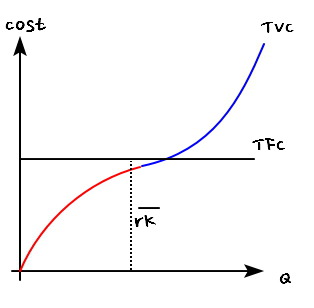
Now, shall we draw the graph of the two functions’ sum — i.e. STC??!
For the sum, it looks like we can just slide the TVC function up along the Cost axis by  !!!
!!!
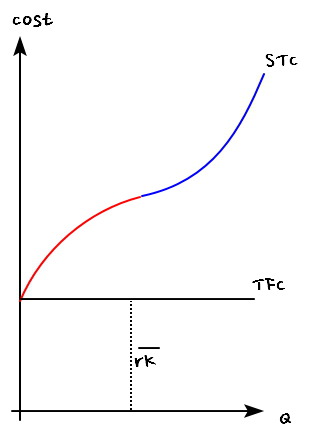
Back when we drew TC, did I ever make a big deal about it passing through (0,0)???? I did. The reason I hammered on it:
STC, no matter what, does NOT pass through (0,0)!!!@@
What that means: “even if you produce 0 units, in the short run there are still costs being burned”!!!!
OK, right about now you might be having a small mental breakdown.
Wait?!?! The shape of TC was!!!
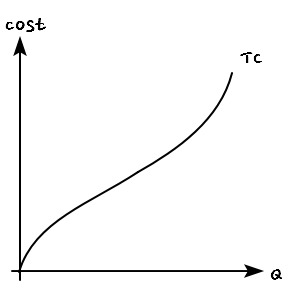
like this, you said — and that’s the long-run perspective, you said — and now we’re switching to the short-run perspective, and the short-run STC is
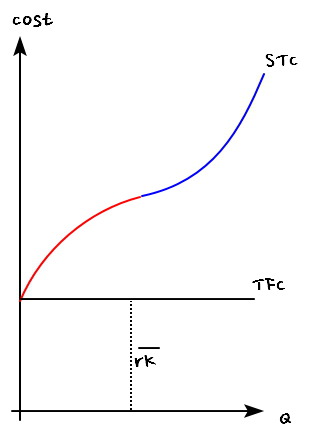
shaped like that?!?!
Huh?? Then if you just take the long-run curve and shift it up the y-axis by  , doesn’t that give you STC??
It’s an easy thing to misunderstand. But it’s clearly a misunderstanding.
Why? Because when we explained the two graphs, we never once pinned down the functions algebraically. We just sketched the general shape. And more fundamentally — the long-run analysis traced the set of costs that hit the real minimum, while the short-run analysis traced the set of costs that hit the possible minimum (not the real minimum). (See #34 for this.)
So what are we doing now? Here too, we won’t derive an exact algebraic form for the functions. We’ll just upgrade and refresh the general shape. We’re going to lump long-run and short-run together, and figure out exactly how they lump together.
What we know: TC
looks like this, and STC
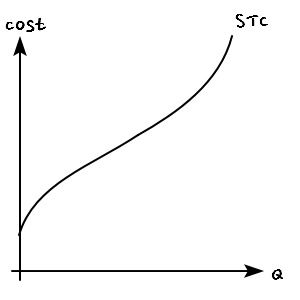
looks like this. Those two facts are literally all we’ve got. So if we lump them into one,
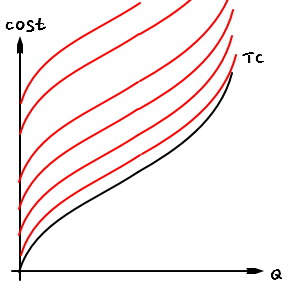
it’s gotta be one of the many, many possible cases of that red line.
Once we lump them… spoiler, the conclusion first: it ends up drawn like this.
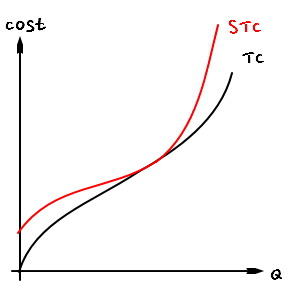
(All we know is the general shape, so it’s not at all… OK fine, it’s a little different from the pictures above. But notice the general shape hasn’t changed.)
This is how we get to see the point: the two must touch at one point.
The logic for nailing down that point — it’s the expansion path. The short-run and long-run expansion paths were drawn like this:
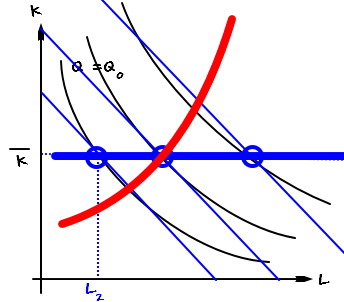
(See #34.)
First — the expansion path is “the set of (L, K) that achieves the minimum cost.” Now let’s read this graph again!!!!
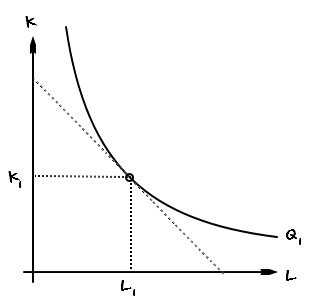
Say the L and K that hit the minimum cost at output  are
are  . And say the short-run K is locked at
  , and let’s bump output Q up from
  to a higher
  .
.
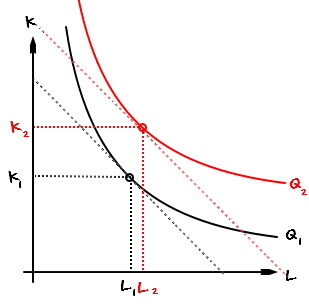
Among all the (L, K) that produce  , the one that hits the minimum cost is
  . But in the short run, K can’t change to
  , because it has to stay locked at
  . Meaning — we’ve gotta use
  to crank out
  .
.
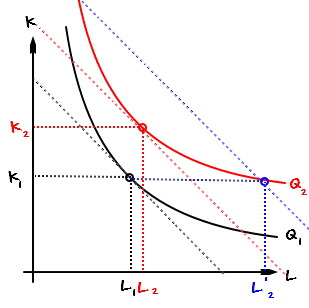
That’s the spot where we have to use  , but — the isocost line through
  sits higher than the red isocost line, as you can see there. So if you use
  to produce
  , you burn more cost than the red dotted line.
Same logic — let’s go the other way and cut output from  down to
  .
.
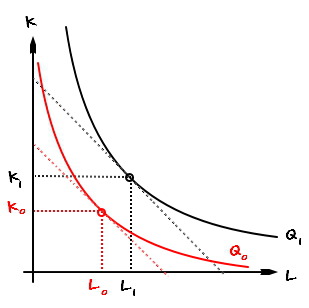
Among the (L, K) that produce  , the cost-minimizing one is
  .
.
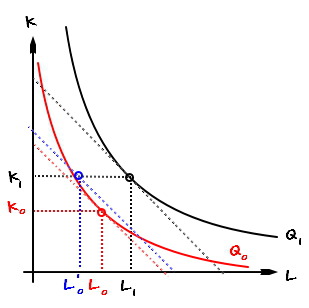
But same deal here — in the short run, K can’t change to  , because it has to stay locked at
  . Meaning — we’ve gotta use
  to crank out
  .
.
So we end up having to use  , but….. the isocost line through
  ;;; sits higher than the red isocost line too, as you can see there. So if you use
  to produce
  , you also burn more cost than the red dotted line.
OK, back to the cost curves. Let’s stack up what we’ve figured out.
The long-run total cost curve (TC) —
we know it looks like this. And the general shape of the short-run total cost curve (STC) —
we know it looks like this. And we found that at one Q point,  , TC and STC are equal, and for every Q other than that one, $TC \lt STC$ holds.
Now let’s use these facts to fit the pieces together one by one.
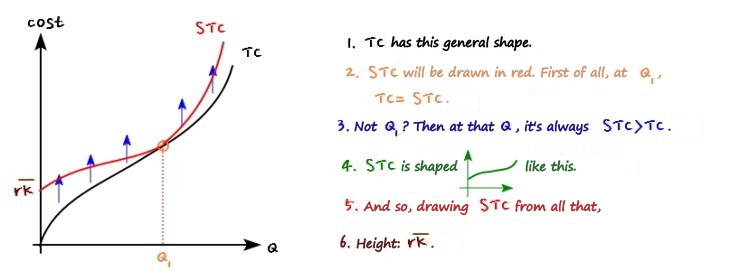
Just follow the colors ^^ Make sense…? hehehe
So now, for
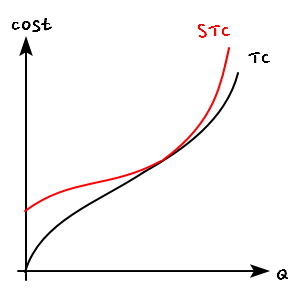
let’s dig into the function for its slope too. For the long run — i.e. the slope analysis with respect to TC — we already did that earlier.
(See #36.)
Here we’ll zoom in more on these, for STC:
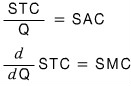
(Short-run Average and Marginal Cost).
OK then: how do SAC and SMC get drawn? Let’s get their general shape first.
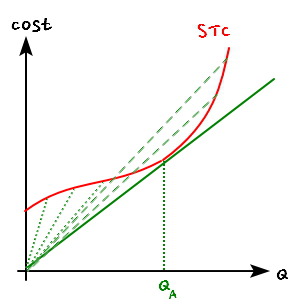
For SAC, it’s the slope from the origin, and there’s clearly a point where SAC bottoms out ‘right there’!!! Let’s call it $Q_A$.
(Oh?! So is this the Q where STC touches TC? Only if the long-run AC bottoms out right there too; in general, no. (whisper whisper))
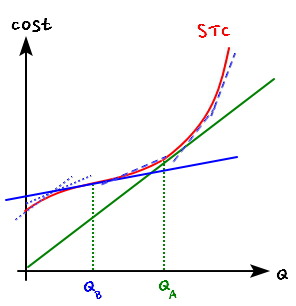
Now SMC. Until it reaches the slope of that solid line way over there, the slope of the tangent to STC keeps dropping. Then it gradually starts climbing!!! Let’s call the Q with the minimum SMC $Q_B$!!!!
(Oh!!! At $Q_A$, SMC and SAC must be equal….. (whisper whisper))
With all that info, if we toss SAC and SMC onto the same set of axes,
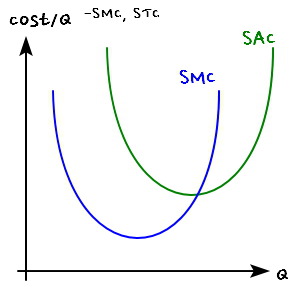
Whoa!!!
Deriving AC and MC from TC and deriving SAC and SMC from STC give exaaaactly the same general shape?!?!
OK so now, for real, let’s draw AC, MC, SAC, and SMC all lumped together. This has already gone way too long, so I’ll jump straight into the next post and pick it up there — no yakking.
Heads-up. The figures here are the original notes, slips and all. A few things to watch for:
- The cost of the variable input $L$ is $wL$; the small picture right after "the variable that can change" shows $r\overline{K}$, the fixed cost, by mistake.
- In the short-run passage, the point we are stuck with is $(L'_2, K_1)$, since capital stays at $K_1$; the two small pictures write $(L'_2, K_2)$.
Comments
Discussion happens via GitHub Discussions. You'll need a GitHub account to comment.