Average Variable Cost and Average Fixed Cost (AVC, AFC)
Breaking STC into FC + VC, then dividing by Q, shows SAC decomposes neatly into AFC + AVC — and why SMC passes through the minimum of AVC too.
Just one more quick thing before we move on. It’s small, but I’ll need it later.
I want to break STC apart like this:
STC = FC + VC
So short-run total cost = fixed cost + variable cost. Standard stuff.
Now divide both sides by $Q$:
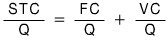
Obviously this still holds.
And that gives us:

(Average Fixed Cost and Average Variable Cost, respectively.)
OK, so what does AFC look like? Here’s FC:
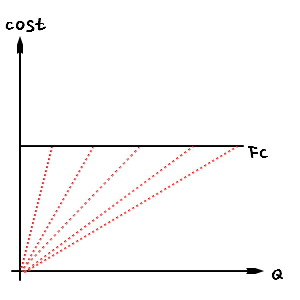
AFC is the slope from the origin to a point on this graph, so plotting that out, you get:
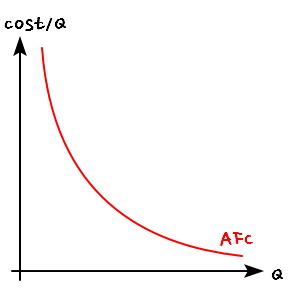
There it is.
Same deal for AVC. Here’s the VC curve:
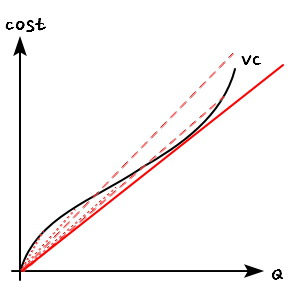
AVC = slope from the origin to a point on the VC curve, which gives us:
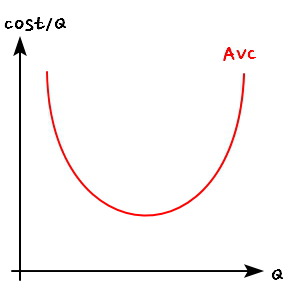
There.
So the SAC graph we drew earlier? It’s literally just the sum of these two:
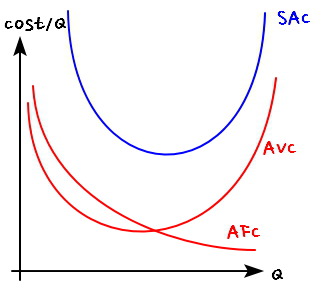
The SAC curve we sketched without thinking — it decomposes cleanly into AVC + AFC!!!!
OK so why am I bothering with this little aside? Because it’s going to come back and bite us in a sec.
Specifically: we already know SMC passes through the minimum of SAC. But — SMC also passes through the minimum of AVC (average variable cost).
And you can prove this in like, two lines of math:
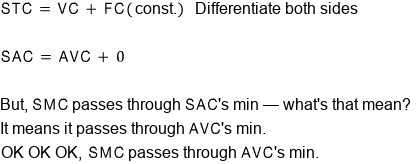
OK OK so let me throw this onto the picture too:
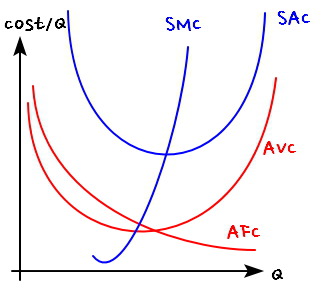
There we go.
This is going to show up immediately in the very next thing we do, so — heh heh heh — don’t forget it.
Heads-up. The figures here are the original notes, slips and all. A few things to watch for:
- In the picture that differentiates STC = VC + FC, the second line should read SMC = MC + 0, not SAC = AVC + 0: differentiating gives marginal costs, and the constant FC drops out. The conclusion in the last line (SMC passes through the minimum of AVC) holds.
Comments
Discussion happens via GitHub Discussions. You'll need a GitHub account to comment.