Short-Run Supply Curve
We derive the short-run supply curve in a perfectly competitive market — turns out it's just the SMC curve above AVC, and here's exactly why that matters.
Alright, today’s mission: derive the supply curve in a perfectly competitive market.
Where we’re heading is the long-run supply curve. But the play is — first nail down the short-run supply curve, and then push from there into the long run.
So the short-run supply curve is what we need to figure out right now. And the short-run case actually splits into two scenarios.
There are fixed costs, sure — but:
- the case where all fixed costs are sunk costs, and
- the case where fixed costs are sunk costs + non-sunk costs.
Two flavors. Let’s do them in order.
First one up: all fixed costs are sunk costs.
In that world, whether you produce anything or not, fixed costs just sit there as a constant. So~~~ honestly, this isn’t very different from what we were already doing. Looks like we can just drag over the SMC, SAC, and AVC we drew back in #41.
Yep — exactly those 3 curves. Why those three? You’ll see as we walk through it.
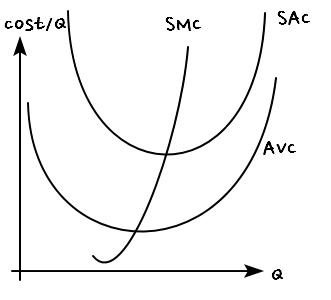
This is the picture we’re going to do all our analysis on. Kind of a fun one, actually.
The whole point of the analysis is to land on the supply curve.
A supply curve shows how Q moves as P changes, right? But it’s not just any Q — it’s the Q that maximizes the firm’s profit.
Now, in a perfectly competitive market, P is a given. It’s handed to you. So — let’s say the price comes in at 
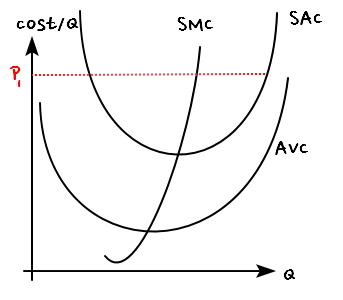
When the price drops in like that, how does the firm pick Q??? Well, the firm maximizes profit at P = MC, so —
it picks the Q at this point right here.
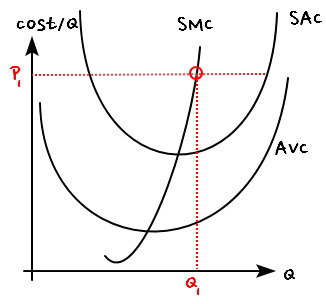
Yeah? Make sense??????
OK what about when the price is $P_2$ instead????
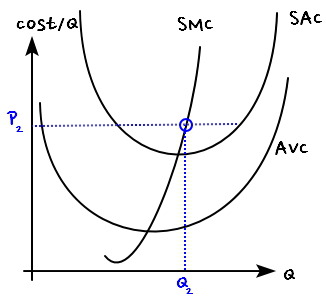
Same deal — the firm picks $Q_2$ right there to max its profit.
Now stitch this together with what we just did:
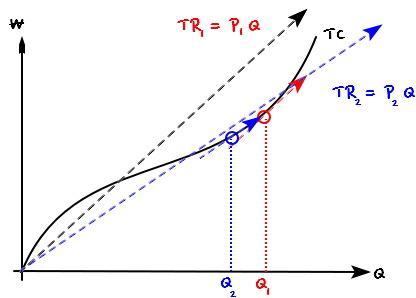
This is the little trick that’s playing out right now.
OK OK OK, anyway — you can kind of feel it: the SMC itself is becoming the short-run supply curve. The SMC curve is single-handedly telling you both P and Q at the same time, isn’t it??!?!!
Heh, so are we done already?
Nope. SMC is the short-run supply curve, true — but only the chunk of SMC that sits above AVC. This piece right here:
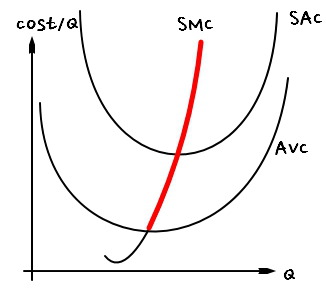
only this part counts as the short-run supply curve.
Let’s figure out why only that part gets to be the short-run supply curve. Suppose the price in the perfectly competitive market lands here, at $P_0$.
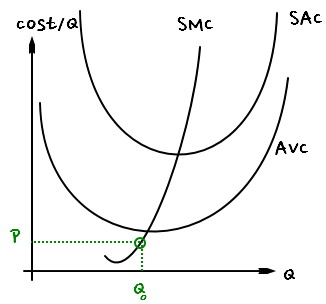
Then the firm picks its production at $Q_0$, where SMC = P. When it produces $Q_0$, the cost burned per unit — I’ll color in green. What it receives per unit, I’ll color in red.
And what’s left over per unit, I’ll color in blue.
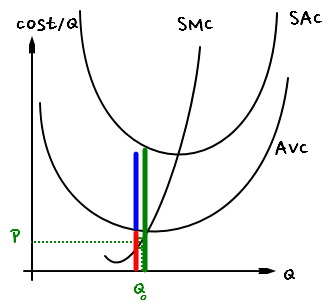
Let me say that again, slowly.
Cost burned per unit = the green amount. What’s received per unit = the red amount, which is P. So what’s left — the blue amount — is the loss per unit right now!!!!
The firm is hemorrhaging money like that — would it produce???? Nope, right????
Right. It wouldn’t.
But — careful — that answer isn’t exactly right either. The logic “there’s a loss, so the firm doesn’t produce” is wrong logic.
Why it’s wrong is the very next thing you’ll see. For now, the answer here: when the price is $P_0$, the firm does not produce.
OK now, to really get it, we need to look at the case where P lands somewhere between the minimum of SAC and the minimum of AVC.
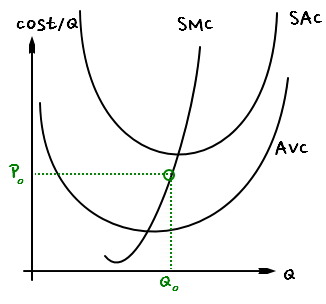
Say the price comes in at this level. Then the firm picks the Q where MC = P as its production.~~~
So the situation is now:
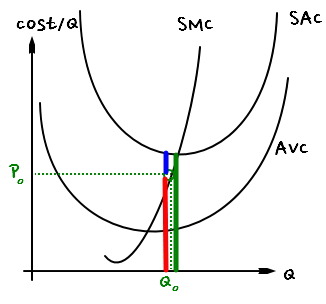
The cost burned per unit while producing = the green amount. The amount received per unit = the red amount.
So right now it’s running a loss of the blue amount per unit.
Now suppose the firm says “nah, I’m losing money, I won’t produce.” Then the loss it eats is exactly the sunk cost.
How much is that sunk cost????
$(SAC - AVC) \times Q$
$= (AFC) \times Q$
So the sunk cost per unit is SAC - AVC. That amount? It’s right here:
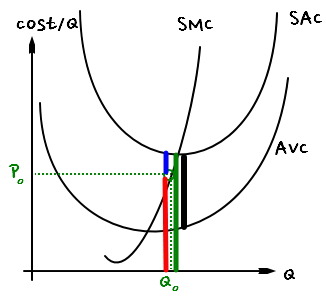
The black part!!! That’s how much.
So in this situation, not producing means your loss balloons up to the black amount per unit.
Wouldn’t it be better to just go ahead and produce and shrink the loss down to the blue amount, instead of swallowing the full black amount?????
Ahhh~~~ So that was the range where the firm produces in order to minimize the loss!!!!
So the short-run supply curve is — “the part of SMC that sits above AVC, that becomes the short-run supply curve!!!!” Got it?????
The firm doesn’t produce at any price below where AVC hits its minimum,  because below this price
  it just won’t produce —
and this price is called the shut-down price.
it just won’t produce —
and this price is called the shut-down price.
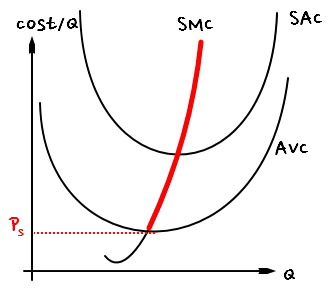
And now you can see why the earlier logic — “there’s a loss, so the firm doesn’t produce” — is wrong logic. That upper region…. was a region where the firm is producing even while taking a loss.
Comments
Discussion happens via GitHub Discussions. You'll need a GitHub account to comment.