Chapter 5 Practice Problems
Chapter 5 practice problems, one painful step at a time: a vertical price consumption curve, Ginger's optimal basket and the price cut that keeps her just as happy, a corner solution, consumer surplus as an integral, adding up demand curves, and Lou's income and substitution effects with compensating and equivalent variation.
The early problems were easy enough that I just slapped photos in and called it a day, but from here on out I’ll try to actually type things out as much as I can.
T_T T_T T_T Uuuugh, somebody do this for me, pleeeease lol lol lol
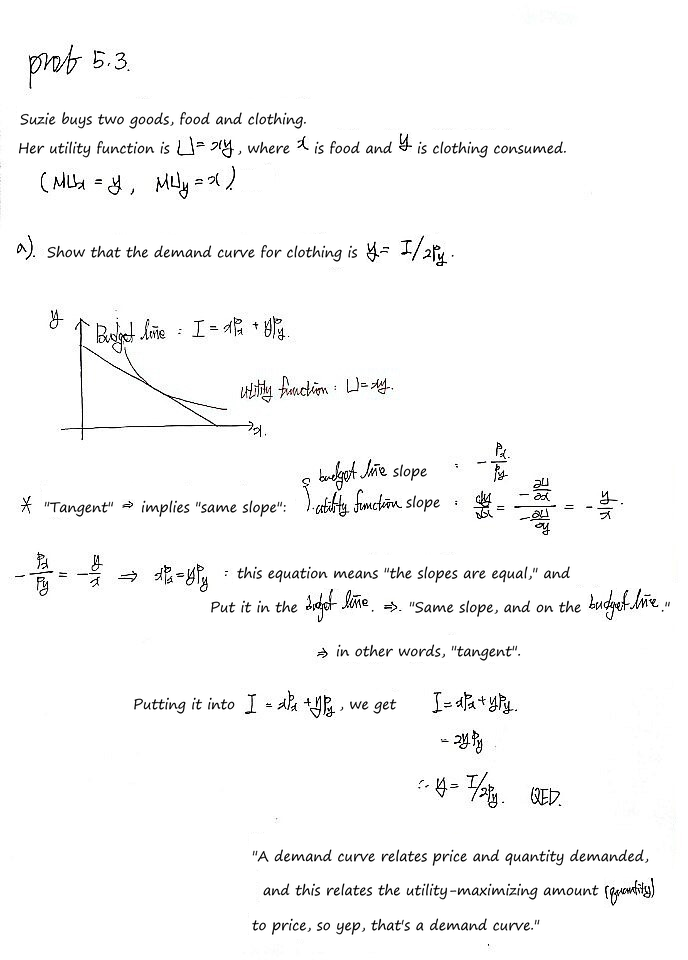
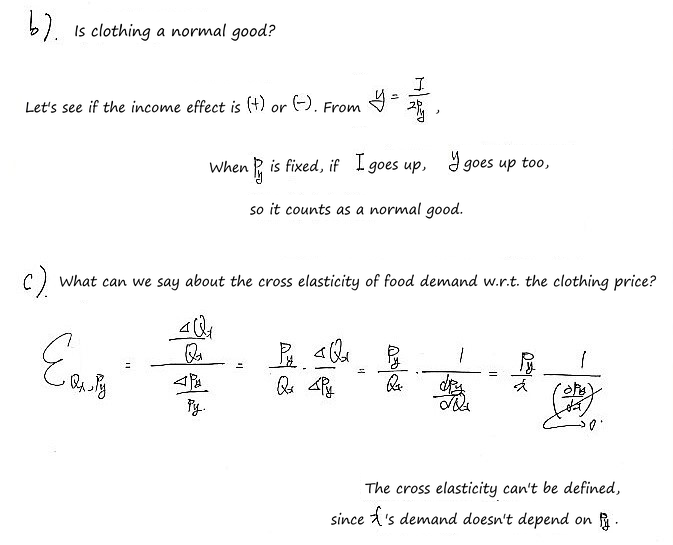
Prob 5.3
Prob 5.7
Reggie only consumes two goods: food and housing. On a graph with housing on the x-axis and food on the y-axis, the price consumption curve for housing comes out as a vertical line. Draw a budget line and indifference curves that are consistent with these preferences.
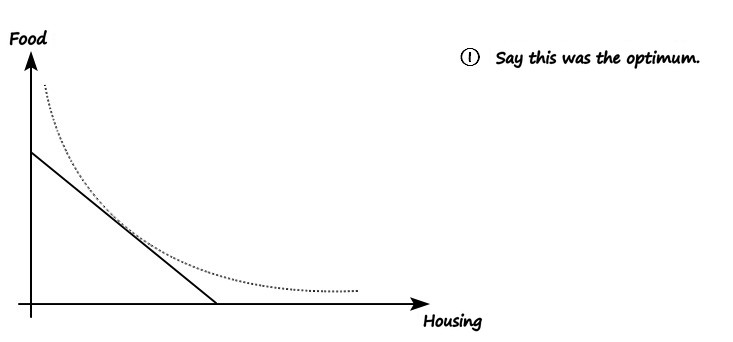
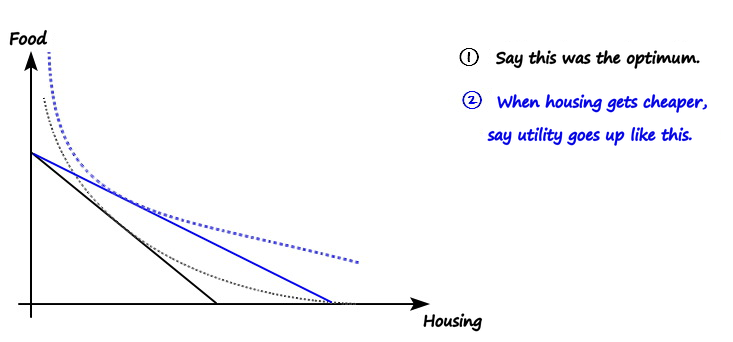
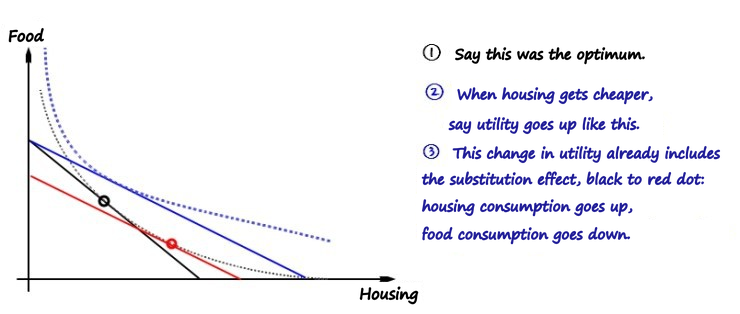
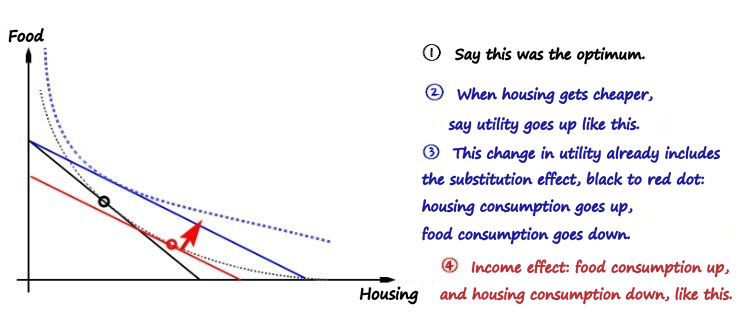
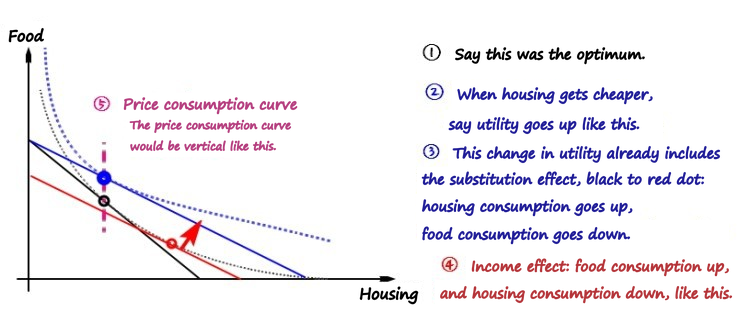
For reference — a good whose consumption drops because of the income effect is called an inferior good, and a good whose consumption rises from the substitution effect but then gets clobbered in the negative direction by the income effect by more than that amount is what we specifically call a GIFFEN GOOD.
Prob 5.8
Ginger’s utility function is  . So the marginal utilities are
  and
and  . Income is $I = 240$ and the prices are
  ,
,  .
.
a) Given these prices and this income, find Ginger’s optimal basket.
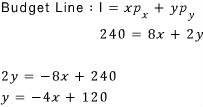
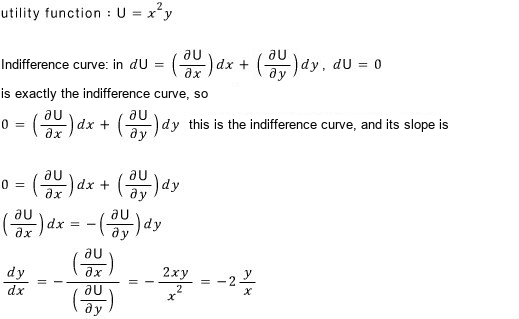
At the tangency point, the slope of the budget line equals the slope of the indifference curve, so —
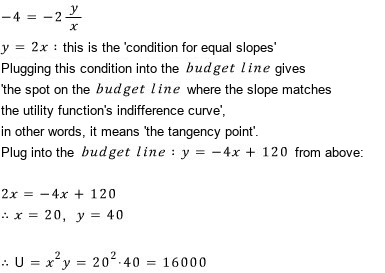
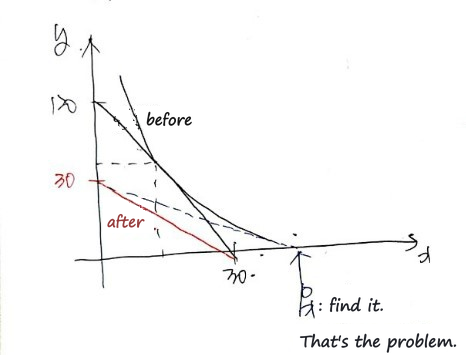
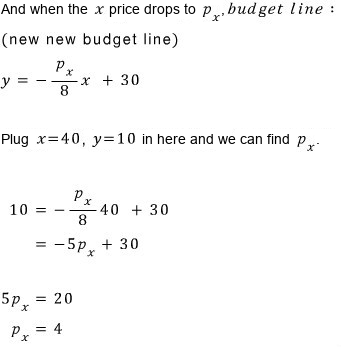
b) If the price of y rises to 8 dollars and Ginger’s income stays the same, how low does $p_x$ have to drop for her to keep the same level of welfare she had before  changed?
In one sentence, here’s the problem:
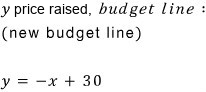
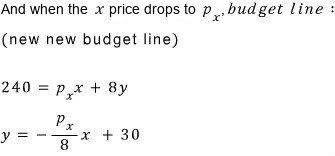
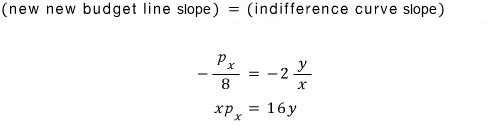
Same as everything we did above: I’m going to plug this condition into the new new budget line, because we want the spot where the indifference curve of the utility function and the new new budget line are tangent.
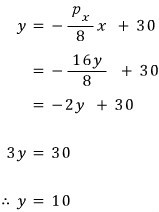
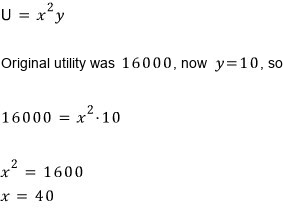
For utility to stay exaaactly the same, we just need the partner of $y=10$ that makes $U = 16000$.
Prob 5.11
Scott only consumes two goods, steak and ale. When the price of steak drops, he ends up buying more of both steak and ale. Explain this with budget lines and indifference curves.
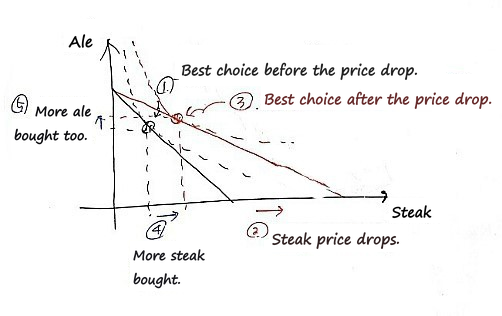
It’ll help if you follow along in numerical order. The problem just asks for an explanation, so honestly I think this one diagram is enough.
Prob 5.13
Suppose the consumer’s utility function is  . (This is obvious from a partial derivative, but anyway —)
  &
& 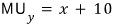 .
.
The price of x is  , the price of y is
  , and both prices are positive. Income is
  .
.
a) For an interior optimum, show that the demand for x can be written as
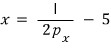
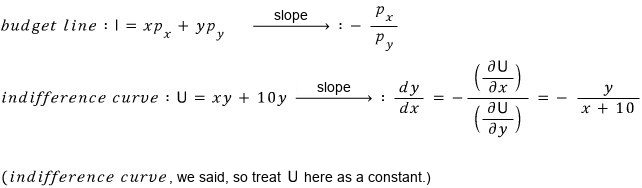
The tangency condition (slopes equal) is
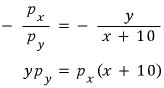
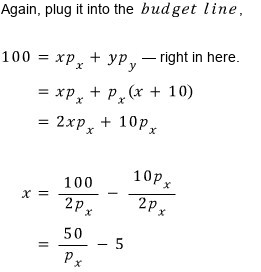
Plug that into the budget line —
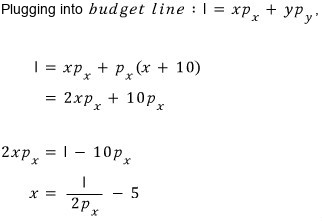
QED for an interior optimum. Including the corner, demand is $x = \max\{I/(2p_x)-5,\,0\}$.
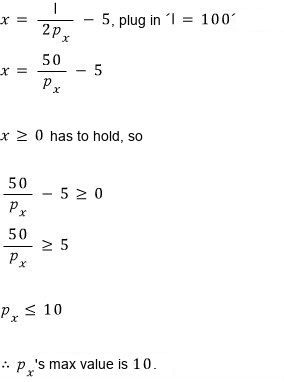
b) Now suppose $I = 100$. At what value of  does consumption of x fall to zero?
c) Suppose the price of x is 20 and the price of y is 20 as well. On a graph showing the optimal basket of x and y, show that since  exceeds the value from (b), this is a corner solution where the consumer only buys y.
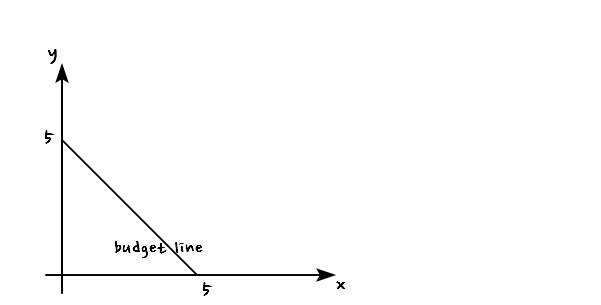
If the prices of x and y are both 20 and income is 100, then $100 = 20x + 20y$ is the budget line, so the picture looks like this, right? Now let’s try to find the optimal point (the one that maxes out utility) with our utility function $U = xy + 10y$.

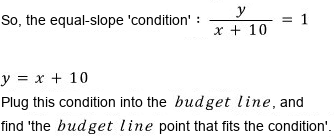
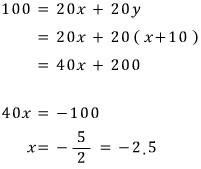
The tangency equations give $x = -2.5$ and $y = 7.5$. But that point is outside the feasible region, so it is not the consumer’s optimum.
If we mark that algebraic tangency on the extended budget line above
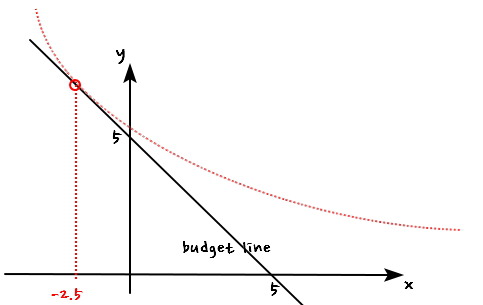
That tangency sits to the left of the y-axis. On the feasible part of the budget line, $U=(x+10)(5-x)$ falls as x increases from zero, so the best feasible choice is at the corner.
But hang on — x isn’t allowed into the negative region, $x \lt 0$.
(We said x is a good being consumed, so negative consumption is weird. It doesn’t even mean selling the good off or anything.)
So this consumer, trying to max utility “as best as possible,” settling for slightly lower utility than that, the highest utility you can get within the constraint —
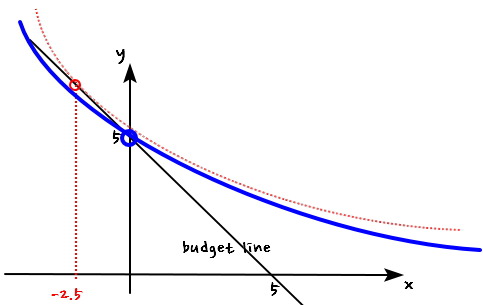
— is going to pick $x = 0$. That’s what I’m saying.
So they pick $x = 0$, $y = 5$, and the utility from that choice is $U = xy + 10y = 0 \times 5 + 10 \times 5 = 50$.
d) Easy, skip.
e) Still assuming income is 100, draw the demand for x across all values of  .
.
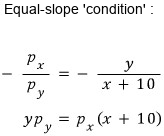
For an interior solution, the tangency condition is still the same. Across all positive prices, though, demand is $x=\max\{50/p_x-5,\,0\}$: it is zero once $p_x\geq10$. The calculation below gives the positive-demand branch —
Prob 5.15
The demand for some little widget is $D = 16 - 2P$. Calculate the change in consumer surplus when the price rises from 1 dollar to 3 dollars.
First, let me sketch the function out a bit. I’m going to put $P$ on the y-axis and $D$ on the x-axis. So instead of writing $D = 16 - 2P$, it’s nicer to write $P = -(1/2)D + 8$ and draw a line with slope $-1/2$ and y-intercept 8. OK, drawing —
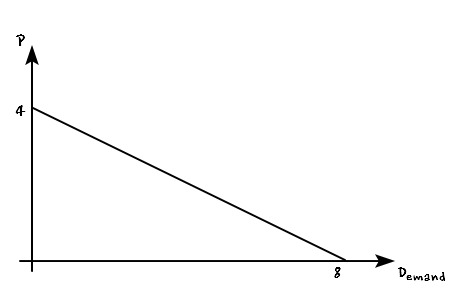
That’s what it looks like, right? We were asked for the change in consumer surplus when the price moves from 1 dollar to 3 dollars, so we need —
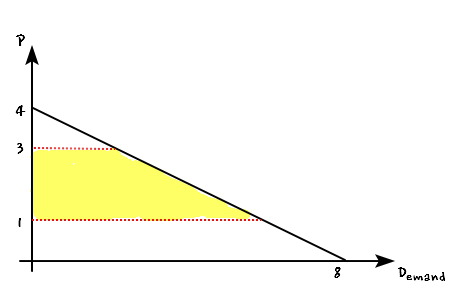
— the area in here, right????????
Of course, this area is easy to get with right triangles, but I’m gonna write it out the hard way for no particular reason.
Why? Just to show it can always be calculated no matter what shape the demand function takes?

The area is 24, and since the price went up, consumers are worse off: consumer surplus dropped by 24, so $\Delta CS = -24$.
That’s how I’d write it.
Prob 5.20
Two consumers in the market. (Jim & Donna.) Jim’s utility function is $U = xy$, Donna’s is $U = x^2 y$. Jim’s income is  and Donna’s income is
  .
.
a) When the price of y is 1 and the price of x is P, find Jim’s and Donna’s optimal baskets.
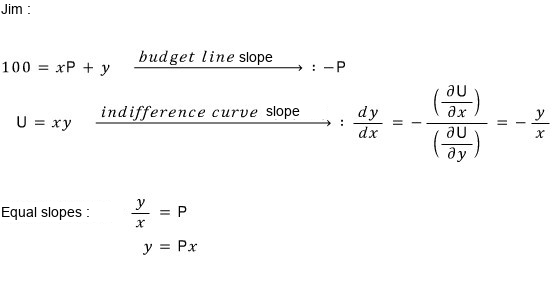
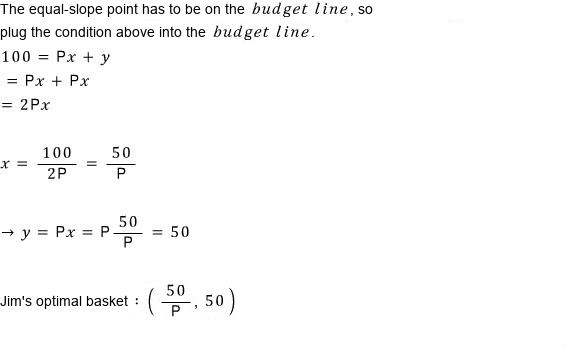
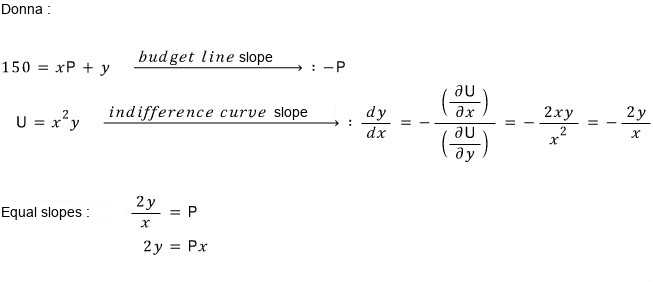
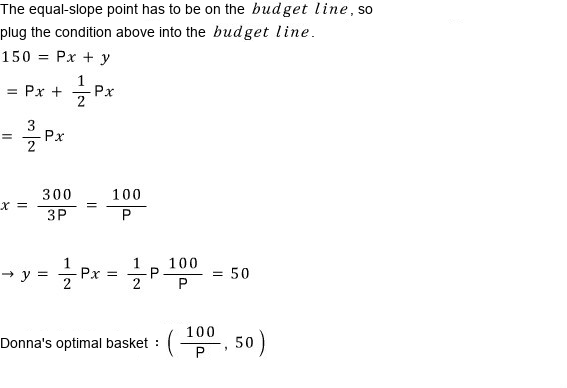
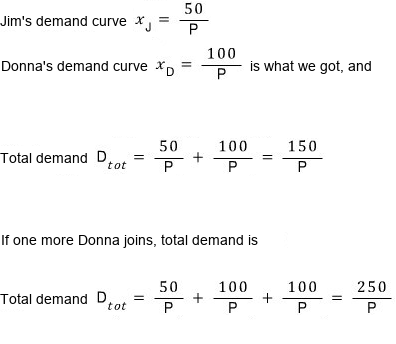
I’m pretty sure this solves everything up through (d)??????
Prob 5.22
Suppose Bart and Homer are the only people in Springfield who drink the soft drink Seven-Up. And suppose their inverse demand curves for Seven-Up are 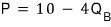 and
and 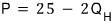 , respectively, and obviously they don’t consume negative quantities. Draw the market demand curve for Seven-Up in Springfield.
Oh, this is just asking us to draw the two functions and then draw a new function that’s their sum.
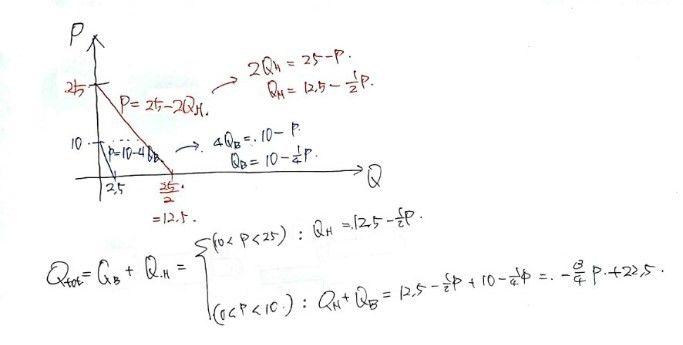
Easy, let’s bang it out and move on. We just add them range by range, and the ranges split up naturally because the two curves hit zero at different prices: above P = 10, Bart drops out. So at the boundary you’ll get a kink. heh heh heh
Prob 5.17
Lou’s preferences over pizza (x) and other goods (y) can be written as $U(x,y) = xy$, and his income is 120.
a) When $p_x = 4$ and $p_y = 1$, find the optimal basket.
Ahh, I’m getting kind of sick of these by now….
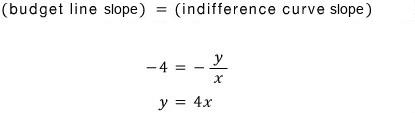
That’s the condition for the point where the slopes are equal, and now we plug that into the budget line again. Let’s plug.
I didn’t bother writing the budget line out above and just said the slope was $-4$ — because I was going to write it right here. That’s why I skipped it earlier.
Anyway, writing it now —
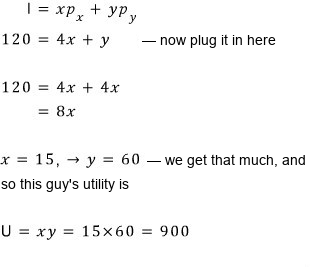
Now let me draw the situation up to this point.
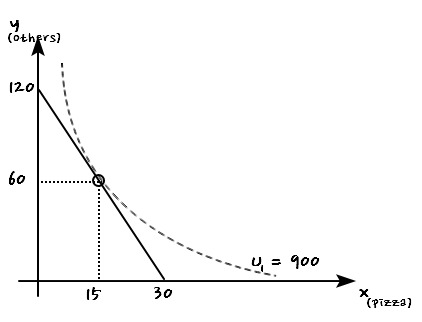
And then we move on to part (b). The reason I drew that picture is so part (b) goes nice and smooth~.
b) When the pizza price drops to 3 dollars, calculate the income and substitution effects.
That’s the problem — but on top of the income and substitution effects, let’s go ahead and grab the equivalent variation and compensating variation while we’re at it. All of it.
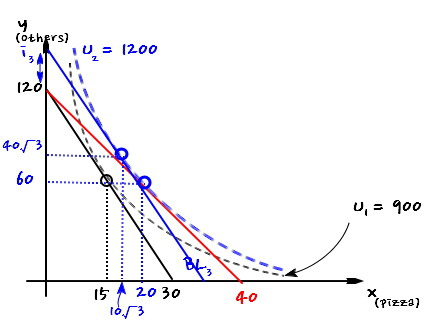
First, since the price moved from 4 dollars to 3 dollars, the budget line gets drawn in red like this.
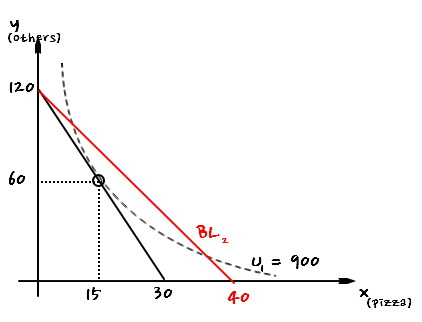
Since $120 = 3x + y$, the slope of $BL_2$ is $-3$.
OK, let’s first find the compensating variation. Keep the slope of $BL_2$, and call the income the unknown  .
.
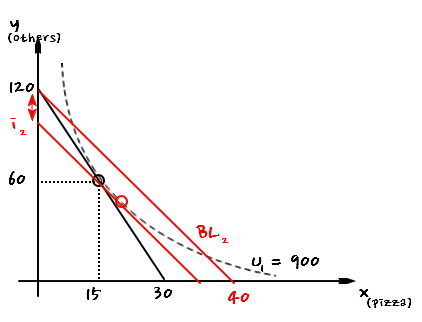
The amount marked by the red double-headed arrow is going to be the “compensating variation” — compensating variation: the key was “assuming the changed price,” right. I’m going to find the size of that arrow.
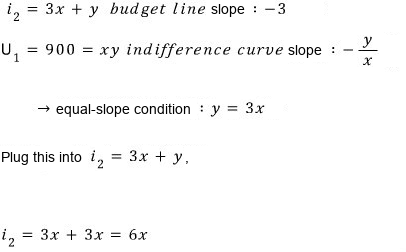
I need to find $x$, and I’ll get it from the $U_1$ indifference curve. Because right now $i_2$ is unknown and $U_1$ is known, instead of plugging the condition into the budget line like we’ve been doing all along, we plug it into the utility function.
(And conversely — the reason we’ve been so casually plugging into the budget line instead of the indifference curve up until now was that income was known and utility was unknown.)
So on the $U_1$ indifference curve, let’s find the $x$ where the slope is $-3$.
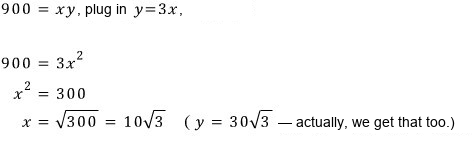
Plugging that back into the equation above —

So the compensating variation is  , I guess. Let me mark all this on the diagram and keep going.
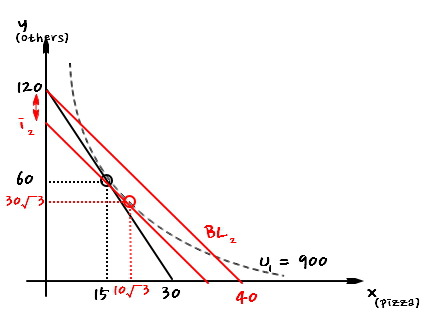
Still with me?
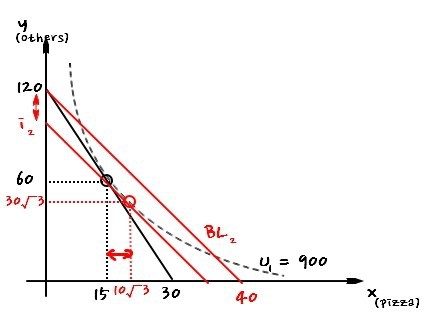
Ah ah ah ah and the red arrow I marked in the figure above — that amount is exactly the $\Delta x$ from the substitution effect!?!?!?!?
That is,

I guess.
Now let’s go find $U_2$.
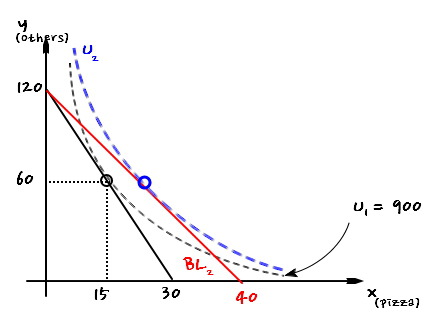
We’re going to find a $U_2$ that looks like this — the $U_2$ that’s tangent to $BL_2$ and gives max utility!!!!!!!!!!!!!!!!!!!
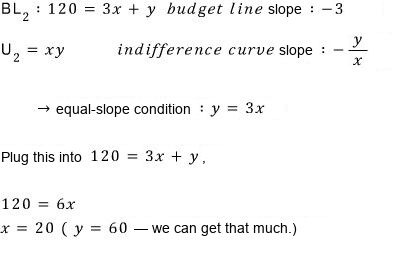
Whoa whoa whoa. So then $U_2 = 1200$ is what we calculate. Then back to the diagram, go go go go go. Let me mark the info we’ve found again.
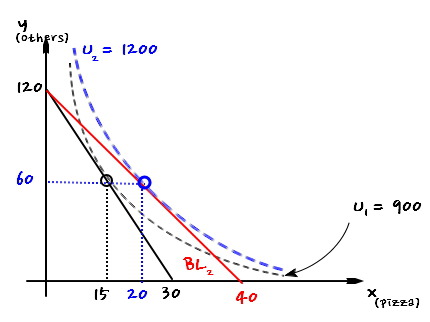
Looks like the income effect is basically game over now. Earlier we found the substitution effect  , and from there, the chunk that brought us up to $x = 20$ right now is exactly the income effect. So —
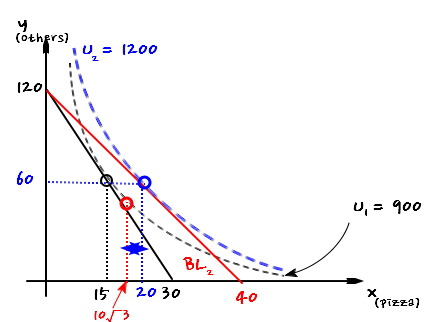
That amount right there is the income effect, is what I’m saying. So

Now finally all that’s left is the equivalent variation, right????????
Equivalent variation……….. The key with equivalent variation was “assuming the price before the change.” Let’s keep going with the diagram.
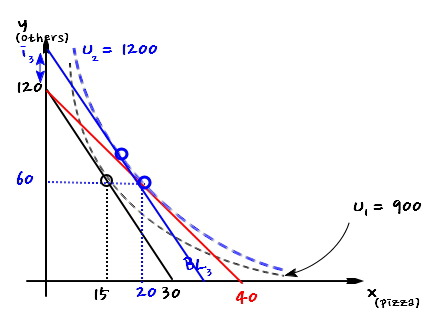
Assuming the price before the change, we need to find the unknown $i_3$. So I named the budget line with $i_3$ as $BL_3$. “$BL_3$ — the one with a tangency point like that.” Then on with the game of hunting down $i_3$.
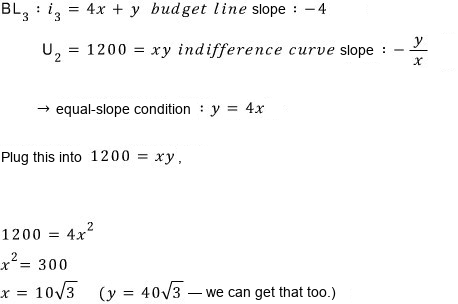
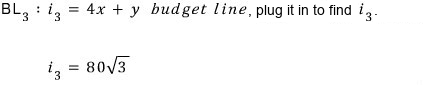
So the equivalent variation is  , I guess.
Heads-up. The figures here are the original notes, slips and all. A few things to watch for:
- In Prob 5.3 c), the food demand $x = \frac{I}{2p_x}$ has no $p_y$ in it, so the cross elasticity of food demand with respect to the clothing price is 0, not undefined.
- In Prob 5.15, the demand line $D = 16 - 2P$ meets the price axis at $P = 8$ and the quantity axis at $D = 16$; the sketches label them 4 and 8. The shaded band between $P = 1$ and $P = 3$ and its area, 24 (the fall in consumer surplus), are right.
- In Prob 5.22, Bart’s demand is $Q_B = 2.5 - \frac{1}{4}P$ (from $4Q_B = 10 - P$), not $10 - \frac{1}{4}P$, so for $0 \lt P \lt 10$ the market demand is $Q_H + Q_B = 15 - \frac{3}{4}P$, not $22.5 - \frac{3}{4}P$; the branch for $10 \lt P \lt 25$, $Q_H = 12.5 - \frac{1}{2}P$, is right.
- In Prob 5.13, the tangency formula gives only the interior branch. Including the corner, $x=\max\{I/(2p_x)-5,0\}$. With income 100, x is positive below $p_x=10$ and zero at or above 10; 10 is not an upper bound on the price itself.
Comments
Discussion happens via GitHub Discussions. You'll need a GitHub account to comment.