Chapter 6 Practice Problems
Chapter 6 practice problems, production edition: hunting down where average, marginal and total product peak, sketching the DVD factory's MP and AP curves, getting an MRTS ratio out of an elasticity of substitution, poking a CES function for its σ and returns to scale, and checking whether a new technology saves labor.
Prob 6.3
For the production function 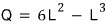 , fill in the table below, then figure out how much labor the firm should use to make each of these happen.
| L | Q |
|---|---|
| 0 | |
| 1 | |
| 2 | |
| 3 | |
| 4 | |
| 5 | |
| 6 |
- a) Average product is maximized.
- b) Marginal product is maximized.
- c) Total product is maximized.
- d) Average product becomes 0.
OK, table first!
| L | Q |
|---|---|
| 0 | 0 |
| 1 | 5 |
| 2 | 16 |
| 3 | 27 |
| 4 | 32 |
| 5 | 25 |
| 6 | 0 |
Simple: just plug each L into the function 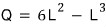 and read off the values.
Now, to actually solve the problems, let’s draw that function!!!! I’m gonna draw it exactly the way I learned in high school, heh.
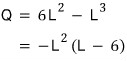
It bounces off at $L = 0$, passes through $L = 6$, and shoots off to $-\infty$ as $L \to \infty$! hehehe
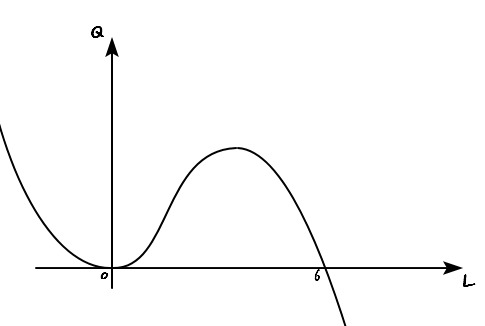
Ah, but the region $L \lt 0$ makes no economic sense, so we don’t need to draw it on this graph. Erasing it.
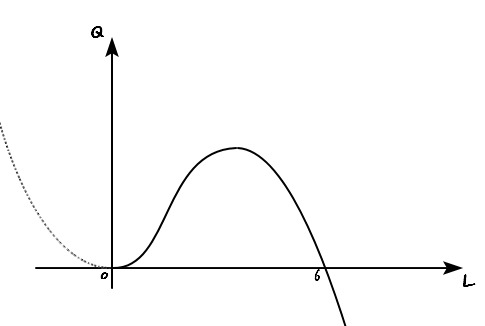
Alright~ Solving a): “average product is maximized” means we need the value of L that maximizes the slope from the origin.
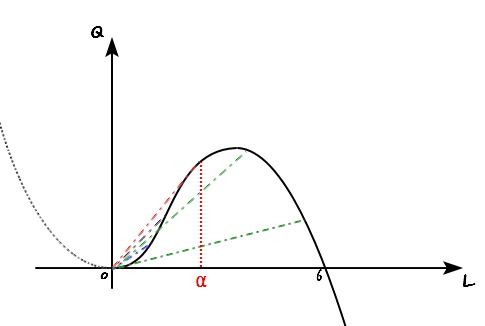
So we just need to find the $L = \alpha$ that makes the slope from the origin the biggest. Concretely, that $\alpha$ is
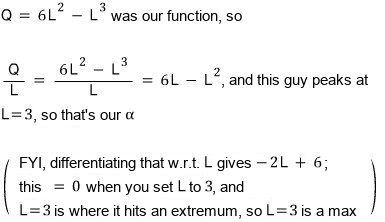
Let’s knock out d) while we’re at it. When the average product hits 0:
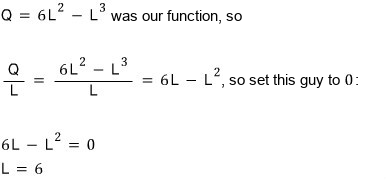
You can do it like that, or you can just look at the graph and find the point where the slope from the origin goes to 0.
b) asks for where the marginal product is biggest, which means: find the point on the graph where the slope of the tangent line (the derivative) is the largest.
In formulas first:
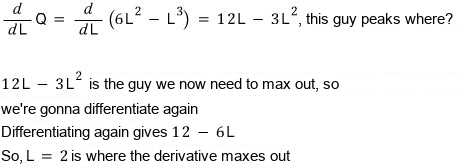
And what does that look like in a picture?
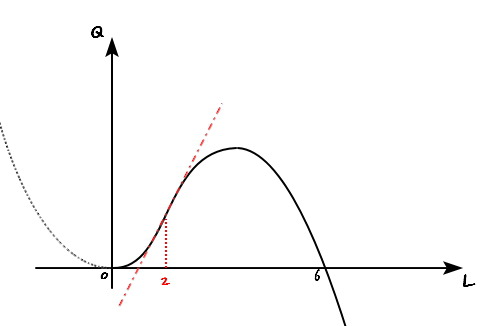
It hits its max right there!!! hehe
The last one, c), just asks for the point on the graph above where Q itself is the biggest, so
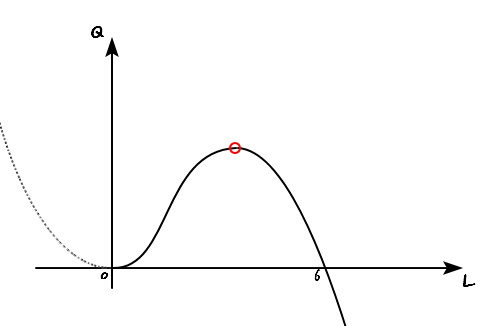
it’s nothing more than finding the extremum: $L = 4$.

Prob 6.4
Suppose the production function for DVDs is 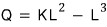 . Here Q is annual disc production, K is capital measured in machine-hours of input, and L is labor-hours of input — the labor flow.
a) Suppose $K = 600$. Find the total product function, plot it over $L = 0$ to $L = 500$, and also draw the average product and marginal product curves. At what level of labor L does the average product curve hit its max? At what level does the marginal product curve hit its max?
Looks like the move here is just to slam in $K = 600$ and draw.
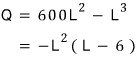
Yesss! I get to recycle~
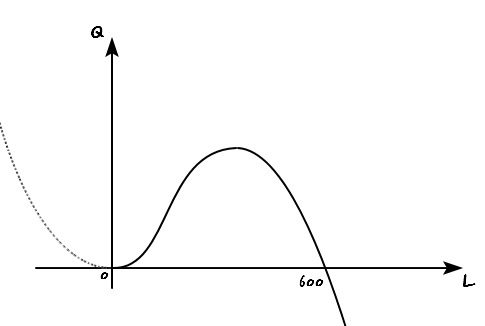
Done! Now I need to draw MP and AP, so let me grind out the formulas first and then draw.
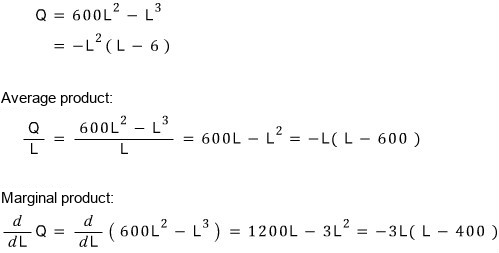
Based on that, let me draw the derivative curves too. I’ll just throw MP and AP on the same picture in one go.
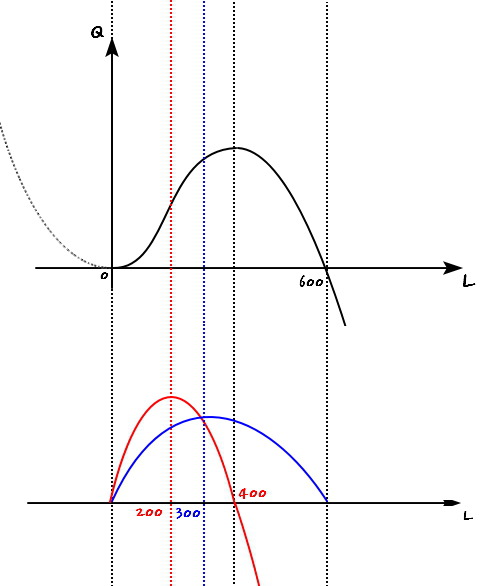
Maybe I should’ve just plotted this with code…. I drew it by hand, so the scale is off — 300 should sit at about half of 600, ugh T_T
Anyway…!!!! You can still tell what’s going on, so I’ll call it done. Moving on.
Prob 6.14
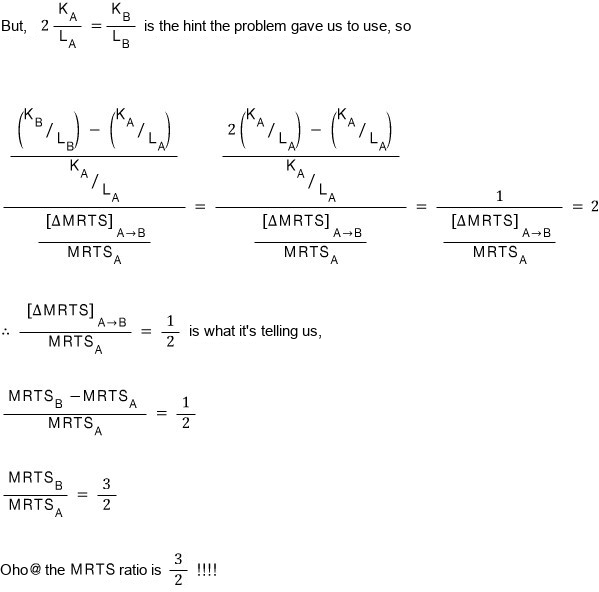
Points A and B sit on an isoquant drawn with labor on the horizontal axis and capital on the vertical. The capital-labor ratio at B is twice the one at A, and as you move from A to B the elasticity of substitution is 2. What’s the ratio between the MRTS at A and the MRTS at B?
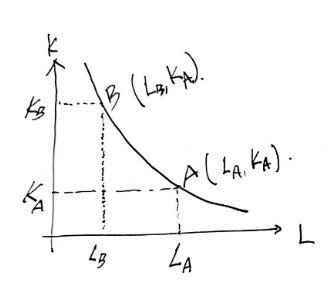
I drew a picture anyway, but honestly I think the problem can be solved without it.
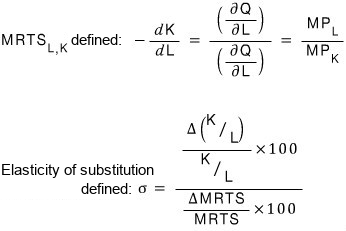
Here the exercise uses changes measured as percentages of their starting values at A. With that finite-change convention, we were told  , so that means
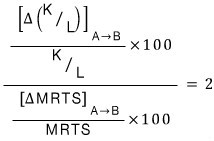
which gives us
Prob 6.21
Consider this CES (constant elasticity of substitution) production function:
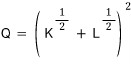
- a) What’s the elasticity of substitution of this production function?
- b) Does it show increasing, constant, or decreasing returns to scale?
- c) Suppose instead the production function looks like this:
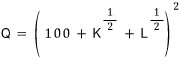
Does this one have decreasing returns to scale? Increasing? Constant?
Before diving in, let me throw down the definition of the CES function — which, fair warning, is a little bewildering.
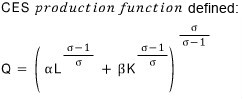
Literally a production function whose elasticity is constant — and presumably this thing was conceived and engineered so that the elasticity comes out constant.
How on earth do you cook something like this up???
I asked this once, and the answer I got was something like: “Well, you’d only really deserve to be called an economist if you could come up with stuff like this,” “and this is the problem with our country’s education system, and this is the problem, and also this is the problem,” “I hope we become a nation that can produce that kind of creative work~” — so I walked away having gotten an earful about the education system, haha.
Anyway: apparently this is a function dreamed up by someone’s creativity. There’s a ton to say about it in relation to the Cobb-Douglas production function, but I’m not going to dive into the economic significance here — I’ll just solve the problem and move on.
a) Go go go go! Since we’re told it’s a CES production function, looks like we can just match it up and read off $\sigma$.
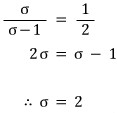
Simple enough.
b) Let’s scale L and K by the same $\lambda$ and feed them in.
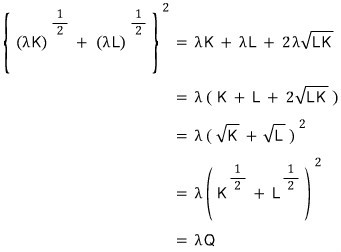
Yoho, constant returns to scale!
Now on to c).
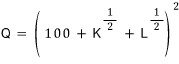
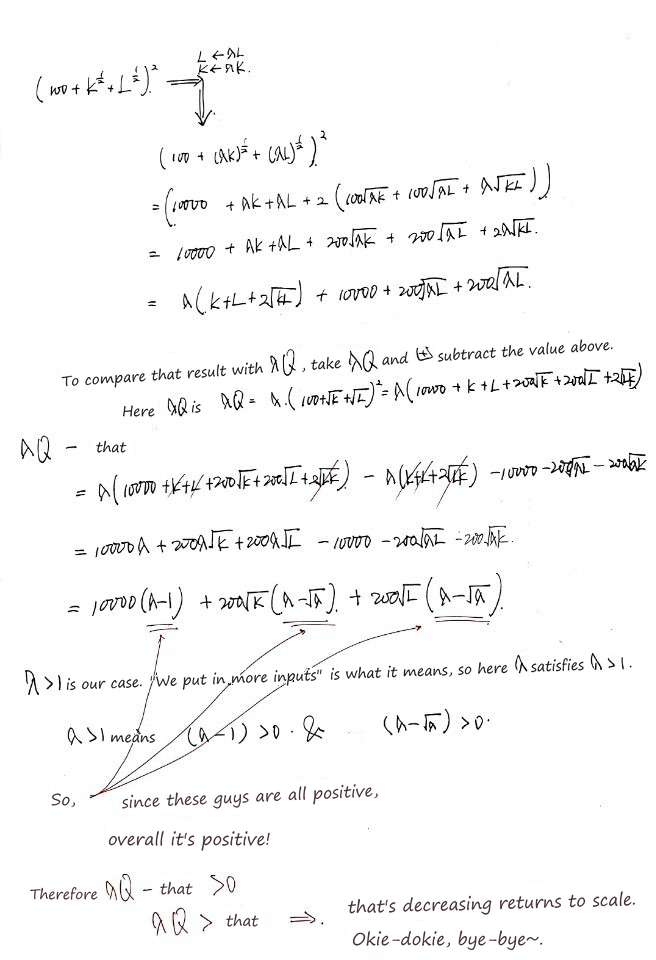
Plug in $\lambda K$ and $\lambda L$ here!
Prob 6.23
Suppose initially the firm’s production function is  . But thanks to an advance in manufacturing technology, the production function becomes
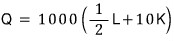
- a) Show that this innovation counts as technological progress.
- b) Is the progress neutral, labor-saving, or capital-saving?
a) is easy to answer.
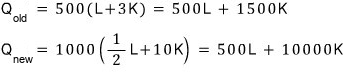
So for the same $(L, K)$ — for any $(L, K)$ at all, as long as $K \gt 0$ — we always have  , so I’d say it’s clear there was technological progress.
Now, to answer what type of progress it is, we need to check the MRTS. The definition itself is
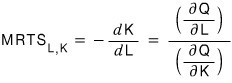
so it works out to
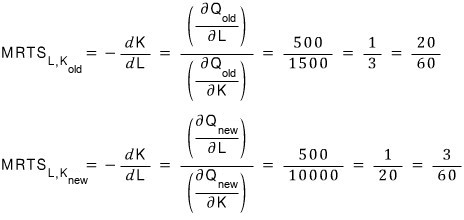
Before, if you cut labor by 60, you had to throw in 20 units of K to keep producing the same Q. Now, if you cut labor by 60, you only need to throw in 3 more units of K to hold Q steady. Capital has become more productive relative to labor. Whether a firm actually changes its input mix also depends on their prices.
So we can call this labor-saving technological progress.
Heads-up. The figures here are the original notes, slips and all. A few things to watch for:
- In Prob 6.4, $Q = 600L^2 - L^3$ factors as $-L^2(L - 600)$, not $-L^2(L - 6)$; the average and marginal products below are right.
- In the definition of the MRTS, the bottom of the middle fraction is $\frac{\partial Q}{\partial K}$: $MRTS_{L,K} = -\frac{dK}{dL} = \frac{\partial Q/\partial L}{\partial Q/\partial K} = \frac{MP_L}{MP_K}$.
- In Prob 6.21, matching the exponents gives $\frac{\sigma - 1}{\sigma} = \frac{1}{2}$ (the sheet writes $\frac{\sigma}{\sigma - 1}$, and its $2\sigma = \sigma - 1$ would give $-1$), so $2(\sigma - 1) = \sigma$ and $\sigma = 2$, the answer the sheet reaches. In the returns-to-scale check, the expansion has $200\sqrt{\lambda K} + 200\sqrt{\lambda L}$ (the last line of the first block writes $\sqrt{\lambda L}$ twice); the comparison after it uses both, so the conclusion stands.
- Prob 6.14 uses finite percentage changes measured from A: this gives $MRTS_B/MRTS_A=3/2$ (or $MRTS_A/MRTS_B=2/3$). If instead 2 were a constant differential elasticity along the whole interval, the finite ratio would be $\sqrt{2}$.
Comments
Discussion happens via GitHub Discussions. You'll need a GitHub account to comment.