Chapter 7 Practice Problems
Chapter 7 practice problems, cost edition: hunting down cost-minimizing input bundles by making two gradients parallel. A CES fuselage maker, a Q = LK firm whose wage jumps to 8 times the rental rate, a paint maker that won't touch capital until r drops below 20 or Q passes 25, a three-input Cobb-Douglas in the long and the short run, and blueprints from perfectly substitutable computers and draftsmen.
From around Chapter 7 onward, unlike when we did the utility function stuff, I just used math that’s explained near the back of a general math or calculus textbook. I went at it picturing the original function in 3D (a plane, or a curved surface) and finding the optimal point with the gradient.
But — let me sneak in a small comment here, presumptuous as it is — what we did back in Chapter 5 and what we’re doing now differ only in the names of the pieces.
Peel the names off and the structure is exactly the same.
So if things here don’t quite click, I think getting a handle on Chapter 5 Practice Problems is a good way in, too.
Prob 7.7
The production of aircraft fuselages can be described with a constant elasticity of substitution production function, like this:
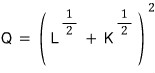
The marginal products of this production function come out as:
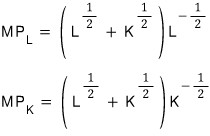
Say the price of labor is 10 dollars per unit and the price of capital is 1 dollar per unit. Find the cost-minimizing combination of labor and capital for a firm that wants to make 121,000 fuselages.
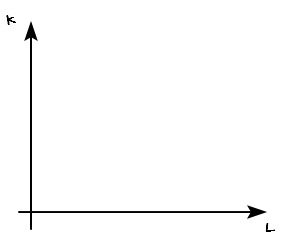
On axes like these, the gradient of
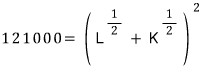
(the isoquant) is
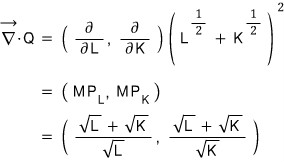
and the gradient of  is
is
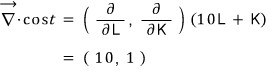
At an interior cost minimum here, those two vectors have to be parallel.
And “parallel,” written as an equation, just means the two vectors are equal up to a constant multiple. So the cost-minimizing condition is

which gives
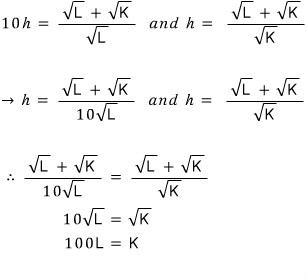
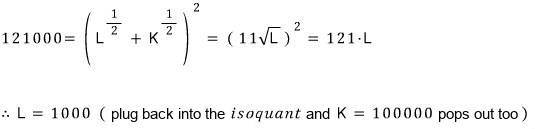
That’s exactly what “they’re parallel” means. And since this condition has to hold on the isoquant, we plug it into the isoquant.
(What we’re doing right now, mathematically, is exactly!! the same move as plugging “the two slopes are equal” into the utility function back when we were dealing with utility functions.)
Prob 7.12
A cost-minimizing firm has the production function

with  and
and  . The price of labor is
  and the price of capital is
  .
.
When $w = 4$ dollars and $r = 2$ dollars, the firm’s total cost comes to 160 dollars. Now suppose input prices change so that the wage $w$ is 8 times the rental price of capital $r$, and the firm can adjust its input mix without changing total output. What’s the cost-minimizing input combination after the price change?
So, stripping the problem down, what we’ve actually been handed is


and that’s it, huh. I’ll just find the gradients of the isoquant and the cost, get the “parallel condition” equation out of them, and carry on by plugging that condition back into the isoquant.
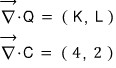
(I took the $C$ from Cost.)
With this, we can write

— that is,

That’s the condition I was talking about. Plug it into the isoquant:
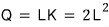
…wait. They never told us the total output. OK, I’ll plug it into the iso-cost line.
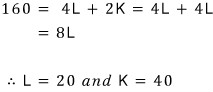
Now let’s try solving it with  .
.
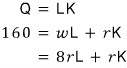
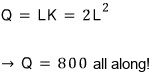
So those are our two equations now, and
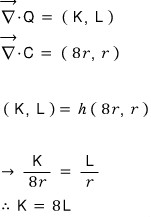
using that to find the $(L, K)$ pair that produces 800:
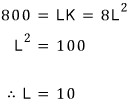
Prob 7.15
A paint company’s production function is

The price of labor is $w = 1$ dollar per unit, and the price of capital is $r = 50$ dollars.
- a) Show that the cost-minimizing input combo for producing $Q = 10$ uses no capital.
- b) Holding $Q = 10$ and $w = 1$, how low does the price of capital have to drop before the firm uses a positive amount of capital?
- c) Holding $w = 1$ and $r = 50$, how high does $Q$ have to climb before the firm uses a positive amount of capital?
a) Let’s go
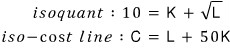
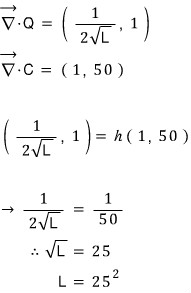
That’s the tangency condition. And since the tangency point has to live on the isoquant, we have to plug it into the isoquant.
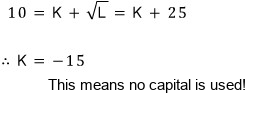
That negative K is outside the feasible region. The actual corner is $K=0$, $L=100$, with cost 100 dollars.
b) Let’s go
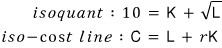
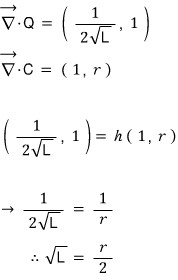
Same logic — push it into the isoquant!
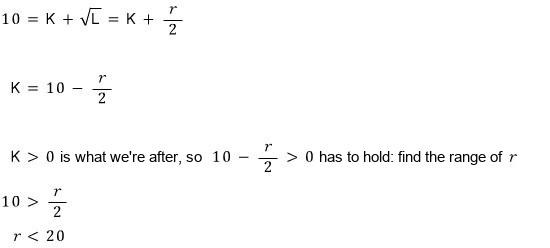
c) Let’s go go go
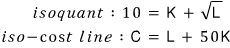
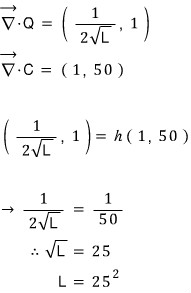
Plug into the isoquant!
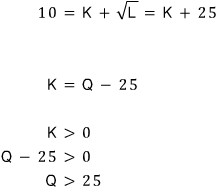
…has to hold.
Prob 7.26
A firm uses three inputs — capital $K$, labor $L$, materials $M$ — to make its output. Its production function is
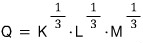
The prices of capital, labor and materials are $r=1$, $w=1$, $m=1$.
a) If the firm produces $Q$ units of output, what’s the solution to the long-run cost-minimization problem?
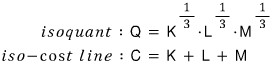
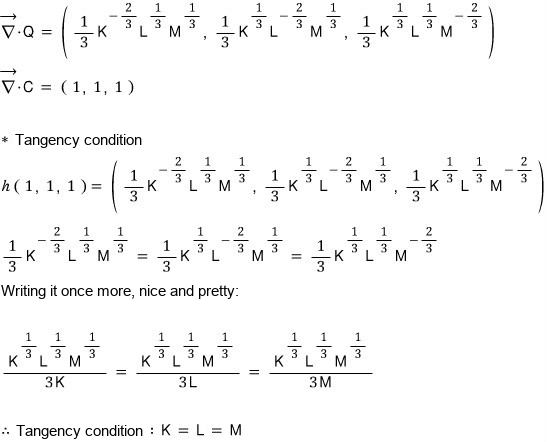
Plug that condition into the isoquant:
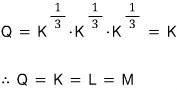
b) The firm wants to produce $Q$ units, but capital is fixed at  . What’s the short-run cost-minimization solution?
A problem that was 3D just collapses into a 2D problem. That’s all this is.
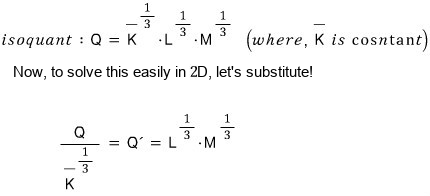
And by the same principle I’m gonna write the isocost line in 2D too. Like this!
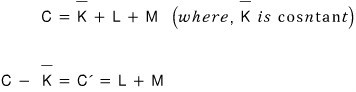
At which point — it’s literally the same problem we already solved.
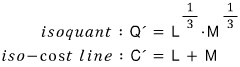
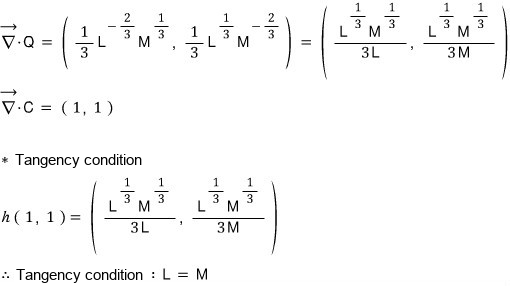
Then of course we push it back into the isoquant.
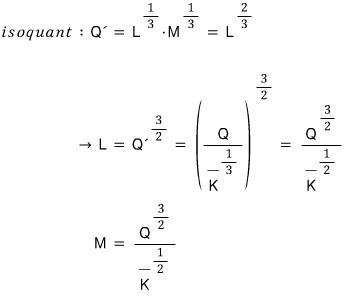
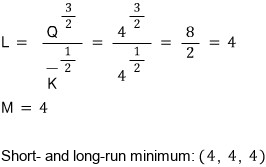
c) When $Q = 4$, the long-run cost-minimizing amount of capital is 4. When capital is fixed in the short run at  , show that the short-run and long-run cost-minimizing quantities of labor and materials are the same.
…wait, what? They told us the long-run minimum sits at $(4, L, M)$. And then in the short run, with  , the minimum would sit at $(4, L, M)$ too…
Isn’t that just… the same thing?
As long as $r, w, m$ don’t budge, why would anything change? Just writing the conclusion:
Prob 7.30
Under a fixed production process, a blueprint ($B$) gets made either with 1 hour of a computer ($C$) or with 4 hours of a draftsman ($D$) drawing by hand. ($C$ and $D$ can be treated as perfect substitutes — so for instance the firm could also make a blueprint with 0.5 hours of $C$ and 2 hours of $D$.)
a) Write down the production function for this process.
Picture it: every hour of $C$, one blueprint pops out, pop pop. Every 4 hours of $D$, one blueprint pops out, pop pop. Calling $C$ the “hours” of computer use and $D$ the “hours” of draftsman use:
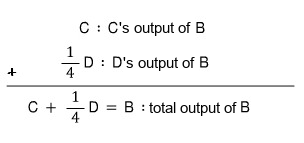
b) The price of computer time,  , is 10, and the wage of the draftsman working by hand,
  , is 5. The firm wants 15 blueprints. To minimize cost, how should it pick $C$ and $D$? Draw the isoquant for 15 blueprints and the isocost lines on a graph with $C$ on the horizontal axis and $D$ on the vertical, and use them to explain your answer.
This time the isoquant and the isocost are both straight lines, huh. Isoquant: $15 = C + (1/4)D$, which we can rewrite as $D = -4C + 60$. So we draw a straight line with slope $-4$ and $D$-intercept $60$.
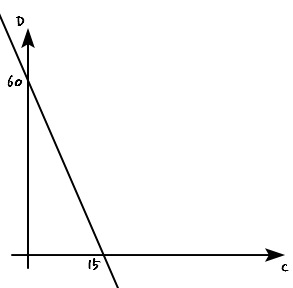
Drawing it like this should do. And the isocost line is
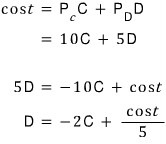
so the slope is $-2$, and we just draw lines whose $D$-intercept is $\text{cost}/5$:
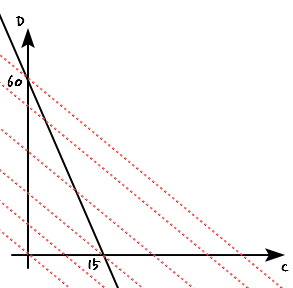
There are a bunch of lines to choose from, but the one that meets the isoquant with $C$ and $D$ both non-negative and makes the cost as small as possible — so the $(C, D)$ pair we want — has to be this one:
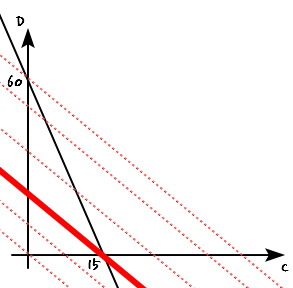
Then $\text{cost}/5 = 30$, so $\text{cost} = 150$. The minimized cost falls right out, just like that.
Heads-up. The figures here are the original notes, slips and all. A few things to watch for:
- In Prob 7.12, after the price change only the output ($Q = LK = 800$) stays fixed, so the cost is an unknown $C = wL + rK = 8rL + rK$, not 160. The tangency condition $\frac{K}{L} = \frac{w}{r} = 8$ with $LK = 800$ gives $L = 10$ (and $K = 80$), as the sheet finds.
- In Prob 7.15 c), the isoquant is $Q = K + \sqrt{L} = K + 25$, with $Q$ (not 10) on the left, which is why $K = Q - 25 \gt 0$ leads to $Q \gt 25$.
- The gradients are written $\nabla Q$ and $\nabla C$, with no dot ($\nabla\cdot$ would be a divergence); in Prob 7.26 the gradient is that of $Q' = L^{1/3}M^{1/3}$, $\nabla Q'$.
Comments
Discussion happens via GitHub Discussions. You'll need a GitHub account to comment.