Rutherford Scattering and the Rutherford Scattering Formula
Deriving the Rutherford scattering formula while stumbling through the wild history of how we went from Thomson's pudding model to discovering the atomic nucleus — scary math incoming lol.
Ah, today while studying I got so sleepy that I figured I’d post the piping hot Rutherford scattering formula I just studied. Alright, let’s go!!!
From a history-of-science perspective, I used to mistakenly think the structure of the atom had been figured out by around the 1600s? 1700s? Around the time classical mechanics and electromagnetism were completed by Newton and Maxwell, I was under the illusion that at least the structure of the atom had all been revealed.
But while reading this book called Quantum Story this time, I learned that the rise of ‘atomism’ was in the late 1800s, and that Thomson’s discovery of the electron and Rutherford’s discovery of the atomic nucleus around this time is what modern physics is — and I only just properly got that this time. (I probably knew this before too,,,, but this time I properly organized it….)
Actually, the reason Planck (a master of classical thermodynamics) jumped into blackbody radiation research was that he wanted to shut the atomists up. That’s why he started that research.
(According to the atomists’ logic, an assumption that went into his proof of the second law of thermodynamics would be broken; that assumption was apparently “matter is continuous”.)
And then he somehow…..became the leader of the atomists, and also,,, threw the doors of quantum mechanics wide open, lol. It was fun, hehe.
Anyway, in 1897 J.J. Thomson discovered the electron and discovered that it carries a negative charge. And he proposed that at least a few hundred negatively-charged electrons would be embedded in some positively-charged something, proposing the so-called pudding model.
That pudding model ended up being broken by the New Zealand physicist Rutherford. During his α-ray scattering experiment, Rutherford witnessed a strange phenomenon.
(α rays are actually helium ions — helium atoms that have lost their outermost electrons, so they carry two positive charges — but here let’s just call them α particles! Back then they probably just thought it was a ray?)
“Hey hey hey hey hey!! The positively-charged something isn’t spread out evenly like pudding!!!”
“It seems to be clumped up SMACK!!! somewhere!!!” Let’s call this the nucleus!!! he said, and then he went:
“Turns out the nucleus has the same charge as all the electrons put together?!?!”
So Rutherford’s conclusion was to propose an “orbital model” for the atom,,,,,
(Rutherford probably knew too that the orbital model was wrong……hehe But through the α-ray scattering experiment it’s clear it’s not the pudding model.,,, I think there just wasn’t really any other way…hehe Now the world just waits for the next luck-blessed~~~ genius…!!)
The “Rutherford scattering formula” that Rutherford obtained after the α-ray scattering experiment is
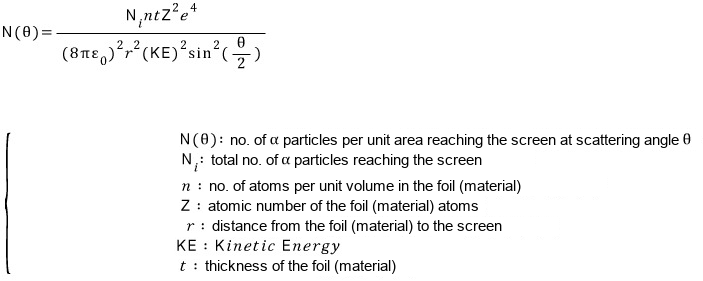
From now on I’m going to derive this……haaa…… I’m already scared lol. How do I actually do this lol aaargh!
Channeling Rutherford
Alright, let’s think about it like this… From now on, assume I’m channeling Rutherford. From now on the writer is Rutherford (Rutherford still thought it was the pudding model).
“Ohoho~~ pudding, you say? Then the α particles would all pass through~~ Assistant~~~~ fire the α rays~~~~~”
(Ting!~ting!ting!ting! Taeng!~taeng!taeng!taeng!) — the sound of α particles bouncing off
“What on earth is this!!! A frying pan game!!! Attendants!!!! Are you outside!!!! Fetch me my pen and paper at once!!”
“This must surely mean there is some densely packed sardine that bounced off our powerful α particles, methinks.”
“Then let us assume the following. First, let us call that densely packed particle the nucleus, and since that nucleus is small and the α particle is also freaking small, let us think of them as point masses and point charges. And since they both carry positive charges, they will produce a repulsive force!!!”
“My good fellow, tell me how this repulsive force arises.”
(Yes my lord, I understand that the repulsive force has a coefficient of 1 over four-pi-epsilon-zero, and is inversely proportional to the square of the distance and proportional to the product of the charges…)
“Correct, it is the Coulomb force 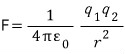 indeed.”
“For now, let’s set aside the head-on collision and think about being scattered by the repulsive force when slightly off to the side. This is my assumption.”
“Also, I am inclined to think that the nucleus is very heavy compared to the α particle, because there are α particles that collide head-on and come back out. So I made the assumption that it is heavy, and therefore let us assume that during the time the repulsive force acts, the nucleus does not move.”
The change in momentum
“If no one objects, behold this figure.”
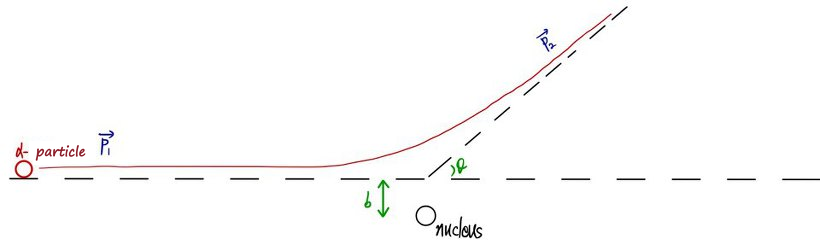
“This is a figure of an α particle going past the nucleus, off to the side by a distance $b$. Watch carefully: what I am about to do is derive the relationship between that $b$ and $\theta$. But since we assumed that the nucleus thing stays put, energy will be conserved. Then what does that mean? The magnitudes of the momenta $\vec{p}_1$ and $\vec{p}_2$ are equal. The change in momentum is $\Delta \vec{p} = \vec{p}_2 - \vec{p}_1$ — any objections?”
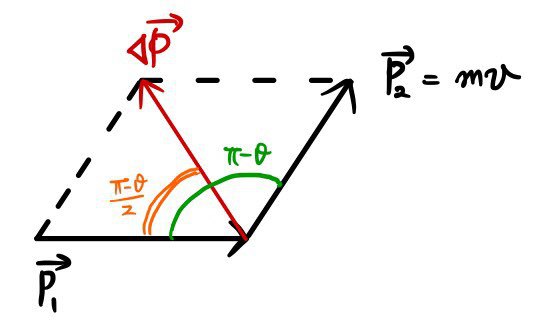
“Let us say the α particle has mass $m$ and speed $v$, so the magnitude of its momentum is $mv$.”

“Alright, first let me throw out a question.”
“What caused that change in momentum (it’s a vector, so there is a change)?”
“The electric repulsive force, my lord.”
“Yes, correct. Let us move on.”
“Alright then,

if you look at the figure this relation is obvious, so we will move on.”
“Alright, the sine function, if you shift it by pi over two, becomes cosine, and sin is an odd function, cos is an even function. Massaging the equation with that gives”
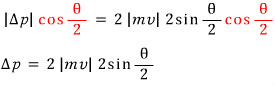
“We have derived the relation between delta p and theta. Now let us write delta p differently. What caused delta p was the electric repulsive force, as I said earlier. I will draw that electric force at each position. (The blue is the direction of the delta p vector.)”
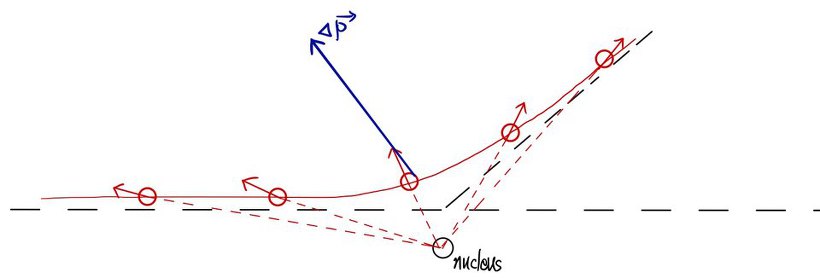
“Ohoho, these fellows face a headwind as they approach and a tailwind as they pass by — I see, that’s how energy is conserved. Alright then, the total sum of each $\vec{F}$ would have caused $\Delta \vec{p}$.”
Did you not learn this in 10th grade?

(It’s like dropping an egg on a cushion versus dropping it on asphalt…heh)
But let us be crafty. Instead of summing all those $\vec{F}$’s, let’s project the components only in the direction of $\Delta \vec{p}$ and sum those up. That is,
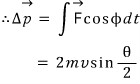
“Alright then, from where to where would it be reasonable to integrate???”
“Yes my lord, this humble servant thinks from $-\infty$ to $\infty$ would be reasonable.”
“Correct. Even when the α was really really far away, the electric force was just small but not zero, so as you say, let us do it that way.”
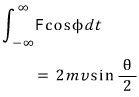
Alright… the integration variable is $t$. Who can integrate this! Ugh T_T Right, let’s change the integration variable to an angle too…. Let’s use the chain rule. I will change it;;
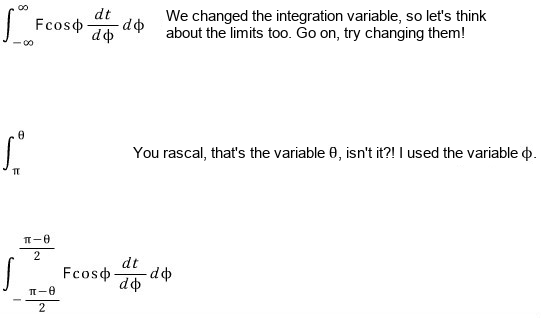
“The reason I specifically used $\varphi$ is that the rate of change of $\varphi$ with respect to time can be described as circular motion, and I thought we could manipulate it that way. Let us continue.”
The birth of b
“Now now now, the electric force always points straight along the line between the α particle and the nucleus, so it never twists the α particle around the nucleus….. no torque, which means the angular momentum $\vec{r} \times \vec{p}$ stays constant.”
Alright, we can now witness the birth of $b$ right here, watch carefully!!!
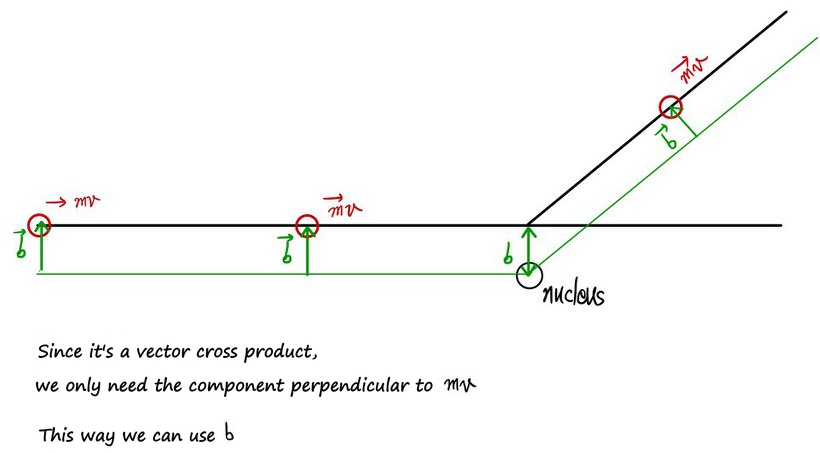
“Alright, angular momentum is constant……yes.”
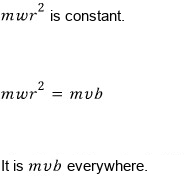
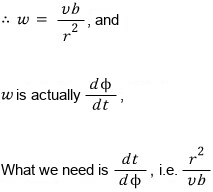
“Let us plug it into our equation.”
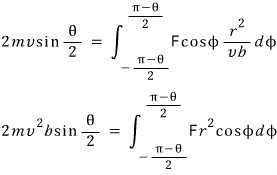
Ohoho. Right, now let us calculate the electric force between the α particle and the nucleus.
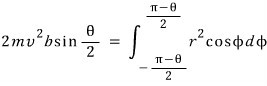
I will mash these equations together
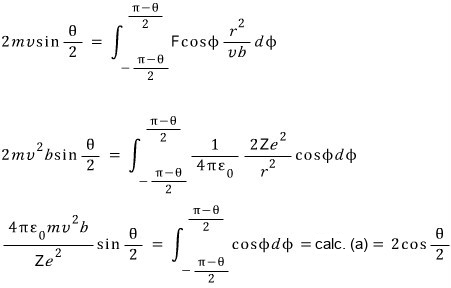
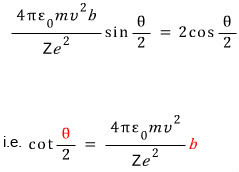
Alright, we have pulled out the relationship between $b$ and theta, heh heh heh!
Ah but let us clean up the equation just one more time
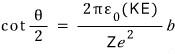
Done done. This is the equation I made with my assumptions..
Uh huh… my thinking was pretty much “Where could this thing called the nucleus be! >_<” and I built the equation like that,,,,, Haaa~~~ how to use that equation experimentally is really a problem T_T
First of all, many atoms together would form matter, and matter has thickness, doesn’t it T_T? It would be hard to make it graze past just one atom T_T
How do I use this equation……
Alright!!! First, suppose an α particle coming in at spacing $b$ gets scattered by theta, then an α particle coming in at a smaller spacing than $b$ will be deflected at an angle greater than theta.
That is, α particles incident within $\pi b^2$ will be deflected at angles greater than theta!!!
Okay, and, let’s say matter has $n$ atoms per unit volume, and the thickness is $t$ (where $t$ is sufficiently small).
Alright alright alright, then how shall we fire our α particles? We will fire α particles uniformly over an area of $A$~~~ Then the α particles will encounter $ntA$ nuclei,~~~ and among those, only the α particles that went into $\pi b^2$ will be deflected by angles above theta, hehehe. Does everyone agree?!!?!
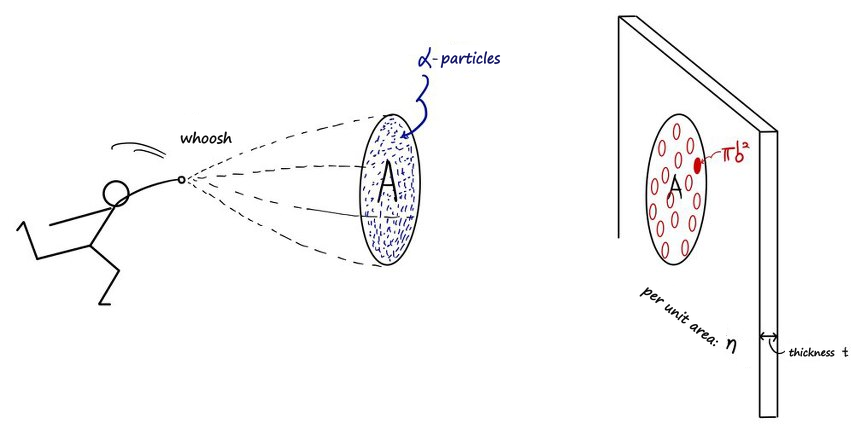
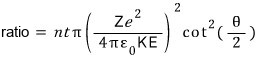
Alright then, we will find the ratio: the fraction of the α particles scattered by theta or more.

Okay, using the equation from before, let us express the ratio as an equation in theta.
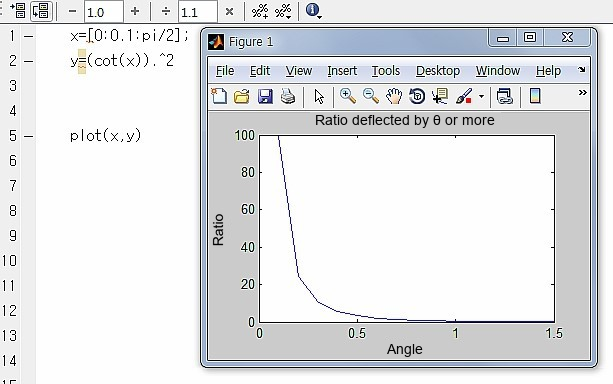
For reference, I Rutherford have drawn the cotangent-squared graph. Other than theta, what’s in front is just constants, so you don’t need to worry about them~~~
I Rutherford shall think like this: if I think about “when $\theta$ changes by thiiiiiiis~~~ much, how does that ratio change???” then shouldn’t I just differentiate that equation with respect to theta??!?!
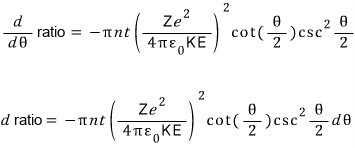
Let us think about the α particles scattered into the band between $\theta$ and $\theta + d\theta$.
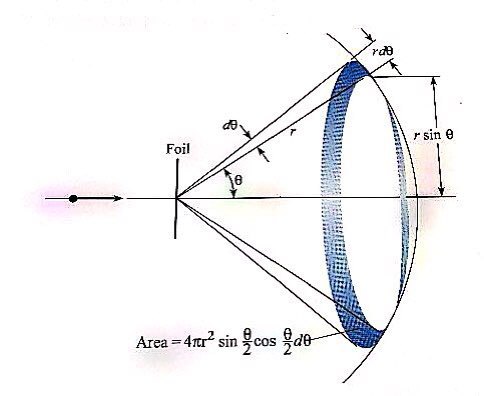
That is, if we call that region $dS$, this humble Rutherford can predict the number of α particles reaching $dS$, can he not~?
(For $dS$ do a spherical integral, it’s not a difficult integral.)
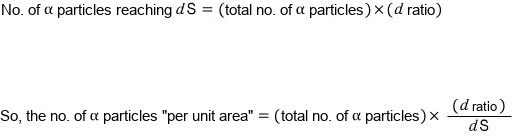
Done…
I will now go change majors, may you all live well and eat well….keh keh keh

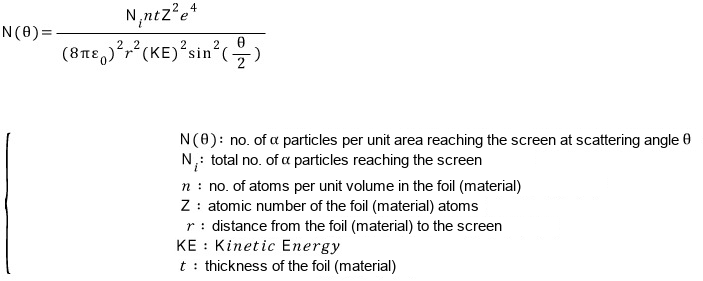
Sorry for making it feel like I posted this while high on drugs…hehe
Heads-up. The figures here are the original notes, slips and all. A few things to watch for:
- In the Rutherford formula at the top (and its repeat near the end), the denominator should have $\sin^4(\theta/2)$, not $\sin^2(\theta/2)$.
- In the picture of the momentum change, both lines carry an extra factor 2: $|\Delta p|\cos\frac{\theta}{2} = 2|mv|\sin\frac{\theta}{2}\cos\frac{\theta}{2}$, so $\Delta p = 2|mv|\sin\frac{\theta}{2}$.
- In the integral pictures, the integrand should be $F r^2\cos\phi$ (the first one drops $F$). With $F = \frac{1}{4\pi\varepsilon_0}\frac{2Ze^2}{r^2}$ the $r^2$ cancels, so the second line should read $\int \frac{1}{4\pi\varepsilon_0}\,2Ze^2\cos\phi\,d\phi$, without the $1/r^2$.
- Dividing $\frac{4\pi\varepsilon_0 m v^2 b}{Ze^2}\sin\frac{\theta}{2} = 2\cos\frac{\theta}{2}$ by $2\sin\frac{\theta}{2}$ gives $\cot\frac{\theta}{2} = \frac{2\pi\varepsilon_0 m v^2}{Ze^2}\,b = \frac{4\pi\varepsilon_0(\mathrm{KE})}{Ze^2}\,b$. One picture writes $4\pi\varepsilon_0 m v^2$ and the next $2\pi\varepsilon_0(\mathrm{KE})$; the ratio formula after them uses the right one.
- In the drawing of the foil, $n$ is the number of atoms per unit volume, as the legend in the first picture says, not per unit area.
- The fraction scattered by $\theta$ or more falls as $\theta$ grows, so the number reaching $dS$ is (total number) $\times\,(-d\,\text{ratio})$; the minus sign is missing in that picture.
Comments
Discussion happens via GitHub Discussions. You'll need a GitHub account to comment.