The Relativistic Doppler Effect
We connect the classic Doppler effect to time dilation, and it turns out moving really fast changes the frequency you perceive even when you're not getting closer or farther away!
In the previous post we learned that time is relative. Hmm~~ we saw that there’s a discrepancy in time between something moving and something at rest (lol)
Alright then, now let’s look at ‘period’ instead of ’time’!!!! The period, which is ’the time it takes for one oscillation in a wave’!!! Looking at the period should be totally the same concept as time, so I expect it to be easy!!!! Then let’s start!
“Time flows (relatively) more slowly for something that is moving relatively.”
↓
“The period of a wave for something moving relatively is relatively longer (as we measure it).”
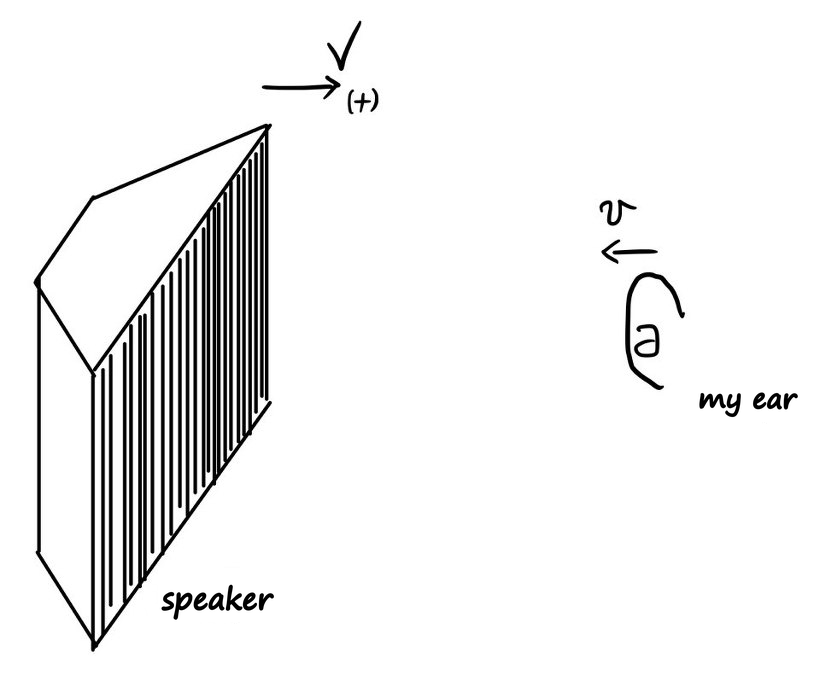
If we take the direction in which the Source and Object approach each other as (+) for their velocities, the frequency of the sound source (Source)  (nu-zero) and the frequency heard by my ear (Object)
  have the relationship!!
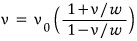
(Here w is the speed of sound, and the speaker and my ear each move at speed v through the air. I’ll skip the derivation of the Doppler effect formula we learned in high school.)
If we now try to understand that formula, when moving toward each other it sounds higher-pitched than what the source emits, and when moving apart it sounds lower-pitched~~ We learned this Doppler effect in high school, and if you think back carefully to that time, the effect when my ear moves vs. when the speaker moves must obviously be different (for sound, at least)!!! (ah, of course~)
Now, let’s connect that Doppler effect to the ’time dilation’ we learned earlier!!!
Before that, now, instead of thinking of the speaker moving with respect to my eye, or my eye moving with respect to the speaker, let’s describe the motion with respect to the medium!!! Also, because it’s annoying to keep saying medium medium, let’s think of it as light, which doesn’t need a medium — these guys get by without one! (So for light there’s no medium to measure against: only the motion of the eye and the lamp relative to each other counts.)
So let’s say something shaped like a speaker, like a lamp, is blinking a red light on and off at regular time intervals!
First, let’s look at this case. The eye is as small as a ‘point’, while the speaker, relative to it, is freaking enormous!!!! And say the eye is moving at constant velocity upward!!!! (Surely it has nothing to do with the classical Doppler effect, since it’s not getting any farther away.)
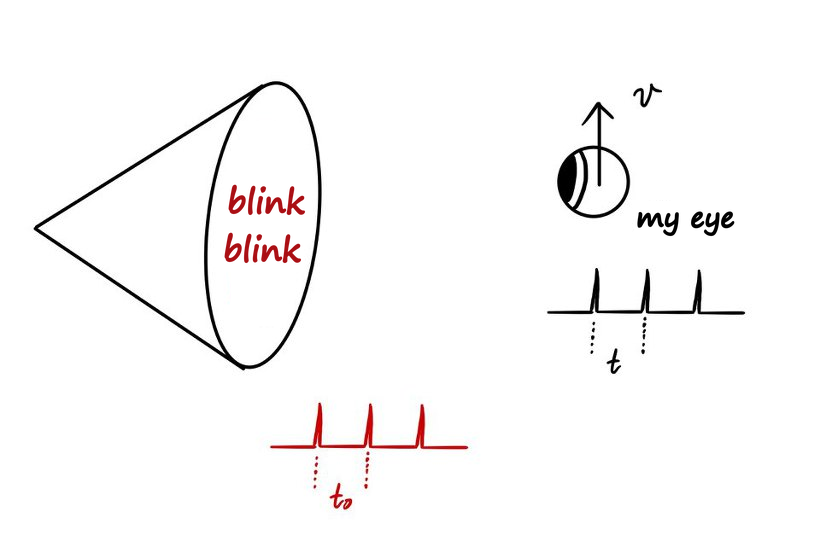
Here the relationship between t and t-zero comes from the time dilation relation we derived earlier. The eye and the lamp move relative to each other at speed v, and in the eye’s own frame it’s the lamp’s clock (its blinking) that runs slow:
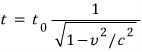
But  — can we call this the frequency?!?!
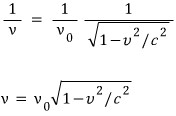
What I want to say here is that even though it’s clearly supposed to be a situation with no (classical) Doppler effect, if you move at a freaking fast speed… you end up being able to feel a difference in frequency!!!
(One subtlety: this is the textbook’s transverse case, where the light meets the eye at a right angle in the eye’s frame. Take the right angle in the lamp’s frame instead, and it’s the eye’s own clock that runs slow, so the eye sees a slightly higher frequency, $\nu_0/\sqrt{1 - v^2/c^2}$. Both are relativity; they just answer different questions.)
Alright, now, when the eyeball moves in the horizontal direction!!!!!
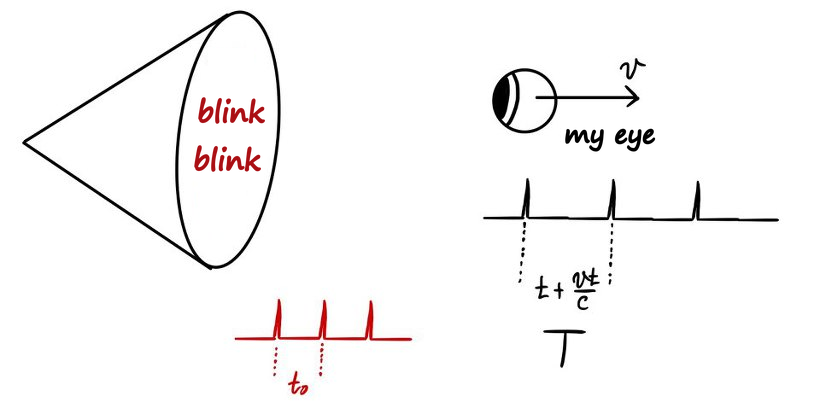
Unlike when it moves vertically, now the velocity v will clearly have an influence too!!!!! (On top of time dilation already happening because of the motion, it’s also moving in the direction where signals are received later…)
How much more delayed will the periodic signal be received compared to the previous situation?!
Since you only receive the signal after going an additional vt…

That is, if we call the period of the signal my eyeball sees T — large T —,

adding this on top,
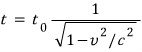
if we add this in too,
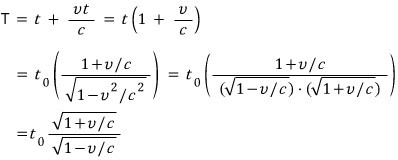
Then shall we head toward ‘frequency’ like before?
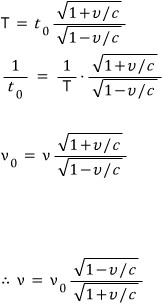
Now let’s try to understand this formula again. I derived this formula taking v to be in the -> direction, this way.
So if we put -v in place of v in this formula, what does it mean~
It means the case where they’re approaching each other….!!!!! When approaching!!!!!!!
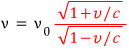
The red part is greater than 1!!!!! If the light the source emits is red light, the frequency my eyeball sees  is saying it’s seen at a higher frequency than nu-zero.
So it could be seen not as red, but as one of the colors of the rainbow (orange-yellow-green-blue-indigo-violet)!!
Comments
Discussion happens via GitHub Discussions. You'll need a GitHub account to comment.