The Rayleigh-Jeans Formula and Blackbody Radiation
Diving into Chapter 2 with blackbody radiation — what a black body even is, how to fake one in a lab, and why standing waves are the secret behind that glowing-sword spectrum!
Chapter 1. Done with relativity, and now it’s Chapter 2. The particle nature of waves, hmm~~ Just looking at the title, I can already tell what this is going to be about! Stuff I learned in high school, like the photoelectric effect or the Compton effect, that’s what we’re gonna do…..
Alright, let’s dive in. So the first thing up is the blackbody radiation experiment?
Then first, let’s figure out what a blackbody is!!!!! In English it’s “black body,” so… a body that’s black????
Well~~ a blackbody is defined like this: “something that absorbs ALLLLLLLLLLLLLL light regardless of type, just sucks it all up”!
(An apple that we see as red looks red because the apple absorbs everything except red and reflects only red light, right? A blackbody absorbs everything and reflects no light, so it would look freaking totally pitch black in the world)
So, that means, a blackbody doesn’t exist on Earth!!!!! haha It’s an ideal substance!@!!! (as if such a thing exists anywhere)
Then can we make something like a blackbody somehow???
We can make one like this:
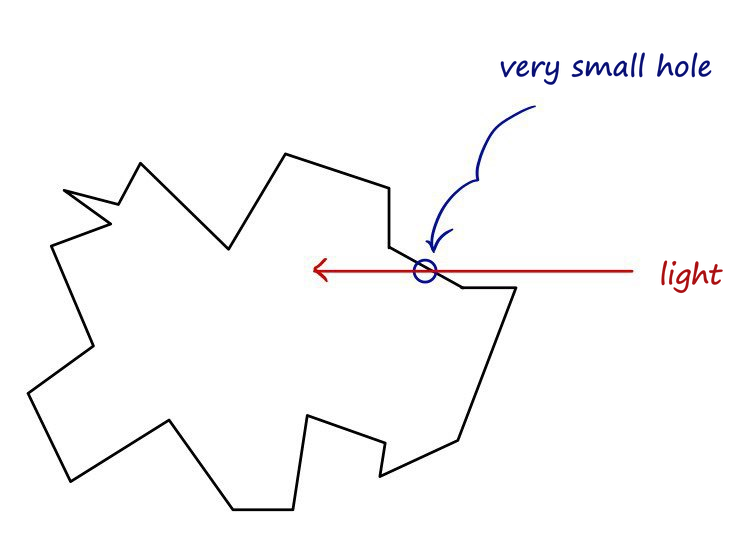
(Light goes in and follows a cleverly designed path so that it can never come back out! haha neat, right)
So then, what is blackbody radiation actually studying~~~
Talking about it along with the picture above,,, what it studied is
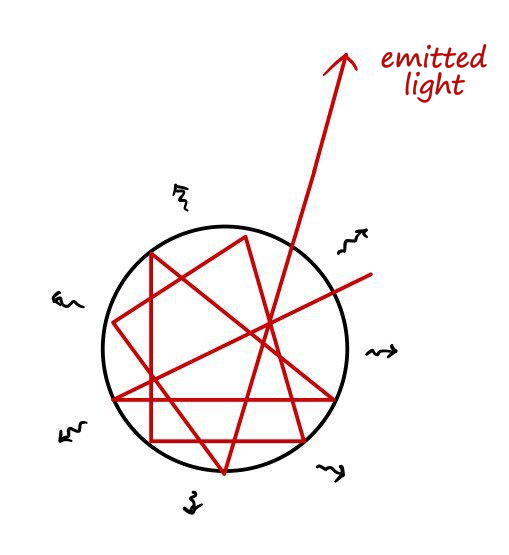
It studied that light right there
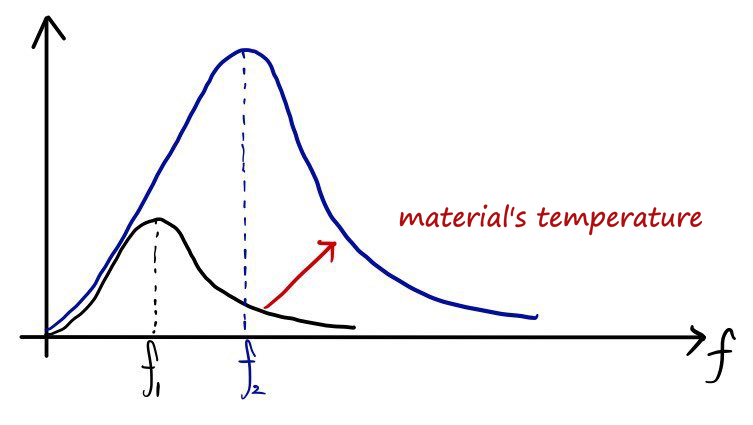
And it turns out to be like this….
But what the graph above shows is something we already know empirically.. Haven’t you at least once been on a field trip to the POSCO steel mill around elementary school? haha (I’ve been there heh heh?heh?heh?heh??^^)
Aaaahhhh no wait, let’s think about a blacksmith making a long sword. When quenching, the sword glows reeeeed, and if you heat it more it turns yelloooow, can’t you kinda picture that?… haha Isn’t that kind of obvious empirically?!?
Okay so if there’s light that’s entered the blackbody, it absorbs that light’s energy and re-emits it as radiation energy, and the light that comes out has a distribution like the one above… (empirically too)
Then for the light energy to be absorbed by the blackbody inside there, the light in there must be a standing wave!!!
(Things that aren’t standing waves either cancel each other out and disappear~ so only waves that satisfy the standing wave condition remain!!!!)
Now, to make the thinking easier, let’s drop a dimension and think 1-dimensionally!!
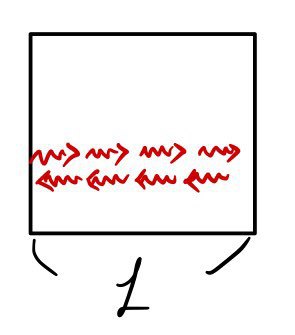
The square thing is the blackbody, and for light inside it to keep~~~ bouncing back and forth, that wave has to be a standing wave~~~ that’s what we talked about above, right!? You learned standing waves in high school so you know, for it to be a standing wave within that $L$, the wavelength of the wave has to be

This kind of condition!?!!!
Alright alright, common sense tells us $\lambda$ for light is freaking tiny, which means, I’m trying to say, $n$ is large. So, for example, the standing wave with  , and then the standing wave with
 ……….
Would those two waves be,,, distinguishable from each other???
They’d basically be the same. $n$ is discrete, but the waves could kinda be seen as continuous…..
Thinking about it that way, inside there, for frequencies between  and
 , how many $n$ satisfy the standing wave condition?!?!!!
I mean, how many standing waves can fit in?! That’s the density of states.
(Hmm~ the number of lights that keep~~~ bouncing back and forth???)
That number is said to be

……haha (I didn’t know in my 2nd year~ why that is~ ugh~ hahaha it’s covered in detail in thermal statistics! See the links below!)
( Density of States and Statistical Mechanics of the Ideal Gas (Thermal & Statistical Mechanics I Studied #36) ) ( Density of States: Another Perspective (Thermal & Statistical Mechanics I Studied #37) )
Rayleigh and James Jeans calculated this hahahahaha so~ ~ ~
(Up there is the number! Number! Because it’s density times volume?!)
Alright, now let’s move on to energy.
If we compute the average energy each individual wave has,

This was learned in high school,

This too is a relation learned in high school!! (If you haven’t learned it, it’s easily derived here. Equipartition Theorem (Thermal & Statistical Mechanics I Studied #31))
But since we lowered our dimension to 1D,

$k$ is the Boltzmann constant….. hahaha This is the energy corresponding to ‘degree of freedom 1,’ but standing waves have 2 degrees of freedom (an oscillator has a kinetic part and a potential part), so the average energy of one standing wave is

Hmm, (number of standing waves × average energy per standing wave)

This is called the energy density, and it’s called the Rayleigh-Jeans formula….
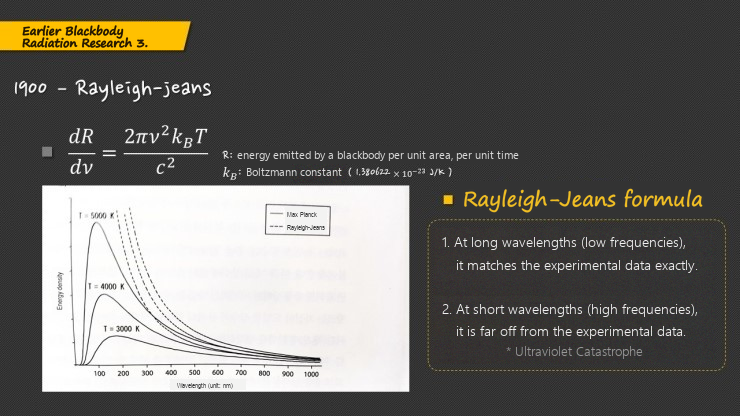
But this equation didn’t exactly match reality……. It roughly matched the blackbody radiation at each temperature in the low-frequency (long-wavelength) region, but apparently couldn’t cover anything beyond that, out past ultraviolet,,,,,,
(That’s why the equation ends up diverging from ultraviolet onward, and that’s why that area is called the ultraviolet catastrophe…)
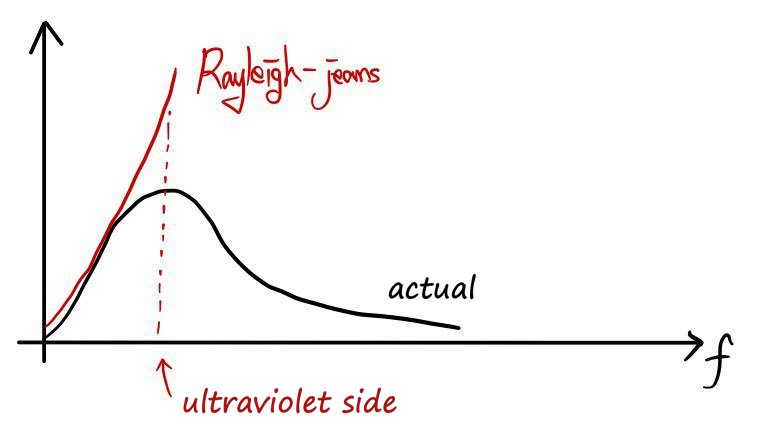
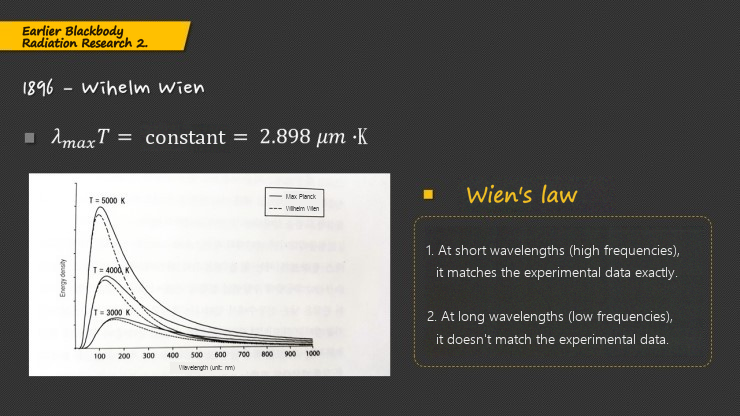
(On the other side of the actual line (the high-frequency part), Mr. Wilhelm Wien made an approximation, right? It’s not mentioned here)
<reference>
(More details at Planck’s Constant and the Photoelectric Effect (Quantum Mechanics I Studied #43)!!!)
From here on, we hit a roadblock…………..
The low-frequency part is approximated approximately by Sir Rayleigh-Jeans’ approximation, and the high-frequency part is approximated approximately by Mr. Wilhelm Wien’s approximation, but they couldn’t make anything that could swallow up both sides at all T_T
And people waited for the arrival of Mr. Max Planck in 1900…… lol That man arrived and said this…heh heh
“The energy density, you see. "

it’s not this, you see.

It’s this.
($h$ : Planck’s constant $= 6.626 \times 10^{-34}\ \mathrm{J \cdot s}$)
The multiplying term should be changed from $kT$, to this!!!
When you do it with this equation, it exactly matches that actual graph of course, and in the low-frequency part, way before the ultraviolet catastrophe happens, it even reduces to the Rayleigh-Jeans formula!!!
Mr. Max Planck, instead of $kT$,

he stuck this term on, which means he replaced the average energy that 1 standing wave has like that, right??
So Mr. Max Planck is saying that the average energy of 1 standing wave is
this, which means~~~
Actually, the meaning that this carries is exactly the idea that threw the door of ‘quantum mechanics’ wide open!!!
(He did do quantization)
We’ll learn about it in detail later, but the meaning is  , in the sense that “the oscillators of the cavity wall, instead of having continuous energy
 , have only specific energies of !!!” That’s the meaning…..
cf.) Originally, Mr. Planck was a damn conservative person, so, he was apparently someone who damn hated stuff like ‘challenges?’, ‘adventures?’ ‘smashing existing theory?’!!!!! (so he kinda didn’t work that hard??)
But, because of the atomists who kept trying to smash existing theory, he threw himself into blackbody radiation research to shut them up lol But the more he researched, the more he kept arriving at the atomists’ ultimate conclusion….. and at some point…… he stood at the head of the atomists lolol
Anyway, at least during that time he was one of the damn hardest-working people,,,,,, He himself directly said “the hardest-working time of my life…”..haha [- ‘Quantum Story,’ Jim Baggott - ]
Heads-up. The figures here are the original notes, slips and all. A few things to watch for:
- In the picture right after we drop to one dimension, $\frac{3}{2}kT = \frac{3}{2}m\overline{v_x^2}$ is still the three-dimensional total ($\frac{1}{2}m\overline{v^2} = \frac{3}{2}kT$). The energy for one degree of freedom, the one the next step uses, is $\frac{1}{2}kT = \frac{1}{2}m\overline{v_x^2}$.
- On the slide about Wien, the constant is $2.898\ \mathrm{mm\cdot K}$ ($= 2898\ \mu\mathrm{m\cdot K}$), not $2.898\ \mu\mathrm{m\cdot K}$. With it, the $5000\ \mathrm{K}$ curve peaks near $580\ \mathrm{nm}$; the curves in that textbook figure are only schematic.
Comments
Discussion happens via GitHub Discussions. You'll need a GitHub account to comment.