The Compton Effect
Compton's wild experiment pits X-ray photons head-on against electrons and uses conservation of momentum & energy to prove light really does act like a particle.
The photoelectric effect we did earlier was the first to say that light, an electromagnetic wave, ‘has particle properties!’ And building on that, we moved on to X-rays, a light with a bit more energy, and on top of that, quantization…. Well, we’ve been talking about the particle nature of waves like this.
Ah shit, so these electromagnetic-wave guys…. are particles???
Hey then, let’s actually pit them 1:1 against real particles in a collision!!! That’s what Compton’s experiment was.
We decided to collide the ‘photon’ — something whose identity we can’t quite pin down… but it does exist — with an ’electron’.
Hmm~~~ now, the energy of visible light is about 2 eV, right???
But the electron’s rest-mass energy is about 511 keV, so visible light doesn’t even stand a chance. It’s probably going to be like colliding a fly with an elephant, so: ‘Hey!!! Visible light, no way!!!! X-ray, deploy!!! You go smash into it!!!!’
The energy of X-rays, as we saw earlier, is in the tens of keV, sooo~~~ it seems like it’ll be about the level of a motorcycle and a car, or a Matiz (tiny car) and a Starex (big van), crashing into each other!!!~~~ heh heh heh heh let’s go
Alright then, let’s have X-ray and electron go at it one-on-one, with the idea of holding the electron still and firing the X-ray!!! Let’s have them duke it out.
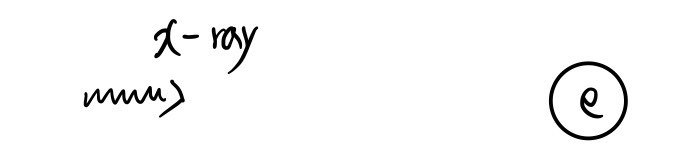
Alright then, from the side we’ll watch the conservation of energy & momentum~~~~
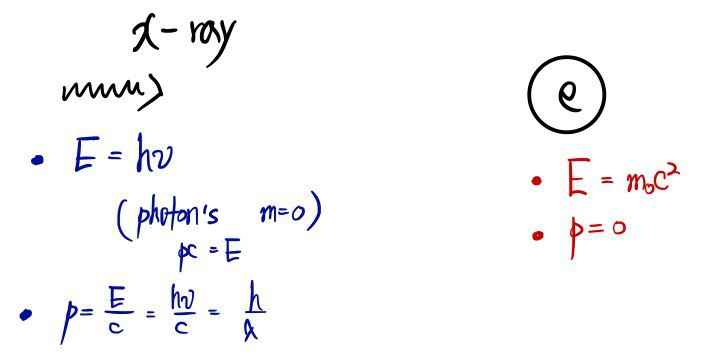
And after the collision
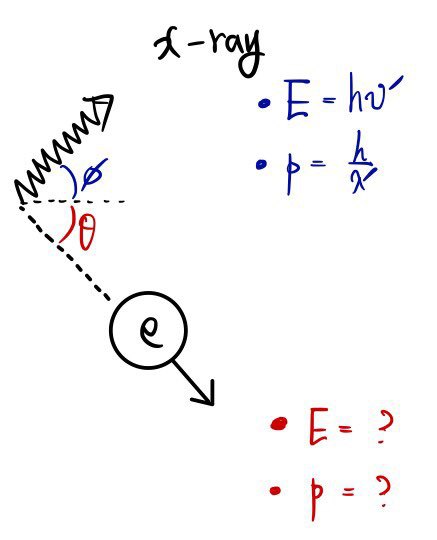
it’ll end up like this. The frequency of the X-ray will change, and because of that its momentum will change too, and the energy and momentum that the electron gains we don’t know~~~ With before and after lined up like this, conservation laws, let’s gogogogo!!
Momentum conservation
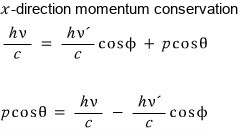
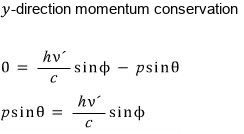
Combine the two equations, gogogogo!
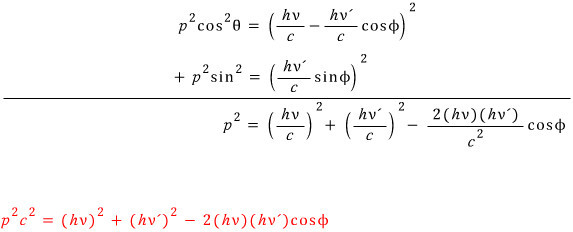
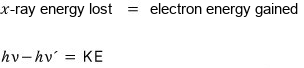
Energy conservation
Here, let’s take a look at the relativistic kinetic energy~~~
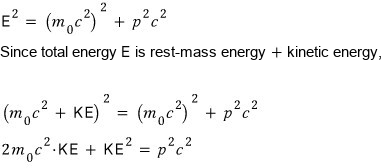
Here the amount of kinetic energy is, like we just said, exactly the energy lost by the X-ray~~~

As a result, if we combine the equation obtained from the conservation of momentum and the two equations derived from the conservation of energy,
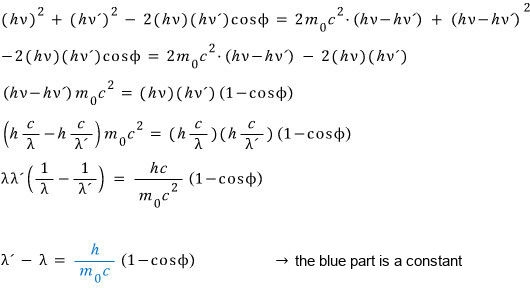
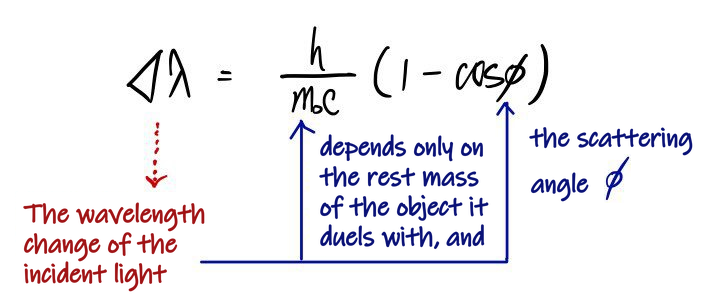
The case where $\Delta\lambda$ is largest is when $\cos\phi$ is $-1$, i.e. 180 degrees!!! That means the case where it rams straight in and bounces right back out. Also, it’s interesting that the blue part is a constant.
Ahhh, and that also means the larger the rest mass of the object it’s duking it out with, the smaller the change in $\lambda$!!!
Comments
Discussion happens via GitHub Discussions. You'll need a GitHub account to comment.