Why Study Money and Banking?
Casually skimmed then carefully re-read Ch. 1–2 of money & banking — vocab check on stocks, bonds, debt instruments, and short-term money market tools!
- Chapter 1. Why do we study money and finance?
- Chapter 2. The financial system
If this had been my major, I would have (out of habit?) lightly skipped over this part and moved on…… But this spaced-out double-major student… tiptoed through it lightly once, and then realized there were a lot of words I didn’t know…
So I did a careful read-through for vocab review~ Lightly~~~ Check the words I didn’t know! And the ones I think I know but need to know for sure — check!!!
Basic(?) vocabulary… heh
Security: a claim on future income.
Stock: a claim agreeing to participate in a firm’s “net income” and asset distribution. e.g.) If you hold 1 share of a firm that has issued 1 million shares, you can claim 1/1,000,000.
cf.) Characteristics of stocks: Stocks pay their holders periodically (dividends). Since there is no maturity, they are classified as “long-term securities.” Owning a stock = owning part of the firm, so you have voting rights in the firm.
cf.) Downsides of stocks: Stockholders are “residual claimants,” and there is something called the “principle of creditor priority,” but in return there is at least the possibility that the dividend might be large :)
Foreign exchange rate: the price of the home currency (in terms of foreign currency).
Fiscal policy —

Through finance, both the person borrowing money and the person lending money benefit, which promotes economic efficiency. That’s why financial markets are essential.
Debt instruments (bonds or mortgages): a contractual agreement by the debtor (the humanoid who borrowed money) to pay the ‘debt instrument holder’ periodic fixed amounts (interest and principal) until a specific period (maturity) at which the final payment occurs.
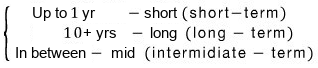
cf.) maturity —–
Equity issuance ·······(things like stocks)
Financial instruments of the short-term money market
1. US Treasury bill: The most liquid of short-term money market instruments. The safest (because the probability of default is nearly zero).
2. (Bank) Certificate of Deposit (CD): An instrument that pays a set interest and is redeemed at the purchase price at maturity. It’s sold by the bank to the depositor, and it serves as an important means by which the bank raises funds from firms, MMFs, charitable institutions, and government agencies.
3. CP (Commercial Paper): A financial instrument issued by well-known firms or large banks.
4. RP (Repurchase Agreement, repo): Generally a short-term loan with a maturity of 2 weeks or less (in effect). But! Treasury bills are provided as collateral.
cf.) Equivalent to MS lending the bank 1 million dollars in exchange for holding 1 million dollars of Treasury bills, and then when the bank repays the loan, returning the Treasury bills.
5. Federal Fund: Banks lending to other banks (1-day interbank loans via reserve deposits). The reason for doing this is that they have to maintain the legally required reserve ratio, and they do this when they’re short.
Financial instruments of the capital market
Basically, prices fluctuate more than short-term money market instruments, and risk is higher.
1. Stock: A claim on the firm’s net income and assets.
2. Mortgage: A loan for a household or firm to purchase “housing, investments, or other real assets.”
3. Corporate bond: A typical corporate bond pays the holder interest twice a year and redeems the ‘face value’ at maturity. A convertible bond is a bond that grants the holder the right to convert into a set number of shares at any time before maturity.
4. Government securities: Issued by the Treasury to cover fiscal deficits, the most liquid among bonds, usually held by the Fed, banks, households, foreigners, etc.
5. Government agency bonds: Some carry a full federal guarantee (the mortgage-backed securities Ginnie Mae guarantees, for example), while bonds of government-sponsored enterprises like Fannie Mae and Freddie Mac rely on their own credit… so they trade close to government bonds, but not quite like them.
6. Municipal bond: Issued to finance schools, roads, and other large-scale projects. Characteristics: exempt from federal interest income tax, also exempt from state taxes, so banks with high interest income taxes are the main buyers, and the super-rich buy ’em a lot too.
Financial intermediaries
1. Depository institution:  bank. A financial intermediary that receives deposits from individuals and institutions and makes loans.
(1) Commercial bank: Mainly raises funds by issuing demand deposits, savings deposits, and time deposits.
(2) Savings and loan association (S&L) & mutual savings bank: Mainly acquires funds through savings deposits (shares), time deposits, and checkable deposits.
(3) Credit union: A small-scale cooperative-type lending institution organized around a specific group such as members or employees of a specific firm. After acquiring funds through deposits called shares, it mainly makes consumer loans.
Demand deposit: a deposit that allows checks to be written. Savings deposit: can be withdrawn, but checks cannot be written. Time deposit: a deposit with a fixed maturity.
2. Contractual savings institution: A financial intermediary that acquires funds periodically based on a contract. Since they can accurately predict how much benefit they’ll have to pay in the future, they don’t need to worry about funds being withdrawn now, so they tend to invest in long-term securities.
(1) Life insurance company: Acquires funds through premiums from people and mainly purchases corporate bonds and mortgages.
(2) Fire and casualty insurance company: Since a large disaster would cause large losses of funds, they spend money purchasing highly liquid assets.
(3) Pension fund & government retirement fund
3. Investment intermediary
(1) Finance company: Raises funds by selling CP (commercial paper) and issuing stocks and bonds. Some finance companies are organized by a parent firm that wants to promote the sale of its own products.
(2) Mutual fund: Sells shares to many individuals. Allows them to hold a well-diversified portfolio. (Since the value of the portfolio fluctuates greatly, the value of the shares also fluctuates greatly.)
(3) MMF (money market mutual fund): Selling shares is the same as a mutual fund!!! The difference is that checks can be written! ( ∴ In effect, MMFs function the same as interest-paying demand deposits.)
Investment bank: Unlike the name, these guys don’t take deposits and don’t make loans either. They are “another form” of intermediary that helps firms issue securities… that is, they underwrite the securities issued by firms. And then they sell them again in the market to help firms sell their securities!!!
Or they give advisory services (advice on which to issue — bonds? equity? — for firms with decision-making paralysis). Or they’re negotiation specialists. Or they play the role of M&A specialist helpers, earning huge fees to make their living….;;haha whoa
Still more vocabulary… heh
Foreign bond: Sold abroad, denominated in that foreign currency!!! Then came the Eurobond: a bond ‘denominated in a currency other than’ the currency of the country where it is sold.
A variant of the Eurobond, Eurocurrency: foreign currency deposited in banks outside its home country. The most important of the Eurocurrencies is the Eurodollar: US dollars deposited in banks outside the US or in foreign branches of US banks.
The word Euro is a unit of European money, so it might be confusing, but don’t get confused!!! haha
Adverse selection: The problem that arises when, due to asymmetric information before the transaction — that is, due to insufficient information — an undesirable choice is made.
Economy of scope: The fact that information resources can be applied to various services to lower the cost of producing information.
From the next posting, I’m gonna dive straight into Chapter 15. The money supply process! See you in the next posting
Comments
Discussion happens via GitHub Discussions. You'll need a GitHub account to comment.