The Money Supply Process
A casual rundown of Chapter 15 — breaking down the Fed's balance sheet, monetary base, reserves, and how open market operations move the money supply!!!
Since the course is called Money and Banking, I think we go straight through~~ from Chapter 15 for a whole semester!!! I just followed along with the school’s syllabus, so I’m posting in that order, lol, and I want to read through it again later~~ heh. Alright then, heading in to Chapter 15.
First off, who are the characters in money supply?

So let’s understand money supply by looking at the Fed’s balance sheet! They say we only need to look at 4 items that are important in understanding the money supply process:
| Assets | Liabilities |
|---|---|
| Securities Loans to financial institutions |
Currency in circulation Reserves |
Red guys: the sum of securities + loans of these guys changes the monetary base, and thereby changes the money supply. Blue guys: an increase in these guys means an increase in the money supply.
Currency in circulation + reserves = monetary liabilities, and the sum of these is called the “Monetary Base”! It’s a concept that keeps coming up.
Then let’s look at the blue guys first: the Fed’s liabilities!
Liabilities: financial obligations owed to a third party.
Currency in circulation: the amount of money held by the private sector, and the Fed issues this money (Federal Reserve notes)! Money held by deposit-taking institutions (banks) is an ‘asset’, but to the Fed, money is a liability: “Federal Reserve notes” are the Fed’s debt certificates to the holder, and therefore, a liability.
Reserves: an increase in reserves increases deposits, and accordingly the money supply increases.
Red guys! The Fed’s assets change reserves, which changes the monetary base. So the money supply changes.
Securities: US Treasury securities & other securities held by the Fed. The first way the Fed supplies bank reserves is by buying bank securities.
Loans to financial institutions: the second way the Fed supplies bank reserves is by making loans! (borrowed reserves)
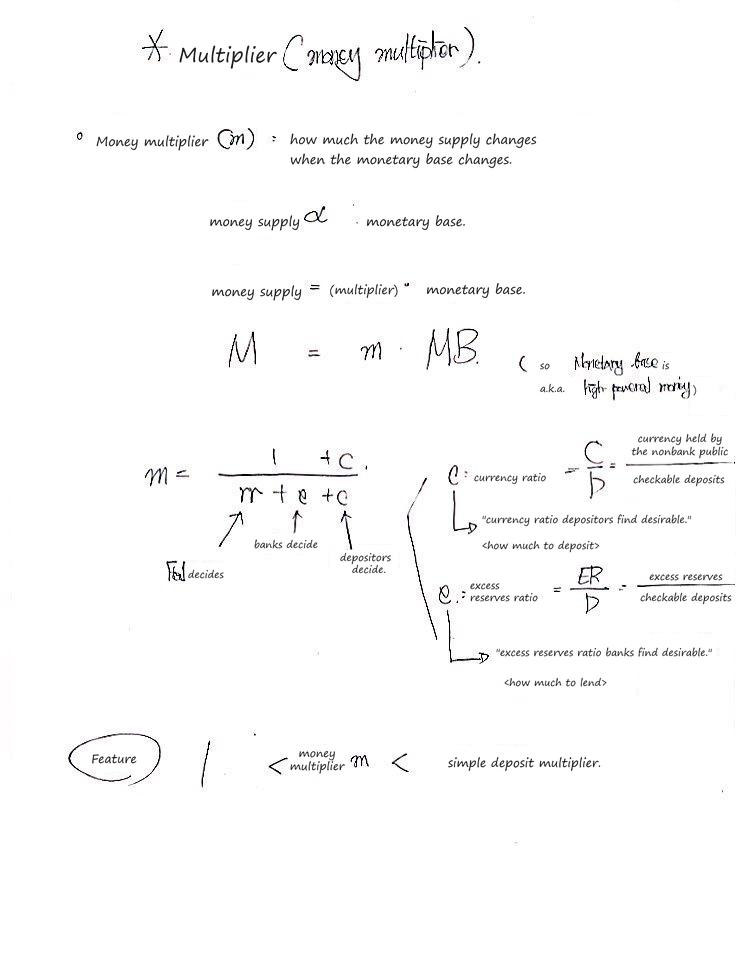
(Important) star star star: Monetary Base (also called high powered money)
C + R = {Federal Reserve notes + US Treasury money} + {Total reserves}
cf.) The US Treasury issues coins rather than bills, but because this amount is so small compared to the bills, they say we won’t worry about it going forward.
Open market operation: the Fed’s primary method of changing the monetary base — open market purchase or open market sale. I’ll handle it case by case and then draw a conclusion afterwards.
Let’s say the Fed purchases $100 million of bonds from a bank and pays by check.
| Institution | Assets | Liabilities |
|---|---|---|
| Bank | Securities -$100M Reserves +$100M |
|
| Fed | Securities +$100M | Reserves +$100M |
On the Bank’s assets side, the bank sells the securities and receives the money. At the Fed, the purchased securities came to the assets side, and on the liabilities side, reserves go up (+) by the amount paid, since the money has to be given back later! To the Fed, that’s a liability.
Let’s say the Fed purchases a bond from an individual (institution), and the individual (institution) who sold it deposits the Fed’s check at a bank. And let’s say the bank in turn deposits it at the Fed.
| Institution | Assets | Liabilities |
|---|---|---|
| Individual | Securities -$100M Deposits +$100M |
|
| Bank | Reserves +$100M | Deposits +$100M |
| Fed | Securities +$100M | Reserves +$100M |
On the Individual’s assets side, the bond is sold and that amount went into the bank account. On the Bank’s assets side, reserves go up since the money went into the bank account, but on its liabilities side, deposits go up too — and that’s a liability! A ‘financial obligation’. At the Fed, that bond went to the assets side, and the money to be paid someday increases on the liabilities side.
Then what if the seller who sold the bond to the Fed doesn’t go through a bank at all and just cashes the Fed’s check?
| Institution | Assets | Liabilities |
|---|---|---|
| Individual | Securities -$100M Currency in circulation +$100M |
|
| Fed | Securities +$100M | Currency in circulation +$100M |
On the Individual’s assets side, they sold the bond and receive the money directly! At the Fed, it took that bond on the assets side, and on the liabilities side, currency in circulation goes up like this on the T-account.
Implication: whether it becomes a deposit or not changes the amount of ‘reserves’, but the amount of the monetary base is the same!
Let’s just see what happens to the monetary base when ‘withdrawing money’.
| Institution | Assets | Liabilities |
|---|---|---|
| Individual | Deposits -$100M Currency in circulation +$100M |
|
| Bank | Reserves -$100M | Deposits -$100M |
| Fed | Reserves -$100M Currency in circulation +$100M |
On the Individual’s assets side, the account balance falls by that amount and they got cash! On the Bank’s assets side, reserves go down as money leaves the bank’s vault.., and on its liabilities side, the financial obligation also goes minus ~. At the Fed, reserves on the liabilities side (the money to be paid later ~) go down, while currency in circulation goes up: money gets sprinkled into the world.
Implication: reserves change, whereas the monetary base stays constant. [The variable ‘monetary base’ can be considered a more stable variable.]
What if the Fed extends a $100M loan to a financial institution?
| Institution | Assets | Liabilities |
|---|---|---|
| Bank | Reserves +$100M | Loans +$100M |
| Fed | Loans +$100M | Reserves +$100M |
Now when this bank pays it back!
| Institution | Assets | Liabilities |
|---|---|---|
| Bank | Reserves -$100M | Loans -$100M |
| Fed | Loans -$100M | Reserves -$100M |
(I don’t think I need to write an explanation. I’ve got the hang of it now >0<)
Conclusion: the Fed’s loans to financial institutions have a 1:1 relationship with changes in the monetary base! heh
Other variables that cause changes in the amount of the monetary base:
- float: temporary changes in total reserves arising in the check clearing process
- Treasury deposit at the Fed
- Intervention in the foreign exchange market (we’ll learn why later^^)
Cf.) float and the Treasury deposit at the Fed complicate control of the monetary base in the short run, but they don’t prevent the Fed from precisely controlling the monetary base!
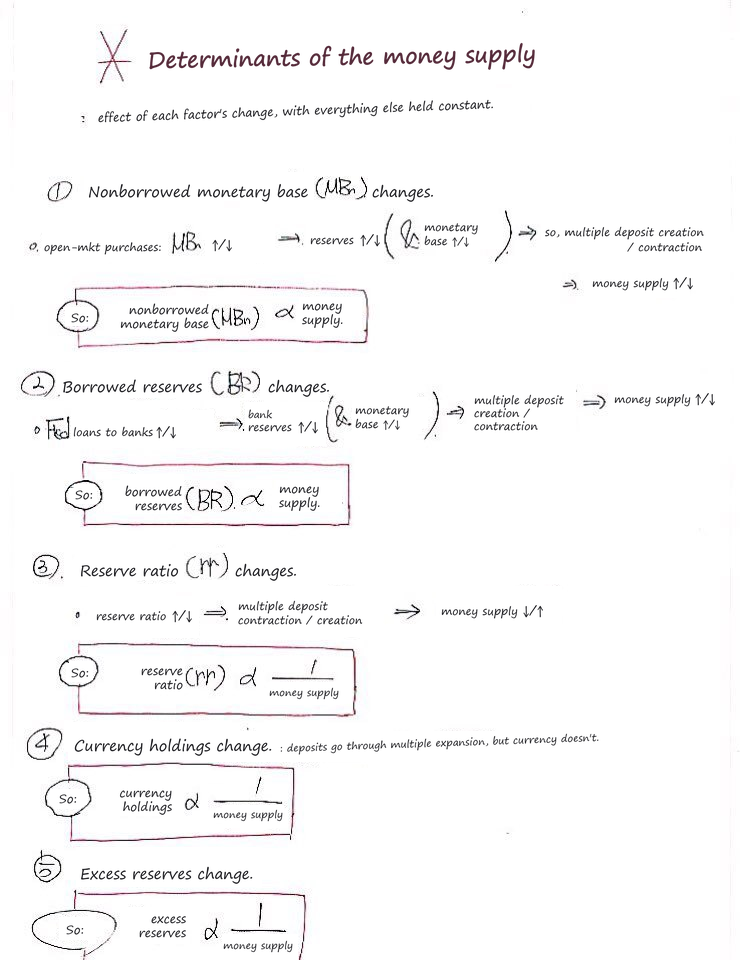
The Fed’s ability to control the monetary base: earlier the methods of controlling the monetary base were open market operations (open market purchases, open market sales) and loans to financial institutions.
Open market operations can definitely control changes in the monetary base (since the choice is with the Fed).
For loans to financial institutions, since it’s not the Fed but the financial institution that decides whether to take out a loan, it’s hard to say they can control it for sure. The Fed merely adjusts the ‘discount rate’ (interest)!
That is, the monetary base can be split into two types: the monetary base that is controlled for sure, and the monetary base that isn’t completely controlled. Let’s give these two different names!



All three mean the same thing, heh.
Comments
Discussion happens via GitHub Discussions. You'll need a GitHub account to comment.