Conducting Monetary Policy: Strategy and Tactics
A breezy rundown of how central banks juggle inflation targeting, the time-inconsistency problem, and a whole laundry list of goals beyond just price stability!
This chapter is literally about strategy and tactics… heh
Those various tools we learned about before need to be used correctly so they apply well~ to society, right???
Okay, so first — what does applying them well~~ even mean? Let’s find out!!!!
Applying them well~~ covers several things.
Price stability, inflation rate stability, production up, unemployment down…. etc.
Achieving those kinds of things is what’s good for people,
and one of the strategies for making things good for people
is something called Inflation Targeting….. hmm.. seems important?????
So first, let’s set “what is inflation targeting” as our first destination,
and then “learn something else” as the next destination!! Alright, departuuure
Before starting, to state the conclusion up front — most countries’ central banks set “price stability” as their most important goal.
They think that if this gets tangled up, nothing else can be kept under control!
Well, everyone probably knows how bad inflation is for us… anyway!! That’s how central banks think, apparently
So. because of that, they think stabilizing the nominal anchor is that important for reining in inflation,
and keeping nominal variables within a narrow range triggers low inflation expectations in people, which promotes price stability,
and! another reason nominal variable stability is important is that it also limits the time-inconsistency problem.
Huh? What’s the time-inconsistency problem?????
Simply put, it could be called the gap (?) between short-term perspective and long-term perspective.
“If we sprinkle money now, we can boost production up and bring unemployment down in the short term~~~”
“But how do we stop the inflation storm that’ll hit laaater~”
“If we don’t sprinkle money now, the inflation storm won’t hit later… but how do we deal with this pain we have right now T_T”
Well, this kind of worry? This is what the time-inconsistency problem is;; hehehe
Anyway, the most important goal is indeed price stability!
But then again, that doesn’t mean
“Hey~~~ we just need to catch this one~~~~ you guys handle the rest~~~~~~~”
“We’ve got this one, so everything else will go smoothly~~~ don’t worry~~~~^^”
They’re a central bank, they’ve got “face” to keep — they’d absolutely never do this
(I used the word “face” and I think I used it quite aptly lolol the reason comes up later~~ keep going)
Central banks don’t just look at price stability~~~
Next after price stability, there are 5 things monetary policy managers worry about:
-
High employment level & production stability
-
Economic growth
-
Financial market stability
-
Interest rate stability
-
Foreign exchange market stability
That’s a hell of a lot… could this be… overreaching???
Let’s see whether these are things they really need to worry about or not~
- High employment level and production stability.
Hmm… why is a high employment level important? The production output in a state that isn’t high employment isn’t at maximum super-power energy.
If you tweak it a bit more you can raise it up…, so these folks want to use monetary policy to solve unemployment and head toward a higher production level.
Then what on earth is the definition of a low unemployment rate???? Does it mean 0% unemployment?!
As everyone probably knows, 0% unemployment is an impossible number in the real world;; hehe
That’s because of frictional unemployment and structural unemployment,
<It’s not a difficult concept.. so I’ll skip the supplementary explanation and just the old platform-search it gogogo hehe>
(Just my personal thought, those kinds of unemployment seem to resemble natural phenomena like evaporation rate = absorption rate, or ejection rate = inflow rate, or thermodynamic equilibrium.. things like this lolol the interesting part is that people also behave like molecules or atoms lol)
Anyway, the natural rate of unemployment is usually around 4%~6%.
And it’s right at that point!! the output produced at that time is called the natural rate of output or potential output????
This is one of the monetary authorities’ managers’ goals!
- Economic growth
No need to even say it… so I’ll skip past.
- Financial market stability
The ultimate function of a financial market is to raise economic welfare by transferring money from people with surplus money to people lacking money…
If the financial market is unstable, economic welfare takes a hit right off the bat, so that’s not good.
So this is also said to be one goal.
Actually, originally ‘financial market stability’ was being neglected and then the 08 Financial Crisis screwed them over,
so this time they learned the lesson and are emphasizing its importance
- Interest rate stability
Fundamentally, if interest rates bounce up and down it just feels bad lolololol the ripple effects when our country cut the base rate this time were no small matter, right??
If interest rates aren’t stable (stable, not safety), it causes economic uncertainty, which can make it so we humans or companies can’t make plans even if we try.
And another reason interest rate stability is important is that rates need to be somewhat stable for the financial market to be stable!
(For example, a large rise in interest rates can cause massive losses in long-term bonds or mortgages… lol)
So it’s important!
- Foreign exchange market stability
Our era is the global era!!!! As we enter the global era, ‘foreign exchange market stability’ is being emphasized more and more lolololol, or rather, isn’t it just obvious?
This also needs to be somewhat stable for people to plan things like overseas expansion or import/export, right???
So among all these many important things, why must “price stability” be #1?????
Price stability also conflicts with other things in the long run, and some of those listed ones conflict heavily with each other.
For example, if you think about the Phillips curve, unemployment and inflation rate,,, the tradeoff is enormous.
But price stability doesn’t conflict with everything.
And as I said earlier, they believe this needs to be solved first before anything else can get solved
But! The key point is that there are countries that think this way, and countries that don’t think this way.
** Hierarchical mandates & Dual mandate **
Many countries put ‘price stability’ first and then pursue the next goal after that — this hierarchical mandates approach, many countries do that,
and there are also countries that argue for a dual mandate, going “No!!!! Price stability & maximum employment!!! These are equally important!! We catch both at the same time!!!”
(Something about going off the rails feels just like North Korea? Or there’s also a whiff of thinking-they’re-the-biggest-shot England, but surprisingly the country is the US lololol)
- There’s a monetary policy strategy called “Inflation Targeting”, which is one of the strategies of countries that think ‘price stability’ is most important,
This strategy was first done by New Zealand in the 90s, followed by Canada, the UK, and our country is also using this strategy.
Inflation Targeting
step 1. Announce the medium-term (intermediate) inflation target as a number to the private sector, saying “Our~ goal is~ price stability!!!!”
step 2. Integrate and use not just the money supply but a freaking lot of information.
step 3. The monetary authorities communicate the hell out of it with the private sector and markets regarding their plans and objectives, and ‘show off’ (must show off) policy transparency.
The advantage of this inflation targeting strategy is that because they made such a bold declaration and also communicate, the chance of falling into the time-inconsistency problem is low!!!!
(Higher likelihood of consistent action, or of carrying out what they said)
Also, through such actions, “the central bank’s accountability” grows, which makes them try to keep face, see.
Well anyway, in countries that tried it the results were said to be good,
but there are said to be a few points of controversy!
Controversy 1. “Inflation inherently has a time lag, so you have to wait longer to know.”
Controversy 2. “Acting discretionarily based on the situation might have been better — it could make things too rigid.”
Controversy 3. “Focusing too much on inflation can cause large production fluctuations.”
Now let’s look at The only one country introduced in the book that didn’t use the inflation targeting strategy.
What strategy are these American bastards using that makes me have more stuff to study…T_T let me at least hear it out,,
The US, unlike the countries we’ve seen so far, “has no nominal anchor that acts like a target”
They don’t proclaim an explicit strategy, and they don’t particularly say what their goal is…
But! They do have a consistent policy strategy!!! ☞ and what it is
The FRB’s strategy isn’t explicit, but there is an implicit nominal anchor,
and also they have a forward-looking characteristic of closely monitoring signs of future inflation while frequently using “preemptive strike” monetary policy in response to inflation risks.
The US’s thinking is this — the time lag of monetary policy is like F (force) and m (mass),
m (mass) differs by country, so we’ll match our timing to that inertia and strike (F, force)!!!!
Expectations and anticipations about inflation are already reflected in wage-price setting, and this process can create an unstoppable acceleration (F=ma),
“So we strike before that acceleration kicks in!!!!”
Even though this FRB approach pursues inflation stability, it’s often described as a “just-do-it strategy”
Because it has the big differences of “no nominal anchor” and “lack of transparency”!!
Advantages of the just-do-it strategy
Despite the different name, it has very similar aspects to inflation targeting.
First, ‘it utilizes a lot of information’, and these guys have forward-looking thinking, which resolves the time-inconsistency problem for them!!
This strategy still functioned very excellently up until 07,,,,,it did get smashed to pieces in 07 though…
Disadvantages of the just-do-it strategy
Disadvantage 1. No transparency. Only the monetary authorities know why they’re using a given policy.
So it can lower trust (though people will probably still believe since it’s worked so far, right?)
Anyway, the uncertainty it creates brings unnecessary psychological unrest, which can shake other variables.
Disadvantage 2. When results are bad, you can’t hold them accountable.
“Did we ever say what our goal was~~~~~~??? It happens sometimes whyyyyy~~~~~~ " — if they say this you’ve got nothing to say T_T T_T
Disadvantage 3. Such low accountability can, on the other hand, make them fall into the time-inconsistency problem.
Disadvantage 4. Policy can end up depending on whoever the central bank chair is at the time….
Disadvantage 5. The just-do-it strategy isn’t consistent with democracy.
The 4 lessons the Global financial crisis gave us.
(Out of nowhere — we were talking about policy and suddenly what’s this…T_T T_T T_T)
-
We learned that changes in the financial sector have a far greater impact on economic activity than previously recognized. (We’ll be careful going forward.)
-
We learned that zero interest rates are a serious problem. (We’ll be careful going forward.)
-
We learned that the resolution costs that hit after a financial crisis are huge. (We’ll be careful going forward.)
-
We learned that price stability and production stability do not mean financial stability. (We’ll be careful going forward.)
Also, something we should know!
“Interest rates and the money supply cannot be controlled at the same time.”
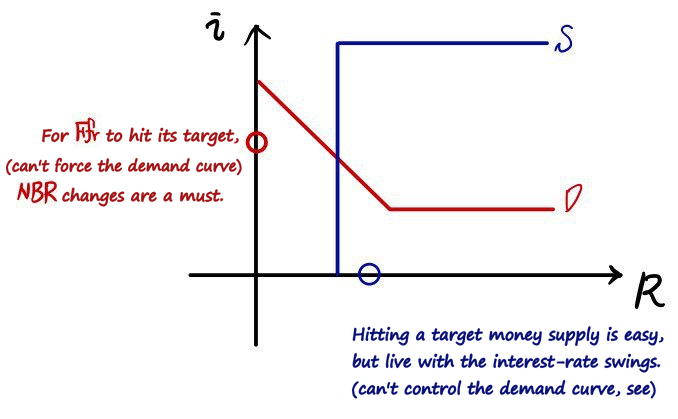
If you look at the graph I think you can easily understand!!!>_
Comments
Discussion happens via GitHub Discussions. You'll need a GitHub account to comment.