Foreign Exchange Markets and Exchange Rates
A casual intro to foreign exchange markets — covering why exchange rates matter, spot vs. forward transactions, OTC trading, and how long/short-term rates are determined.
Alright, before jumping into the main introduction, let me share one case first!
In the 1980s, the competitiveness of American companies was said to be behind that of their foreign counterparts, but in the 90s and 2000s, American companies became more competitive.
So, does that mean Americans were bad at management in the 80s when America was super strong,
and Americans were good at management in the 90s~00s??? Something’s off…!
Yeah, the key to this question lies in the “Exchange rate,”
and I introduced the case from the book above just to emphasize how important the exchange rate is hehe
And there’s another reason why the exchange rate is important — apparently the exchange rate has a super-direct link with domestic inflation rates and output.
That’s why it’s important, and that’s the reason monetary authorities have no choice but to keep a close eye on the exchange rate.
We’ll gradually find out how they’re connected.
What is the exchange rate??????
First, the “exchange” in “exchange rate” literally means “to exchange,”
so~ could we interpret “exchange rate” literally — character by character — as something like “ratio of exchange?”
<Dictionary meaning: the exchange ratio between one’s own country’s money and another country’s money? So it’s this type too,
Back in high school, I took the meaning of the exchange rate as “the price of the dollar.” Let’s not discard this meaning either and keep it tucked away somewhere in our heads as we continue studying!
Generally, foreign exchange transactions come in two types.
The ‘spot transaction’ which is mainly conducted, and the “forward transaction” which many people probably don’t know about.
So there are also 2 kinds of exchange rates,
the ‘spot exchange rate’ applied in spot transactions,
and the ‘forward exchange rate’ applied in forward transactions.
Now, where do people actually trade at these exchange rates?
Well, they’re not traded at the KRX or the New York stock exchange,
probably because foreign exchange is classified as an OTC derivative, so foreign exchange trading takes place in the Over-the-counter market!
(Well, have you heard of FX swaps? I think the Park Geun-hye government also did an FX swap with Japan when they took office?…. Hazy….)
And one more thing — when we talk about doing a foreign exchange transaction, we shouldn’t think of it as the kind of transaction we do at Woori Bank, Hana Bank, or a currency exchange office before going on an overseas trip~~~
We need to know that “buying dollars means buying deposits denominated in dollars.”
Long-term Exchange Rate & Short-term Exchange Rate
The exchange rate, like goods and services, is correctly determined by the interaction of supply and demand! But for the sake of simplicity, we’ll divide it into long-term and short-term exchange rates and take a look!
We’ll start with the long-term exchange rate, and I’ll introduce 2 laws that help us understand it.
- The law of one price
For someone who wants to know “how is the exchange rate determined?”, the first button to fasten is apparently this law of one price.
The. Law. Of. One. Price. ☞ One. Item. One. Price. law
Let me bash it out in writing a bit more,
Suppose Korea and China both make the same ballpoint pen — the Korean-made pen is 1000 KRW in Korea, and the Chinese-made pen is 10 yuan.
If the exchange rate were 100₩/yuan, then the Korean-made pen would be 10 yuan in China, and the Chinese-made pen would be 1000₩ in Korea.
But suppose the exchange rate was 200₩/yuan — then the Chinese-made pen would be 2000₩ in Korea, and the Korean-made pen would be 5 yuan in China.
If it’s the same pen~
If it were me, where would I buy what… If it were me lolol I’d probably also make 1000-won pens and sell them for 2000₩ in China lolololol
But as more people like me start doing this,
the exchange rate gets adjusted so that the two prices become equal… That a given good must have the same price everywhere is the law of one price.
- Theory of purchasing power parity (PPP)
Ah, now let me take it up just one level higher from what we did before.
If the law of one price was about “one good,” here purchasing power parity (not evaluating purchasing power, but purchasing power being equal!) is not about “one good” but ~~ “the price level” it iiiis~
According to purchasing power parity, if Korea’s prices rise by x relative to China’s, then the value of China’s yuan will go up by x.
Say our country’s refrigerator cost 100,000 won, but suddenly Inflation blew into our country and we now have to pay more money to buy it in China,,,, that’s ridiculous..???
Inflation means our money has lost that much power, so we need more currency than before for the same added value, so it’s being explained as the Chinese yuan’s value (which was sitting still) rising relatively.
We can also think of it in terms of the real exchange rate.
Let’s buy our country’s Basket items with our country’s money, and also buy our country’s basket items in China.
Say it was 3 million won in our country, and when we buy those items in China with Chinese money and convert at the exchange rate back into won value, it was 2.5 million won!
Then 300₩/250₩ = 1.2 is the real exchange rate, and being greater than 1 means China’s prices are lower than ours,
and it means the real exchange rate of Korean money is high relative to China.
But PPP theory says this real exchange rate approaches 1.0!!!! It must be the same everywhere!! hehe
However! Purchasing power parity only predicts ‘a tiny bit’ about long-term changes in the exchange rate, and in the short term, the theory’s power gets mercilessly trampled.
(The theory becomes a scrap of paper….heh)
Why??
It’s obvious even without saying — first, it’s obvious that the value of goods differs between two countries, and the idea that goods are the same is a mistake to begin with.
Are all people Yi Bangwon??? Are they going to buy goods going “What does it matter this way, what does it matter that way~~~ (from Yi Bangwon’s famous sijo urging compromise)”???
Even if not 100%, someone would be like “Even if this body dies and dies, dies a hundred times over, could my single-hearted devotion toward Adidas ever fade~” (parody of Jeong Mong-ju’s famous Dansimga counter-poem)
Like this, because of brands, the theory is ju~st slightly distant from reality~~
(If you tell me to give more reasons I could, but I’ll stop here hehe)
Anyway, now we’re at the level of being able to understand the long-term exchange rate, I guess.
So let’s go find out about the long-term exchange rate.
Long-term Exchange Rate
First, 4 factors that affect the long-term exchange rate
<relative price levels, trade barriers, domestic/foreign preferences, productivity>
Assuming other factors are fixed, knowing what effect each factor has!!! seems to be the core of this section.
For example, proportional? Or inversely proportional??
(Rather than saying proportional/inversely proportional, it seems better to say (+) or (-)?) Since it’s not an Equation.
- Relative price level
According to PPP theory, when the price of American goods rises, demand for American goods decreases, and the dollar tends to depreciate so that American goods keep selling well.
Or conversely, when the price of Japanese goods rises, the relative price of American goods falls, demand for American goods increases, and accordingly, the dollar tends to appreciate.
In a word, the long-term exchange rate responds to the relative inflation rate between some countries!
ex.) Our country’s relative price rise depreciates the value of the won, and our country’s relative price fall appreciates the value of the won. (in the long term)
- Trade barriers
Representative barriers like tariffs (“if you want to buy foreign products, pay a litt~le more~^^”) and quotas (‘I’ll only import this much!’) can affect the exchange rate.
How? If the US imposes harsh tariffs and quotas on Korean-made cars,
then demand for American-made cars in the US will increase, which means they’ll sell well anyway even if the exchange rate goes up, right???
So the dollar appreciates~~~
Anyway, the conclusion is that raising trade barriers appreciates that country’s foreign exchange value (in the long term).
- Preference between domestic goods and foreign goods
Um, if Koreans think “American-made! American-made! USA is the best!”, the value of the dollar tends to appreciate.
Even if the dollar’s value goes up, it’ll sell well anyway, so it makes sense that the dollar’s value appreciates, right?!?!
Conversely, if Americans go “Ohhh ~ Samsung~ Guuut!!~”, the won’s value appreciates — that’s what we covered above,
so relatively, the dollar would depreciate, right?????
American products aren’t selling in America, so they have to lower the dollar’s value to sell them outside, I guess T_T T_T
Conclusion: An increase in demand for ‘Korea’s exports’ causes the won’s value to appreciate, and an increase in demand for ‘(foreign goods) imported into Korea’ causes the won’s value to depreciate.
- Productivity
An increase in productivity is said to be linked to a decline in the price of domestically produced tradable goods relative to foreign tradable goods,
um~ so if Korea’s productivity is low, then Korea’s prices become relatively more expensive!
And then Koreans probably won’t buy a lot, right??
So this is the content that the won’s value falls!
Anyway, these 4 were from a long-term perspective, and the basic way of reasoning is — is Korea’s product increasing demand in some country? ~ Or decreasing it?
Or is demand for foreign products in Korea increasing? Or decreasing?!
Oh, so~ is it selling well~ or not selling well~?
Oh oh~? Then the exchange rate will move like thiiiis~~
If you get familiar with this reasoning method, you can derive it when you’ve forgotten,
but the best thing would be to become so used to it that it’s internalized.
Bbasha, fighting!
Short-term Exchange Rate
So far we’ve looked at the long-term exchange rate, and now let’s find out how the daily exchange rate (spot exchange rate) that we’re really curious about on the news is determined!
First, the Key !!! of this Chapter that I introduced at the very beginning.
A bit more concretely: “The exchange rate is the price of domestic assets (deposits, bonds, stocks, etc. denominated in domestic currency) expressed in terms of the price of foreign assets (deposits, bonds, stocks, etc. denominated in foreign currency).”
The exchange rate, once again! The price of domestic assets in foreign currency!
The exchange rate is also determined by a supply curve and a demand curve!!!
Then, as always, let’s understand the supply curve and the demand curve and find the equilibrium exchange rate!
For now, in order to properly understand the content of the book (what the author is trying to say), let’s continue the discussion by taking the home country as ‘America’ and the foreign country as ‘Europe’ like the book does!!
- Supply curve of domestic assets
The amount of dollars supplied is… determined by America.
That is, at any given exchange rate (whatever way the exchange rate is determined), the amount of dollars is unchanged!
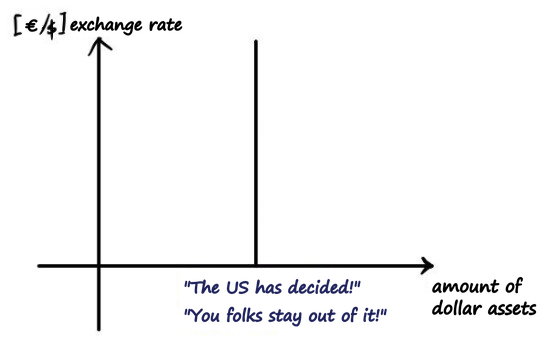
Um, this isn’t hard!!
- Demand curve for domestic assets
We look at the demand for domestic assets.
If the exchange rate falls, foreigners would want to buy, right????
Because it feels within reach, they’ll buy more at 5 euros/$ than at 100 euros/$.
So when the exchange rate falls, demand for assets increases.
That is, the demand curve for assets slopes downward to the right!
Well, as always, let’s slam them both onto one graph!! hehe
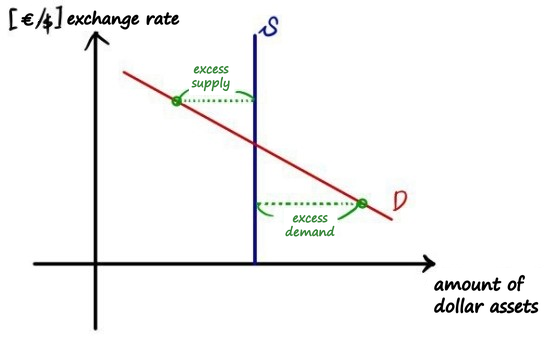
And as always, let’s figure out what factors will cause that graph to shift!
<Assumption: the amount of dollar assets is fixed.>
3 factors that move the demand curve
- Domestic interest rate

change
- Foreign interest rate

change
- Expected future exchange rate

change
- Domestic interest rate
change
Simple!
If our country’s interest rate rises, would foreigners want to buy our country’s assets! Or not want to buy them!?
The answer is obvioous.
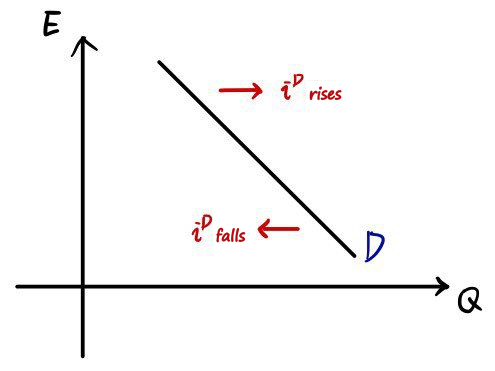
Moving on.
- Foreign interest rate
change
This is also obvious. If their country’s interest rate is rising, would you want to hold our country’s assets!??!
So it’ll react in the opposite direction from a change in the domestic interest rate.
<Without using the term expected rate of return, our brains and hearts already know expected rate of return. I won’t use unnecessarily difficult words.>
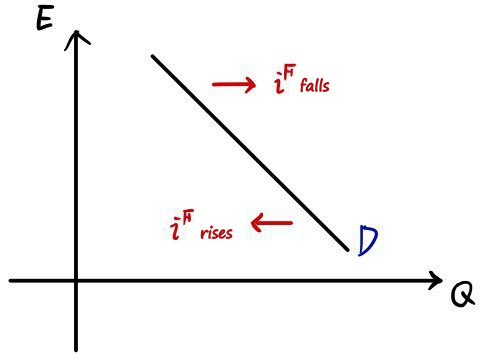
- Expected future exchange rate
change
If people think “I feel like our country’s won value is going to rise!!!”, what would happen???
Even if they get the same interest (= same expected rate of return), the value of that money rises!
That is, the answer is “gotta buy!!!!”
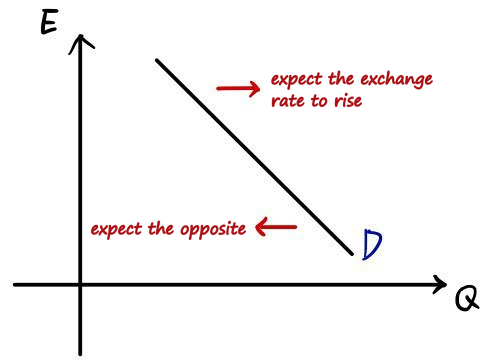
cf. ) Things that make people think the exchange rate will rise.
-
Expectation of a drop in Korea’s relative price level
-
Expectation that Korea will relatively build up more trade barriers.
-
Expectation that Korea’s import demand will decrease
-
Increase in foreign demand for Korean export goods.
-
Expectation that Korea’s productivity will relatively increase.
Comments
Discussion happens via GitHub Discussions. You'll need a GitHub account to comment.