Aggregate Supply and Aggregate Demand
We're throwing AD and AS together on one graph, diving into equilibrium, output gaps, and how the self-correcting mechanism handles demand and supply shocks!!
Alright!!~ Jumpin’ right iiin!!!
We learned AD and AS!~~!~! (aggregate demand - aggregate supply), so let’s lump the two together and draw them, and then we’ll look at Equilibrium!!~
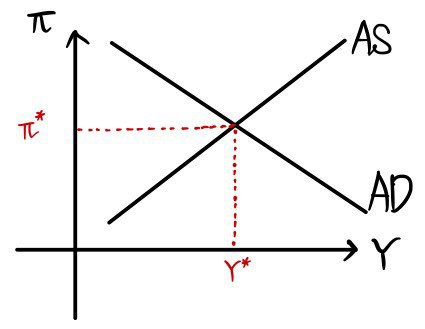
Doooone~~~~~ Here the two curves cross at the short-run equilibrium! Their opposite slopes make that crossing unique in this diagram; opposite slopes alone wouldn’t guarantee a crossing in every possible case.
But wait! There was a fact that got super emphasized in the post right before this one:
If the long-run aggregate supply  and the equilibrium output
  are not equal to each other, the curve moves!
What does???
In this model, as inflation expectations adjust, the short-run aggregate supply curve moves! Because  isn’t 0!!!!! An output gap opens up, so the inflation rate goes up (down, when output is below potential), the expected inflation rate follows it, and the short-run aggregate supply curve moves, until = 0!!
Then we can divide it into two situations: the case where  and the case where
  !!!!!
!!!!!
(The case  just sits still, so it’s boring and it’s out! hehehehe)
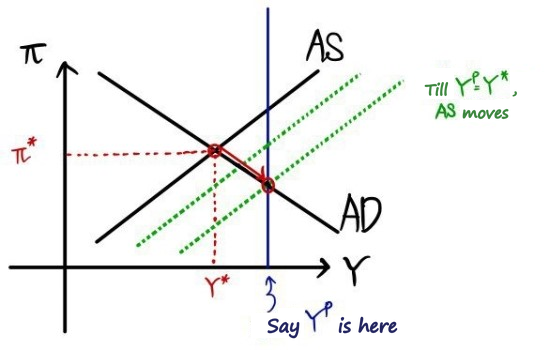
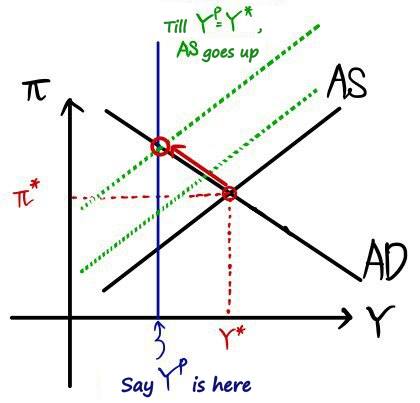
Jus’ attaching the pics should be aight? hehe
In this model, with the other curves held fixed and inflation expectations adjusting, output works its way back to potential. This is called the “self-correcting mechanism”! How quickly it works in practice is another question.
Okay, from now on the story is different!! Let’s think of it like this!
Suppose some country, having weathered every storm~~~, reaches long-run aggregate equilibrium!!
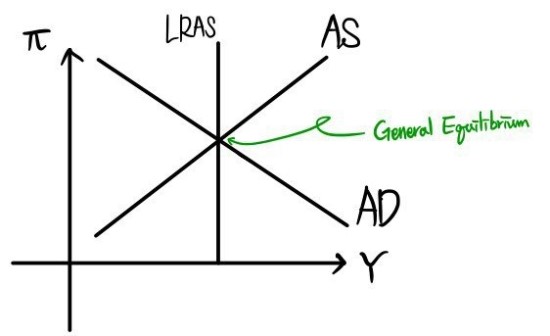
Like sooo!!!!!
Now from here, we’ll look at the cases where AS, AD, or LRAS (long run aggregate supply) moves because of all sorts of variables!
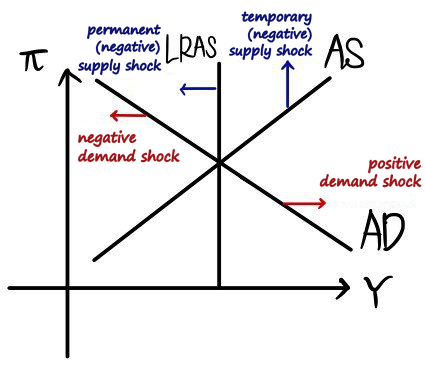
- Negative demand shock,
- positive demand shock,
- temporary (negative) supply shock,
- permanent (negative) supply shock
Let’s look at these 4 situations. In those situations, on the graph it looks like this:
Soooo~~~ easyyy. It can all be explained with what we did~~~ before~
If the long-run aggregate supply and the equilibrium output are not equal to each other, the curve moves!! What does?~?~? In this model, the short-run aggregate supply curve moves as inflation expectations adjust!!!!!!
Because isn’t 0!!!!! An output gap opens up, so the inflation rate goes up (down, when output is below potential), the expected inflation rate follows it, and the short-run aggregate supply curve moves, until = 0!!
That explains everything, lol.
When a negative demand shock sud!denly hits!!
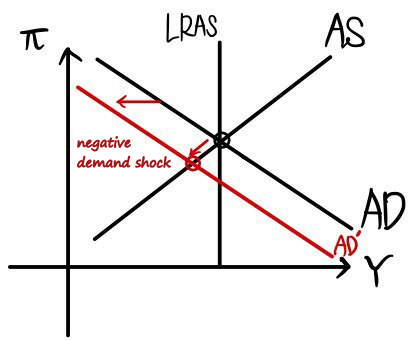
When a sud!den negative demand shock hits like this!! There can be all sorts of things that set off a negative demand shock:  ,
,  ,
,  ,
,  ,
,  , and so on and so on and so on! (We did this here.)
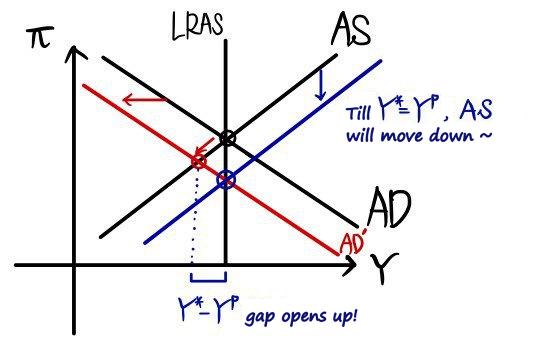
Then: if the long-run aggregate supply and the short-run equilibrium output are not equal to each other, the curve moves. Because isn’t 0! Until = 0!!
When a positive demand shock sud!!denly hits
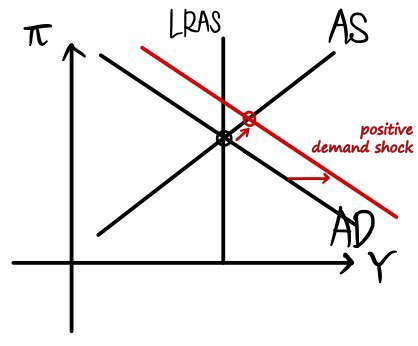
When the demand curve suddenly moves like this!!!
(Causes: same as above.)
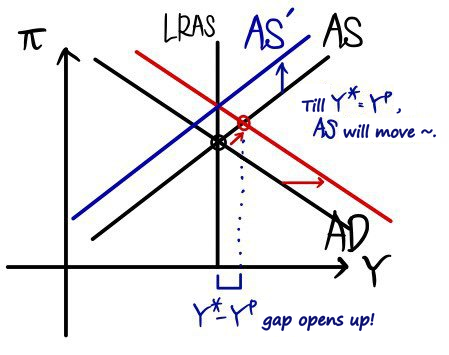
Then: if the long-run aggregate supply and the short-run equilibrium output are not equal to each other, the curve moves. Because isn’t 0! Until = 0!!
When a temporary (negative) supply shock sud!!denly hits
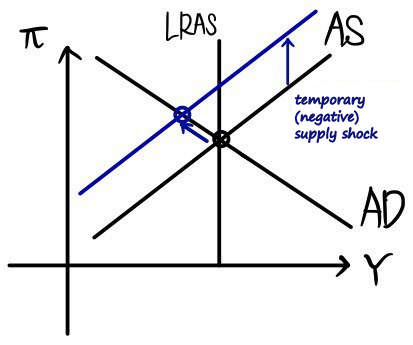
There seem to be lots of things that could make it move like this!!! A temporary rise in crude oil prices, for example. Here we’re assuming the shock doesn’t change potential output; a disaster that destroys productive capacity would also affect LRAS.
This kind of temporary supply shock doesn’t change the economy’s production capacity, so LRAS stays just as it is!!!
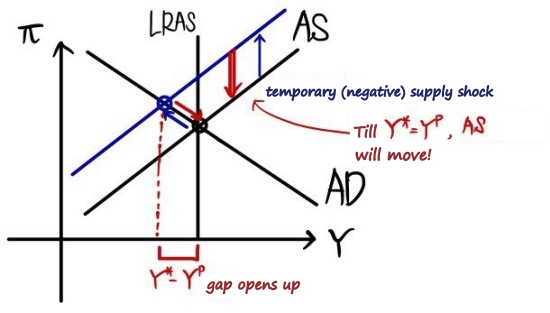
Then: if the long-run aggregate supply and the short-run equilibrium output are not equal to each other, the curve moves. Because isn’t 0! Until = 0!!
When a permanent negative supply shock sud!!!denly hits!?
What kind of case is this??!
It’d be a case where the economy’s production capacity drops….well…. Like the country being reduced to ruins by a war? Or some regulation getting tightened for political reasons?? Something like that? hehehe
Well, in this case, on the graph:
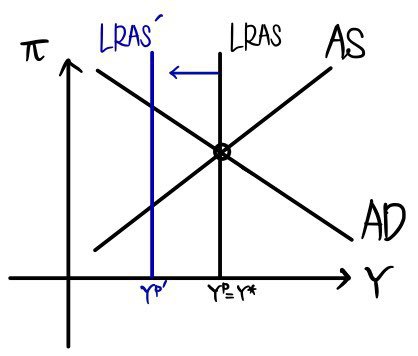
Well, here LRAS would move like this:
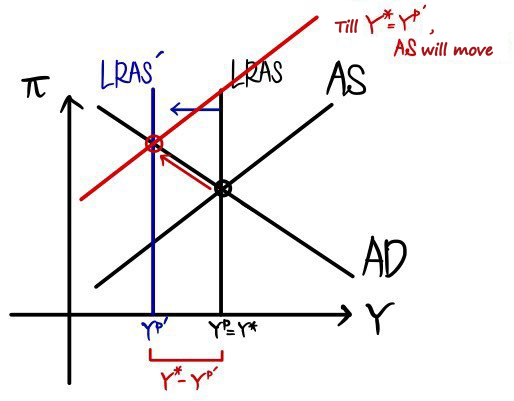
The original notes write this as follows: if the long-run aggregate supply and the short-run equilibrium output are not equal to each other, the curve moves. Because isn’t 0! Until = 0!!
After this permanent shock, read those potential-output symbols as the new, lower $Y^{p\prime}$. The gap is $Y^*-Y^{p\prime}$ and closes at the new potential output, not at the old $Y^p$!
Okay, that’s it for this post. As for the next post, apparently it’ll cover “how to respond” in situations like those, hehe
Heads-up. The figures here are the original notes, slips and all. A few things to watch for:
- After the permanent supply shock, the relevant potential output is the new $Y^{p\prime}$. The gap is $Y^*-Y^{p\prime}$, and it closes at that lower potential output, as the preceding diagram shows.
- The label “General Equilibrium” here means long-run aggregate equilibrium in this AS–AD model.
Comments
Discussion happens via GitHub Discussions. You'll need a GitHub account to comment.