Monetary Policy Theory
How should a central bank respond when the economy gets knocked around? Activists vs. nonactivists, why deflation is scary, and the AS–AD playbook for a demand shock, a permanent supply shock and a temporary one (the AS curve on a spring), plus when the divine coincidence shows up and when it doesn't.
Picking up right where the previous post left off. As promised, this post is about “how we should respond.”
Earlier we looked at how aggregate equilibrium shifts for all kinds of reasons. But!
‘OK, I get that it moves that way!! So are you just gonna sit there and watch it happen with your eyes wide open?! I mean, are you gonna get robbed blind in broad daylight?!@@@ There’s gotta be some kind of plan, right!’
That kind of plan is what we’re looking at, and here’s what’s still a hot debate:
“Yo yo yo yo yo, don’t intervene -_- if the government steps in, things get even more screwed up; all it does is cause inflation!!!!” “Because there’s a lag between a policy and its effect!!! It doesn’t kick in right away!!!!!” (data lag, recognition lag, legislative lag, implementation lag, effectiveness lag) “So intervening just ends up shoving around something that’s already sitting at equilibrium, for nothing!!!” That’s the nonactivists.
And to that, the people on the other side say: “Haa -- so damn frustrating -- you’ve gotta step in the right way so things are at least a little better,,,,, good old Keynes said this, you know!!!” — “In the long run we are all dead.” That’s the activists.
So whose side should we take???? The answer?????
There isn’t one, which is exactly why it’s still a hot debate!
First, the ideal economy the monetary authority dreams of is one where the inflation rate stays at the target inflation those guys are aiming for ( ).
Well, high inflation is bad, I mean… obviously bad!
But if the inflation rate goes down?? Isn’t that a good thing??? Huh???
It depends!!!! Lower positive inflation is disinflation: prices are still rising, just more slowly. Deflation means the general price level is actually falling, and a persistent fall can be scary!!
Because, let’s imagine a situation where prices just keep dropping. I could buy a car today, but wouldn’t I wait a bit and try to buy it tomorrow instead? Since prices keep dropping?? Nah, I might even wait a whole year!
In the words of Master Park Je-ga: “Wealth is like a well: if you don’t draw from it and use it, it dries up all on its own. When thrift goes too far, the people cannot enjoy anything, and when livelihoods grow hard, only the thieves multiply.”
Looks like Master Park Je-ga knew the danger of not spending, too~ If people don’t spend, we’re toast, and since expected deflation can make people postpone some spending like this, everything dries up and rots like that well…. T_T
So~~~ the monetary authority sets its target inflation (, the inflation target) at a low positive rate, often around 2% (the exact target depends on the central bank and the period)!! OK!!! So the monetary authority’s goal is to pin inflation at that target!!!
So from here on out: case by case!
1. A demand shock! How do we respond?
What happens when the monetary authority does abso~~lutely nothing??? We covered that earlier!!! Back then, output ultimately settles at  , so output eventually returns to potential after falling in the short run, while inflation settles lower in this model!!!! hehe
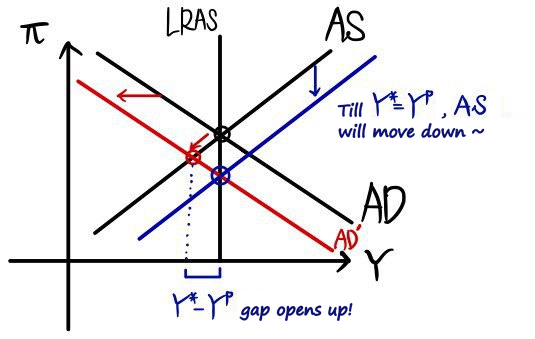
The inflation rate dropped!!!! The monetary authority can’t be too happy about that, right?! So what are these folks scheming now?
(* In this simple diagram, monetary policy works through AD; it can’t directly rebuild the economy’s productive capacity.. T_T)
To push the demand curve back to the right, these folks go for an “autonomous easing of monetary policy”: they lower  and try to move the demand curve back to the right!!! The AD’ curve will climb back up to AD!!!
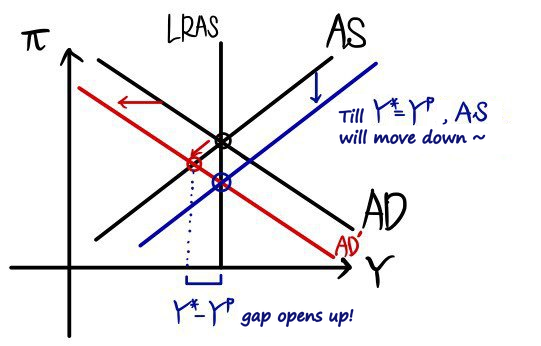
If it moves successfully, the inflation rate can be kept at !!! And output stays at its long-run level too!!!!
In this simplified demand-shock case, timely policy can stabilize inflation and the output gap together!! That is the idea behind the divine coincidence, a term used by Olivier Blanchard and Jordi Galí. Real-world policy lags can get in the way.
2. When a supply shock hits! How do we respond?
2-1. A permanent supply shock: what’s the right response?
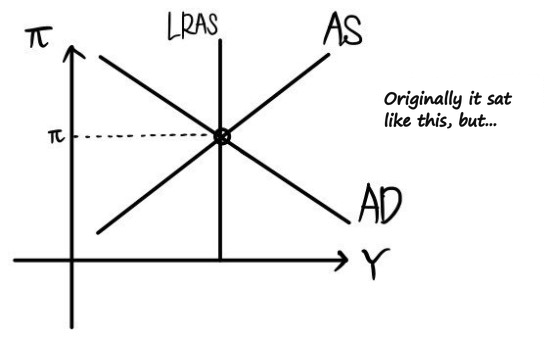
If you do nothing here, then just like we learned before…. in the end the inflation rate goes up!! (Output can’t be helped,,) The black lines show where things settled after LRAS moved to the left!!
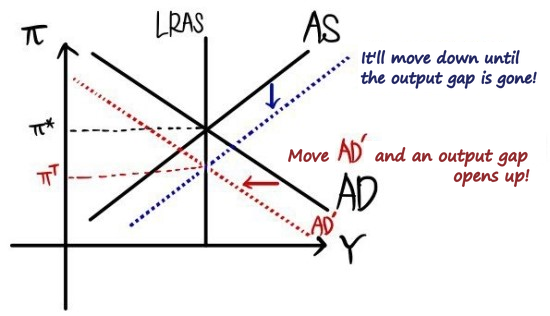
So is lower than  , that’s where we are!! The monetary authority’s goal is!! to get back to !! So it has to fiddle-fiddle with the AD curve and shift it to the left, like the red one!!
Then the AS curve will follow along!!! hehehe And that’s how we can land on hehe
In the long run here, inflation can return to target while output settles at its new, lower potential. But that is not a free pass during the adjustment: the contraction in the picture creates a temporary output gap. Monetary policy cannot undo the lost productive capacity.
2-2. A temporary supply shock: how should we respond?
If we do nothing, then this too goes just like we learned before!!!!

It goes out like thiiis and comes right back!! To show off my physics major a little: you could say the AS curve bounces out as if it were hanging on a spring, and then comes back.
Because of this, the monetary authority has 3 policy options, they say! Let’s take a look.
1. Just do nothing
If the shock fades and expectations adjust as assumed here, AS eventually comes back!!! But here’s the problem! The spring constant might be so small that the economy gets totally wrecked during the time it takes to come back. In this case AS’ does have a spring on it, sure, but the spring constant might just be way too small!!!
2. Shoot backward
Now say the monetary authority only has eyes for . So the monetary authority, too, hangs a spring on AD’ in exa~~ctly the same way and shoots it! Where to?!?!?! Backward!!
Let’s see what happens when you shoot it backward.
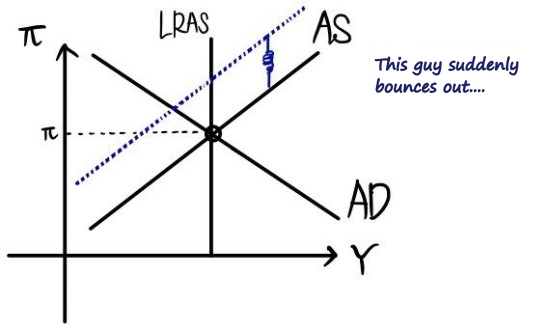
Right then, the monetary authority also hooks a spring onto AD and shoots it backward!
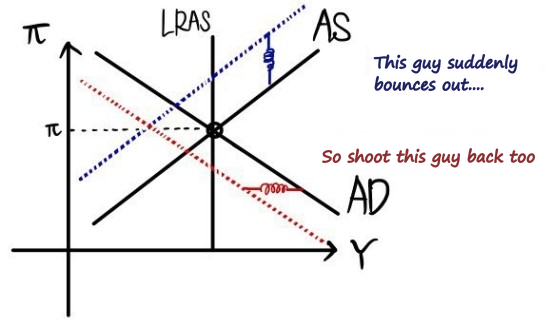
And as both slowly come back, at that point
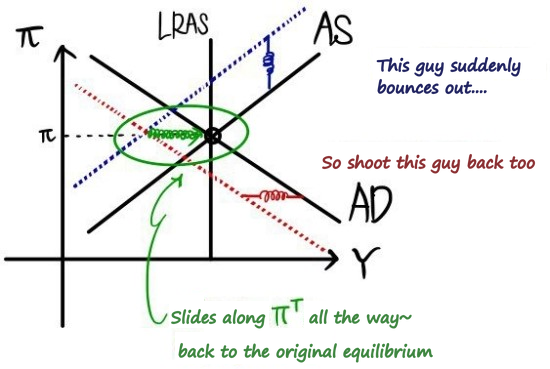
this is how the monetary authority can hold the inflation rate steady at the whole time.
Nobody suffers from inflation, but people can suffer from the drop in national income Y. So we can say the divine coincidence doesn’t happen here.
3. Shoot forward
Just because it’s the monetary authority, do you think it only ever wants to stare at ?!?!? If the monetary authority just shoots the other way, it can hold on to national income Y….? Shall we see?
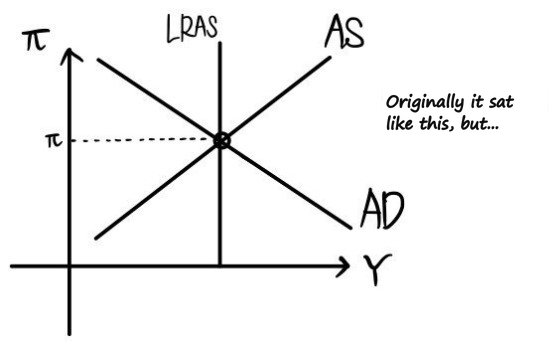
It was right here~~
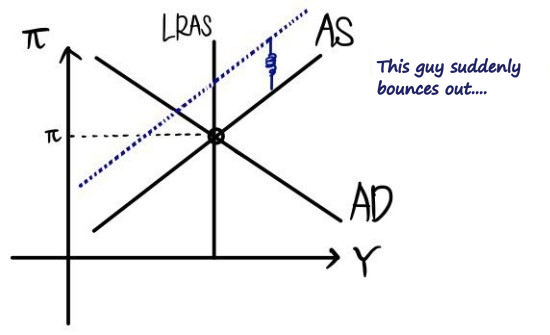
Bounces out!! Right then, shoot forward!!!!
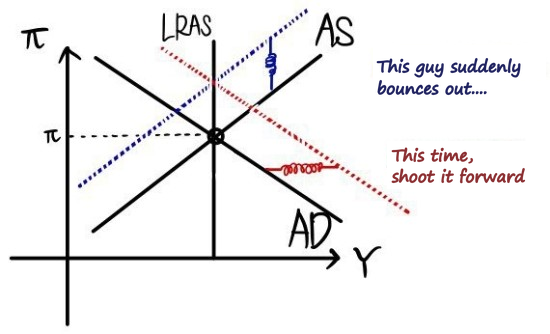
Like this!!!! hehehe
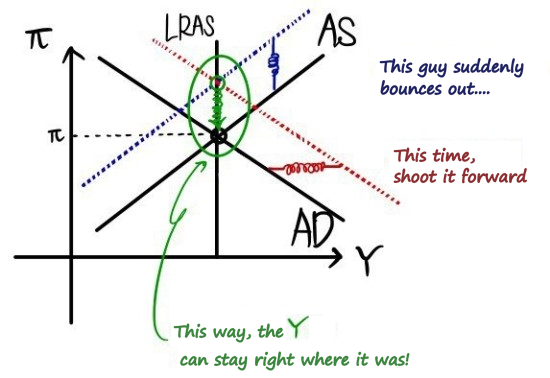
Then, like this, output can be held right where it was!!
But the moment you choose to keep national income like this….. you have to let  go: the inflation rate climbs above the target.
So here too, the divine coincidence doesn’t happen.. T_T
The world is so cruel~
That’s why the government and the Bank of Korea are supposed to keep~~ duking it out… that’s how it’s supposed to be… Hmm… how are things here in Korea…?? (I’m asking because I honestly don’t know) lol Are they doing OK~ hehe?
Huh, but why do the government and the Bank of Korea have to fight anyway?~??
Because the main goal of most governments is “boosting employment”!! To boost employment, they might try to raise productivity for a while (that shifts AS down, to the right), or they might go for a policy like increasing G to shift AD to the right!! That second move raises inflation pressure in this model, especially when output is already near potential; the outcome depends on spare capacity and the policy response.
So their priorities can pull in different directions!!! That does not mean they have to fight all the time. Pbbbt
Heads-up. The figures here are the original notes, slips and all. A few things to watch for:
- The graph right after "the AD’ curve will climb back up to AD" repeats the one before it, where nothing is done and AS drifts down until $Y^* = Y^p$. With the autonomous easing described there, AD’ shifts back to AD instead, so the economy stays at $\pi^T$ and $Y^p$, as the next sentence says.
Comments
Discussion happens via GitHub Discussions. You'll need a GitHub account to comment.