Introduction to Quantum Mechanics: Probability (Chapter 1, Section 1...)
A 2015 physics student's introduction to quantum mechanics, followed by discrete and continuous probability, variance and Gaussian normalization, with marked editorial corrections.
Alright—this is why I went into physics! The time to study quantum mechanics has finally arrived.
As I write this, I’ve had about two weeks of classes, and… haaa. All I can do is sigh. T_T T_T T_T
Still, isn’t part of what makes this subject so exciting that it’s still a work in progress???
Mechanics has Newton,
electromagnetism has Maxwell,
and relativity has Einstein—
each has a name that immediately springs to mind!
But quantum mechanics apparently still has no single “owner”… hehe.
Ah, I’m absolutely not saying, “That owner will be me!” LOL.
(I’m getting out of physics, hahaha. For the past year I’ve felt all too keenly that these aren’t waters I can swim in.)
It’s just that studying quantum physics gives me this feeling… like I’ve entered the Grand Line in search of the One Piece? Hahaha.
That’s what goes through my head when I open the book. (Am I Monkey.GD.Luffy, by any chance? LOL.)
Aaaaah, that was when I first opened the book at the beginning of quantum mechanics. I definitely don’t feel that way now. After just two weeks of studying,
all I can think is, “Ah, I’m screwed. HAIR-LOSS RED ALERT!!!” Hahaha.
Anyway, enough of my rambling nonsense.
The professor recommended a book to read alongside our studies,
so I bought The Quantum Story, too. Hehehe. Let’s give this another good try!
The Schrödinger equation
In Newtonian mechanics, we solve things using $F=ma$. That’s the truth—the truth!
So what about quantum mechanics? Its equivalent of $F=ma$ is the Schrödinger equation!!!!
In Newtonian mechanics, we wanted to find $x(t)$;
in quantum mechanics, we want to find the particle’s wavefunction, $\psi(\mathbf r,t)$.
Just as $F=ma$ lets us find $x(t)$, the Schrödinger equation lets us find that “psi-r-t”!
Well then, let me throw the Schrödinger equation at you first:
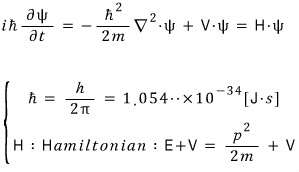
Editorial note — the energy symbols. For this nonrelativistic particle, $\hat H=\hat p^{\,2}/(2m)+V$ means kinetic plus potential energy. The original’s “$E+V$” needs $E$ to denote kinetic energy, not total energy. See MIT’s notes.
Right from the start… it feels like coming face to face with an alien language. T_T
Huh… hahaha. The Greek letter psi, which I’m writing for the first time, and now a Hamiltonian too? What is all this?!
(I think this is a drawback of Griffiths’ book, haha: it puts the result first, then slowly fits the pieces together, one by one.)
(But I’m absolutely not saying Griffiths’ book is bad. The exercises are real gems.
He puts exercises with so much meaning in just the right places… God-riffiths.)
(Still, I studied electromagnetism that way too, so I accepted it and got on with studying. Hehe.)
(By the time the semester was nearly over, I could at least say, “Ah, so that’s what I was doing!” Hahaha. Well, the easy material from the beginning, anyway…)
(So I’ll just keep going.)
Haaa… what is a wavefunction?
Apparently it contains all the information about position and velocity at time $t$… huh?
For now, mathematically, the wavefunction is just a complex number…
Editorial note — what the wavefunction contains. A wavefunction is a complex-valued function, not a single complex number. It determines measurement probabilities for a pure state, not simultaneous definite position and velocity values. Position and momentum obey an uncertainty relation. See MIT’s notes.
So what does it mean physically???
While all the world’s geniuses were thinking about this,
Editorial note — the imagined dialogue. The Born and Einstein exchanges below are the author’s comic dramatization, not quotations from historical documents.
a genius named Max Born said something like this:
(Max Born: “Hey, guys, I’m a maths genius. That thing doesn’t mean anything by itself—you’ve got to square it for the meaning to appear!!!!
That meaning is ’the probability density for finding the particle at position $\mathbf r$ at time $t$’~~~~~~~~!”)
If we follow what that genius gentleman is telling us to understand,
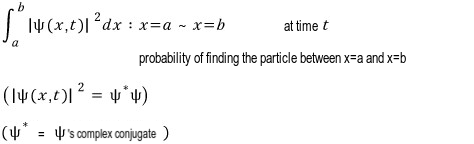
Editorial note — “square it.” Born’s rule uses the squared modulus, $|\psi|^2=\psi^*\psi$, not $\psi^2$. For a normalized one-dimensional wavefunction this is position probability density; its integral over an interval is a probability. Relative phases also matter for interference. See Born’s Nobel lecture and MIT’s notes.
(A little fun.) Hearing this, Einstein got seriously pissed off.
“Hey, hahaha. What the hell? This is ridiculous, hahaha.
You measured it and it was there? Then it was there to begin with! LOL.
What is this nonsense? We simply didn’t know, and when we measured it, we found it there. What’s all this talk about probability…?
Haaa… and these clueless people are studying physics? You still call yourselves physics students???
The end is nigh, the end~~~~! If we add the variables we don’t know yet and make our predictions, we’ll be able to work it out for certain, you silly fools. -_-
You’re studying an incomplete theory and still giving it the name ‘quantum mechanics’!!!!!! You silly idiots!!! >0<”
The opposing camp, the people called the Copenhagen school, supposedly answered like this:
“Sir… look, we understand what you’re saying… but take a look at these experimental results here…~”
//
Einstein: “Right, here’s a thought experiment from my head. Listen to this. Look at this, look at this!”
//
“Sir… hehe, here we go again… look at these experimental data, hahaha.”
Apparently they fought like hell over it, hahaha.
Einstein never accepted this subject called quantum mechanics, right up to his death—
or so the story goes, hahaha.
Anyway, let’s say the Copenhagen interpretation was right—so far—
and that John Bell’s experiment later shut everyone up… hehe.
Editorial note — Einstein, Bell and the experiments. Einstein challenged the completeness of quantum mechanics; the passage above is a deliberately comic simplification of that dispute. Bell supplied a theorem in 1964, not the experiment described here. Later experimenters tested Bell inequalities and found violations. Under the assumptions used to derive those inequalities, the results exclude the corresponding local hidden-variable models; they do not uniquely establish the Copenhagen interpretation or exclude every hidden-variable theory. See the Nobel account of the experiments and MIT’s introduction to quantum information.
Anyway, the main point of the Copenhagen school’s interpretation, as I understand it, is its emphasis on the interaction between the “act” of an experiment and its target!!
The act itself changes the target,
so, they say, you can’t insist that the position you measure is the position the particle had immediately before the measurement.
Editorial note — measurement. The author’s disturbance analogy does not replace quantum measurement probabilities, state updates or the uncertainty relation for noncommuting observables. See MIT’s notes.
All that earlier discussion was basically a way of saying that quantum mechanics,
as a subject, is very closely connected with probability.
So now let’s go back over this “probability” thing we need to handle,
just to get it straight again: Section 3, Probability.
Probability with discrete variables
Suppose there are $N$ people in a classroom, and we group the students by age.
Taking age as a discrete number, $N(j)$ means the number of students who are $j$ years old!!!
Ah, then we can also express the fact that there are $N$ students like this:
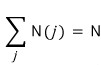
Then, common sense says that if you pick exactly one person, the probability that they’re $j$ years old is
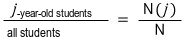
Let’s take the P from “probability” and call this $P(j)$.

Then

is common sense too. It’s the sum of all the probabilities!
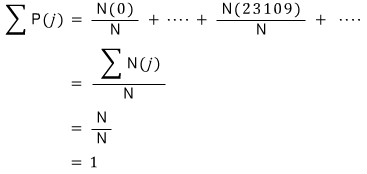
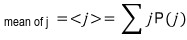
So, if we want to use a class’s “average age” as a representative value, how do we calculate it?
Just think about how we worked out average marks in middle school and high school.
Average, mean, expectation value:
And now, let’s very briefly review the probability and statistics we learned in high-school Mathematics I.
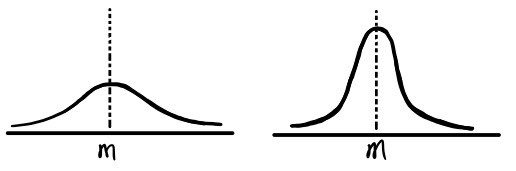
These two distributions—these two sets of data—have the same average, but there’s clearly a difference between them, right?!
We’re going to learn something that expresses that difference.
We call it $\Delta j$: how far each $j$ is from the average, $\langle j\rangle$.
$\Delta j=j-\langle j\rangle$.
Then let’s average those “distances of each $j$ from the mean.”
Uh-huh~~~ but if we average delta-j,
of course $\langle\Delta j\rangle=0$, right??? That’s what a mean does!
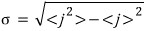
Okay, then let’s square those distances, average them, and finally take the square root instead!!
(Man, Mathematics I is coming back to me, hahaha.)
First,
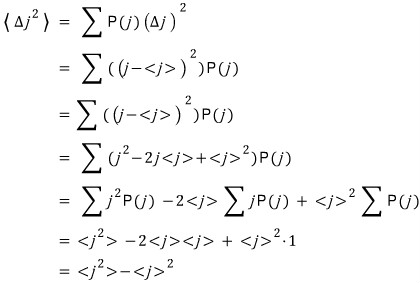
we write this as

and call it “variance,” remember!!?!?
Then taking its square root gives the standard deviation!!
Now, what happens with continuous variables?!
This is what I was setting things up for earlier.
Before, I used “age” as a discrete variable. Now, a continuous variable… hmm~~.
The book uses age measured more precisely as its example.
(For example, my age right now!!! Exactly 24 years, 7 months, 14 hours, 51 minutes, 23… 24… 25… seconds. Still ticking.)
Anyway, probability:
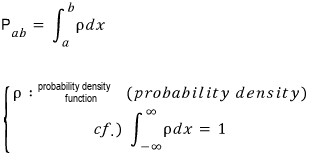
This isn’t unfamiliar; we did it in high school.
But then why did I go through all that obvious stuff about discrete variables earlier?
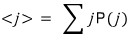
Probably because of this.
Get a feel for it~~,
so that when the variable doesn’t jump in separate steps like $j$—tick! tick!—you won’t get muddled about calculating its average either~!!!
How? For a continuous variable $x$,
the expectation value of $x$ is:
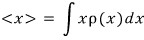
Like this~~~?!?!?!? Hahahahaha.
Then, apparently, in many cases in nature the probability density is a Gaussian function.
(Next most common is the exponential, then the Lorentzian, and then… and so on.)
Editorial note — the informal ranking. The ordering of Gaussian, exponential and Lorentzian distributions is the author’s informal remark, not a universal ranking of how often distributions occur in nature.
Anyway, a Gaussian function

Editorial note — the Gaussian’s domain. The original image says $x,\lambda,a\gt0$. For the Gaussian integrated over the whole real line here, the correct conditions are $x,a\in\mathbb R$ and $\lambda\gt0$. In this convention $\rho(x)=Ae^{-\lambda(x-a)^2}$ is the probability density itself, not a wavefunction. Normalization gives $A=\sqrt{\lambda/\pi}$. NIST’s Gaussian integral, at zero linear term, supplies the normalization integral.
looks like this. Let’s look at just one of its properties:
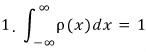
What value of $A$ makes that true?????????
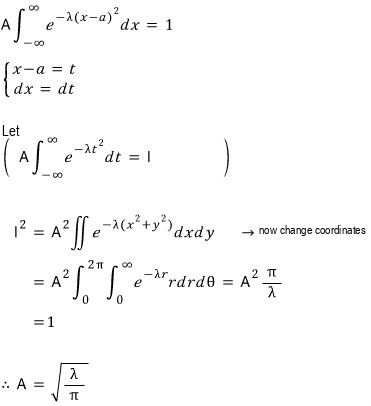
Editorial note — the missing square in the retained derivation. The original and its previously approved English image both print $e^{-\lambda r}$ in the polar-coordinate step. Since $x^2+y^2=r^2$, that factor must be $e^{-\lambda r^2}$. The corrected step is
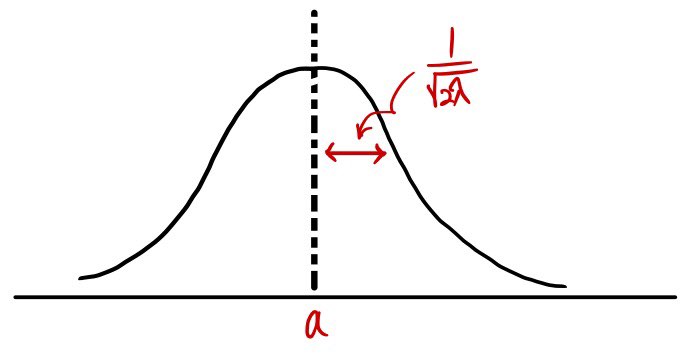
$$ I^2=A^2\int_0^{2\pi}\int_0^\infty e^{-\lambda r^2}r\,dr\,d\theta =A^2\frac{\pi}{\lambda}=1. $$This gives the stated $A=\sqrt{\lambda/\pi}$. It is a correction to the source formula; the source image has been retained. The subsequent mean $a$, second moment $a^2+1/(2\lambda)$ and variance $1/(2\lambda)$ use this normalized whole-line density.


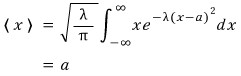
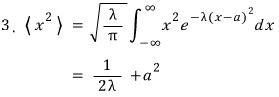
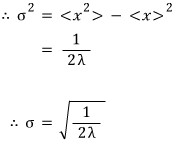
What that means:
Translated from the original Korean study log, published 10 August 2015. The marked editorial notes are additions; the author’s dialogue and informal claims are preserved as the original study-log voice.
Comments
Discussion happens via GitHub Discussions. You'll need a GitHub account to comment.