The Time-Independent Schrödinger Equation
A fun, casual rundown of how the time-independent Schrödinger equation came to be — tracing the genius relay from Planck to Einstein to de Broglie to Schrödinger!
Before moving on to Chapter 2!!!
Let me just quickly go over how the Schrödinger equation — which is to quantum mechanics what F=ma is to Newtonian mechanics — was built.
Saying it like that makes it sound huge, so let’s just call it a fun story in quantum mechanics?????
You’ll see this in more detail in the modern physics posts later, but,
In 1900, Mr. Max Planck proposed the concept of energy quantization, (

)
and Mr. Einstein, right at that timing, announced the results of the photoelectric effect experiment,
so light, as if n “light particles” gathered together, meaning that the energy of light — an electromagnetic wave — is

that is, the energy of a single light particle is

he announced,
(geniuses, I tell you,,,) and in that same year, 1905, he announced special relativity,,,
Historical clarification (2026-10-02): My 2015 story compresses several steps. Planck introduced energy elements \(h\nu\) for resonators in 1900. Einstein proposed light quanta and a theoretical explanation of the photoelectric effect in 1905, drawing on existing experiments; he did not report an experiment he had performed. His special-relativity paper was a separate 1905 work. The energy–momentum relation below is written in standard modern notation, rather than quoted as an equation from the photoelectric paper. For \(n\) photons of the same frequency, their total energy is \(nh\nu\).
Sources: Planck’s 1900 paper, translated, pp. 2–3; Einstein’s 1905 light-quantum paper, §8; Einstein’s separate relativity paper dated June 30, 1905.
rest mass

came up, and
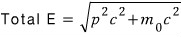
Formula correction (2026-10-02): The original image has a typo in the rest-mass term: \(m_0c^2\) has units of energy, whereas \(p^2c^2\) has units of energy squared, so they cannot be added under this square root. The correct positive-energy relation is
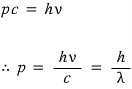
$$ E^2=p^2c^2+m_0^2c^4, \qquad E=\sqrt{p^2c^2+m_0^2c^4}. $$Here \(p\) is the magnitude of momentum. For a photon, \(m_0=0\), so \(E=pc=h\nu\) and \(p=h/\lambda\), as the following source formulas state.
Source: Feynman’s energy–momentum invariant and photon relations, §17–4, equations 17.6–17.7. The chapter uses \(c=1\); restoring ordinary units gives the displayed correction.
this relation came out,
and since the photon has a rest mass of 0, for light specifically

but the energy of a single photon is

right?????
so Einstein hit a single.,,,,, and after getting on base
Planck’s on second, Einstein’s on first~
If Einstein wrapped up the particle nature of “waves” in 1905, the next batter is de Broglie in 1924!!!!!!
Simply put, de Broglie wrapped up the wave nature of “particles” in 1924,
simple, just lol
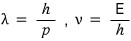
Now the last batter, Schrödinger the cleanup hitter came up to bat in 1926,
bases are loaded now, loaded!!! On third was Planck, on second Einstein, on first de Broglie,
and Schrödinger thought, ‘ah, then what kind of wave form would the electrons in the microscopic world exist as???’!!
But as you can see from the Fourier series, we learned that any wave function, whatever it may be, can be expressed as a linear combination of sin and cos!!!
But to keep it simple, let’s just say it’s a general sin function. <assuming it doesn’t depend on time>
Scope clarification (2026-10-02): The sine below is one illustrative spatial mode, not a general wavefunction. Fourier series can represent square-integrable functions on a finite interval in the mean-square sense, with complex coefficients when needed; a function on the whole line is normally described using a Fourier transform. This nonrelativistic calculation assumes a constant potential \(V_0\) in a region with \(E>V_0\). Here \(E\) is the mechanical energy in the nonrelativistic Hamiltonian, not the earlier relativistic total energy. Twice differentiating gives \(-k^2\psi\), not literally \(\psi\). The source’s positive square root gives the momentum magnitude; the traveling components have momenta \(p=\pm\hbar k\), and \(\sin(kx)\) combines both directions. For \(E\lt V_0\), the spatial solutions are exponential rather than sinusoidal.
Sources: MIT wave mechanics notes, §§1–2, equations 2.3–2.11; MIT Fourier lecture, Theorem 12.

and this guy
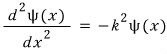
satisfies this!!!!(differentiate twice and you get itself back)
Now k is 2pi over lambda! and into that lambda
let’s plug in the de Broglie matter-wave wavelength
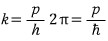
If we express momentum p in terms of energy,
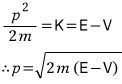
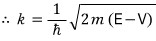
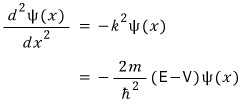
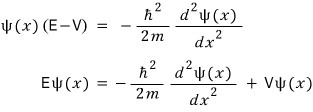
Equation clarification (2026-10-02): The last line is an equation for the spatial function \(\psi(x)\), not a solution for an arbitrary potential. The constant-potential calculation motivates the equation; it does not derive its general form from classical energy identities alone. In nonrelativistic quantum mechanics, separation of the time-dependent Schrödinger equation for a time-independent \(V(x)\) gives
$$ -\frac{\hbar^2}{2m}\frac{d^2\psi}{dx^2}+V(x)\psi=E\psi. $$A stationary state has the full wavefunction
$$ \Psi(x,t)=\psi(x)e^{-iEt/\hbar}. $$Its spatial factor and position probability density are time independent, although its overall phase varies with time. Boundary conditions determine the allowed solutions.
Sources: MIT wave mechanics notes, §§1–2, equations 2.3–2.11; MIT Fourier lecture, Theorem 12.
And so… I just derived the time-independent wave function that shows up right after this,
what I really want to say is
it’s not like the Schrödinger equation just plop!!!! dropped out of some equation…
but historically, various people together built up this equation?!?!?! something like that
Just like F=ma wasn’t derived from some such-and-such equation,
but rather many principles were gathered up and plop!!! this relation was made,
the Schrödinger equation also isn’t derived from some such-and-such equations,,,
I’ve also heard that thinking of it as just “the truth of the world???” is better for your mental health,,,,hehehehe
hahahaha
Anyway the cleanup hitter Schrödinger hit a foul and flied out!!! because
the Schrödinger equation is just a complex number after all…. it has no meaning,…..(and of course he himself didn’t know either)
Interpretation clarification (2026-10-02): That is my 2015 joke, not a literal assessment of Schrödinger’s work. The equation is a differential equation; its wavefunction may be complex. Schrödinger did explore physical wave interpretations, so saying he had no interpretation is misleading.
was there anyone who could hit a grand slam home run…T_T T_T T_T~~~
our physics team fell into deep despair, but a fifth batter named Max Born steps up to the plate,,, 1926…
announcing that the square of the wave equation has probabilistic meaning, a bases-loaded home run sweep~~~~~~~~~~~~~~
Born-rule clarification (2026-10-02): Born developed the probabilistic interpretation of scattering amplitudes in 1926. For a normalized one-particle position wavefunction, the probability density is \(|\Psi(x,t)|^2=\Psi^*(x,t)\Psi(x,t)\), not \(\Psi^2\) and not the square of the equation. In one dimension, the probability of finding the particle in an interval is the integral of that density over the interval. The wavefunction’s phase also matters for interference.
Sources: Born’s own 1954 Nobel lecture, pp. 261–264 and reference 17, primary lecture reprint; MIT wave mechanics notes, equations 1.9–1.13 and 2.4.
and at that time the second batter Einstein, while coming home, said
“God does not play dice.”
the ironic thing is that even though he scored too (= even though he left his mark on quantum mechanics)
his expression was glum (= he didn’t believe in quantum mechanics….) lol lol lol lol lol
Historical clarification (2026-10-02): The home-run scene is my metaphor. The familiar dice line paraphrases Einstein’s letter to Born of December 4, 1926; it was not a remark made while the physicists literally scored in a game. In that letter he recognized quantum mechanics’ achievements while resisting its probabilistic interpretation as the final account of nature. “He didn’t believe in quantum mechanics” is therefore too broad.
Source: Einstein’s December 4, 1926 letter to Born, translated and republished by AIP. Interpretation-versus-formula context is also discussed in Born’s own Nobel lecture, pp. 263–264.
<I just totally slapped this together,,,, a better post will be coming up in the modern physics posts.! I’ll take this down when that happens>
Comments
Discussion happens via GitHub Discussions. You'll need a GitHub account to comment.