The Time-Independent Schrödinger Equation, Part 2
We crack the time-independent Schrödinger equation by assuming ψ separates into x and t parts — basically the same separation-of-variables trick from electromagnetism!
Alright, when we meet an equation, we look for the x that satisfies the equality, right!?
That x we found, we call it a root or a solution, right?!
Oh, then when we meet a differential equation?? We look for the function f(x) that satisfies the equality, right?!
That f(x) we found is also called a solution.
Oho, now we’ve met the Schrödinger equation, see.
Let’s find the wave function ψ(x,t) that satisfies the equality!!!
Well, that’ll be for later,
For now let’s assume “the wave function is not time-dependent!”

Let’s assume it’s like this.
And then let’s find the solution that satisfies the Schrödinger equation!!
(We also have to assume… that the potential energy V is time-independent… hehe we’re still noobs after all)
Editorial clarification (2 October 2026): The opening wording is imprecise: it is the spatial factor \(\psi(x)\) that is independent of time. For a time-independent Hamiltonian, a stationary energy state has \(\Psi(x,t)=\psi(x)e^{-iEt/\hbar}\); the full wave function generally retains this time phase. Stationary refers to its probability density and the well-defined expectations of observables with no explicit time dependence, not to a universally constant wave function. This product ansatz selects stationary solutions; it does not describe every solution. MIT stationary-state notes.
This is the main content of Chapter 2!
But actually, it’s sooooo extremely similar to what we did in Chapter 3 of electromagnetism, the potential part.
The potential was

We ‘assumed’ it separates like this and then solved the Laplace equation….
The calculation is almost completely the same.
Alright, now let’s solve the Schrödinger equation with the assumption above.
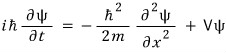
Into this Schrödinger equation,

If we do separation of variables like this and substitute in,

The x stuff with the x stuff,
The t stuff with the t stuff! If we massage the left and right sides that way!!
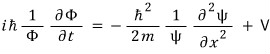
Editorial clarification (2 October 2026): Division by \(\psi(x)\Phi(t)\) is valid only where those factors are nonzero. At spatial nodes, use the undivided equation \(\hat H\psi=E\psi\), with the required regularity and boundary conditions; division does not exclude nodes from the solution. The separation argument works because a function of time alone equals a function of position alone for all independent \(x,t\). Their common constant is the energy eigenvalue. For the physical self-adjoint Hamiltonian with its specified domain and boundary conditions, \(E\) is real. Absorbing the time-factor constant into \(\psi\) is harmless, but normalization still has to be imposed. MIT derivation and normalization.
If we massage it like this,
The left side becomes a thing about t, and the right side becomes a thing about x.
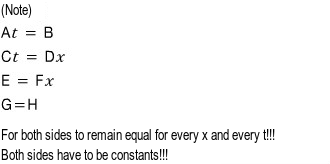
But for them to be equal via Equal~~~~~
Both sides have to be equal as a constant! If it’s not a constant, there’s no equal number!!! (It was like this in electromagnetism too,)
Alright, so let’s say the left and right sides are each equal to a constant called E (why did they call it the constant E, of all things? To be confused with ’energy’?)
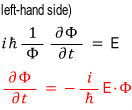
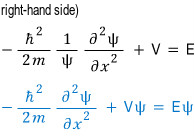
With the red equation we can find the solution for Φ(t) with respect to time t,
And with the blue equation we can find the solution for ψ(x).
So what -.-?
What was the purpose we’ve been doing all this stuff here for at the start??????

We assumed it splits apart like this~
(And of course we assumed the potential V also depends only on x!)
And then when we put it into the Schrödinger equation, in the end we got to find each of the ‘function of x’ and ‘function of t’.
In other words, if we multiply the two we found, we’ve found ψ(x,t)!!!!!!!!!!!!!!!!!!!!!!!!!!!!!!!
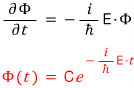
First-order differential equations are a piece of cake, cake!!!~~~~
Then
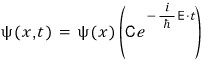
We can write it like this,
But some constant can get attached to ψ(x) too,
With the idea of lumping that constant together with everything else,
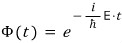
Let’s see this guy’s constant as 1~!~!!!
Alright, that’s it for the equation about t,
And now from here,
Solving this equation is the key,
Actually, this is the time-independent Schrödinger equation!!!!!!!!!
(I did it in the previous post too, yeah~? hehe)
Now I want to solve this exactly, but we’ve got to know V(x), which we said depends only on x, exactly,
So that we can know ψ(x) or whatever….heh
In other words, what I’ll be doing from here on out is dividing V(x) into cases,
In this case of V(x), this kind of ψ(x).
In that case of V(x), that kind of ψ(x).
·
·
·
But honestly, every time I do separation of variables, I feel like there’s a stone placed on my heart…T_T
Because, for some reason I feel like separation might not be allowed?
Because in reality there are cases where it doesn’t work (it’s not that there aren’t any),
We’re looking at a somewhat non-general case? And even that only a tiny bit…..hehehehe
But in the book there’s a part that says that for cases where separation of variables is possible, “it’s not meaningless!!!!!!”
3 reasons why the act of separation of variables is not meaningless!!
I’m thinking of copying that down once….hehe (2 are physical interpretations, 1 is a mathematical interpretation)
- Separable solutions ‘represent stationary states.’
Even though the wave function itself of course changes as time changes, the “probability density” that the wave function represents does not change with time!
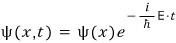
&&&&&&
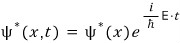
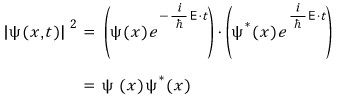
This means that ‘in the process of calculating expectation values, the Φ(t) term disappears in the same way,’
So when representing the wave function, we could also omit Φ(t).
That is, <x> comes out as a constant, and <p> comes out as 0.
Editorial clarification (2 October 2026): The single global time phase cancels in probability density and well-defined expectation values of time-independent observables. It must still be kept in the time-dependent Schrödinger equation, and relative phases between different energies cannot be discarded. For the usual one-dimensional normalizable bound state with finite position expectation and boundary conditions that justify \(d\langle x\rangle/dt=\langle p\rangle/m\), stationarity gives \(\langle p\rangle=0\). This is not universal: on a periodic ring of length \(L\), \(\psi_n=e^{2\pi inx/L}/\sqrt L\) is a stationary free-particle state with \(\langle p\rangle=2\pi n\hbar/L\), which is nonzero for \(n\ne0\). Its density is constant while its probability current circulates. The usual position argument needs different domain treatment on a ring. Ehrenfest conditions and MIT particle-on-a-circle notes.
In other words, we can say it represents a stationary state!!
- Separable solutions represent states in which the total energy of the given physical system is measured with certainty.
(In classical mechanics the total energy E (is it called mechanical energy?) is also expressed as a quantity called the Hamiltonian. $H(x,p) = p^2/2m + V(x)$)
But in quantum mechanics p is an operator, so
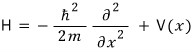
So so so the Time independent Schrödinger Eq is

(now I get why they picked E of all things for the constant)
And this is something you can see in the linear algebra posting,
Skipping the linear algebra background, when we think of the operator H as some linear map and stick the function ψ(x) onto it,
linear map × ψ(x) = constant × ψ(x),,,
In linear algebra, when we said Lx = λx,
For the linear map L,
x was the eigen vector and λ was the eigen value.
In quantum mechanics in the same context, in exactly the same way we call E the eigen value,
And ψ(x) the eigen vector. (Let’s call it eigen function.)
- When you solve the time-independent Schrödinger equation, actually an infinite number of solutions come out….
That is, the general solution can be said to be a linear combination of these,
The general solution can be said to be
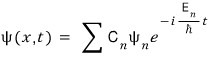
Editorial clarification (2 October 2026): The displayed sum is the energy-basis solution of the time-dependent equation when a complete discrete eigenbasis is available. Continuous spectrum requires spectral integrals, and degeneracy requires the corresponding extra labels; the potential, operator domain and boundary conditions determine the spectrum. Initial data determines the coefficients. Different-energy terms generally produce time-dependent interference, whereas a combination within one energy eigenspace retains a common phase. A normalized physical state in one eigenspace gives that energy with certainty; continuous-spectrum eigenfunctions are usually generalized modes rather than individually normalizable states. This discussion does not claim that every potential has infinitely many discrete bound energies, or that a sum over different energies solves a single fixed-energy eigenvalue equation. MIT spectral-expansion notes.
We can say it like this, but we’ll get to know this gradually,
Anyway, the solution is exac~~~tly the same as in electromagnetism so there’s nothing hard about it… hehe hahahaha
Editorial clarification (2 October 2026): The electromagnetism comparison concerns the separation-of-variables method. An electrostatic potential separated into two spatial factors obeys Laplace’s equation; here a wave function is separated into a spatial factor and a time factor under the Schrödinger equation. The electrostatic potential and the quantum potential energy also represent different physical quantities. Similar algebra does not make their equations, boundary conditions or physical solutions identical.
Then from the next posting on, continuously~~~~~
Depending on V(x), we’ll see how the state function ψ(x) falls out case by case,
And let’s try to catch even the physical meaning!!hehe
Fighting, fighting!!
Original post: Original Korean notes (11 August 2015).
Comments
Discussion happens via GitHub Discussions. You'll need a GitHub account to comment.