The Infinite Square Well
We dive into the infinite square well potential and nail down ψ(x) by slapping on boundary conditions — and honestly, it's basically the same math as electromagnetism lol.
Alright, as I announced earlier, we’re now going to deal with $V(x)$ case by case, and the very first potential case is… the infinite square well!!!
In the case of an infinite square potential, what shape does the wave function take~~~
Huh??! But wait, what was it we said we were solving case by case for $V(x)$…?
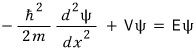
We’re going to find the $\psi(x)$ that satisfies this ODE!
An “infinitely deep square potential well” is this:
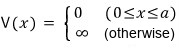
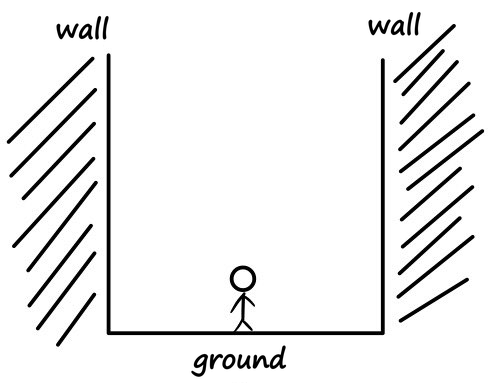
Well, just,,,, even though it’s not really okay to compare it like this,,,,, I think you could kind of picture a potential of $\infty$ like this.
Solving it, electromagnetism style
Anyway, $\psi(x)$ only has meaning between 0 and $a$, so let’s look at that case!!!
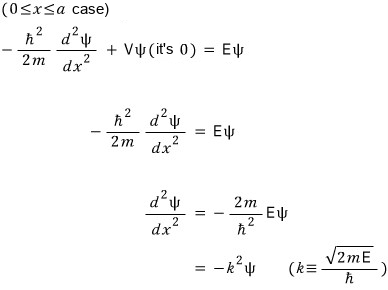
Dragging around too many letters is a pain to write, and I might make a mistake, so I’m just gonna bundle them all up into $k$ and drag that around. That is,
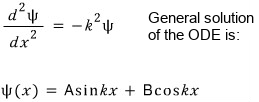
Aaaaaaagh, this is literally the same as in electromagnetism!!! Even $V(x)$ is the same, hehehe

The undetermined coefficients $A$ and $B$ of this: in electromagnetism we fit them piece by piece using Boundary Conditions, and it’s similar here too!
First, at $x = 0$ and $x = a$, the wave function $\psi(x)$ will be 0. That is, $\psi(0) = \psi(a) = 0$!
What else is there????? Well, there’s Normalization. We’ll tackle that gradually later on, so for now let’s apply the condition that the wave function $\psi(x)$ becomes 0 at $x = 0$ and $x = a$!

This gives us $B = 0$, so

We’ve got this far. Now if we use the $x = a$ condition
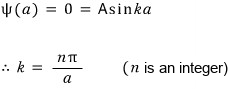
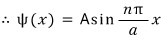
(Really, it’s exactly the same as electromagnetism…heh)
And again, and again, and again… is this the only solution?????
Nope, desu no-no!!!! A linear sum of these can also be a solution. So the general solution!!!! I’ll write it later. For now, Keep Going.
Wait, before that: what does it mean?
Now, while doing normalization, we just need to determine the undetermined coefficient $A$!!!! Wait, before that, let’s look at what kind of meaning the behavior of a particle in an infinitely deep potential well has. We’ll plug that general solution back into the differential equation
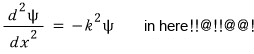
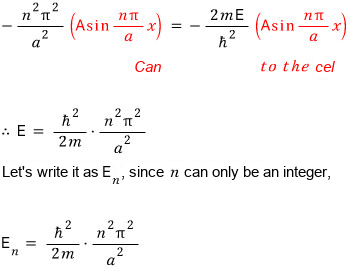
Since we came all the way here just following the equations, you might think “obviouslY”, but in fact………… we’ve arrived at a conclusion that is absolutely impossible to understand from common sense….. namely..
A particle trapped in an “infinitely deep square potential” cannot have arbitrary energy……!
The conclusion is that, depending on the length $a$ of the square potential well, the energies it can have are predetermined from the start….. wow! From here on out, quantum mechanics goes full mental-breakdown mode…. hehehehe lol
Normalization
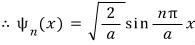
Alright, and now through normalization (so that $|\psi|^2$ becomes a probability density function, so that the statistical interpretation is meaningful!!!) let’s determine the undetermined coefficient $A$!!!
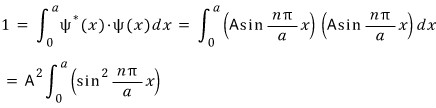
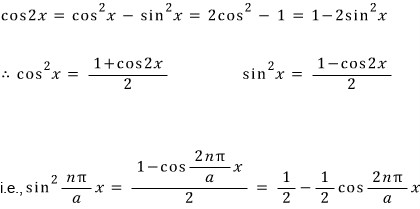
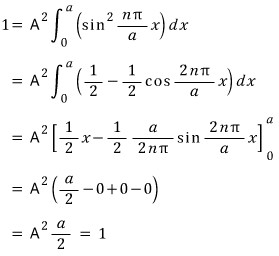
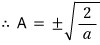
Whether $A$ is (+) or (-), it’s the same thing either way, so let’s just settle on  .
.
Ground state, excited states, nodes
And there are a few more fun things. First, as background, the state function  for $n = 1$ is called the Ground state, and the
  for $n = 2$ and up are called Excited states.
Hmm, b.u.t.
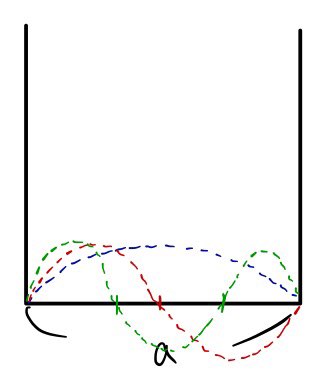
What I’m saying is that the state functions are determined like this!
Looking at this formula, even a fool would get it. Saying the same thing, “wave functions (state functions) change as $n = 1$, $n = 2$, $n = 3$ go up, as even function, odd function, even function ······· like this..” (even and odd around the middle of the well, I mean)
That is, in physics terms, you can say it like this: at $n = 1$, no nodes / at $n = 2$, 1 node / at $n = 3$, 2 nodes /·····/ at $n = k$, $k - 1$ nodes (the two ends of the well don’t count).
(I think there’s a mistranslation here. A node originally means something like an intersection point or a knot, and in the picture above I should have counted the points where it touches the ground, but both the translated edition of the book and I made the mistake of counting the number of waveforms. The numbers above are the corrected ones. Please be aware of this part!)
Orthogonal, Complete, and the General Solution
“Wave functions are orthogonal to each other!!!!” This means that the inner product of any two different ones is 0 (I caught on when using Fourier’s trick in electromagnetism), in an infinitely deep potential well!!!!
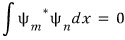
Now extending the meaning further,
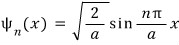
these are Complete with respect to each other. The solutions you get by solving the time-independent Schrödinger equation with $V(x)$ being the case of the infinite square well — those solutions are complete with respect to each other.
Actually…. when solving this kind of time-independent Schrödinger equation  , its solutions here are
That’s what it’s saying.
So with in mind, aren’t the $\psi$’s eigenfunctions of the $\hat{H}$ operator????
Just as eigenvectors are linearly independent of each other, here the eigenfunctions are linearly independent of each other!@!@!@@!!!!
(I’ll cover this in more detail in linear algebra T_T)
Now I’m going to write the general solution. The General Solution is a linear sum of these
which you write like this

And what does being complete tell us?
That you can write any wave function with these, in exactly one way: the General Solution is unique.
In formula form

there is absolutely no way to represent it by changing the constants!!! That’s what it’s saying.
I’ve been rambling on, spouting a bunch of bullshit above, but the “conclusion” is simple. The wave function  can be represented in terms of basis functions like ,
  ,
,  , ~~~~
And the representation is unique!!! Just!!!! one~~!!~!~ only one in the world~~~
Therefore
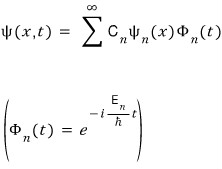
Fourier’s trick
One more thing aaaa!!!! I want to find  !!!! In electromagnetism we found the coefficients of functions, and using the same method as then, we’ll use Fourier’s trick.

Fourier’s trick, GoGo
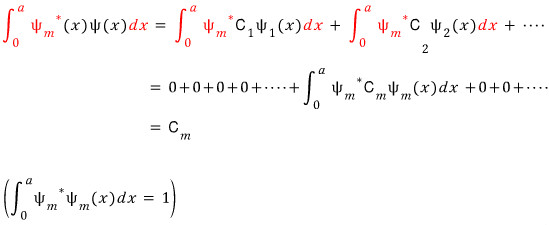
O~~~~kay, so now we know how to find $C_n$ too!!! Now let’s take a look at what it means! That meaning!!!!

So what do the C’s mean?
Now let’s figure out the meaning of $C_1$, $C_2$, $C_3$, …. inside that equation.
Since $C_1$ ~ $C_n$ are constants, how much stock (share) does the $\psi_n(x)$ placed in the $n$th position of the expansion of $\psi(x)$ hold in $\psi(x)$?!?!?!!!
Ahh, so $\psi(x)$ is a stock company.
So, this comes up in the next chapter (chapter 3), but the square of  is exactly the probability of having the energy
  , that’s how it can be interpreted.
(I’ll do the deep investigation in chapter 3)
That is, if you add up the squares of all the you get 1?!?!!!! (but we already know!! because we know how to normalize! hehehe)
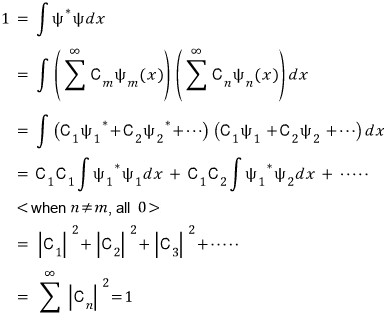
And I said the square of is the probability of having the energy , but you could also interpret it this way~!!
Okay~~ look over here. Let’s summon the Energy-measuring guy and ask him to find the energy of $\psi(x)$ for us!!!!
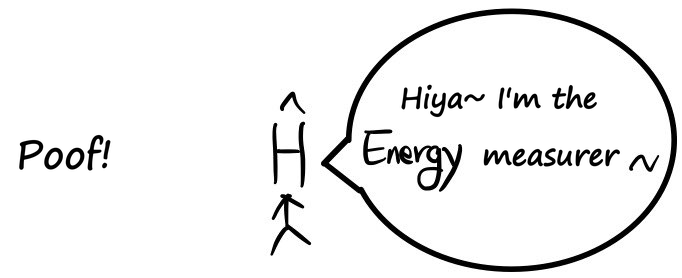
Hey, kid;;;; measure my $\psi(x)$’s energy for me~~~~
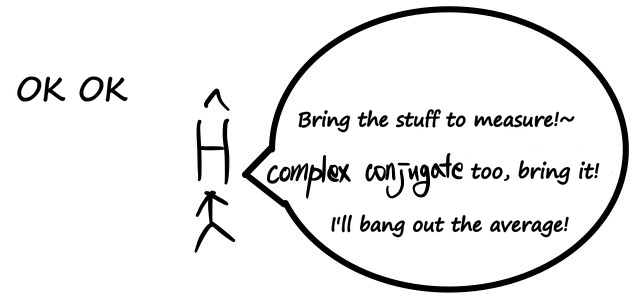
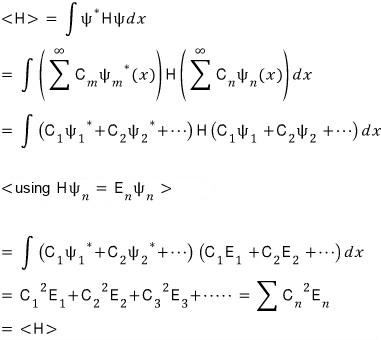
The final conclusion here, this part
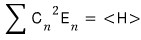
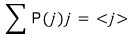
if you understand it in the same context as this one we did earlier!!!
Couldn’t we understand $|C_n|^2$ as ’the probability of having $E_n$'?
Time for an example
I solved example 2.2, but thinking about typing all of this out in the old equation editor is a bit overwhelming………. I’ll scan it and upload it. Anyway, the examples are things anyone can solve~~~~ easy hehe
(easy for everyone but me….T_T)
Ex) 2.2
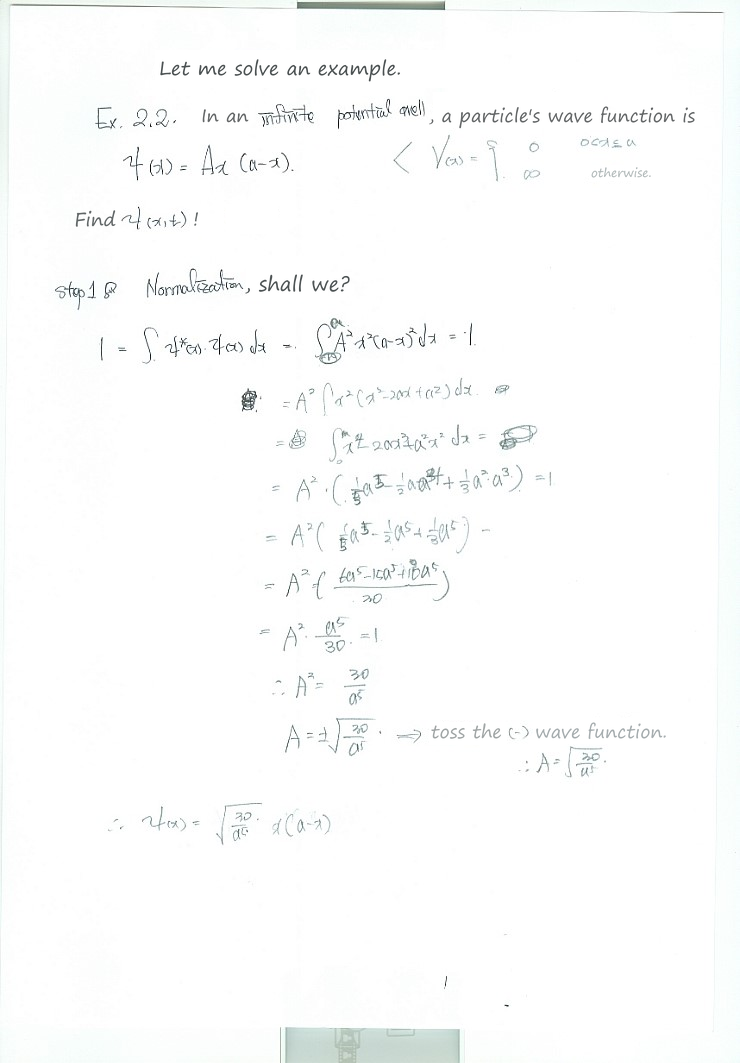
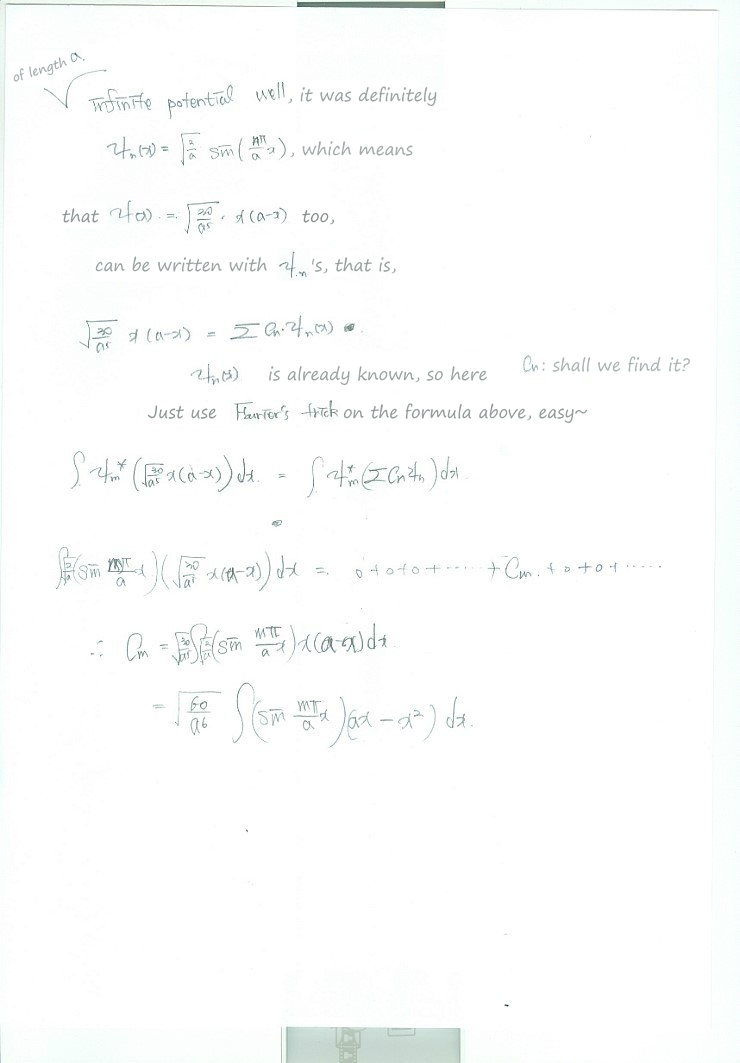
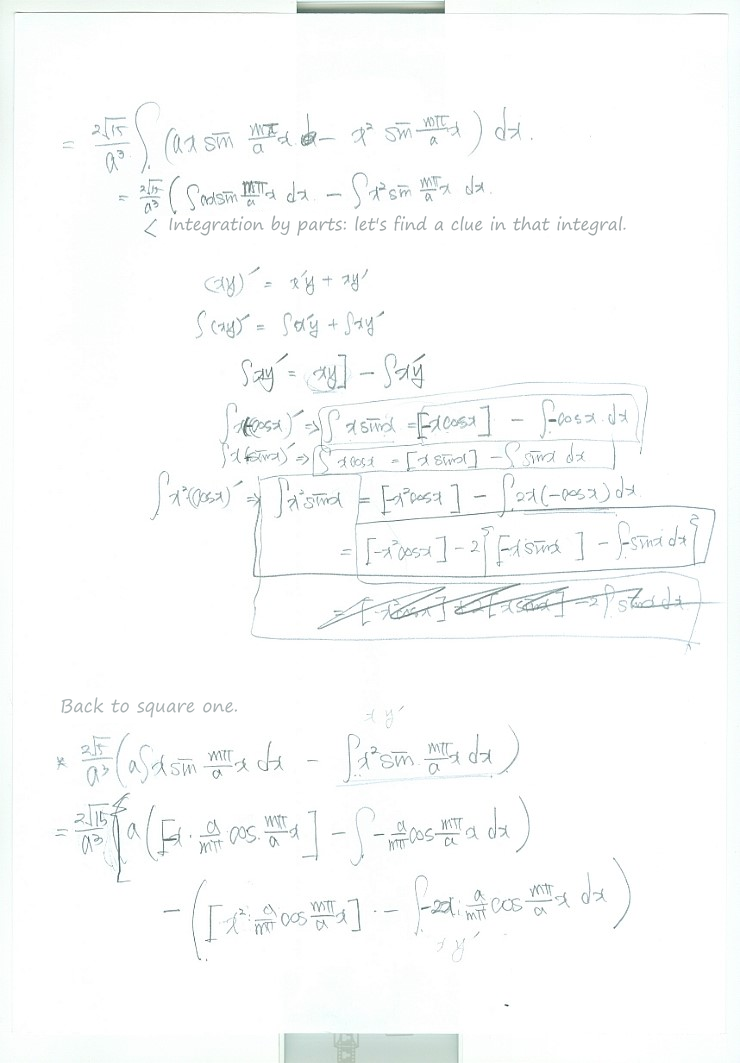
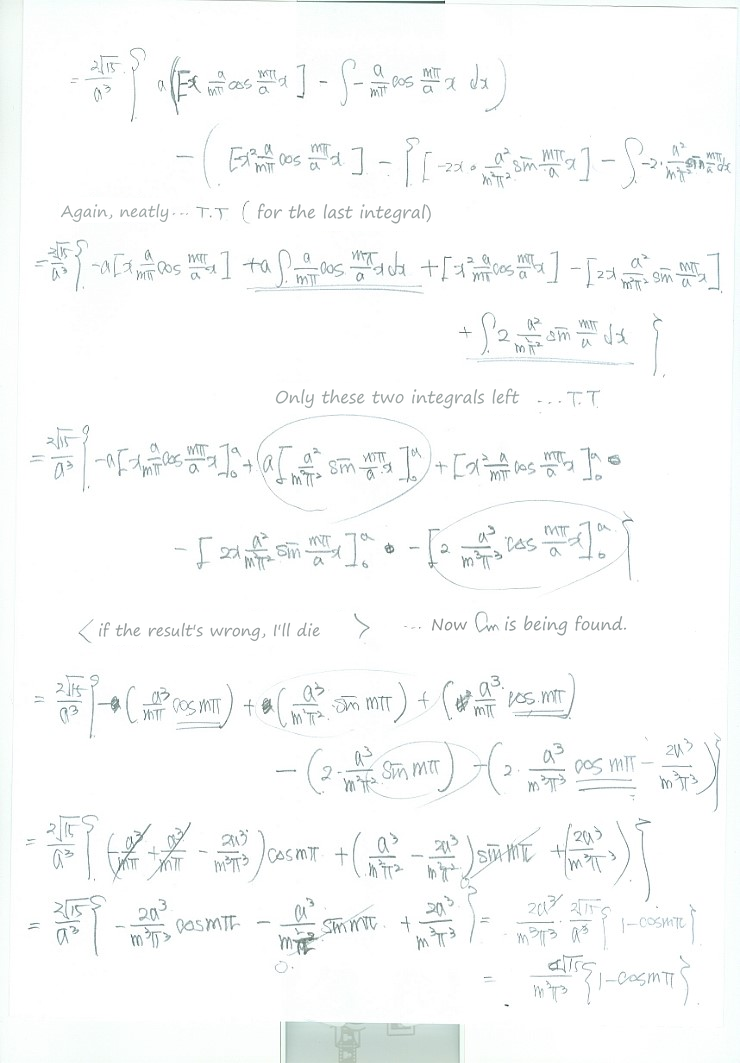
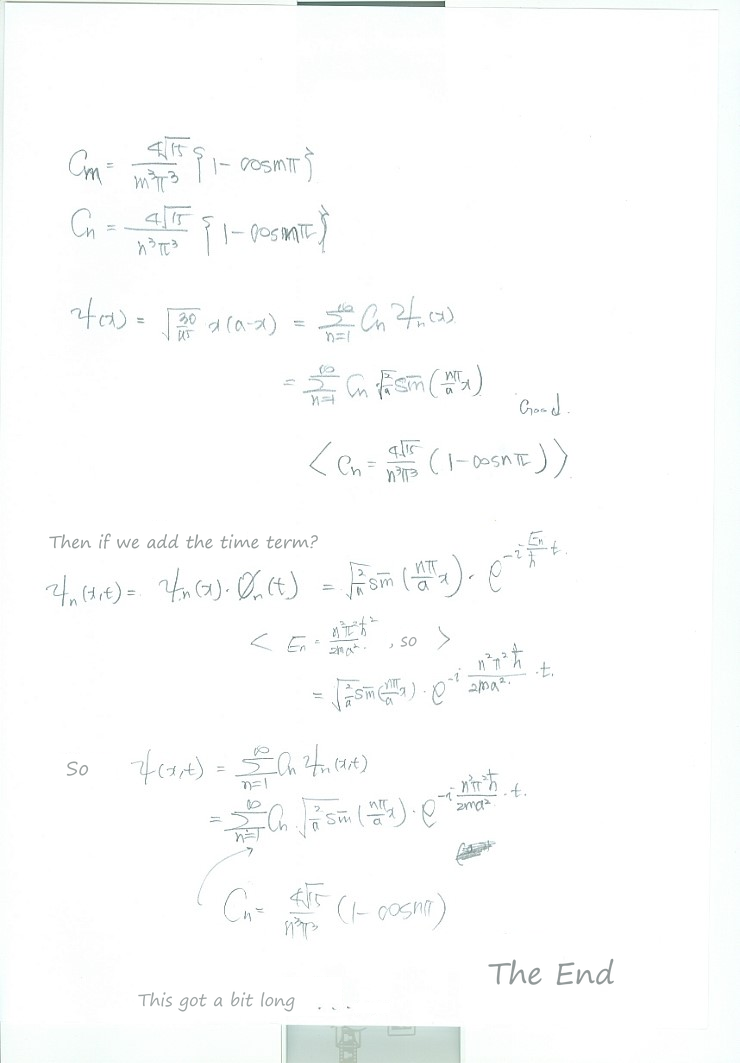
Heads-up. The figures here are the original notes, slips and all. A few things to watch for:
- In the normalization picture, the first sum carries complex conjugates, $\psi^* = \sum c_m^* \psi_m^*$, so the surviving terms are $c_n^* c_n = |c_n|^2$ and the result is $\sum |c_n|^2 = 1$.
- In the energy picture, after using $H\psi_n = E_n\psi_n$ the second bracket should read $(c_1E_1\psi_1 + c_2E_2\psi_2 + \cdots)$, and the result is $\sum |c_n|^2 E_n$.
- In the last handwritten note, the first line of $\Psi_n(x,t)$ should have $\sqrt{\frac{2}{a}}$, not $\sqrt{\frac{2}{n}}$; the next line has it right.
Comments
Discussion happens via GitHub Discussions. You'll need a GitHub account to comment.