The Harmonic Oscillator and Ladder Operators

We tackle case 2 of V(x) — the harmonic oscillator — unpack why springs are *everywhere* in physics, then get into ladder operators to solve it.

OK so as I said last time, we’re going through $V(x)$ case by case.

Case 1 was the infinite square well — the infinitely deep rectangular potential.

And now, case 2~~

The potential of the harmonic oscillator!!

Wait, huh?? But didn’t we say we’d go case by case for $V(x)$…?? (sob)

$$-\frac {\hbar^{2}}{2m}\frac {d^{2}\psi}{dx^{2}}\quad +\quad V\psi \quad =\quad E\psi$$

We want to find the $\psi(x)$ that solves this!!!!

$$V\quad =\quad \frac {1}{2}kx^{2}$$

This is the case we’re doing!!! Let me nerd out about it for a sec.

This is exactly the potential you get from a spring system. What I’m saying is, if the potential looks like

$$V\quad =\quad \frac {1}{2}kx^{2}$$

we’re in a force system governed by Hooke’s law!

Force obeying Hooke’s law means $x$ and $F$ have a clean linear relationship —

$$\overrightarrow {F}\quad =\quad -k\overrightarrow {x}$$

So plugging into Newton’s second,

$$F\quad =\quad ma\quad =\quad m\frac {d^{2}x}{dt^{2}}\quad =\quad -kx$$

and the $x(t)$ that satisfies this is

$$x(t)\quad =\quad A\sin\omega t\quad +\quad B\cos\omega t\quad \left(\omega=\sqrt {\frac {k}{m}}\right)$$

But… does a system acted on by exactly this kind of force actually exist out there in nature..??… hahaha

Probably not, right? A perfectly linear restoring force is kind of a fairy tale.

So why does my entire physics department go spring spring spring from day-one enrollment all the way to graduation spring spring spring — why is it like that?!

Here’s why springs matter:

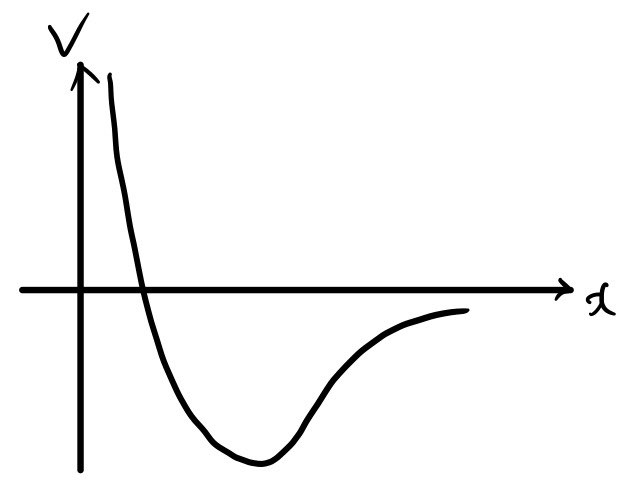
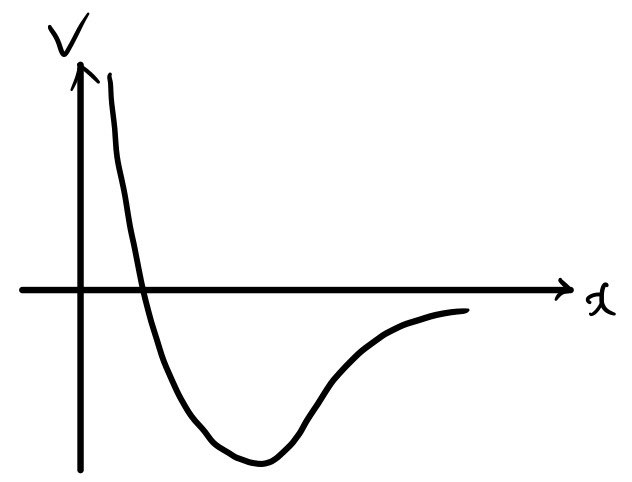
Look at the carbon-carbon potential. First impression —

ah ok, first of all, it is not

$$V\quad =\quad \frac {1}{2}kx^{2}$$

Nope. Not even close.

Hmm~~~ BUT!!

We’re going to Taylor-expand it. And where do we expand?

At the $x$ where $V(x)$ sits at its minimum!

$$V(x)\quad =\quad V(x_{0})\quad +\quad V'(x_{0})(x-x_{0})\quad +\frac {1}{2!}\quad V''(x_{0})(x-x_{0})^{2}\quad +\quad \cdots$$

At the minimum the slope is zero, so the red term dies!!

$$\therefore \quad V(x)\quad \cong \quad V(x_{0})\quad +\frac {1}{2!}\quad V''(x_{0})(x-x_{0})^{2}$$

That’s the approximation we’re going with!!

Oh, and the blue one~~~ since it’s the potential at the bottom of the well, we’re free to set that zero point wherever we want. Kill it.

And that $V''$ that survives — that’s literally playing the role of the spring constant $k$.

So even when there’s no actual spring attached, there are tons of situations in nature you can treat as if a spring is attached. That’s why the spring system matters!!!!!

I feel like I’ve written this same speech all over the place on this blog… I’ll stop.

Back to the main event.

The (time-independent) Schrödinger equation
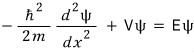
$$-\frac {\hbar^{2}}{2m}\frac {d^{2}\psi}{dx^{2}}\quad +\quad V\psi \quad =\quad E\psi$$

and into this we’re plugging

$$V\quad =\quad \frac {1}{2}kx^{2}\quad =\quad \frac {1}{2}\left( m\omega^{2} \right) x^{2}$$

Which gives:

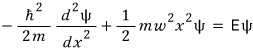
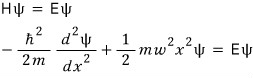
$$-\frac {\hbar^{2}}{2m}\frac {d^{2}\psi}{dx^{2}}+\frac {1}{2}m\omega^{2}x^{2}\psi \quad =\quad E\psi$$

And now all we have to do is solve this second-order ODE……………. hah………… this feels rough………..

There’s an $x^2$ in there, so finding the solution is a liiittle spicy!

For this problem, our physics ancestors came up with a million different methods. We’re going to learn the two that sit at opposite ends of the spectrum.

Method 1 — I’ll call it The Super Clever Method!!!!

We’re gonna try to be cle~~~~verly sneaky and crack the problem that way.

Method 2 — The Armored Tank Method!!!!!

Just slam straight through, no finesse, crush everything in the way!!!

Slamming and crushing means I’m the one getting slammed and crushed, by the way… heh.

(Is there a royal road in getting through life? Nope. Walk the Right Road!!! I recommend method 2.)

OK. Let’s get into 1. The Super Clever Method!!!!!

Diving in. Setting up the equation:

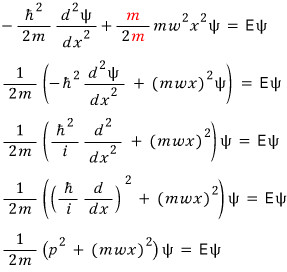
$$H\psi \quad =\quad E\psi \\ -\frac {\hbar^{2}}{2m}\frac {d^{2}\psi}{dx^{2}}+\frac {1}{2}m\omega^{2}x^{2}\psi \quad =\quad E\psi$$$$-\frac {\hbar^{2}}{2m}\frac {d^{2}\psi}{dx^{2}}+\frac {m}{2m}m\omega^{2}x^{2}\psi \quad =\quad E\psi \\ \frac {1}{2m}\left( -\hbar^{2}\frac {d^{2}\psi}{dx^{2}}\quad +\quad (m\omega x)^{2}\psi \right) \quad =\quad E\psi \\ \frac {1}{2m}\left( \frac {\hbar^{2}}{i}\frac {d^{2}}{dx^{2}}\quad +\quad (m\omega x)^{2} \right) \psi \quad =\quad E\psi \\ \frac {1}{2m}\left( \left( \frac {\hbar}{i}\frac {d}{dx} \right)^{2}\quad +\quad (m\omega x)^{2} \right) \psi \quad =\quad E\psi \\ \frac {1}{2m}\left( p^{2}\quad +\quad (m\omega x)^{2} \right) \psi \quad =\quad E\psi$$

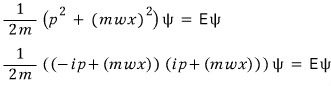
Getting this far is chill!!! Now I’m gonna factor it.

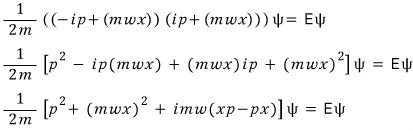
$$\frac {1}{2m}\left( p^{2}\quad +\quad (m\omega x)^{2} \right) \psi \quad =\quad E\psi \\ \frac {1}{2m}\left( \left( -ip+\left( m\omega x \right) \right) \left( ip+\left( m\omega x \right) \right) \right) \psi \quad =\quad E\psi$$

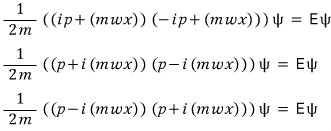
(cf.) Not only this particular ordering — any of these three would work out the same way:

$$\frac {1}{2m}\left( \left( ip+\left( m\omega x \right) \right) \left( -ip+\left( m\omega x \right) \right) \right) \psi \quad =\quad E\psi \\ \frac {1}{2m}\left( \left( p+i\left( m\omega x \right) \right) \left( p-i\left( m\omega x \right) \right) \right) \psi \quad =\quad E\psi \\ \frac {1}{2m}\left( \left( p-i\left( m\omega x \right) \right) \left( p+i\left( m\omega x \right) \right) \right) \psi \quad =\quad E\psi$$

Hold on!!!!!!!!!!!!!!!!!!!!!@@!@!@!@!@!@!!!!@@!

Is this factoring even legal?!?!?!!!!!!!!!!!!!!!!!!!!!!!!!!!!!!!!!!!!!!!!!!!

Let’s expand it back and see:

$$\frac {1}{2m}\left( \left( -ip+\left( m\omega x \right) \right) \left( ip+\left( m\omega x \right) \right) \right) \psi \quad =\quad E\psi \\ \frac {1}{2m}\left[ p^{2}\quad -\quad ip(m\omega x)\quad +\quad (m\omega x)ip\quad +\quad (m\omega x)^{2} \right] \psi \quad =\quad E\psi \\ \frac {1}{2m}\left[ p^{2}+\quad (m\omega x)^{2}\quad +\quad im\omega(xp-px) \right] \psi \quad =\quad E\psi$$

And here’s where the problem shows up……

The thing is — $p$ and $x$ here aren’t just “values! (numbers)”. They’re operators. So

$$px\neq xp$$

A thing like $xp - px$ between operators has a name: it’s called the commutator. We write it

$$xp - px = [x, p]$$

And physically what it means is — for a state $\psi$, “which one you measure first, and then what’s left for you to measure afterwards” — the order matters. The outcomes differ.

That’s the rough idea.

So — not for some random operators $Q$, $T$, but specifically!!!! for $p$ and $x$ — let’s see what $(xp - px)$ reduces to after it finishes doing all~~~ its work as an operator.

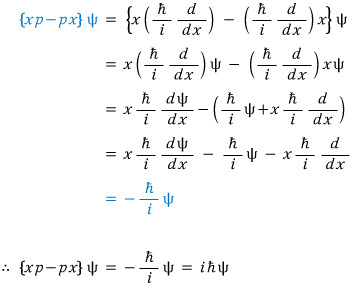
$$\begin{aligned}\left\{xp-px \right\} \psi \quad &=\quad \left\{x\left( \frac {\hbar}{i}\frac {d}{dx} \right) \quad -\quad \left( \frac {\hbar}{i}\frac {d}{dx} \right) x \right\} \psi \\ &=\quad x\left( \frac {\hbar}{i}\frac {d}{dx} \right) \psi \quad -\quad \left( \frac {\hbar}{i}\frac {d}{dx} \right) x\psi \\ &=\quad x\frac {\hbar}{i}\frac {d\psi}{dx}-\left( \frac {\hbar}{i}\psi +x\frac {\hbar}{i}\frac {d\psi}{dx} \right) \\ &=\quad x\frac {\hbar}{i}\frac {d\psi}{dx}\quad -\quad \frac {\hbar}{i}\psi \quad -\quad x\frac {\hbar}{i}\frac {d\psi}{dx} \\ &=\quad -\frac {\hbar}{i}\psi \\ \therefore \quad \left\{xp-px \right\} \psi \quad &=\quad -\frac {\hbar}{i}\psi \quad =\quad i\hbar \psi\end{aligned}$$

Strip the $\psi$ off the cloak~~~

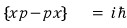
$$\left\{xp-px \right\} \quad =\quad i\hbar$$

Hmm~~~ so plugging back into our equation:

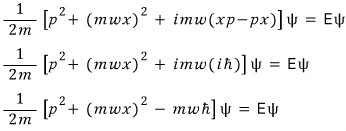
$$\frac {1}{2m}\left[ p^{2}+\quad (m\omega x)^{2}\quad +\quad im\omega(xp-px) \right] \psi \quad =\quad E\psi \\ \frac {1}{2m}\left[ p^{2}+\quad (m\omega x)^{2}\quad +\quad im\omega(i\hbar ) \right] \psi \quad =\quad E\psi \\ \frac {1}{2m}\left[ p^{2}+\quad (m\omega x)^{2}\quad -\quad m\omega\hbar \right] \psi \quad =\quad E\psi$$

Since we’re doing this for $x$ and $p$, this is how it ends up!!! Might as well write it this way, since that’s where it lands anyway.

OK so now — how do we actually solve this thing sitting in the Schrödinger equation~~

Honestly? I don’t know.. (sob)

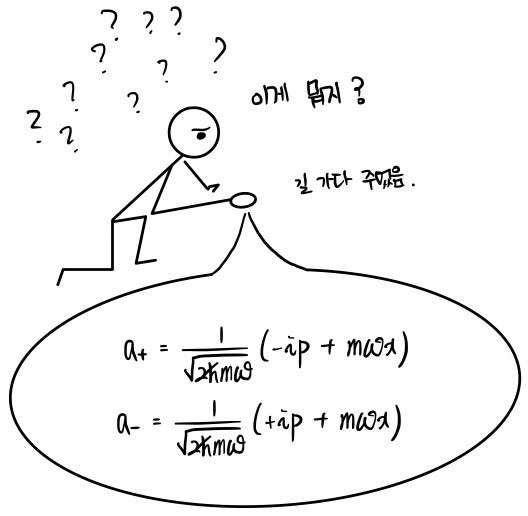
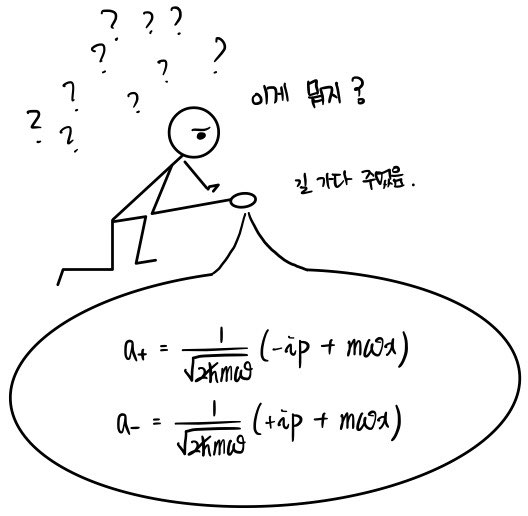
A regular person, a commoner, a random civilian like me has no clue how the formula on the next page magically appears.

So.

Let’s just say some “new operator” built out of operators fell from the sky — plop! — and I picked it up while walking down the road haha

Oho, what’s this? You’re telling me those two operators spit out that formula up there?

OK, let’s check it out right now!

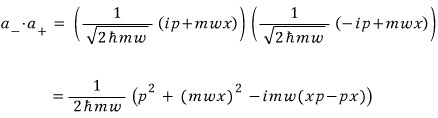
$$a_{-}\cdot a_{+}\quad =\quad \left( \frac {1}{\sqrt {2\hbar m\omega}}\left( ip+m\omega x \right) \right) \left( \frac {1}{\sqrt {2\hbar m\omega}}\left( -ip+m\omega x \right) \right) \\ \quad \\ \quad =\frac {1}{2\hbar m\omega}\left( p^{2}\quad +\quad (m\omega x)^{2}\quad -im\omega(xp-px) \right)$$

Ohoooo~~~~~ a term that looks exactly like the one from before pops out, right?!?!!?!!

Yeah. So what we’re gonna do is take the calculation that couldn’t move because of the operator-ordering issue, and patch it up piece by piece using these newly-picked-up operators $a_+, a_-$.

Now let’s slowly walk back to the Schrödinger equation with the New Operators!!!

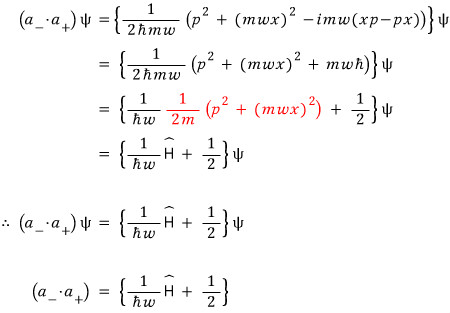
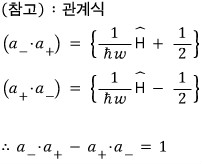
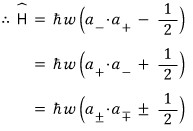
$$\begin{aligned}\left( a_{-}\cdot a_{+} \right) \psi \quad &=\left\{\frac {1}{2\hbar m\omega}\left( p^{2}\quad +\quad (m\omega x)^{2}\quad -im\omega(xp-px) \right) \right\} \psi \\ &=\quad \left\{\frac {1}{2\hbar m\omega}\left( p^{2}\quad +\quad (m\omega x)^{2}\quad +\quad m\omega\hbar \right) \right\} \psi \\ &=\quad \left\{\frac {1}{\hbar \omega}\frac {1}{2m}\left( p^{2}\quad +\quad (m\omega x)^{2} \right) \quad +\quad \frac {1}{2} \right\} \psi \\ &=\quad \left\{\frac {1}{\hbar \omega}\hat {H}\quad +\quad \frac {1}{2} \right\} \psi \\ \therefore \quad \left( a_{-}\cdot a_{+} \right) \psi \quad &=\quad \left\{\frac {1}{\hbar \omega}\hat {H}\quad +\quad \frac {1}{2} \right\} \psi \\ \left( a_{-}\cdot a_{+} \right) \quad &=\quad \left\{\frac {1}{\hbar \omega}\hat {H}\quad +\quad \frac {1}{2} \right\}\end{aligned}$$$$(\text{reference})\quad :\quad \text{relations}\\ \left( a_{-}\cdot a_{+} \right) \quad =\quad \left\{\frac {1}{\hbar \omega}\hat {H}\quad +\quad \frac {1}{2} \right\} \\ \left( a_{+}\cdot a_{-} \right) \quad =\quad \left\{\frac {1}{\hbar \omega}\hat {H}\quad -\quad \frac {1}{2} \right\} \\ \therefore \quad a_{-}\cdot a_{+}\quad -\quad a_{+}\cdot a_{-}\quad =\quad 1$$$$\begin{aligned}\therefore \quad \hat {H}\quad &=\quad \hbar \omega\left( a_{-}\cdot a_{+}\quad -\quad \frac {1}{2} \right) \\ &=\quad \hbar \omega\left( a_{+}\cdot a_{-}\quad +\quad \frac {1}{2} \right) \\ &=\quad \hbar \omega\left( a_{\pm}\cdot a_{\mp}\quad \pm \quad \frac {1}{2} \right)\end{aligned}$$

Sweet!!!! Using these new $x, p$-built operators $a_-$ and $a_+$ that we picked up off the street with no idea what they were —

we just expressed the Hamiltonian!!!!!!!

So now we can rewrite the Time-Independent Schrödinger Equation with the New Operators:

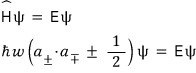
$$\hat {H}\psi \quad =\quad E\psi \\ \hbar \omega\left( a_{\pm}\cdot a_{\mp}\quad \pm \quad \frac {1}{2} \right) \psi \quad =\quad E\psi$$

Done! heh

We’ve got the Schrödinger equation written in terms of the new operators. So now let’s actually figure out what those new operators do.

To spoil the ending: these two are called the Ladder Operators. Let me show you why.

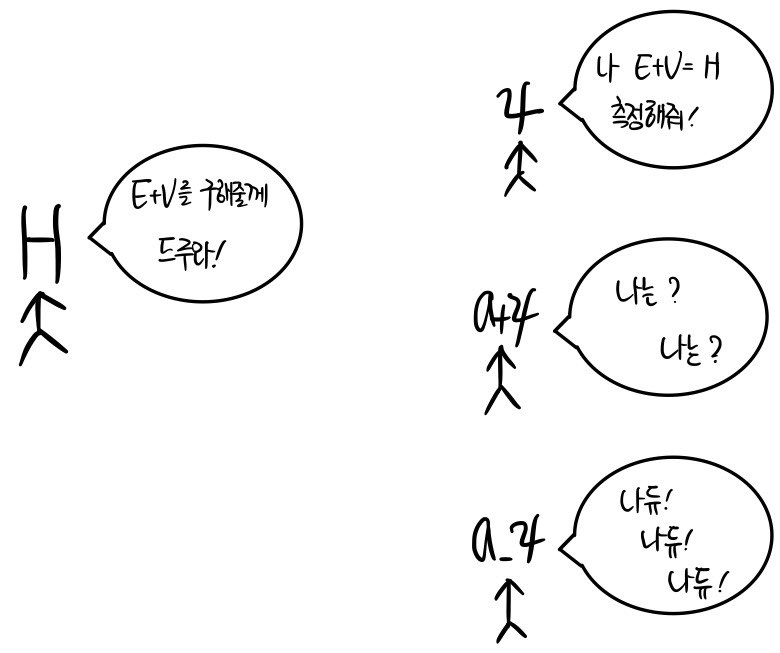
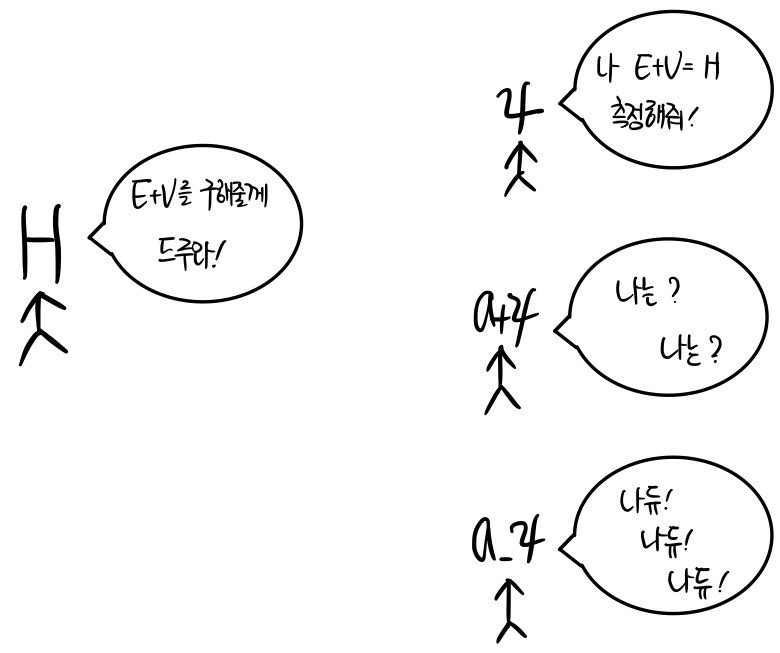
The Energy Measurement Guy

I’m gonna call this guy up and commission a measurement.

What I’m asking him to measure is

$$\left( a_{+}\psi \right)$$

I want the energy measured for this state!!!!! → (let’s see what eigenvalue shows up)

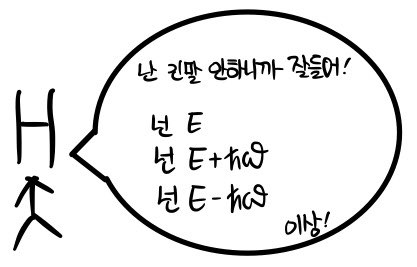
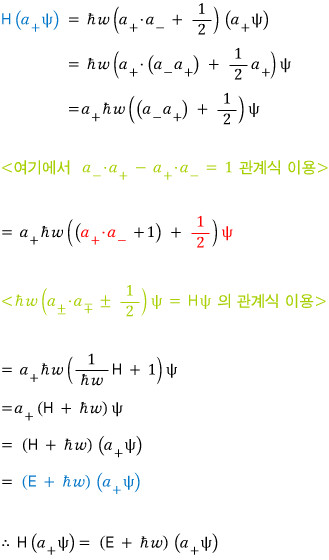
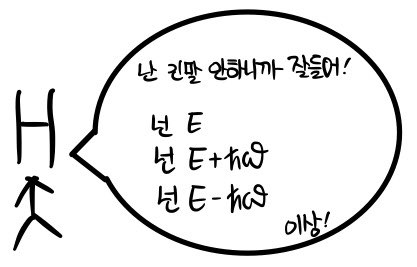
$$\begin{aligned}H\left( a_{+}\psi \right) \quad &=\quad \hbar \omega\left( a_{+}\cdot a_{-}\quad +\quad \frac {1}{2} \right) \left( a_{+}\psi \right) \\ &=\quad \hbar \omega\left( a_{+}\cdot \left( a_{-}a_{+} \right) \quad +\quad \frac {1}{2}a_{+} \right) \psi \\ &=a_{+}\hbar \omega\left( \left( a_{-}a_{+} \right) \quad +\quad \frac {1}{2} \right) \psi \end{aligned}$$$$\langle \text{using }\quad a_{-}\cdot a_{+}\quad -\quad a_{+}\cdot a_{-}\quad =\quad 1\quad \text{here} \rangle$$$$=\quad a_{+}\hbar \omega\left( \left( a_{+}\cdot a_{-}\quad +1 \right) \quad +\quad \frac {1}{2} \right) \psi $$$$\langle \text{using }\quad \hbar \omega\left( a_{\pm}\cdot a_{\mp}\quad \pm \quad \frac {1}{2} \right) \psi \quad =\quad H\psi \rangle$$$$\begin{aligned}&=\quad a_{+}\hbar \omega\left( \frac {1}{\hbar \omega}H\quad +\quad 1 \right) \psi \\ &=a_{+}\left( H\quad +\quad \hbar \omega \right) \psi \\ &=\quad \left( H\quad +\quad \hbar \omega \right) \left( a_{+}\psi \right) \\ &=\quad \left( E\quad +\quad \hbar \omega \right) \left( a_{+}\psi \right)\\ \therefore \quad H\left( a_{+}\psi \right) &=\quad \left( E\quad +\quad \hbar \omega \right) \left( a_{+}\psi \right)\end{aligned}$$

And in the exact same way, if we commission a measurement for

$$\left( a_{-}\psi \right)$$

we get

$$H\left( a_{-}\psi \right) =\quad \left( E\quad -\quad \hbar \omega \right) \left( a_{-}\psi \right)$$

Boom.

And if I re-explain the whole situation with my signature look-like-I’m-on-drugs cartoon —

So — why are $a_+$ and $a_-$ called the ladder operators?

$a_+$ is called the raising operator, or equivalently the creation operator,

(( since $\hbar\omega$ is the energy of one photon, you can say it creates one photon’s worth of energy ))

$a_-$ is called the lowering operator, or the annihilation operator

(( because it kills off one photon’s worth of energy ))

Together, $a_+$ and $a_-$ are the ladder operators… heh.

OK so — once we’ve got any particular solution, and we just keep~~~~ hammering the lowering operator onto that $\psi(x)$, at some point the energy is gonna hit 0.

The moment $E + V = 0$ is supposedly going to arrive.

BUT! There is no physical system — none — where $E + V = 0$!!!!! (You’ll see why as we go further. You might already know.)

Ahhh so — the particle’s ground state,

$$\psi_{0}(x)$$

if you hit this with the lowering operator one more time, it has to give 0.

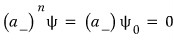
$$\left( a_{-} \right)^{n}\psi \quad =\quad \left( a_{-} \right) \psi_{0}\quad =\quad 0$$

We just have to accept this!! ….

Sure sure! Fine, accepting!!

Using the same machinery to describe the ground state — since

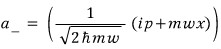
$$a_{-}\quad =\quad \left( \frac {1}{\sqrt {2\hbar m\omega}}\left( ip+m\omega x \right) \right)$$

we get

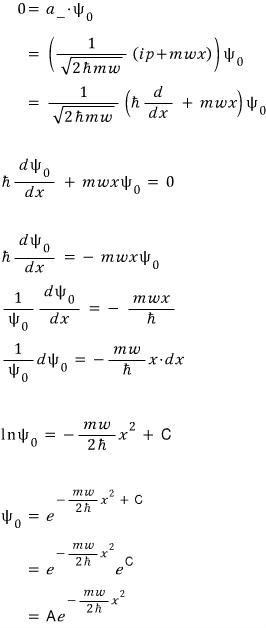
$$\begin{aligned}0&=\quad a_{-}\cdot \psi_{0}\\ &=\quad \left( \frac {1}{\sqrt {2\hbar m\omega}}\left( ip+m\omega x \right) \right) \psi_{0}\\ &=\quad \frac {1}{\sqrt {2\hbar m\omega}}\left( \hbar \frac {d}{dx}\quad +\quad m\omega x \right) \psi_{0}\end{aligned} \\ \hbar \frac {d\psi_{0}}{dx}\quad +\quad m\omega x\psi_{0}\quad =\quad 0 \\ \hbar \frac {d\psi_{0}}{dx}\quad =\quad -\quad m\omega x\psi_{0}\\ \frac {1}{\psi_{0}}\frac {d\psi_{0}}{dx}\quad =\quad -\quad \frac {m\omega x}{\hbar}\\ \frac {1}{\psi_{0}}d\psi_{0}\quad =\quad -\frac {m\omega}{\hbar}x\cdot dx \\ \ln\psi_{0}\quad =\quad -\frac {m\omega}{2\hbar}x^{2}\quad +\quad C\\ \begin{aligned}\psi_{0}\quad &=\quad e^{-\frac {m\omega}{2\hbar}x^{2}\quad +\quad C}\\ &=\quad e^{-\frac {m\omega}{2\hbar}x^{2}}e^{C}\\ &=\quad Ae^{-\frac {m\omega}{2\hbar}x^{2}}\end{aligned}$$

The ground-state wave function $\psi_0$ we just found — its square has to have meaning as a probability.

So let’s normalize!!!!! Time to pin down that undetermined $A$. Let’s go!

$$\int _{-\infty}^{\infty}{\left| \psi_{0} \right|^{2}}dx\quad =\quad A^{2}\int _{-\infty}^{\infty}{e^{-\frac {m\omega}{\hbar}x^{2}}}dx\quad =\quad 1$$

That integral has to go through the Gaussian!!!!!!

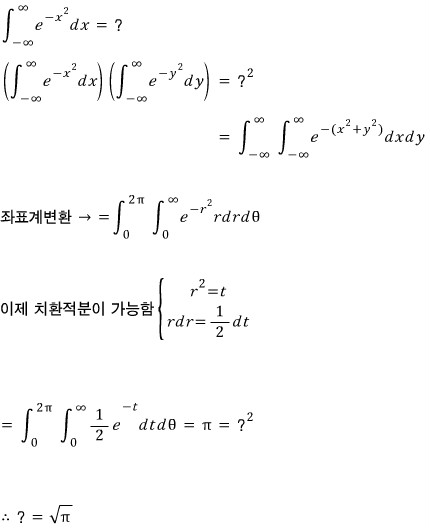
We’ve used Gaussian integration before, but let me show the most bulletproof way to do it one more time:

$$\int _{-\infty}^{\infty}{e^{-x^{2}}}dx\quad =\quad ?$$$$\begin{aligned}\left( \int _{-\infty}^{\infty}{e^{-x^{2}}}dx \right) \left( \int _{-\infty}^{\infty}{e^{-y^{2}}}dy \right) \quad &=\quad ?^{2}\\ &=\quad \int _{-\infty}^{\infty}{\quad}\int _{-\infty}^{\infty}{e^{-(x^{2}+y^{2})}}dxdy\end{aligned}$$$$\text{switch to polar}\quad \to \quad =\int _{0}^{2\pi}{\quad}\int _{0}^{\infty}{e^{-r^{2}}}r\,dr\,d\theta$$$$\text{now } u\text{-sub works}\begin{cases}{r^{2}=t}\\{r\,dr=\frac {1}{2}dt}\end{cases}$$$$=\quad \int _{0}^{2\pi}{\quad}\int _{0}^{\infty}{\frac {1}{2}e^{-t}dt}d\theta \quad =\quad \pi \quad =\quad ?^{2} \\ \therefore \quad ?\quad =\quad \sqrt {\pi}$$

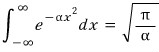
More generally,

$$\int _{-\infty}^{\infty}{e^{-\alpha x^{2}}}dx\quad =\quad \sqrt {\frac {\pi}{\alpha}}$$

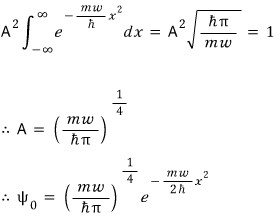
Apply that same trick to our integral:

$$A^{2}\int _{-\infty}^{\infty}{e^{-\frac {m\omega}{\hbar}x^{2}}}dx\quad =\quad A^{2}\sqrt {\frac {\hbar \pi}{m\omega}}\quad =\quad 1\quad \\ \therefore \quad A\quad =\quad \left( \frac {m\omega}{\hbar \pi} \right)^{\frac {1}{4}}\\ \therefore \quad \psi_{0}\quad =\quad \left( \frac {m\omega}{\hbar \pi} \right)^{\frac {1}{4}}e^{-\frac {m\omega}{2\hbar}x^{2}}$$

OK so now we’ve got the full shape of the wave function (state function). Shall we measure the energy?!!!!?!!

Helloooo~~~~~

$$H\psi_{0}\quad =\quad E_{0}\psi_{0}$$$$\hat {H}\quad =\quad \hbar \omega\left( a_{-}\cdot a_{+}\quad -\quad \frac {1}{2} \right) \quad =\quad \hbar \omega\left( a_{+}\cdot a_{-}\quad +\quad \frac {1}{2} \right)$$

Either version works — which one do we use? The second one is way more convenient heh. ($a_-$ kills $\psi_0$, remember?)

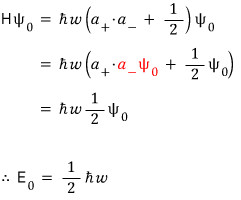
$$\begin{aligned}H\psi_{0}\quad &=\quad \hbar \omega\left( a_{+}\cdot a_{-}\quad +\quad \frac {1}{2} \right) \psi_{0}\\ &=\quad \hbar \omega\left( a_{+}\cdot a_{-}\psi_{0}\quad +\quad \frac {1}{2}\psi_{0} \right) \\ &=\quad \hbar \omega\frac {1}{2}\psi_{0}\end{aligned}$$$$\therefore \quad E_{0}\quad =\quad \frac {1}{2}\hbar \omega$$

Originally written in Korean on my Naver blog (2015-08). Translated to English for gdpark.blog.