Ladder Operators

We pick up the ladder-operator trick to climb from the ground state through every ψ_n, then chase down the normalization constants c_n and d_n purely in terms of n.

Quick recap of where we left off:

If all we know is the mass $m$ and the fact that the potential has some characteristic frequency

$$w$$

then the state function of the particle in there is —

well, at least the ground state, we can pin down!! That was the deal.

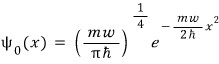
$$\psi_{0}(x)\quad =\quad \left( \frac{mw}{\pi \hbar} \right)^{\frac{1}{4}}e^{-\frac{mw}{2\hbar}x^{2}}$$

and the energy at that point is

$$E_{0}\quad =\quad \frac{1}{2}\hbar w$$

What let us get this far? It was the whole ladder-operator trick — that’s what cracked it open.

And the assumption that got us there: we assumed the wave function was time-independent, did the variational thing, and rode the time-independent Schrödinger equation all the way here!
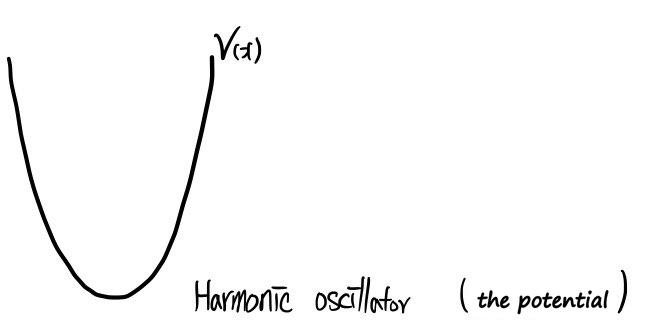
OK, so now that we’ve got the ground state, by hitting it with the raising operator — one, then one more, then one more — from $\psi_0$ on up, we can in principle reach

$$\psi_{n}(x)$$

all of them~~~ in full detail!

But!! We’d have to normalize every single time, right?! Ughhh.

So

$$\psi_{1}(x)\quad =\quad A_{1}\left( a_{+} \right) \psi_{0}(x)$$

and stepping up one little notch at a time like this,

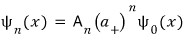
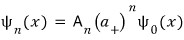
$$\psi_{n}(x)\quad =\quad A_{n}\left( a_{+} \right)^{n}\psi_{0}(x)$$

in general we can write it this way!

The energy at each level we’ve already figured out. Ground state energy is

$$E_{0}\quad =\quad \frac{1}{2}\hbar w$$

and every time we hit it with

$$\left( a_{+} \right)$$

the energy bumps up by

$$\hbar w$$

and every time we hit it with

$$\left( a_{-} \right)$$

it bumps down by

$$\hbar w$$

— we did all of this before — so

$$E_{n}\quad =\quad \frac{1}{2}\hbar w\quad +\quad n\hbar w\quad =\quad \left( \frac{1}{2}+n \right) \hbar w$$

yep, that’s the clean form.

OK so ultimately, the constants

$$A_{n}$$

— what do they turn into every time we apply the raising operator? Let’s see if we can write those in terms of $n$ too!

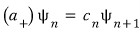
$$\left( a_{+} \right) \psi_{n}\quad =\quad c_{n}\psi_{n+1}$$

&

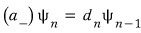
$$\left( a_{-} \right) \psi_{n}\quad =\quad d_{n}\psi_{n-1}$$

From here, what we need is $c_n$ and $d_n$!!!!

($c_n$ and $d_n$ are the constants you’d have to pin down by normalizing in each state — the real question is whether we can express them purely in terms of the principal quantum number $n$!!!!)

To get there, first we need this little fact:

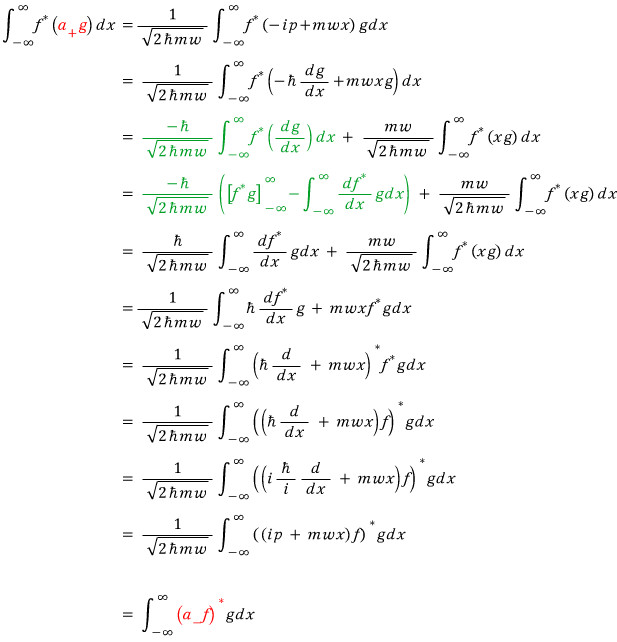
$$\begin{aligned} \int_{-\infty}^{\infty}{f^{*}\left( a_{+}g \right)}dx &= \frac{1}{\sqrt{2\hbar mw}}\int_{-\infty}^{\infty}{f^{*}\left( -ip+mwx \right) g}dx \\ &= \frac{1}{\sqrt{2\hbar mw}}\int_{-\infty}^{\infty}{f^{*}\left( -\hbar \frac{dg}{dx}+mwxg \right)}dx \\ &= \frac{-\hbar}{\sqrt{2\hbar mw}}\int_{-\infty}^{\infty}{f^{*}\left( \frac{dg}{dx} \right) dx}\quad +\quad \frac{mw}{\sqrt{2\hbar mw}}\int_{-\infty}^{\infty}{f^{*}\left( xg \right)}dx \\ &= \frac{-\hbar}{\sqrt{2\hbar mw}}\left( \left[ f^{*}g \right]_{-\infty}^{\infty}-\int_{-\infty}^{\infty}{\frac{df^{*}}{dx}gdx} \right)\quad +\quad \frac{mw}{\sqrt{2\hbar mw}}\int_{-\infty}^{\infty}{f^{*}\left( xg \right)}dx \\ &= \frac{\hbar}{\sqrt{2\hbar mw}}\int_{-\infty}^{\infty}{\frac{df^{*}}{dx}gdx}\quad +\quad \frac{mw}{\sqrt{2\hbar mw}}\int_{-\infty}^{\infty}{f^{*}\left( xg \right)}dx \\ &= \frac{1}{\sqrt{2\hbar mw}}\int_{-\infty}^{\infty}{\hbar \frac{df^{*}}{dx}g\quad +\quad mwxf^{*}gdx} \\ &= \frac{1}{\sqrt{2\hbar mw}}\int_{-\infty}^{\infty}{\left( \hbar \frac{d}{dx}\quad +\quad mwx \right)^{*}f^{*}gdx} \\ &= \frac{1}{\sqrt{2\hbar mw}}\int_{-\infty}^{\infty}{\left( \left( \hbar \frac{d}{dx}\quad +\quad mwx \right) f \right)^{*}gdx} \\ &= \frac{1}{\sqrt{2\hbar mw}}\int_{-\infty}^{\infty}{\left( \left( i\frac{\hbar}{i}\frac{d}{dx}\quad +\quad mwx \right) f \right)^{*}gdx} \\ &= \frac{1}{\sqrt{2\hbar mw}}\int_{-\infty}^{\infty}{\left( \left( ip\quad +\quad mwx \right) f \right)^{*}gdx} \\ &= \int_{-\infty}^{\infty}{\left( a_{-}f \right)^{*}gdx} \end{aligned}$$

A-ha!!!!!

The raising and lowering operators are Hermitian conjugates of each other!!!!!

(Honestly, if you just eyeball the operators themselves, it’s pretty obvious they’re complex conjugates!!!!

Hermitian conjugate is a concept that really lands once you’re looking at it as a matrix, but,,,, for now let’s just wave our hands and call it a complex conjugate. We’re gonna pretend we can do quantum without doing linear algebra!!!)

The reason we dragged that out one more time is — we’re about to use it to find $c_n$.

Let’s go!

One quick thing to park in the back of our heads as we go:

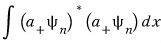
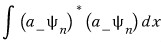
$$\int{\left( a_{+}\psi_{n} \right)^{*}\left( a_{+}\psi_{n} \right)}dx$$

that’s the target — but since it’s pretty easy, I’ll just rip through it in one shot.

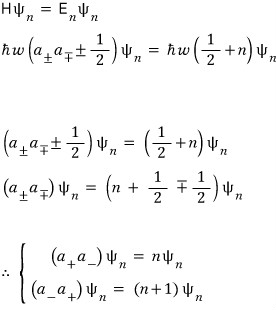
$$\begin{aligned} H\psi_{n} &= E_{n}\psi_{n} \\ \hbar w\left( a_{\pm}a_{\mp}\pm \frac{1}{2} \right) \psi_{n} &= \hbar w\left( \frac{1}{2}+n \right) \psi_{n} \\ \left( a_{\pm}a_{\mp}\pm \frac{1}{2} \right) \psi_{n} &= \left( \frac{1}{2}+n \right) \psi_{n} \\ \left( a_{\pm}a_{\mp} \right) \psi_{n} &= \left( n\quad +\quad \frac{1}{2}\quad \mp \frac{1}{2} \right) \psi_{n} \\ \therefore \quad &\begin{cases}{\left( a_{+}a_{-} \right) \psi_{n}\quad =\quad n\psi_{n}}\\{\left( a_{-}a_{+} \right) \psi_{n}\quad =\quad \left( n+1 \right) \psi_{n}}\end{cases} \end{aligned}$$

OK, now let’s go go go go:

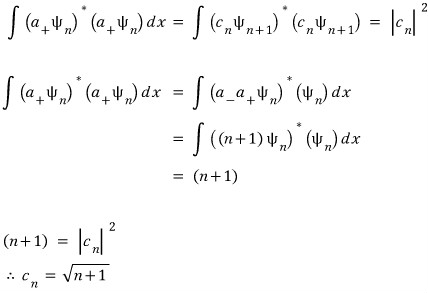
$$\begin{aligned} \int{\left( a_{+}\psi_{n} \right)^{*}\left( a_{+}\psi_{n} \right)}dx &= \int{\left( c_{n}\psi_{n+1} \right)^{*}\left( c_{n}\psi_{n+1} \right)} = \left| c_{n} \right|^{2} \\[12pt] \int{\left( a_{+}\psi_{n} \right)^{*}\left( a_{+}\psi_{n} \right)}dx &= \int{\left( a_{-}a_{+}\psi_{n} \right)^{*}\left( \psi_{n} \right)}dx \\ &= \int{\left( \left( n+1 \right) \psi_{n} \right)^{*}\left( \psi_{n} \right)}dx \\ &= \left( n+1 \right) \\[8pt] \left( n+1 \right) &= \left| c_{n} \right|^{2} \\ \therefore \quad c_{n} &= \sqrt{n+1} \end{aligned}$$

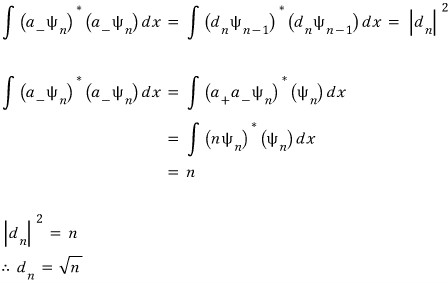
Same idea for

$$\int{\left( a_{-}\psi_{n} \right)^{*}\left( a_{-}\psi_{n} \right)}dx$$

let’s go go go go on this one too!!!!

$$\begin{aligned} \int{\left( a_{-}\psi_{n} \right)^{*}\left( a_{-}\psi_{n} \right)}dx &= \int{\left( d_{n}\psi_{n-1} \right)^{*}\left( d_{n}\psi_{n-1} \right)}dx = \left| d_{n} \right|^{2} \\[12pt] \int{\left( a_{-}\psi_{n} \right)^{*}\left( a_{-}\psi_{n} \right)}dx &= \int{\left( a_{+}a_{-}\psi_{n} \right)^{*}\left( \psi_{n} \right)}dx \\ &= \int{\left( n\psi_{n} \right)^{*}\left( \psi_{n} \right)}dx \\ &= n \\[8pt] \left| d_{n} \right|^{2} &= n \\ \therefore \quad d_{n} &= \sqrt{n} \end{aligned}$$

So — conclusion time.

$$\psi_{n}(x)\quad =\quad A_{n}\left( a_{+} \right)^{n}\psi_{0}(x)$$

the $A_{n}$ in this expression, too, turns out to be writable in terms of $n$!!

$$a_{+}\psi_{n}\quad =\quad \sqrt{n+1}\psi_{n+1}\quad /////\quad a_{-}\psi_{n}\quad =\quad \sqrt{n}\psi_{n-1}$$

stitch these two together and you get it!!!

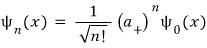
The final answer!!!

$$\psi_{n}(x)\quad =\quad \frac{1}{\sqrt{n!}}\left( a_{+} \right)^{n}\psi_{0}(x)$$

We solved the time-independent Schrödinger equation for the harmonic oscillator potential

using our New Operator (a.k.a. uncle ladder).

Alright, next time —

the second way to solve the time-independent Schrödinger equation for the harmonic oscillator potential: the dumb-as-a-tank, just-bulldoze-it-through method!!!

bye bye


Originally written in Korean on my Naver blog (2015-08). Translated to English for gdpark.blog.