Algebraic Solution to the Harmonic Oscillator

Picking up right where we left off — muscling through the harmonic oscillator's Schrödinger equation with a slick substitution and some algebraic tricks!

No intro today — I’m picking up right where the last post left off!!!

Time to just muscle through this thing.

Muscle through what?

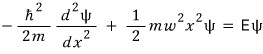
$$-\frac{\hbar^{2}}{2m}\frac{d^{2}\psi}{dx^{2}}\quad +\quad \frac{1}{2}mw^{2}x^{2}\psi \quad =\quad E\psi$$

This differential equation right here !!!!!

But first — a little substitution.

Apparently it’s easier if we clean the equation up a bit, so let’s play along.

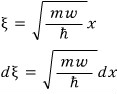
$$\xi \quad =\quad \sqrt{\frac{mw}{\hbar}}x\\ d\xi \quad =\quad \sqrt{\frac{mw}{\hbar}}dx$$

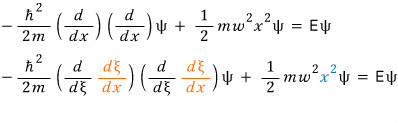
Let’s use this to turn the original into something friendlier.

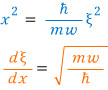
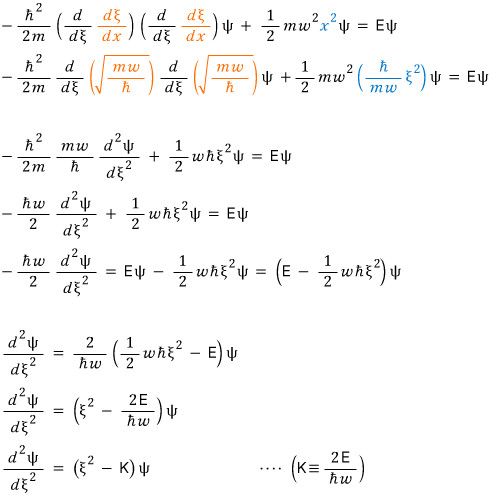
$$-\frac{\hbar^{2}}{2m}\left(\frac{d}{dx}\right)\left(\frac{d}{dx}\right)\psi \quad +\quad \frac{1}{2}mw^{2}x^{2}\psi \quad =\quad E\psi \\ -\frac{\hbar^{2}}{2m}\left(\frac{d}{d\xi}\frac{d\xi}{dx}\right)\left(\frac{d}{d\xi}\frac{d\xi}{dx}\right)\psi \quad +\quad \frac{1}{2}mw^{2}x^{2}\psi \quad =\quad E\psi$$$$x^{2}\quad =\quad \frac{\hbar}{mw}\xi^{2}\\ \frac{d\xi}{dx}=\quad \sqrt{\frac{mw}{\hbar}}$$$$-\frac{\hbar^{2}}{2m}\left(\frac{d}{d\xi}\frac{d\xi}{dx}\right)\left(\frac{d}{d\xi}\frac{d\xi}{dx}\right)\psi \quad +\quad \frac{1}{2}mw^{2}x^{2}\psi \quad =\quad E\psi \\ -\frac{\hbar^{2}}{2m}\frac{d}{d\xi}\left(\sqrt{\frac{mw}{\hbar}}\right)\frac{d}{d\xi}\left(\sqrt{\frac{mw}{\hbar}}\right)\psi \quad +\frac{1}{2}mw^{2}\left(\frac{\hbar}{mw}\xi^{2}\right)\psi \quad =\quad E\psi \\ -\frac{\hbar^{2}}{2m}\frac{mw}{\hbar}\frac{d^{2}\psi}{d\xi^{2}}\quad +\quad \frac{1}{2}w\hbar\xi^{2}\psi \quad =\quad E\psi \\ -\frac{\hbar w}{2}\frac{d^{2}\psi}{d\xi^{2}}\quad +\quad \frac{1}{2}w\hbar\xi^{2}\psi \quad =\quad E\psi \\ -\frac{\hbar w}{2}\frac{d^{2}\psi}{d\xi^{2}}\quad =\quad E\psi \quad -\quad \frac{1}{2}w\hbar\xi^{2}\psi \quad =\quad \left(E\quad -\quad \frac{1}{2}w\hbar\xi^{2}\right)\psi \\ \frac{d^{2}\psi}{d\xi^{2}}\quad =\quad \frac{2}{\hbar w}\left(\frac{1}{2}w\hbar\xi^{2}\quad -\quad E\right)\psi \\ \frac{d^{2}\psi}{d\xi^{2}}\quad =\quad \left(\xi^{2}\quad -\quad \frac{2E}{\hbar w}\right)\psi \\ \frac{d^{2}\psi}{d\xi^{2}}\quad =\quad \left(\xi^{2}\quad -\quad K\right)\psi \quad \cdots\quad \left(K\equiv\frac{2E}{\hbar w}\right)$$

So the time-independent Schrödinger equation ends up looking like this~~~

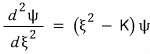
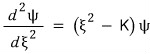
$$\frac{d^{2}\psi}{d\xi^{2}}\quad =\quad \left(\xi^{2}\quad -\quad K\right)\psi$$

And when I stare at that $K$, something kind of jumps out…

$$K=\frac{2E}{\hbar w}\quad =\quad \frac{E}{\frac{1}{2}\hbar w}\quad \cdots\quad E\text{ is}\quad \text{how many}\quad \text{chunks of}\quad \frac{1}{2}\hbar w\text{ worth of energy}~\quad \text{fit inside it}~$$

Just a little thought that crossed my mind… heh heh.

No idea if we’ll actually need that later… heh heh.

Alright, time to bust out some assumptions.

※Assumption Warning※

Assumption: look at the case where $\xi$ is ridiculously large.

$$\frac{d^{2}\psi}{d\xi^{2}}\quad \cong \quad \xi^{2}\psi$$

And just like that the equation becomes this heh heh heh. Solving this diff eq is piece of cake, right?!

The general solution is ~~~

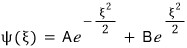
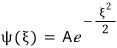
$$\psi(\xi)\quad =\quad Ae^{-\frac{\xi^{2}}{2}}\quad +\quad Be^{\frac{\xi^{2}}{2}}$$

Something like this shape.

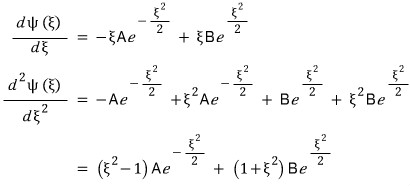
Wanna check?

$$\frac{d\psi\left(\xi\right)}{d\xi}\quad =\quad -\xi Ae^{-\frac{\xi^{2}}{2}}\quad +\quad \xi Be^{\frac{\xi^{2}}{2}}\\ \frac{d^{2}\psi\left(\xi\right)}{d\xi^{2}}\quad =\quad -Ae^{-\frac{\xi^{2}}{2}}\quad +\xi^{2}Ae^{-\frac{\xi^{2}}{2}}\quad +\quad Be^{\frac{\xi^{2}}{2}}\quad +\quad \xi^{2}Be^{\frac{\xi^{2}}{2}}\\ \quad =\quad \left(\xi^{2}-1\right)Ae^{-\frac{\xi^{2}}{2}}\quad +\quad \left(1+\xi^{2}\right)Be^{\frac{\xi^{2}}{2}}$$

Oh ho~~~

But the wave function has to be zero at $x = +\infty$ and $x = -\infty$ — that’s just common sense —

common-sense constraint, right? — so we can just set $B=0$.

When $\xi$ is large, we’ve got

$$\psi(\xi)\quad =\quad Ae^{-\frac{\xi^{2}}{2}}$$

That’s the shape the general solution takes.

(And hey — that $B$ term? Even after we drop the big-$\xi$ assumption, it absolutely cannot show up. Not even for small $\xi$!!!!!! Cannot exist. Will not be tolerated.)

Ahh~~ OK so here’s what I’m thinking.

Now it’s ※Imagination Warning※

Whether we realize it or not, the original equation

$$\frac{d^{2}\psi}{d\xi^{2}}\quad =\quad \left(\xi^{2}\quad -\quad K\right)\psi$$

its general solution~~~ is probably of the form where

$$e^{-\frac{\xi^{2}}{2}}$$

gets combined with something else~~~~ to give us the real general solution!!!

Ahhh~~~~ Let’s just go with this hunch.

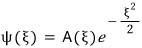
The general solution of the original equation looks like
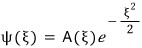
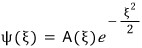
$$\psi(\xi)\quad =\quad A(\xi)e^{-\frac{\xi^{2}}{2}}$$

The exponential times some mystery function of $\xi$!!!

Yup!~!@!!@!@@!!@!@!@!!!!

With that, we officially call it a day on finding the general solution from scratch!!!

Good!! Let’s run with it!!!! Now let’s take this solution-we-imagined-into-existence and plug it back into the original equation!!!

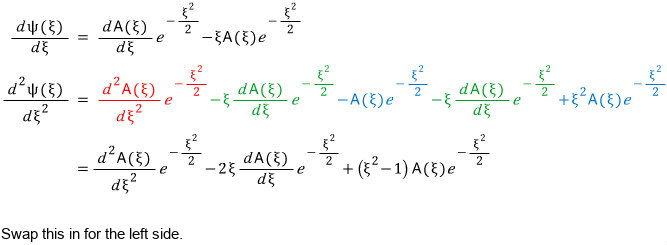
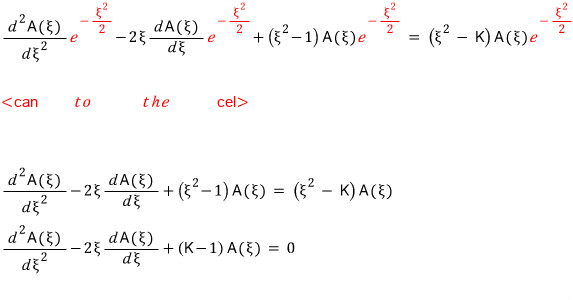
$$\psi(\xi)\quad =\quad A(\xi)e^{-\frac{\xi^{2}}{2}}$$$$\frac{d\psi(\xi)}{d\xi}\quad =\quad \frac{dA(\xi)}{d\xi}e^{-\frac{\xi^{2}}{2}}-\xi A(\xi)e^{-\frac{\xi^{2}}{2}}\\ \frac{d^{2}\psi(\xi)}{d\xi^{2}}\quad =\quad \frac{d^{2}A(\xi)}{d\xi^{2}}e^{-\frac{\xi^{2}}{2}}-\xi\frac{dA(\xi)}{d\xi}e^{-\frac{\xi^{2}}{2}}-A(\xi)e^{-\frac{\xi^{2}}{2}}-\xi\frac{dA(\xi)}{d\xi}e^{-\frac{\xi^{2}}{2}}+\xi^{2}A(\xi)e^{-\frac{\xi^{2}}{2}}\\ \quad =\frac{d^{2}A(\xi)}{d\xi^{2}}e^{-\frac{\xi^{2}}{2}}-2\xi\frac{dA(\xi)}{d\xi}e^{-\frac{\xi^{2}}{2}}+\left(\xi^{2}-1\right)A(\xi)e^{-\frac{\xi^{2}}{2}} \\ \text{Stuff this into the left side.}$$$$\frac{d^{2}A(\xi)}{d\xi^{2}}e^{-\frac{\xi^{2}}{2}}-2\xi\frac{dA(\xi)}{d\xi}e^{-\frac{\xi^{2}}{2}}+\left(\xi^{2}-1\right)A(\xi)e^{-\frac{\xi^{2}}{2}}\quad =\quad \left(\xi^{2}\quad -\quad K\right)A(\xi)e^{-\frac{\xi^{2}}{2}} \\ <\text{kill the exponential on both sides}> \\ \frac{d^{2}A(\xi)}{d\xi^{2}}-2\xi\frac{dA(\xi)}{d\xi}+\left(\xi^{2}-1\right)A(\xi)\quad =\quad \left(\xi^{2}\quad -\quad K\right)A(\xi)\\ \frac{d^{2}A(\xi)}{d\xi^{2}}-2\xi\frac{dA(\xi)}{d\xi}+\left(K-1\right)A(\xi)\quad =\quad 0$$

Oh come on (annoyed face). Now what (annoyed face), how on earth are we supposed to solve this!!!!!!!!!!

Here’s how we solve it: “we expand $A(\xi)$ as a power series.”

(It’s called a power series, right??? Power series hahaha heh.)

When you take mathematical physics, questions like “is there anything out there that can’t be expanded as a power series~~~? Is the power series unique~~~~?” — those kinds of questions get properly answered.

So let’s just trust it and roll!

$$f(x)\quad =\quad a_{0}\quad +\quad a_{1}x\quad +\quad a_{2}x^{2}\quad +\quad a_{3}x^{3}\quad +\quad \cdots$$

We do the power series expansion like this. For $A(\xi)$!

$$A(\xi)\quad =\quad a_{0}\quad +\quad a_{1}\xi\quad +\quad a_{2}\xi^{2}\quad +\quad a_{3}\xi^{3}\quad +\quad \cdots$$

Expanding out like that,

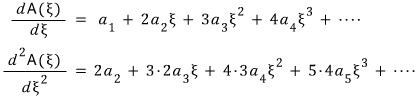
$$\frac{dA(\xi)}{d\xi}\quad =\quad a_{1}\quad +\quad 2a_{2}\xi\quad +\quad 3a_{3}\xi^{2}\quad +\quad 4a_{4}\xi^{3}\quad +\quad \cdots\\ \frac{d^{2}A(\xi)}{d\xi^{2}}\quad =\quad 2a_{2}\quad +\quad 3\cdot 2a_{3}\xi\quad +\quad 4\cdot 3a_{4}\xi^{2}\quad +\quad 5\cdot 4a_{5}\xi^{3}\quad +\quad \cdots$$

Got these, now plug them into the equation above.

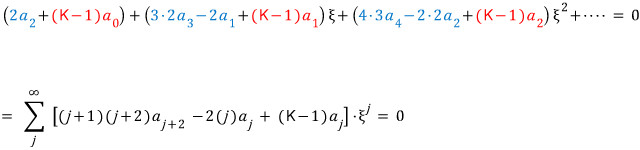
$$\frac{d^{2}A(\xi)}{d\xi^{2}}-2\xi\frac{dA(\xi)}{d\xi}+\left(K-1\right)A(\xi)\quad =\quad 0 \\ \left(\quad 2a_{2}\quad +\quad 3\cdot 2a_{3}\xi\quad +\quad 4\cdot 3a_{4}\xi^{2}\quad +\quad \cdots\right)\quad -2\xi\left(a_{1}\quad +\quad 2a_{2}\xi\quad +\quad 3a_{3}\xi^{2}+\quad \cdots\right)\quad +\quad \left(K-1\right)\left(a_{0}\quad +\quad a_{1}\xi\quad +\quad a_{2}\xi^{2}\quad +\quad a_{3}\xi^{3}\quad +\quad \cdots\right)\quad =\quad 0$$

Let’s line it up from the lowest-degree terms, grouping by same power of $\xi$.

$$\left(2a_{2}+(K-1)a_{0}\right)+\left(3\cdot 2a_{3}-2a_{1}+(K-1)a_{1}\right)\xi+\left(4\cdot 3a_{4}-2\cdot 2a_{2}+(K-1)a_{2}\right)\xi^{2}+\cdots\quad =\quad 0 \\ =\quad \sum_{j}^{\infty}\left[(j+1)(j+2)a_{j+2}\quad -2(j)a_{j}\quad +\quad (K-1)a_{j}\right]\cdot\xi^{j}\quad =\quad 0$$

The whole thing summed up~~~~~ has to equal 0.

The case where $\xi = 0$ — that’s what they call the trivial solution, right? Since that’s a meaningless solution,

every coefficient has to be 0~~~ Yeah, something along those lines.

All coefficients have to be 0~~~ Let’s write it out.

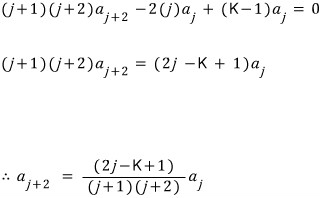
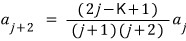
$$(j+1)(j+2)a_{j+2}\quad -2(j)a_{j}\quad +\quad (K-1)a_{j}\quad =\quad 0 \\ (j+1)(j+2)a_{j+2}\quad =\quad (2j\quad -K\quad +\quad 1)a_{j} \\ \therefore\quad a_{j+2}\quad =\quad \frac{(2j-K+1)}{(j+1)(j+2)}a_{j}$$

Oh my god!!!! A recurrence relation is born!!!!!

A recurrence relation — you know, it’s like laying out a long line of firecrackers, and once you light one end it goes pop-pop-pop-pop-BANG all the way down — so if you find one thing, poof, pop-pop-pop~~, everything else is determined. That’s the vibe.

Oh! Nice!

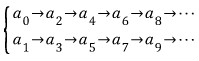
Oh wait crap, the recurrence jumps two steps at a time… (sobbing)

$$\begin{cases}{a_{0}\to a_{2}\to a_{4}\to a_{6}\to a_{8}\to \cdots}\\{a_{1}\to a_{3}\to a_{5}\to a_{7}\to a_{9}\to \cdots}\end{cases}$$

OK so let’s think of $A(\xi)$ as split into two as well!!!

The odd-degree $\xi$ terms have odd-indexed $a$ coefficients inside,

and the even-degree $\xi$ terms have even-indexed $a$ coefficients!

$$A(\xi)\quad =\quad A_{\text{odd}}(\xi)\quad +\quad A_{\text{even}}(\xi)\\ \quad =\quad \left(a_{1}\xi\quad +\quad a_{3}\xi^{3}+a_{5}\xi^{5}+a_{7}\xi^{7}+\cdots\right)\quad +\quad \left(a_{0}+a_{2}\xi^{2}+a_{4}\xi^{4}+a_{6}\xi^{6}+\cdots\right)\\ \quad =\quad <\text{odd function}(odd)>\quad +\quad <\text{even function}(even)>$$

Splitting it up like this, the fact that we get a nice clean odd-function bucket + even-function bucket is basically a freebie?!!

Alright, now let’s look at the wave function again for just a seco~~~nd.

Remember we’d assumed it looks like this.

$$\psi(\xi)\quad =\quad A(\xi)e^{-\frac{\xi^{2}}{2}}$$

Reason I’m hitting pause on this for a sec: normalization!!!!

Because for $|\psi|^2$ to actually mean probability density, we need to be able to normalize it…..

What I’m getting at is — when we do the power series expansion,

$A(\xi)$ absolutely cannot be an infinite series going on forever.

If $A(\xi)$’s terms keep going to infinity, normalization is dead in the water!!!

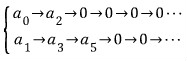
In other words, the recurrence,

$$\begin{cases}{a_{0}\to a_{2}\to 0\to 0\to 0\to 0\cdots}\\{a_{1}\to a_{3}\to a_{5}\to 0\to 0\to \cdots}\end{cases}$$

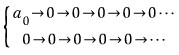
whether it ends up like this,

$$\begin{cases}{a_{0}\to 0\to 0\to 0\to 0\to 0\cdots}\\{0\to 0\to 0\to 0\to 0\to \cdots}\end{cases}$$

or like this, either way,

it has to force $A(\xi)$ to terminate at some point.

(Not “converging to 0” — I mean actually zero from some point on!!!)

That is,

$$a_{j+2}\quad =\quad \frac{(2j-K+1)}{(j+1)(j+2)}a_{j}$$

in this recurrence, if things become 0 starting at some $j = n$,

because the recurrence has this shape:

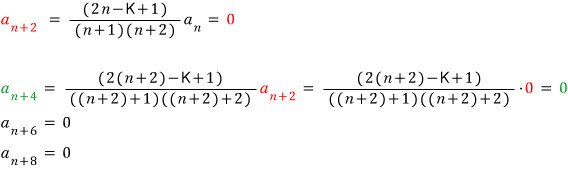
$$a_{n+2}\quad =\quad \frac{(2n-K+1)}{(n+1)(n+2)}a_{n}\quad =\quad 0 \\ a_{n+4}\quad =\quad \frac{(2(n+2)-K+1)}{((n+2)+1)((n+2)+2)}a_{n+2}\quad =\quad \frac{(2(n+2)-K+1)}{((n+2)+1)((n+2)+2)}\cdot 0\quad =\quad 0\\ a_{n+6}\quad =\quad 0\\ a_{n+8}\quad =\quad 0$$

this is totally doable!!!

From some $j=n$ onward it just keeps going~~~~~ 0, 0, 0, 0, 0, 0, 0, 0, 0, 0, 0, 0, 0, 0, 0, 0, …..

So let’s install a little kill switch in the recurrence to make that happen.

The kill switch?

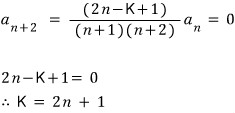
$$a_{n+2}\quad =\quad \frac{(2n-K+1)}{(n+1)(n+2)}a_{n}\quad =\quad 0 \\ 2n-K+1=\quad 0\\ \therefore\quad K\quad =\quad 2n\quad +\quad 1$$

Plug that $K$ in and the kill switch is wired up!!

That is,

$$a_{j+2}\quad =\quad \frac{(2j-(2n+1)+1)}{(j+1)(j+2)}a_{j}\quad =\quad \frac{2(j-n)}{(j+1)(j+2)}a_{j}$$

If we rewrite the recurrence like this,

$$a_{1},a_{2},a_{3},a_{4},\cdots,a_{n},0,0,0,0,0,0,\cdots$$

is that what we get??????

Nononononononononononononononononononono

Because the recurrence jumps two at a time,,,, not yet..

OK so let’s trace this out case by case, starting from $n=0$.

What if the max $n$ that $j$ can reach is $n=0$?

Since $n=0$ is the largest $j$ is allowed to be, there’s nothing else to do —

$$a_{0},0,0,0,0,0,0,\cdots$$

meaning,

$$a_{2}=0$$

that’s the only option, because from there on, jumping two at a time, everything is 0,

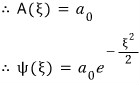
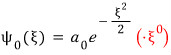
$$\therefore\quad A(\xi)\quad =\quad a_{0}\\ \therefore\quad \psi(\xi)\quad =\quad a_{0}e^{-\frac{\xi^{2}}{2}}$$

What if the max $n$ of $j$ is $n=1$?

Same logic as before, if the max $j$ can hit is 1,

$$a_{0},a_{1},0,0,0,0,0,\cdots$$

we’d get something like this,

$$a_{0},a_{1}$$

so two survive?!?!?!?!

Nope nope.

$$a_{j+2}\quad =\quad \frac{2(j-n)}{(j+1)(j+2)}a_{j}\quad =\quad \frac{2(j-1)}{(j+1)(j+2)}a_{j}$$

Because of this!!!!

Plug in $j=1$ and yeah, the kill switch works as advertised — $a_3, a_5, a_7, \ldots$ all die to 0!!

But if you plug in $j=0$,

$$a_{2}\quad =\quad \frac{2(0-1)}{(0+1)(0+2)}a_{0}\quad =\quad -\frac{2}{2}a_{0}\quad =\quad -a_{0}$$

Which means,

$$a_{0}=0$$

unless this holds, all the even terms just keep going on and on~~~~,

so under the constraint that the max $n$ of $j$ is $n=1$,

$$a_{0}=0$$

we have to force this by hand!!

That is,

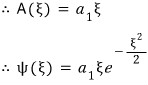
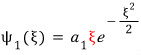
$$\therefore\quad A(\xi)\quad =\quad a_{1}\xi\\ \therefore\quad \psi(\xi)\quad =\quad a_{1}\xi e^{-\frac{\xi^{2}}{2}}$$

One more?

What if the max $n$ of $j$ is $n=2$?

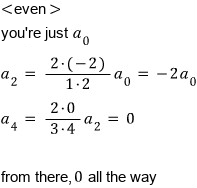
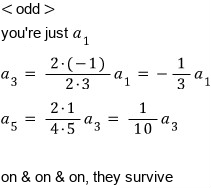
$$a_{j+2}\quad =\quad \frac{2(j-n)}{(j+1)(j+2)}a_{j}\quad =\quad \frac{2(j-2)}{(j+1)(j+2)}a_{j}$$$$<\text{even}>\\ \text{you get}\quad a_{0}\\ a_{2}\quad =\quad \frac{2\cdot(-2)}{1\cdot 2}a_{0}\quad =\quad -2a_{0}\\ a_{4}\quad =\quad \frac{2\cdot 0}{3\cdot 4}a_{2}\quad =\quad 0\\ \text{after that, all 0}$$$$<\text{odd}>\\ \text{you get}\quad a_{1}\\ a_{3}\quad =\quad \frac{2\cdot(-1)}{2\cdot 3}a_{1}\quad =\quad -\frac{1}{3}a_{1}\\ a_{5}\quad =\quad \frac{2\cdot 1}{4\cdot 5}a_{3}\quad =\quad \frac{1}{10}a_{3}\\ they keep surviving, on and on and on$$

Here too,

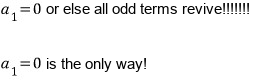
$$a_{1}=0\text{ — unless this holds, all the odd terms come back to life!!!!!!!}\\ a_{1}=0\text{ is the only way out!}$$

So the nonzero guys are

$$a_{0},a_{2}$$

only, which gives us

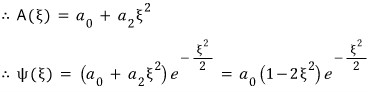
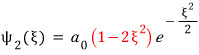
$$\therefore\quad A(\xi)\quad =\quad a_{0}\quad +\quad a_{2}\xi^{2}\\ \therefore\quad \psi(\xi)\quad =\quad \left(a_{0}\quad +\quad a_{2}\xi^{2}\right)e^{-\frac{\xi^{2}}{2}}\quad =\quad a_{0}\left(1-2\xi^{2}\right)e^{-\frac{\xi^{2}}{2}}$$

So the wave function gets pinned down by whatever the max value of $j$ is:

$$\psi_{0}(\xi)\quad =\quad a_{0}e^{-\frac{\xi^{2}}{2}}\left(\cdot\xi^{0}\right)$$$$\psi_{1}(\xi)\quad =\quad a_{1}\xi e^{-\frac{\xi^{2}}{2}}$$$$\psi_{2}(\xi)\quad =\quad a_{0}\left(1-2\xi^{2}\right)e^{-\frac{\xi^{2}}{2}}$$

that’s how it shakes out —

and pay attention to the bits I’d color red here.

Look at that and — “Oh ho?!!!!! That looks suspiciously like a Hermite polynomial?”

Turns out the smart people already cranked through it, (process isn’t bad)

$$\psi_{n}$$

Can’t we just write this generally in terms of $n$ using Hermite polynomials?!?!!

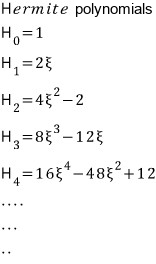
$$\text{Hermite polynomial}\\ H_{0}=1\\ H_{1}=2\xi\\ H_{2}=4\xi^{2}-2\\ H_{3}=8\xi^{3}-12\xi\\ H_{4}=16\xi^{4}-48\xi^{2}+12\\ \cdots\\ \cdots\\ \cdots$$

And yep — it cleans up into Hermite polynomials!!!!!

(I’ll skip writing out the process.)

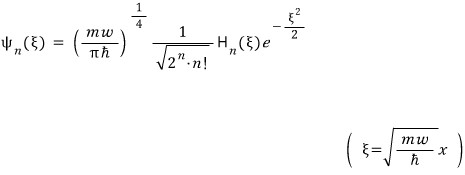
$$\psi_{n}(\xi)\quad =\quad \left(\frac{mw}{\pi\hbar}\right)^{\frac{1}{4}}\frac{1}{\sqrt{2^{n}\cdot n!}}H_{n}(\xi)e^{-\frac{\xi^{2}}{2}}\\ \quad\left(\quad\xi=\sqrt{\frac{mw}{\hbar}}x\quad\right)$$

And then after that there’s a little section checking whether this thing plays nice with the correspondence principle, apparently.

It’s short, easy stuff, so I’ll wrap this post up here.

I’m changing majors. I can’t keep doing physics, bye bye.


Originally written in Korean on my Naver blog (2015-08). Translated to English for gdpark.blog.