The Free Particle
We tackle the free particle (V=0) case of the Schrödinger equation, discover why normalization is a headache, and unpack what wave numbers actually mean — brace yourself for a mini mental meltdown!
Alright, this time let’s think about a free particle that isn’t trapped anywhere — in a space where V(x) = 0.
Are you ready for your mental meltdown today too….heh
Then let’s dive right in.
We’ve been splitting up the Schrödinger equation case by case according to V(x), looking at it situation by situation, and this is the third one!!
The case where V(x)=0 for all x!!! (free particle)
Alright, so if we plug V=0 into the (time-independent) Schrödinger equation,
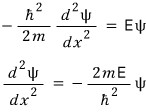
Since E is a positive constant, let’s just put the constant in front like this for now!!!

Oho?! This differential equation is pretty easy?!?!?!!!

Since the square has to come out negative, the exponent has to have an imaginary i term…hehe
heheheh
Ah but there’s something weird.
ψ(x) clearly has to be Zero at x=∞, x=-∞.
(All the wave functions we play around with have to be that way) right?!?!!!!
Ah… but……… there’s no way to determine the values of the constants A, B that would make it 0…T_T
Now, there’s one more problem, and to talk about it let me continue the discussion that we could have stopped here.
The time-independent Schrödinger equation,

we could express as a function of time by just multiplying by the phi(t) we’d worked out beforehand.
Multiplying that to express psi(x, t),
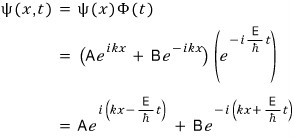
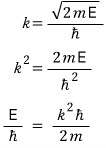
To show the meaning in terms of waves more starkly, instead of looking at k as just that constant from before,
in waves k is the wave number, and

since it’s this kind of thing,
we can say it like this. ‘How many λ-meter wavelengths fit inside 2π meters~~~’ like that.
Alright, and from here,

if we express those red bastards also using k,
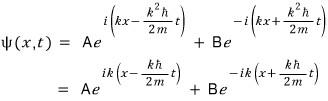
Alright~~~~~

so we could also say this function is a function whose variable is hooked onto the variable

.
Psi really is a wave function~!!!!~~
(When we made the classical wave equation using a string wave, it had exactly!! that shape!!! - Electromagnetism 2, electromagnetic waves)
And that ‘something’ is the ‘speed of the wave’.
Aaaaah so we can see it as a wave with speed k-h-bar over 2m.!!!
Whoa but
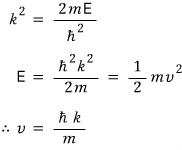
if we work out the velocity from energy classical-mechanically…
it comes out exactly~~!~~!~~~~~ 1/2 of the wave’s speed…..
Alright, so up to now, in the solution of the time-independent Schrödinger equation, two things didn’t fit.
-
Normalization
-
Discrepancy in velocity
We have no choice but to conclude that the ‘assumption’ in the equation is wrong.!!!
The conclusion seems to be that “the assumption that it doesn’t depend on time is wrong”…
Rather than just ‘doesn’t depend on time’
what we learned is that the meaning of ’not depending on time’ is meaning a stationary state, but,
it might be good to take it as meaning that for a free particle, a stationary state doesn’t exist,,, something like that. (what am I even saying, is the mental meltdown starting)
Yeah yeah yeah yeah, time-independence is wrong, then what’s the general solution of the time-dependent Schrödinger equation?
The “general solution of the time-dependent Schrödinger equation” is
a ’linear combination of the general solutions of the time-independent Schrödinger equation’ apparently……;;;
A wave that’s a combination of waves with various wave numbers!!!!
(And then the equation is just thrown at us)
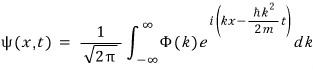
The 1 over root 2-pi is there so the calculation comes out conveniently when we do normalization later,
and Φ(k) is the density of state~
(Earlier it was c_n, but here it doesn’t depend on the quantum number n, it depends on k??!?!
But it’s the same. Because the energy of the wave is determined by k, right??? (actually n determines this k heheheh)
Anyway, that’s the reason for taking k as the important variable in waves.)
To the question of “Then what specifically is Φ(k)?!?!?!~~ what is it?!?!?!!!”
the answer is that you can find it by normalizing exactly~~ with respect to the initial conditions.
(When we first learned normalization, we said something like ’normalization shouldn’t change as time goes by~~
i.e., normalization only needs to be done once. That’s how it matches the principles of nature.’ something like that,)
Normalize just once with respect to initial conditions!!!!
For now, then, let’s plug in the initial condition t=0.
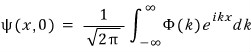
The Φ(k) that fits these initial conditions can be…!! found via Fourier transformation!!!! Right away

it can be determined like this.
Solving an example with the above logic
Ex. 2.6 : A free particle whose starting position is restricted to the range -a<x<a has a wave function at t=0 as follows.
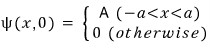
Here A and a are real numbers greater than 0. Find the wave function ψ(x,t) at time t.
- If we Normalize using the initial condition ψ(x,0),
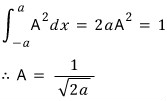
Now then, let’s also find Φ(k).
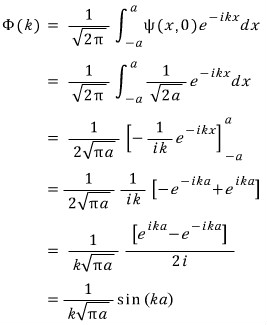
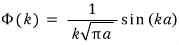
we got this.
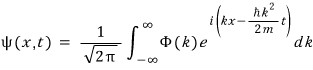
So!!!!

<This integral apparently can’t be done by anything other than a computer… T_T>
Now I think we should talk a bit about the velocity from earlier!!!!!
The normalization problem seems to have been solved, but the classical-mechanical velocity and the velocity of the wave seen as a wave — why!!!!!! is there a discrepancy~~~~~
— rather than here, I think it’d be better to read the ‘phase velocity and group velocity’ part in modern physics and then come back to the quantum mechanics book.
Wave Properties of Particles (Modern Physics I Studied #11)
So lastly, a tip.
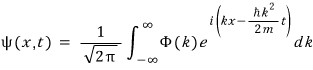
Here, so we can see it as a wave more easily, let me briefly substitute the letters with these letters.


This is called the dispersion relation (the relationship between w and k).
Dispersion relation of electromagnetic waves / dispersion relation of water waves / … like this, each one exists as a kind of characteristic of some wave, and that’s what’s called the dispersion relation, and
the dispersion relation of matter waves comes out like this.
Alright and~! What w means in waves can be thought of as equivalent to energy, and k can be seen as equivalent to momentum.
(Originally, the dispersion relation is, rather than the relation between wave number and angular velocity, more correctly seen as the relation between momentum and energy.)
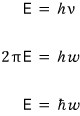
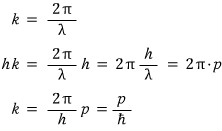
The free particle part feels like Griffiths’ book has pretty thin explanations.
(Not just this part, but well, every part is written in an easy way so… right,,,?)
I think I’ll have to study it properly again next time….Sakurai? I hear that book is good, how would it be…? heh heh, hing
Comments
Discussion happens via GitHub Discussions. You'll need a GitHub account to comment.