The Delta-Function Potential
Diving into the delta-function potential — with a quick pit stop on bound vs. scattering states and why Dirac made the delta function actually make sense~!!
We’re working through the time-independent Schrödinger equation case by case, sorted by what V looks like.
And now — drumroll — potential #4: a potential shaped like a delta function.
(The finite square well is exactly~~!! the same vibe as the delta function potential discussion!!!!)
Before we dive in for real, juuust a tiny bit of vocab on bound states and scattering states.
1. Bound state
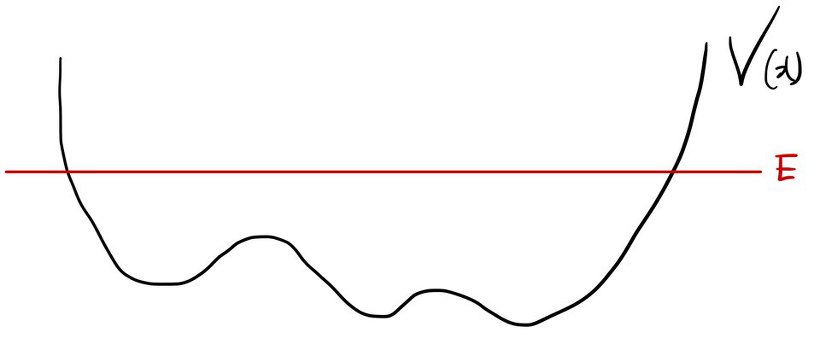
A bound state is when

something like that, or it could be $E<0$,
and honestly most(?) of what we’ve done so far has been bound states —
infinite square well, harmonic oscillator, all bound states.
Why “bound”? Because the particle’s $E$ is less than $V(x)$,
so it absolutely cannot escape the walls of $V(x)$. It’s stuck. Trapped. Bound. …heh
That’s the picture, right!?!? (Is it really trapped though? hehehe~)
2. Scattering state (scattering… what now?)
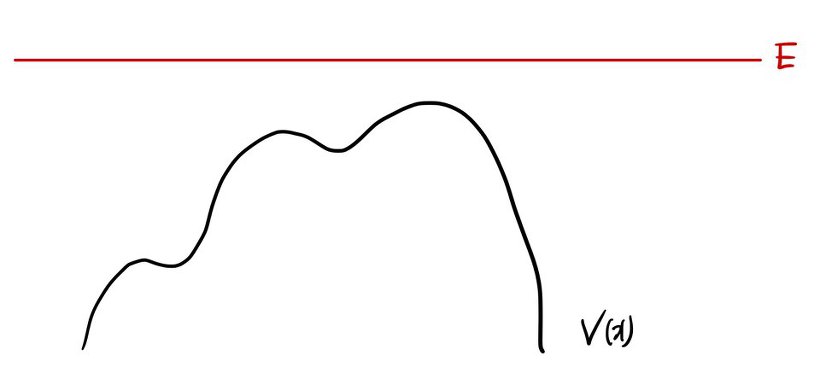
Scattering state is just the opposite of bound.

that’s the deal,
and obviously when $V=0$, the case $E>0$ is the same thing,
and out of stuff we’ve covered, the free particle is a scattering state, heh
But does $E$ have to be greater than $V$ everywhere for it to be a scattering state??
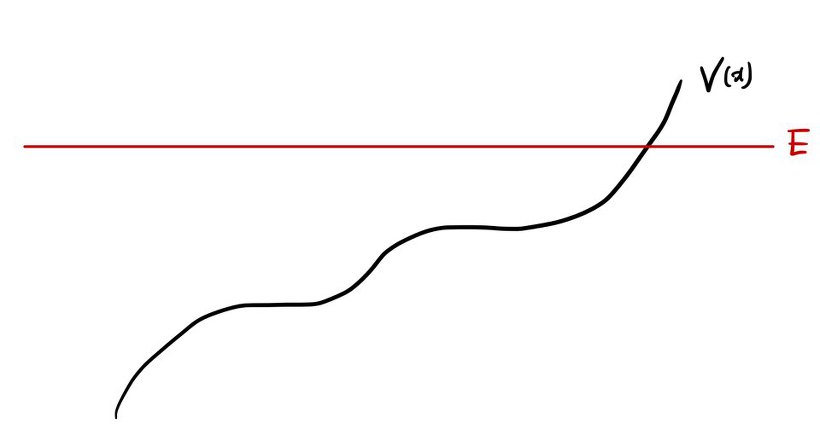
What about something like this..
Apparently this counts as a scattering state too~!!!
OK, on to the delta function.
The definition of the delta function is
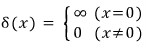
$x$ spikes ridiculously hard!!! at one specific spot, and everywhere else it’s just nothing!!!!
(Like — picture a person who reacts to nothing~~ in life but goes absolutely wild for money!!! If you wrote that person as a delta function:)
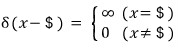
So basically it’s a function people invented when they wanted to capture that kind of behavior~!!
But then this dude named Dirac picked it up and made it actually mean something.
“Hey, c’mon — where in nature does anything respond to one specific thing with an infinite response (-_-)? It wouldn’t be infinite, it’d just be a ‘really high value’~~~”
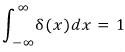
A delta function that satisfies this,

is what we call the Dirac delta function.
What it really means is
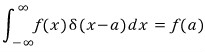
OK so before we dive in for real, let me quickly say why~~~ we even bother with the case where the potential is
Two pictures, that’s all.
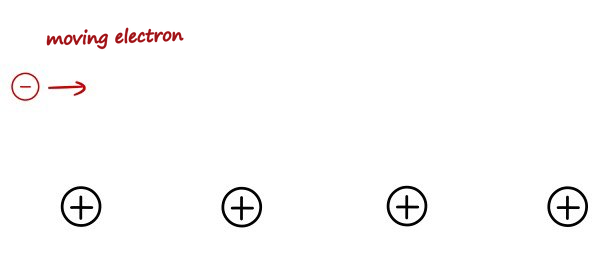
If you take an electron moving inside some material
and just sketch the energy as a graph,
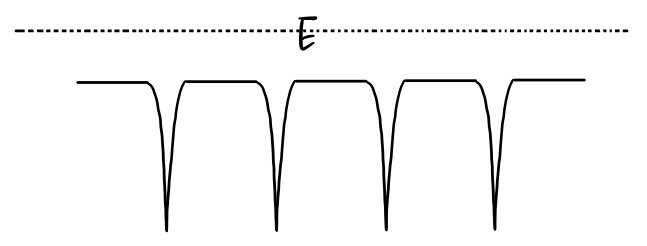
ta-daaa~~~
OK, now for real.
In the Schrödinger equation we need to plug in $V(x)$ as the function — but instead of just plugging in
let’s be a tiny bit more general and write

You can think of $\alpha$ as something like the “properties of the material.”
Like — the depth of the potential in uranium is different from the depth in hydrogen, that kind of vibe???
The minus sign just means the delta function bulges downward~~
So the time-independent Schrödinger equation becomes
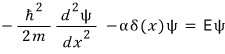
We’re going to look at $E>0$ and $E<0$ separately.
Let’s start with $E<0$.
What does a bound electron look like?
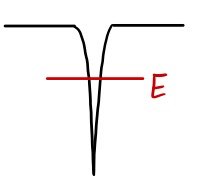
Something like this, right~!?!?
Then, just like with the infinite square well, let’s split by region and gogogo
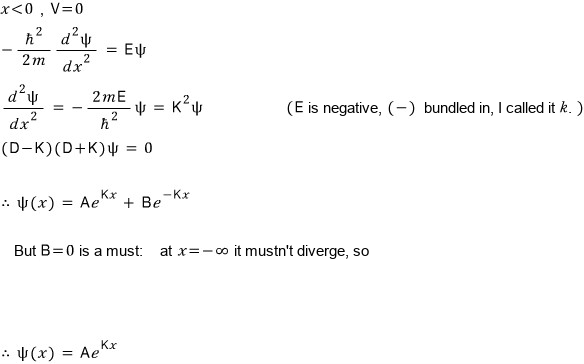
Now for $x>0$!!!!!
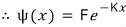
Same logic as above — to keep it from blowing up at $x=\infty$, only that term survives.!?
OK, now the boundary! !!!!
$\psi(x)$ has to be continuous at $x=0$!!!!!
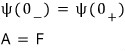
And we land at
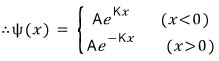
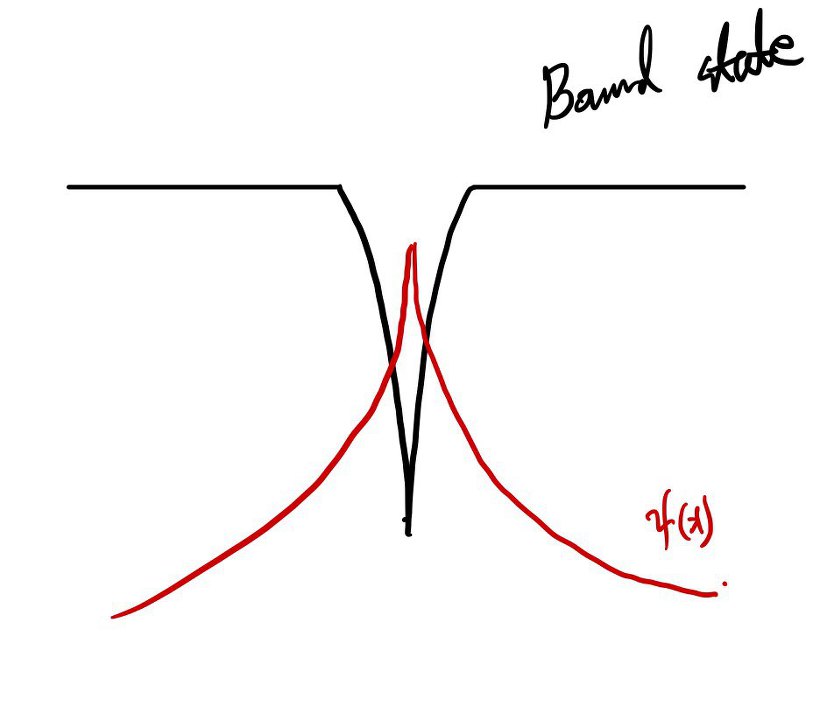
If you sketch this~~~~
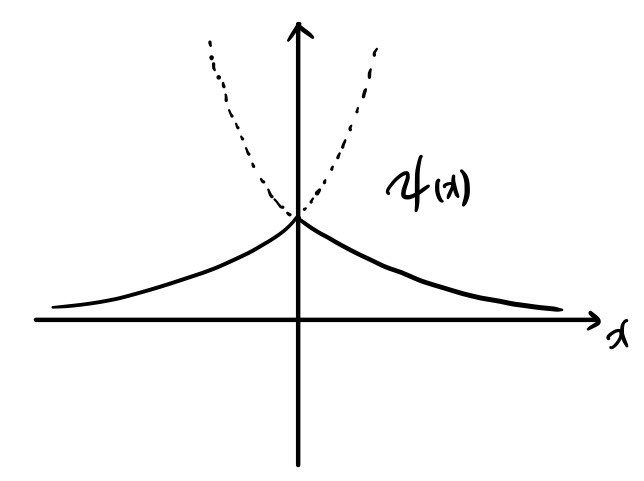
It looks like that — and how sharp the pointy bit at the middle is should depend on the potential, right!? huh~~~?
The sharpness at that boundary probably depends on $\alpha$….. (T_T)
But how do we actually express that?~?~?~~!!
So~
We’re going to integrate both sides — from $-0$ to $+0$…
Buuut writing it as “$-0$ to $+0$” looks too high-school-ish….
(Not a knock on high schoolers! High schoolers can totally follow this!!! Shoutout to high schoolers everywhere!!!)

Writing it like this is fine, right!?!?
Just imagine $\epsilon$ as $0.000000000000000000000001$.
Then GoGo, integrate both sides GoGo
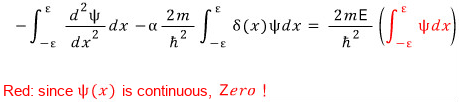
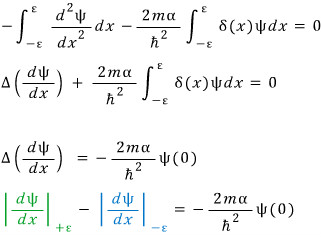
Those colored bits up there — we can totally compute them!!!!!
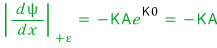
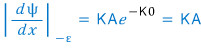
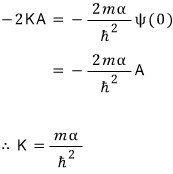
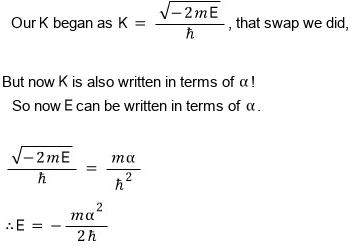
Finding $K$ also means we’ve found $E$ — like you saw above —
and it also means we’ve found the wave function $\psi(x)$. OK, last touch.
Normalize so the square actually means a probability!!!
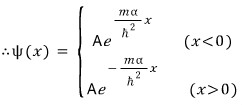
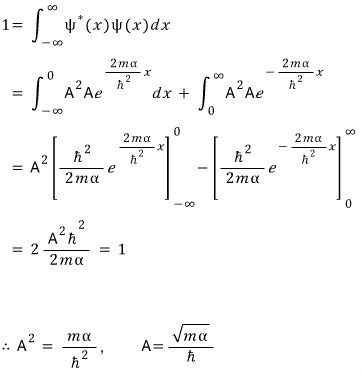
The fully normalized $\psi(x)$:
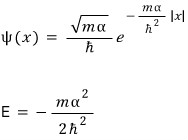
Notice — unlike the infinite square well — there’s no $n$ in the expression!?!?!
Which means: only one state exists. One $E$. That’s it.
And the probability of finding the electron is (obviously) highest right at the atom, right???!!
(Does more of it kinda stick to the atom?) hahahaha I have no idea, don’t ask me.
Comments
Discussion happens via GitHub Discussions. You'll need a GitHub account to comment.