Delta-Function Potential: Scattering States and Quantum Tunneling
Picking up where we left off, we tackle the E > 0 scattering states of the delta-function potential and work through boundary conditions to uncover quantum tunneling!
Picking up directly from the previous post,
the potential stays the same, but let’s look at the case when E > 0.
If I kept this together with the previous post, the scroll-wall would’ve been nuts, so I moved it to this post!
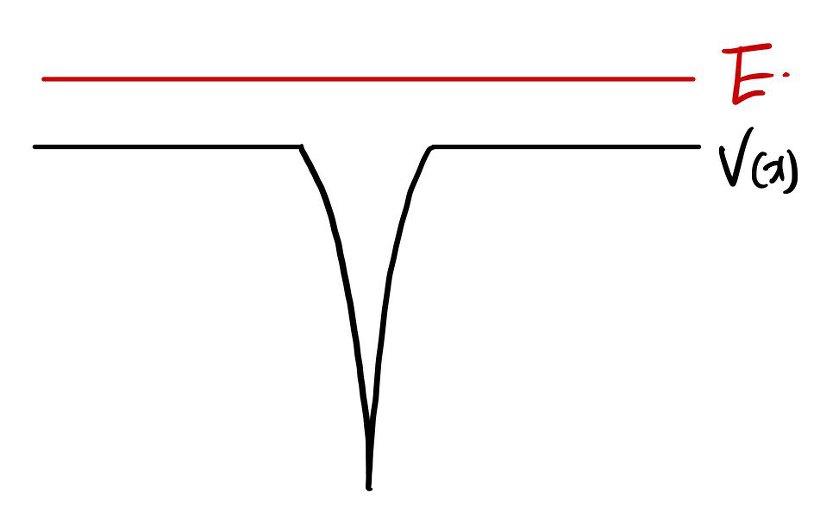
It’d be exactly~~~ this kind of case~~~
It’s very very very very very similar to when E<0 before,,, hmm~
Anyway, let’s get going~!!
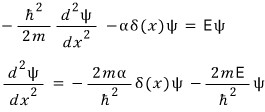
Alright, and we split into intervals.!!!!!
Let’s look at the x < 0 part
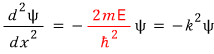
The difference from before is that back then we had to throw in a (-) to get a positive, but here since E > 0 it becomes -k^2*ψ !!!
Now that second-order ODE is a piece of cake, cake!!!!
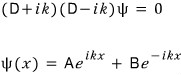
Oh damn, we’re screwed…. Before, it was a real number, so we could kill off one constant using the condition ψ(-∞) = 0,
but here, since it’s now a complex number, it’s just spinning around in place….
OMG we can’t kill it off…
And for x>0 too, well, the situation’s the same, so

two terms survive like this
and if we use the condition “the state function ψ is continuous~!~!~~”,
all we get is the relation A+B = F+G… haa… Sad
Let’s also look at the boundary point x=0!!!!
Like in the Bound state case, let’s integrate the time-independent Schrödinger equation on both sides from -0 to +0.
(The best way to kill off δ is integration, right?!!)
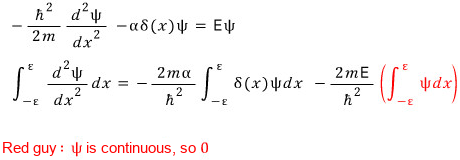
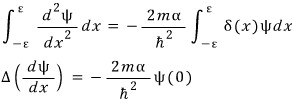


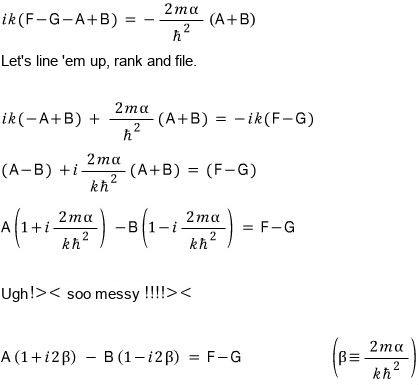
We only managed to pull out two equations… T_T
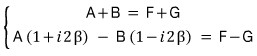
haa…… Counting beta, there are 5 Unknowns,,,,,but we only cracked out two equations… T_T
T_T haa… how do I solve this…?
But except for me, physics students are the smartest people on this earth, the ones who’ll lead the earth forward, right?~?~?~?
‘Hey hey hey hey hey hey you don’t!!! necessarily have to know everything!?!??^^ Think about what it means, and only think about the things that are meaningful!’
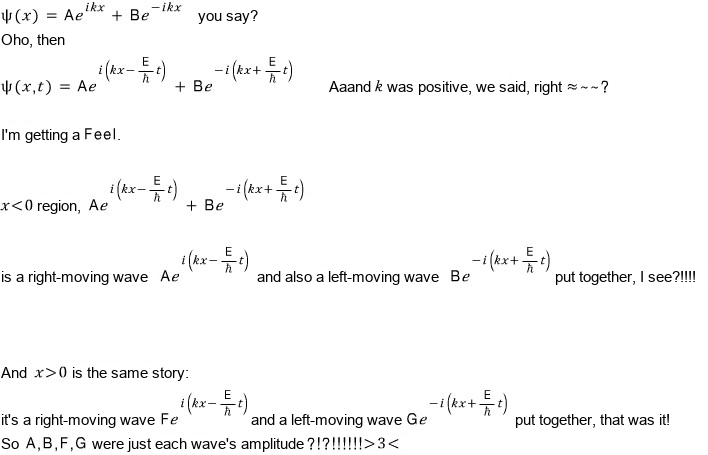
Now that we can interpret it this way~~
we can see it like this.
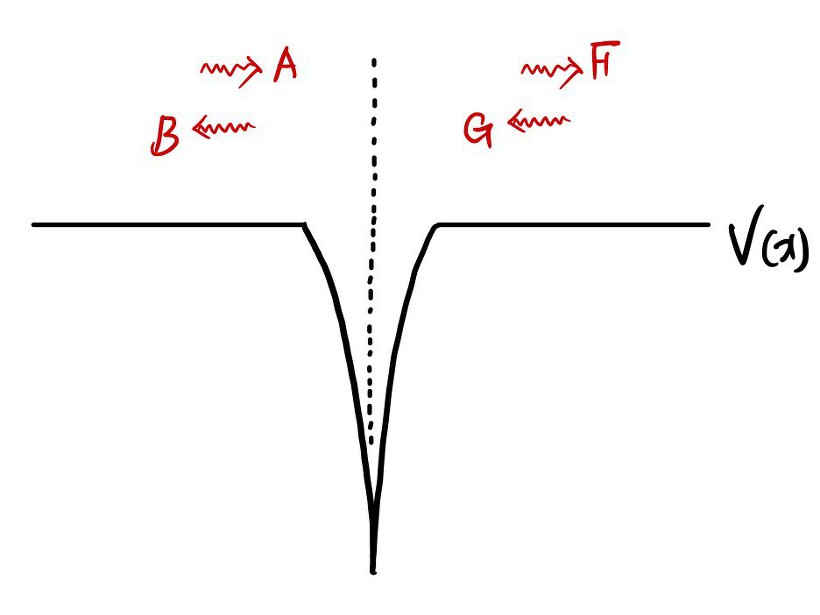
For convenience, if we think of the wave coming in from the left to the right, we can probably set G=0??
Think of the wave A as having come from waaaaay far away at -∞~~~~ and underground there’s a biiiig hole carved out,
so then what about B?~?~?~
※mental breakdown warning※
B is not 0 lol
lol lol lol
lol lol lol
(You might want to go outside and let out a whole bucket of curses to feel better hehe lollol)
What is this for real lol
You can set G to 0, but you can’t set B to 0 — I actually fought with my professor about this in class, ..
Like why is G≠0 nonsensical so G=0, but
even though B≠0 is nonsensical we have to set B≠0 lollol
lol lol lol
It just doesn’t make sense lol
Hmm but since there IS a ‘change in situation’, I thought okay for now don’t set B to 0, and
as for G≠0…. setting it not equal to zero would mean… creating a problem for A coming from -∞ all the way to x=0, so
we have to set G=0!!!! Well, I got talked into it that way
and well, I just accepted it that way…hehe
Setting B≠0,
if we take a macroscopic example, it IS wrong, but if you reeeeally reeeeeally have to,
by drawing the incomprehensible behavior of the microscopic world, or by analogy to a macroscopic situation,
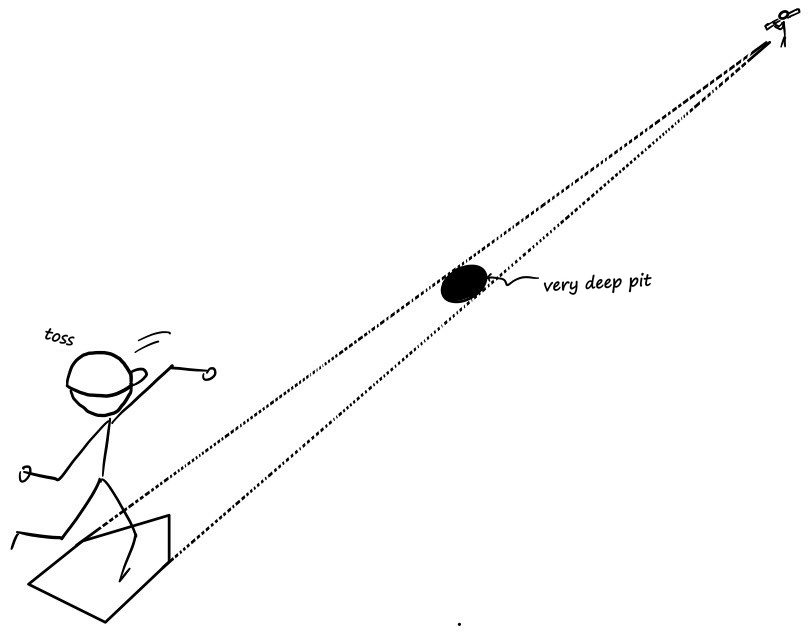
in the microscopic world, a pitcher throws a ball to a batter, and there’s a (freakin’ tiny, and deep) hole in the middle …
a hella small probability, but even with nothing in front of the ball, the ball can be reflected (because of the hole) and fly back to the pitcher..
I want to die for real lol
Why does it reflect when there’s nothing there…(This is how I made up my mind to change majors.)
Like what kind of discipline is this lol, it’s a religion, a religion, quantum physics????pfft.
It’s quantumism, quantumism lol come out cult leader, who is it …haa….
Back to the main point,

okay… I’m a physics student again….
“What matters isn’t each of A, B, F individually!~!!!’
How much is ‘reflected’ relative to A

How much is ’transmitted’ relative to A

THIS is what would be meaningful to us, right??!?!
Then with the two Equations we got earlier we can find at least this much!

So
i) once, make B=F-A from Eq.1 and eliminate B in Eq.2 to get the relation between A and F
ii) another time, make F=A+B from Eq.1 and eliminate F in Eq.2 to get the relation between A and B.
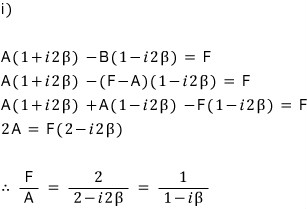
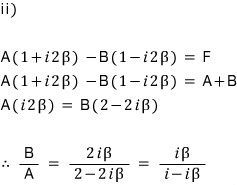
This here is the A-B and A-F relation, and the meaning we really wanted to know earlier was!!!
‘How much does it transmit~~~ & reflect~~~~~ relative to A’ — this kind of meaning
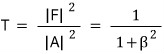
should probably be done with absolute values!!!
But if you just square it, the meaning isn’t damaged!!
And let’s read it this way.
It’s called the transmission coefficient (T, Transmission coefficient)~~~~ and will mean how much is transmitted~~~~
(Squaring isn’t just blindly squaring,,, since it’s the square of a magnitude, it’s the value you get by multiplying by the complex conjugate, riiight)
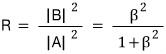
By the same principle, in the meaning of ‘how much is reflected’, it’s read as the reflection coefficient (R, Reflection coefficient), and
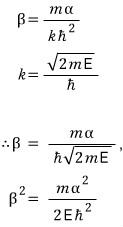
With energy and the material property alpha, beta can be expressed like this
So,

&
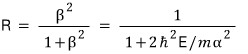
kyaa kyaa kyaa kyaa kyaa
With this, we’ve looked at all the cases of the δ-function potential well!!!!!!
But by doing all this,
we can also easily analyze the case of the δ-function potential barrier.

to

just this switch.
Since that’s the only change,
in our discussion we just need to flip the sign of α and that’s it.
But
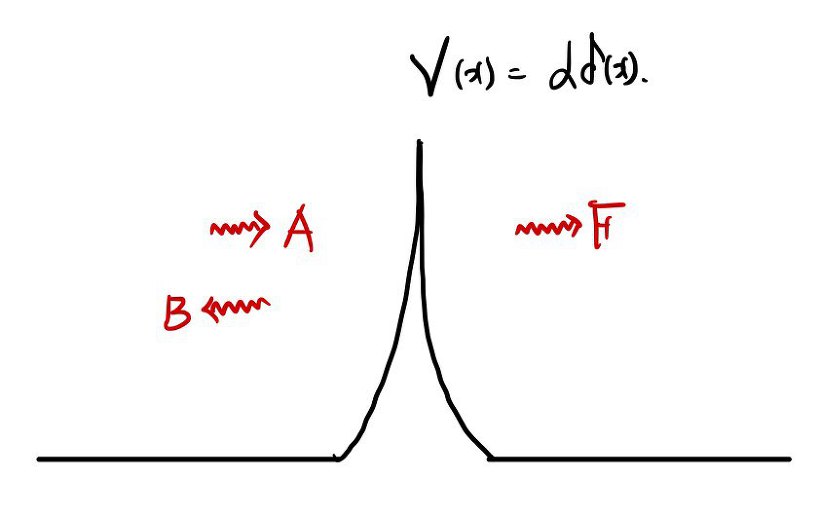
T and R depend on the square of alpha…,
Since alpha changed from -alpha to +alpha, the transmission and reflection coefficients stay the same…!!!!
OMG!!!!
(Can’t take it anymore) Earlier they were saying there’s reflection even though there’s nothing there,
and now they’re saying it passes through the wall (probability of passing through is not equal zero -_-) lol
This phenomenon is called the quantum tunneling effect,
and apparently, because of this bizarre phenomenon, the sun blazes and gives us light, and computers and smartphones could develop technologically at a rapid pace,
and a microscope called the STM gave us bigger eyes,,,,they say.
The gist of this is,
’the fact that the probability of passing through a wall is not 0 is a technology that’s being used a lot right now!’ that’s what it is….
(No, that’s old-school technology lol)
The religion called quantumism is not a cult lol
gotta change majors bye bye
Comments
Discussion happens via GitHub Discussions. You'll need a GitHub account to comment.