The Finite Square Well
Powering through the finite square well: bound states, boundary conditions, and a graphical solution, one painful step at a time.
Ugh…… just one… damn there really are a ton of potentials….hehe lol. One by one, everything, hell hell hell HELL!!!! Hard AND so many, why….lol
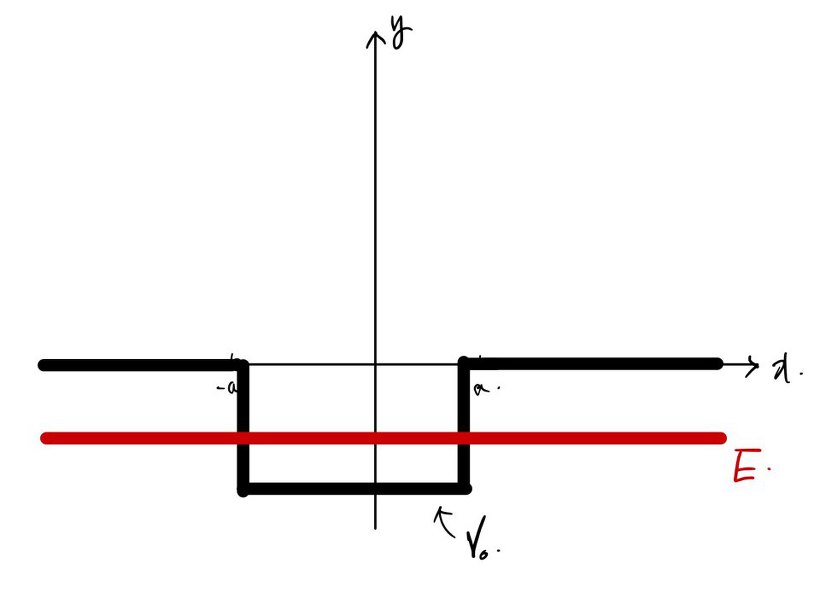
Still, this is for real the last case!!! Let’s power through!!! Its shape is
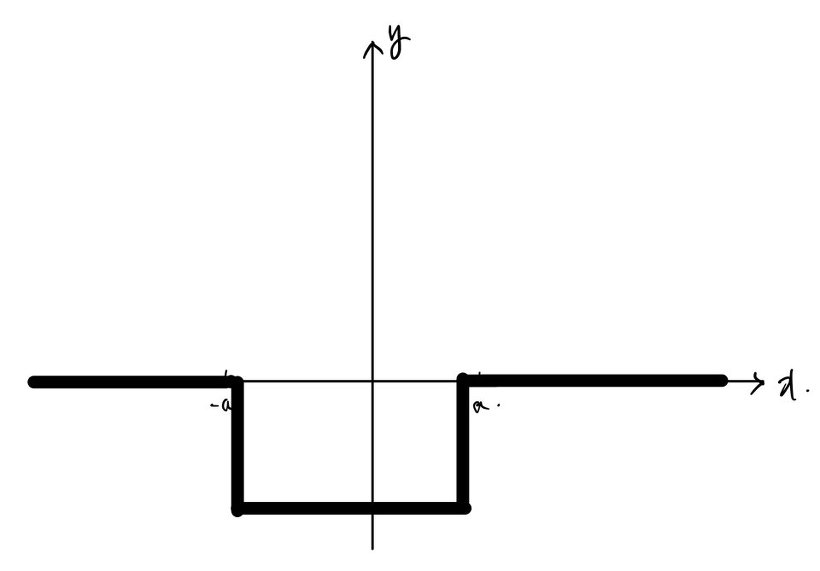
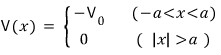
$V_0$ is a constant, a real number greater than $0$ — a constant! it is. This thing is not an infinite square well, nor a $\delta$-function,,,,, Might be somewhere in-between the two~;;~~~~
Anyway, in this case too there’ll be both a Bound state and a scattering state. This time too, let’s look at the bound state and the scattering state one case each.
The bound state, region by region
First!!!! Let’s look at the Bound state!!!!! It’s when the energy is $E \lt 0$, right~~~~~
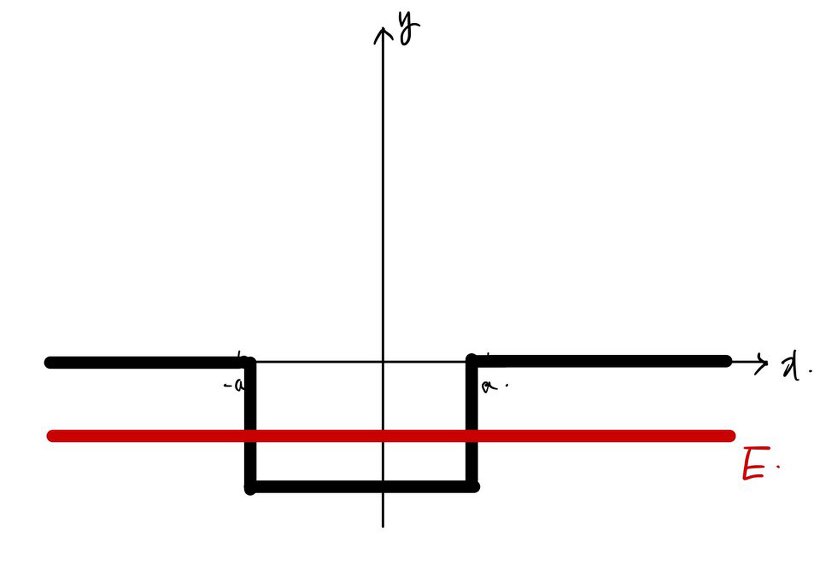
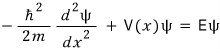
from this~~~~ Alright, starting from the $x \lt -a$ region step by step, the time-independent Schrödinger equation!!!!~~~

Here, just like with the delta function potential well before~ Since $E$ is negative, the whole red thing including the minus comes out positive~~!~!! Freakin’ familiar.
In the $x \lt -a$ region, the general solution of $\psi(x)$ is

and~~~ to stop it from diverging to infinity at $x = -\infty$, $B = 0$ !!!! Ahah~~ then the general solution of $\psi(x)$ when $x \gt a$ is

would be it, but to stop divergence at $x = \infty$, $F = 0$ !!! right?!
(Back then I just said $G = 0$, the notation is different from then…. sorry.)
Ah then what happens in this $-a \lt x \lt a$ part…..(a little nervous..T_T)
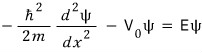
The Schrödinger equation comes out like this

<It could get a bit confusing, but the red color is positive. That V-zero is positive….hehe right!??! V-zero is positive!!!hehehe>
$E$ is negative!!! And in magnitude V-zero is bigger.
ok? Shall we find the general solution of $\psi(x)$ in $-a \lt x \lt a$??

Shall we say this???? That would work too (once the exponents get their $i$’s, which the picture forgot), but when calculating later

setting it like this is more convenient.
(Do you remember when we solved the Laplace equation in the electromagnetism potential part??? It’s the same as then.)
Summarizing the general solutions we’ve found so far
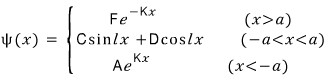
Matching the boundaries
Now, using the condition ‘$\psi(x)$ is a continuous function,’ let’s match the boundaries.
And do you know what other condition we also used back then??
(Back in the Dirac potential well case) Back then we did it using the integral from $-0$ to $+0$!!! That was really a condition on the derivative of $\psi(x)$!!! Here too, if we integrate from $a-0$ to $a+0$,

this comes out. Since we already know~~~~~~ let’s just use the condition ’the derivative of $\psi(x)$ is a continuous function’
($\psi(x)$ is continuous at $x = a$. →)

(The derivative of $\psi(x)$ is continuous at $x = a$. →)

($\psi(x)$ is continuous at $x = -a$. →)

(The derivative of $\psi(x)$ is continuous at $x = -a$. →)

Even and odd, one at a time
Now, $V(x)$ is symmetric about the $y$-axis. (it’s an even function.) Then $\psi(x)$, like in the infinite square well, will be either an even function or an odd function!!
$\psi(x)$ must be either an even function or an odd function!
So now let’s think about the even case and the odd case separately!! First, the even function case!!!!
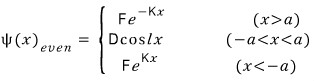
Now we’re going to check the boundary conditions for the even function, and we don’t need to check both $x = a$ and $x = -a$, just $x = a$ will do (since it’s an even function)
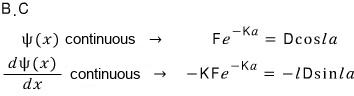
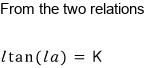
we can make this, and now, to solve that equality,,, I think we need to think about what $l$ and $K$ originally~~~were

Ah~~~~~~ $l$ and $K$ both depend on energy $E$, and also~~~ we can make yet another relation with the two
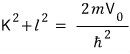
(This relation was supposed to be made way~~~up there and carried down, it looks kind of out of nowhere…T_T sigh…)
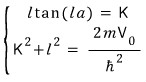
Graphical Solution
We need to find $l$ and $K$ that satisfy these two….
Can’t we just draw an $l$-axis and a $K$-axis and find them by intersection??????
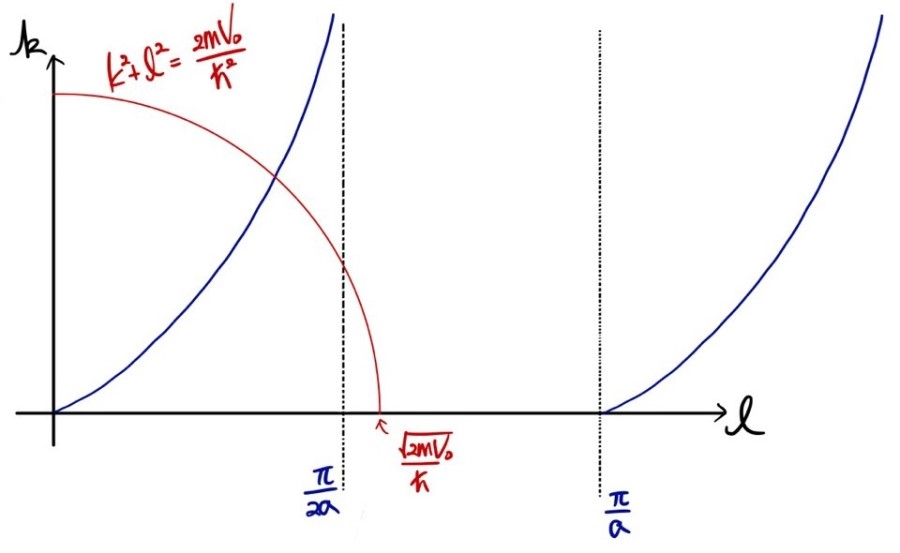
Because that ordered pair $(l, K)$ would be the $l$ — and the $K$ at that time — that satisfies BOTH~ the top equation and the bottom equation! Okay! Let’s move out
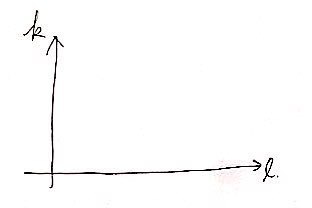
Draw each graph on axes like this and find the intersection. Let’s carry in our hearts even the fact that the $K$ and $l$ we find mean Energy.
And the existence of an intersection means there’s an $E$ that satisfies both. That is, there’s ‘something’ that exists as a bound state!!!!! lol
The meaning of drawing graphs to find intersections is that, I guess……heh. So let’s find the Solution via intersections. (They call this sort of thing a Graphical Solution.)
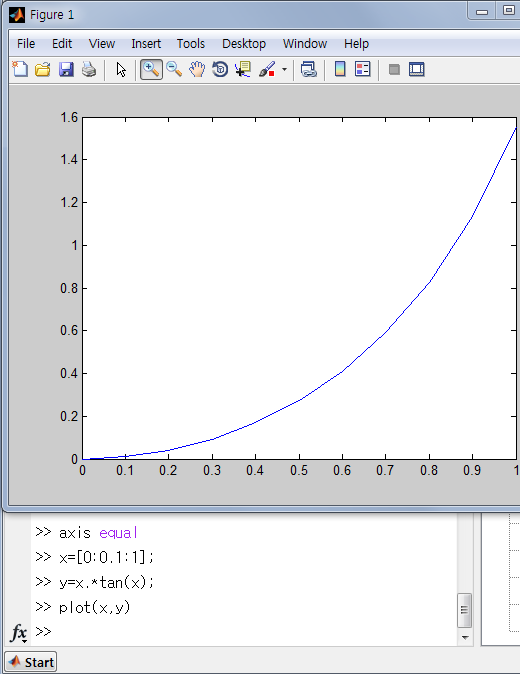
Since both $K$ and $l$ are positive!!!! forget all else and let’s just think about the first quadrant!! Just in case, I went ahead and plotted $x \tan x$ in Matlab!!!
And I combined the two graphs and drew them on my paper.!!!!
Two limit cases
Now what we have to do is check ‘whether there’s an $E$ that exists’. That is, whether — in any situation whatsoever! — at least one intersection always exists!!!!! (That there’s surely!!! at least one, anyone with eyes would know.)
How many solutions exist~~~ (how many $E$’s there are as possible states~~) would be the best thing to find out, but let’s not…T_T Just,,,, with two limit cases,,, let’s only check the extreme situations!!!! Then the question above will be answered.
*Case where the finite square potential well is freakin’ wide~~~~~~~ and freakin’ deep~~~~~~~!!!!!!
Since $a$ is big, $1/a$ is hella short. I’m not sure, but if there’s a solution!!!! if a solution exists, that solution is alm~~~~ost the same as the asymptote!!!! (because $a$ is big,) That is, the solution for $l$ is

we could say~~~~($n$: odd number!)

** Second limit case!! Case of a hella narrow and also hella shallow well!!!!!
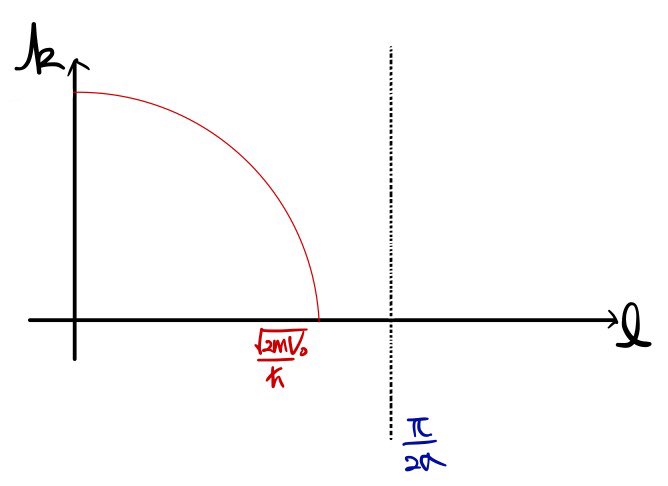
In this case, since  is too small, a situation can arise where only one solution can exist!! Since $a$ is damn~~~~~small, the asymptotes will be way~~~~~far.
But!!! No matter how far, no matter how far the asymptotes are, there’ll definitely!!!!! be at least one solution no matter what.
Then at what level of is there one solution?~?~
Right, in a case like the one right above, there’d be one solution!
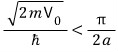
In a case like this there’s one solution.
But the important thing isn’t so much how many solutions exist, but that for a finite square potential well, there’s never a situation where no bound state exists at all!!!!!
※Warning: heart attack※
The other half: the odd function
Up to here we only looked at the case where  is an even function. Half is still left…… the case where is an odd function,,,, since there’ll be cases like that too,…. let’s look at that too.
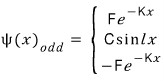
Checking B.C like above
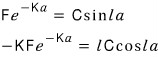
we can get two equations, and the relations
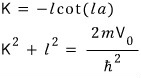
OK~~~
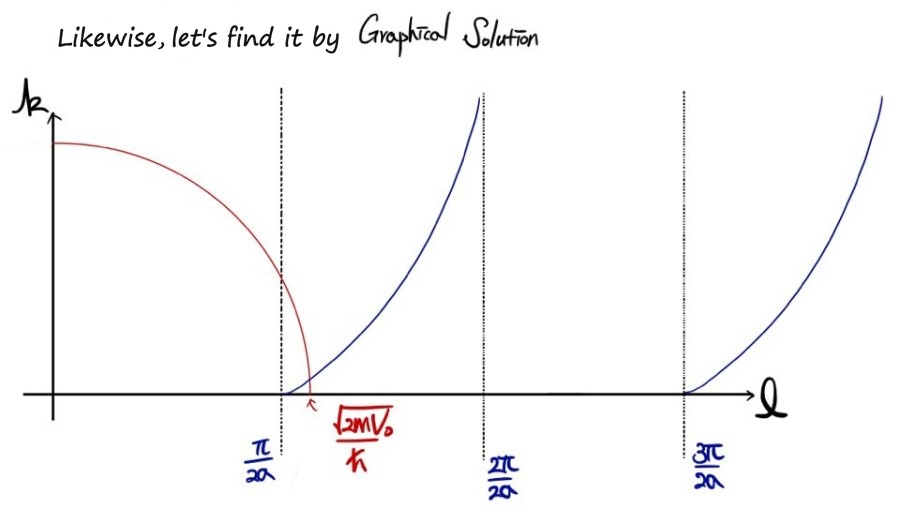
Oh~~~~~ if is too small compared to $1/a$, there might be no solution???? Let’s look at the limit cases like with the even function!!!!!
1.) Case of a freakin’ wide and freakin’ deep well.
Again, if $a$ is freakin’ big, $1/a$ is freakin’ small~ and there’ll be many solutions~~~ Anyway, I’m not sure, but that intersection will be around its next asymptote (this is the difference!!!)
($n$ is even) Into this $l$,
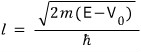
if we substitute,
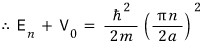
‘In this case a solution absolutely exists!!!’
2.) Freakin’ narrow and freakin’ shallow well.
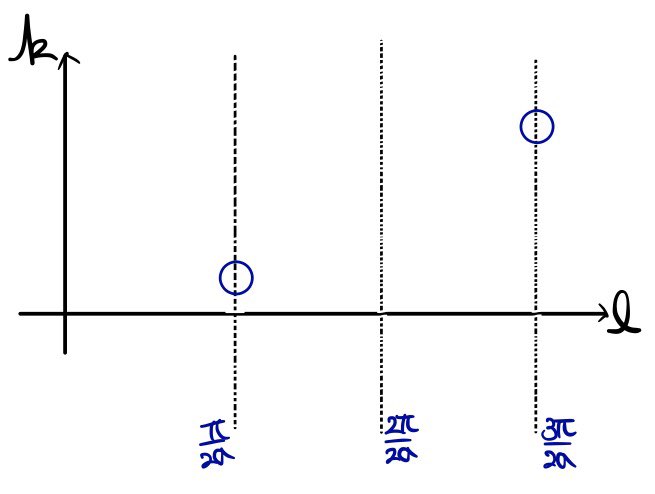
In this case too, like before, we can check by the length of the radius. Now if $a$ is too small and $1/a$ gets big, if this difference gets too too big, there might be no solution. Then, along with that, let’s find the case where there’s exactly~!! one solution!!! The cases outside of that would be either no solution or 2 or more!!! Anyway!!!
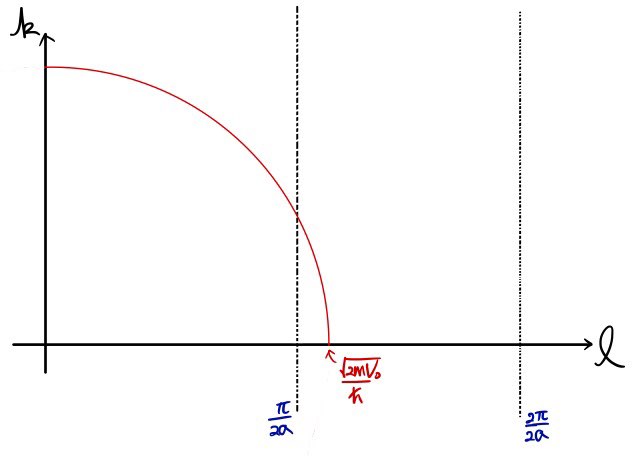
The case where exactly~~~ one solution exists is
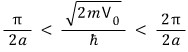
right, this case~~~~~~~~~~~~~ *>0<*
PS. The reason I kept saying ‘one, one’ here is that there’s a range where only one state of the wave function is possible!!!hehe
I should change majors. What was the department office’s phone number….>3<
Heads-up. The figures here are the original notes, slips and all. A few things to watch for:
- In the equation inside the well, the definition should read $l = \frac{\sqrt{2m(E+V_0)}}{\hbar}$; the picture writes $l^2$ on the left.
- Inside the well the solutions are oscillating: $\psi(x) = Ce^{ilx} + De^{-ilx}$, that is $C\sin lx + D\cos lx$; the picture leaves out the $i$.
- In the derivative condition at $x = -a$, differentiating $C\sin lx + D\cos lx$ gives $KAe^{-Ka} = Cl\cos la + Dl\sin la$; the picture drops the factor $l$ in the first line and swaps sine and cosine in the second.
- In the odd solution, the part for $x \lt -a$ should be $-Fe^{Kx}$, which decays as $x \to -\infty$; the picture writes $-Fe^{-Kx}$.
- In the deep-well case, $l = \frac{\sqrt{2m(E+V_0)}}{\hbar}$ with $E + V_0$, as defined earlier; the picture writes $E - V_0$.
- For exactly one odd solution the radius has to lie between the start of the first branch and the start of the second: $\frac{\pi}{2a} \lt \frac{\sqrt{2mV_0}}{\hbar} \lt \frac{3\pi}{2a}$, not $\frac{2\pi}{2a}$ (the graph shows the second branch starting at $\frac{3\pi}{2a}$).
Comments
Discussion happens via GitHub Discussions. You'll need a GitHub account to comment.