Formalism: Hilbert Space
A casual romp through how quantum mechanics got its math — from Heisenberg rage-quitting to the beach to the Hilbert space formalism that makes it all click.
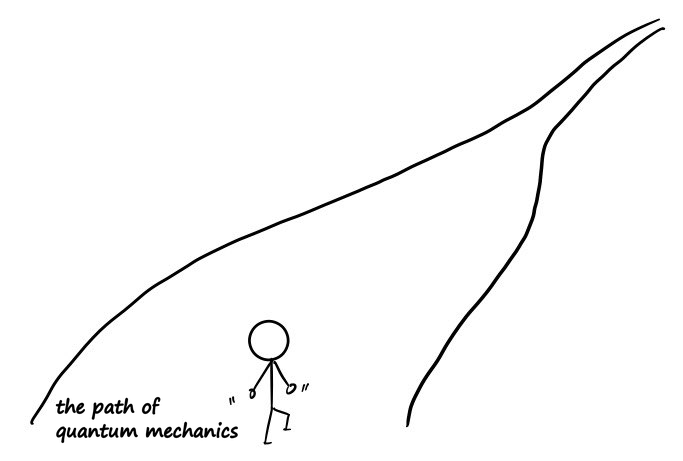
Lately, we’ve been walking the path that is the path of quantum mechanics.
Nunu nanna~~~ so this is the path of quantum mechanics~~!~!~

“Ayyy, you startled me!!! Who are you!??!?!!!”

(the online-shop page for this picture)
“Oho~~ so thou art walking the path of quantum mechanics~~~~ In classical mechanics what is the main equation~~~”
“Huh? F=ma~~~”
“Ohoooo~~ right, in quantum mechanics it is the Schrodinger Equation~~~~~ remember it well~~~”

(vanishes….)
“Huh?? What?? Where are you going!! Hey!! Hey~!~!!!!!”
Well, something like this…. I keep getting hit with this,
and what we’ll talk about from here on is basically a Chapter that says mathematically, what we’ve been saying ‘makes sense’..
How the discipline called quantum mechanics arrived at today’s mathematical framework — we’ll look only at the
very very very very low-difficulty bits.
As for how quantum mechanics was born, I think you’d be better off reading the book called Quantum Story,
what I thought while reading it was lol the parts I’d already covered read really, really fun
but the parts I haven’t covered yet (like the Zeeman Effect) I didn’t understand at all…..awww
Anyway, I recommend giving it a read!!!
The early days of quantum physics (after Planck (around post-1900)) were the birth of quantum mechanics along with a period of huge development.
But it felt like they were blocked by something enormous, Heisenberg had nooooo idea why!!! things wouldn’t work out, and he felt jammed up tight like [CLUNK CLUNK CLUNK]!!!!ack!!
he genuinely couldn’t figure it out no matter how much he thought, there was ‘a certain experimental result’ at the time (something like that) and ah seriously he just couldn’t get it!!
he got reeeeally deeply pissed off (Bohr and Heisenberg were originally a master-disciple pair, so) and he was so pissed that he went to his teacher Bohr and,
“Ay, teacher, I just don’t get it. I’m gonna go to the seaside and rest a bit, clear my head, k?”
Bohr gladly gave permission and Heisenberg went off to the beach to clear his head, but could he shake that thought from his mind?!?!
he was totally ticked off
at that point, this thought apparently came to him.
the reason errors kept occurring at the microscopic level
was that the physical system had completely changed, and yet physicists kept using x, p, T, V and so on — the
variables from before — so it seemed like that’s why things were wrong~~
was what he thought!
So here Heisenberg tried com~~pletely changing the ‘variables’ and thinking about it,
and what he picked as a modern-physics variable was ‘spectral intensity’
and once he picked this as his variable and started cranking through some equations, they clicked, clack, click right into the values he wanted!!
(no idea what he was doing at a vacation spot lolol)
Right there he got soooo excited he KakaoTalk’d Bohr immediately!!
(KakaoTalk my foot, he probably wrote a letter,)
but Bohr received the letter and just could not figure out what the heck Heisenberg was saying
then about 7 months later, Bohr was lying down trying to go to sleep,
and suddenly — flash!!!!!! — and that was that equation Heisenberg had sent back then,
that equation — “Yo damn!!!!!! that was a matrix!!!”
is what came to him, apparently,
and that’s how Heisenberg seems to have discovered what’s called ‘matrix mechanics’???
That’s why linear algebra seems to be super super core and powerful in quantum mechanics?!?!?!!(I don’t really know~)
Ah, at this time Heisenberg supposedly said this to his daughter in a letter
“Daughter… I think your dad may have made a discovery as big as Newton’s……”
wow damn this is seriously insanely cool lol
Why did I ramble on like this~~~~
The first thing we have to look at is Hilbert space
Umm~ the ψ state functions we deal with, these guys exist in Hilbert space~~~
The state function ψ has to be Normalized for it to make sense physically, and we have to describe the world with that,
that is, we
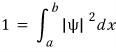
only deal with ψ that satisfies this,
and the set of functions satisfying the above condition, we ‘math folks’ call

and that set is called Hilbert space, apparently!!!
So, the wave function (state function) is a function (vector) that lives in Hilbert space!!
And now we’re gonna look at brackets, there really are a lot of kinds of brackets in the world
there are (), {}, [], <>, etc.,
and we’re going to focus on the brackets that look like <>!!! because there’s a mathematical definition for them!!
For now, () is called “small brackets”
{} is “junggwalho” (medium brackets)
[] is “daegwalho” (large brackets)
right?
What do they call <>??? Angle brackets?? what is it lolol
But in English <> is called “braket”, and whether you say “angle brackets” or “braket”, it’s the same thing.
Okay so far~~~~??
Alright, now math!! and linear algebra at that!!!!
Umm, in linear algebra, a Vector can generally be a Function too. (as long as the basis is properly set up,)
And what transforms a vector in one set into a vector in another set — we usually learn that’s called a ‘function,’ right? maybe?
We said we view the state function as a ‘vector,’ and its basis would be a basis that builds Hilbert space, right~?????
Now, the vector that represents that wave function!!!! that’s a vector too, right?!?!?!!!
In representing this vector, a physicist named Dirac…
Bra-vector
ket-vector
— that’s what he proposed as a notation.
“Hey folks~ it’d be convenient to write it like this~” (dirac notation)
In Braket, ‘bra’ is the front, so of <,> it refers to <,
and the definition of the Bra-vector is (for vector α)

And
the definition of the ket-vector is
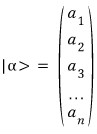
he said to express it like this, apparently.
As to why he said to express it this way,,,,
well,,,this is all stuff you learn in high school,,,,
the inner product of 3-dimensional vectors is

well, this is obvious, and
then if we raise the dimension, the inner product of n-dimensional vectors is

but!!! if the Field is the complex number field, the very definition of vector inner product becomes

(it should really be an integral, but for ease of talking I’ll keep writing it like this.)
The wave function is ‘some element (vector)’ living in Hilbert space, and it can be viewed as one element (vector) that can be expressed as a linear combination of Hilbert space’s basis vectors, so
just take an arbitrary wave function

and as the basis vectors of Hilbert space

with guys like these, we can express it as a linear combination!
A ’linear combination’ is a sum with some numbers, right?!?!

And let’s write one more arbitrary wave function.

The inner product of the two vectors is

Written as a matrix,
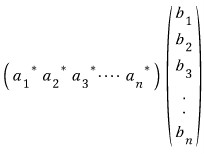
In Dirac notation,

From here on I’m gonna use Dirac notation,,,,
what I kept wanting to say is that for a bra-vector, the entries come as complex conjugates — that’s right!!
This definition brings with it a certain property, namely
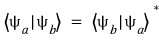
this kind of property too!!!
Now a few more things to add on to Hilbert space…..
The bases of Hilbert space have magnitude 1!!!!!!!
Because these guys have to be normalized first!!!!!!
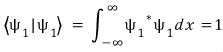
And we said the bases of Hilbert space are Orthogonal!!!!!!
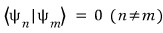
(They’re bases, so of course they’re perpendicular!! you might think!!)
magnitude is 1, and they’re orthogonal, so
combining these we call it Orthonormal!!!@!!
(I just wanted to use this word Orthonormal…..hehe)
Comments
Discussion happens via GitHub Discussions. You'll need a GitHub account to comment.