Formalism: Determinate States
Unpacking what a 'determinate state' actually means in QM — turns out σ_Q = 0 leads straight to eigenvalues, and yeah degenerate spectra are a thing lolol.
Let me transcribe the content from Griffiths’ book, my textbook.
In quantum mechanics, when some physical quantity Q is
applied to an ensemble of identically prepared systems all corresponding to the same state function ψ,
we don’t generally expect the same measurement result every time. (the uncertainty principle)
So then a question: is it possible for some state such that whenever we measure the physical quantity Q, we always get the same measured value q??
=> GD comment here: up there it says we don’t expect the same value to come out, and then the question asks whether it’s possible to get the same value lolololololololol
Is that even a proper question lololololololololololololololol ugh, so annoying hehehe
Anyway, continuing the transcription, here we go
If that is possible, then this state can be regarded as a determinate state with respect to the physical quantity Q.
=> : Now when I read what comes next, it made sense.
We know one example of a determinate state. A stationary state is a determinate state with respect to the Hamiltonian.
If you measure the energy of a particle in the stationary state ψn, it’s certain that you’ll get an allowed energy En.
In the case of a determinate state with respect to the physical quantity Q, it is certain that the measurement yields ‘some value ‘.
If we write that red text not in words but as an equation,
= it’s enough to write “the standard deviation of the measured value of Q is 0,” so,
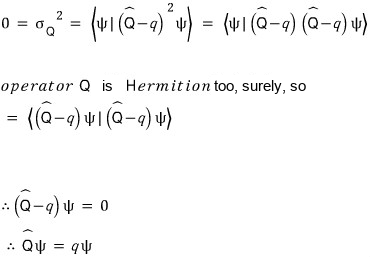
An equation is derived that means the eigen-value of the operator Q is q!
We can say that the eigen-function of the operator Q is ψ.
But not just aaany ψ — it’s a “determinate state ψ”.
Now, let’s organize some terminology a bit,
Spectrum: the set of all eigen-values for some operator is called the spectrum.
But there’s no reason different state functions must have different eigen-values.
eigen function G has eigen value q
eigen function D has eigen value q
They can overlap like this!
In this case, they say ’the spectrum is degenerate, or the eigenvalues are degenerate.’
And following along with us, we can also prove this.
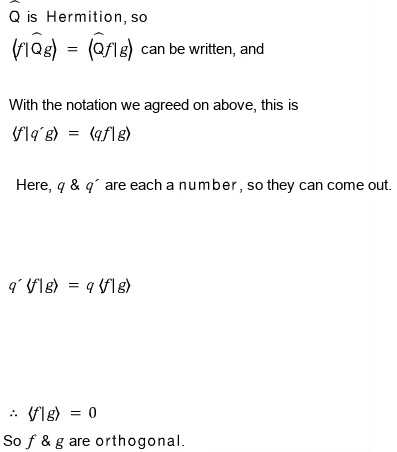
“Eigenfunctions with different eigenvalues are mutually orthogonal.”
I’m going to prove this, and it’s a prooooof that is tail-to-tail linked to the proofs we’ve been doing so far~~
Because it can be explained like this.
“A measurable physical quantity must be real (Real),” → “For that to be the case, the operator must be Hermitian.”
→ “And as a result, eigenfunctions with different eigenvalues are mutually orthogonal.”
We can go like this, so let’s prove this one, “eigenfunctions with different eigenvalues are mutually orthogonal”,
For operator Q, let’s say that the eigenvalues of the different eigenfunctions f and g are q and q’ respectively.

Comments
Discussion happens via GitHub Discussions. You'll need a GitHub account to comment.