The Uncertainty Principle
Let's actually prove Heisenberg's uncertainty principle mathematically instead of just taking it on faith — using variances, Schwarz's inequality, and some operator magic.
Uncertainty principle:

What this equation means is “you cannot precisely measure the two simultaneously.”
We’ve heard this so many times by now that it kinda feels obvious?
Or maybe it’s just that they show it to us experimentally so we have nothing to say back….
So this time, instead of just accepting this as something obvious,
let’s take some time to mathematically prove Heisenberg’s uncertainty principle!
Let’s get right into it.
I’ll do it in general.
‘For some observable physical quantity A,

(the variance) is’
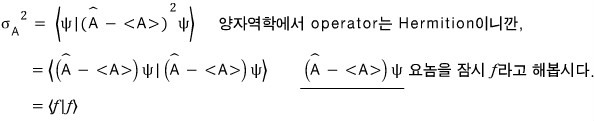
‘And for some other observable physical quantity B,

(the variance) is’
by the same principle let’s say it like this.
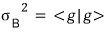
Then~~~~~~the product of the two variances is

But the right side is something we’ve seen many times in the mathematical physics textbook.
It’s exactly ‘Schwarz’s inequality’
So we can change the equation into this form on the right side.
(I’ll skip the proof of Schwarz’s inequality~~~~~?)

Here

will be some ‘complex number’ right?!?!?!!!!
If there’s some complex number a+ib ~~~ the magnitude of that complex number is

so~~~
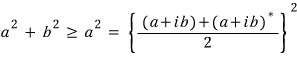
this will also hold,
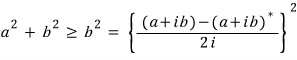
and this will also hold.
Very obvious, very obvious~
But the one we’re going to use is the one below.
Then let’s go back to the original equation.
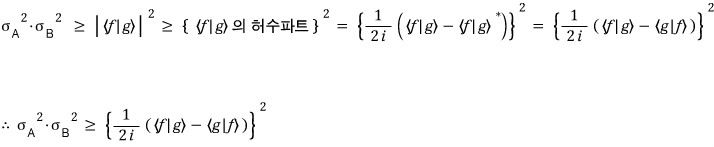
Alright, at this point let’s unwrap the substitution <f|g> and do the calculation.
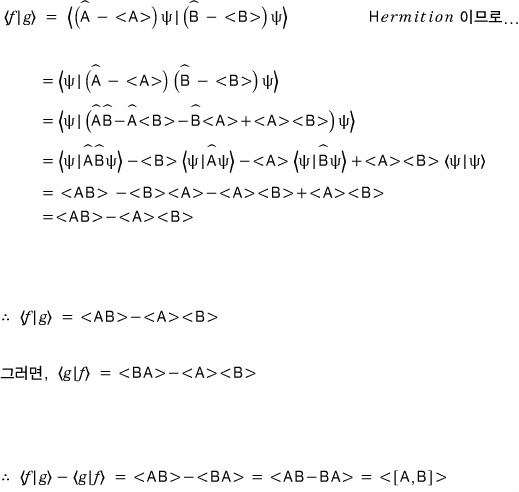
Therefore
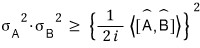
Yep yep yep yep so originally ~~~ this is the generalized uncertainty principle. Originally it’s this equation.
That one we commonly know

this one, if you plug in A = x, B = p, it reduces to the equation above!!
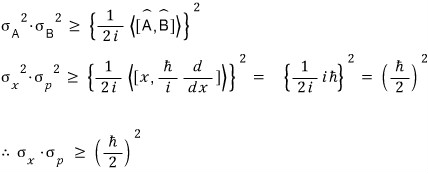
Like this~~
Oho~~ it’s been a while, this is fun lol
“Hey then just when exactly

does it have the smallest possible value!!!
When exactly is that????”
Well we derived the uncertainty as an inequality,
so when the uncertainty is smallest, it’s when the inequality satisfies Equal!?!!!!!
Alright let’s find that time!!!! When does the inequality satisfy equal!!
Especially~~ Heisenberg’s uncertainty principle

when does the equal hold in this one~~
Spoiler coming in. Answer: when ψ is Gaussian, that’s when it has the minimum uncertainty.
Alright then just why~~~
when the function is Gaussian the uncertainty becomes minimum!!! Let’s look at that moment.

We came this far from this kind of inequality. Now looking at this you can see~
“When does equal hold~~~~~”
“When the real part is 0” if that’s the case
the little + plus on the left side from the real part goes away!!!
You understand right
Okay so

’s real part is zero!!!!
That means when that complex number is ‘purely imaginary’ the equality holds!!!! This is exactly it

having its real part equal 0 means

!!!!~ we can say this!!!!
Let me organize it like this
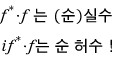
so~~~
Ah but let me leave just a lit~~~tle bit more room here.

like this.~ (a ‘constant multiple’ of it is also fine~~~) I’ve left some room like this.
Now

writing it this way
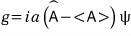
eoheoheoheoheo

when this is the case!!!! the uncertainty becomes minimum~~~~ that’s what we’re saying.
Let’s put x in A and p in B and look at that relation.
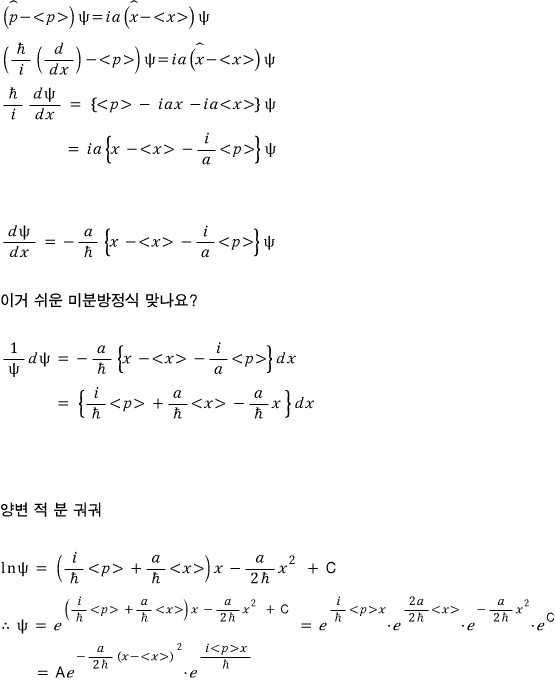
It is Gaussian indeed!? lolololol so cute~ wow~ lolol heh-heh
Another form of uncertainty - “the uncertainty between energy and time”

we learned and derived this, but
besides the uncertainty between x and p, there’s apparently one more representative uncertainty.
‘What other pair besides x and p can’t be measured precisely’
It’s energy and time!!!
This was derived in a very rough way in ‘modern physics’ class.
Let’s briefly look at how we did it there.
We want to measure the E emitted during a time interval Δt from some atom,
this means we’re measuring the E of the emitted electromagnetic wave…
The energy of the electromagnetic wave

because of this
measuring E means we have to count the number of ν frequencies!?
It means we have to count oscillations during Δt, and when counting the number of oscillations it won’t be precise of course..
‘Let’s call that uncertainty 1.’
It means the number of oscillations might be miscounted by at least more than 1
since this means during Δt seconds the number of oscillations could be miscounted by more than 1
the measured frequency ν could be mis-measured by 1/Δt.
Therefore the uncertainty Δν of the frequency ν can be larger than 1/Δt!

The uncertainty of energy is simple!!!!

Then this kind of result equation comes out.

Into this

if you substitute this
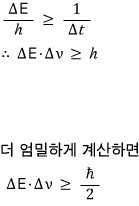
In modern physics we calculated it like this.
And what Δt means ~~~ we patched it as “life time” and skipped right over, that’s a painful memory.
This time since it’s quantum mechanics class, let’s properly go through it.
Rather than calling Δt’s meaning a life time, it’s introduced a bit more broadly and then the derivation starts?~
Δt: “the time it takes for a given physical system to change”
Well~~it’s like this.
“how fast or slow E changes, how fast or slow p changes ~~ and so on, how fast or slow things change”

that’s what we want to look at. Okay let’s do it.
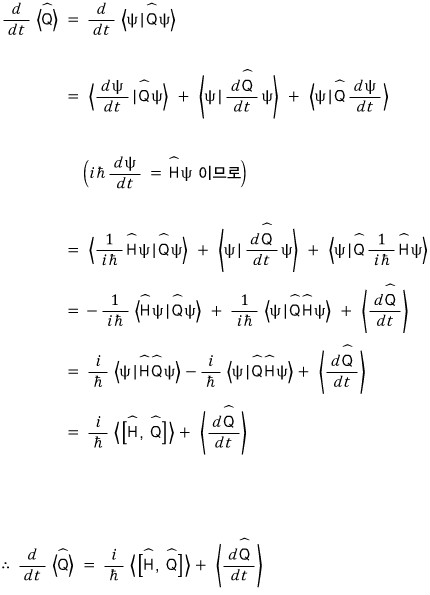
That equation we derived…. the time rate of change of the expectation value….isn’t it kinda fascinating?????
Just mindlessly mobilized the Schrödinger equation and derived it,….
and the Hamiltonian shows up lolololol fascinating
Well I mean, since it’s the Schrödinger equation I guess that’s why,,,,anyway!!!
Moving on.
The footnote at the bottom of the book says this.
“The case where an operator explicitly depends on time is extremely rare. Therefore in almost all cases

you can consider it as.”
Oh my god, in almost all cases

that’s what it’s saying.
That is
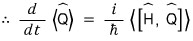
Oh my god!!!!! ‘a commutator between operators?!?!?!!!!!
Where have I seen this a lot?!?!?!? Let me manipulate the equation above a bit.’
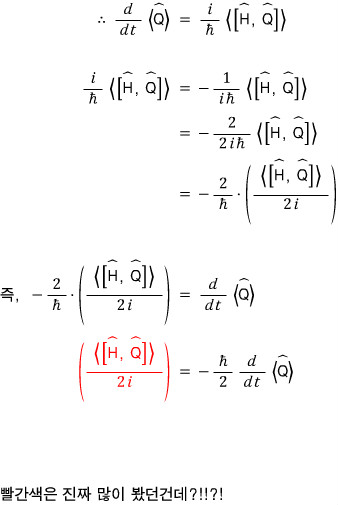
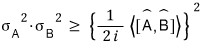
Where I’ve seen it a lot is right here!!!~!!
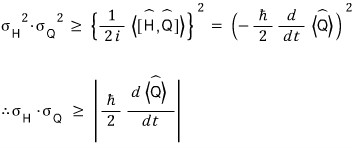
Now I’ve gotta run my mouth a bit,

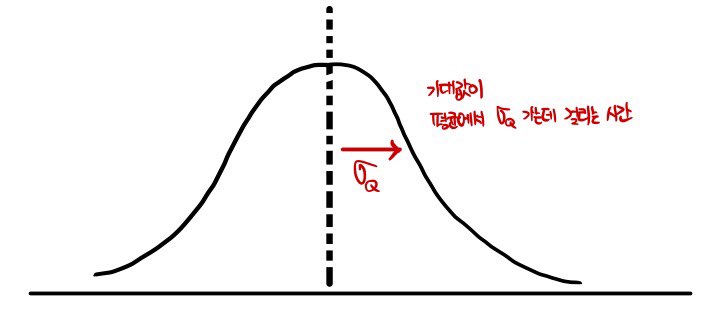
can we call this ΔE???? ‘uncertainty of energy’
Alright~~ and~~~

by pulling some BS I want to turn it into

,
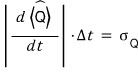
‘uncertainty of <Q>’
(cf. rate of change of <Q> x uncertainty of time = uncertainty of <Q>)
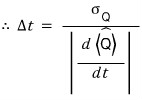
Alright~~~ so~
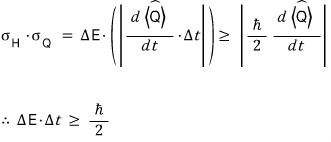
Hmmmmmm~~~~~ in modern physics class we learned Δt as Life time, but
in quantum mechanics class Δt is
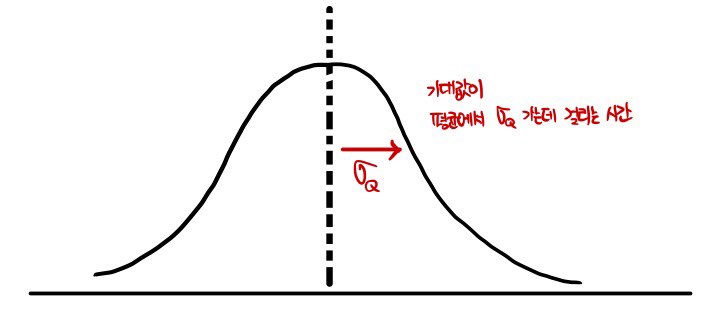
Ahh~~~ so Δt as “the time it takes for some physical quantity to change” can be interpreted as life time! That’s the thought that comes to mind!~
“If some physical quantity changes rapidly (Δt ↓) then the uncertainty of energy becomes large (ΔE ↑)”
(You can think about quantum jumps in the hydrogen atom~~~!!~ apparently in states with high principal quantum numbers they can only exist for a short time~!?)
Comments
Discussion happens via GitHub Discussions. You'll need a GitHub account to comment.