Two-Level Systems
We tackle a quantum system stuck between just two states, slap a Hermitian Hamiltonian on it, and chase down what state it's actually in at time t!
Let’s suppose a physical system made of only two linearly independent states.
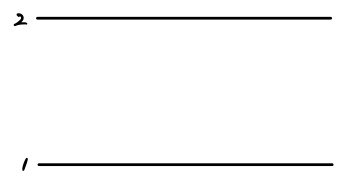
(Typically, LASER?)
Let’s jus’ accept that the electron must exist in either state 1 or state 2, one of the two.
Then

the state function is ‘some vector’

let’s call it this.
And the basis vectors representing state 1 and state 2 respectively,
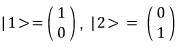
let’s call them this!!
(Not “this IS it!!!” but rather “let’s call them this!!”)
Since the two vectors are orthogonal, it should be appropriate.
Then the state of system (the total all~~~~ the information) representing

is
will be a linear combination of the basis of the states that can exist.

Of course

must be normalizable, so

this condition will always tag along!!!
And to add, a-squared and b-squared respectively clearly represent the probabilities of existing in each state!!!!
Now the problem starts.
“If at t=0 this physical system starts in state 1, at time t what state will this physical system be in?????”
Alright, so let’s bring in the Schrödinger equation.
But, we need to bring in the “time-dependent” Schrödinger equation! So
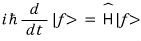
this will be satisfied,
And since state 1 and state 2 are for-su~!~!!~~!~!re states with eigenvalues,
I’ll first write the Time independent Schrödinger Equation. (the time-independent Schrödinger equation)
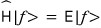
And the H-hat Hamiltonian operator!
Since there are 2 states, as a two-by-two 2x2 matrix
And, since operators in quantum mechanics must be ‘Hermitian matrices’
if we assume the Hamiltonian operator to be the most general and simple Hermitian operator we can assume,
Hermitian means that even after taking transpose and complex conjugate it comes out as itself, so

let’s roughly assume it like this and solve it out.
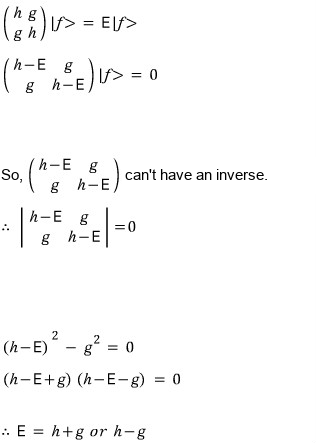
Found the eigenvalues!!!
Let’s also find the eigenvectors that produce those eigenvalues!!!
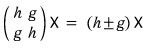
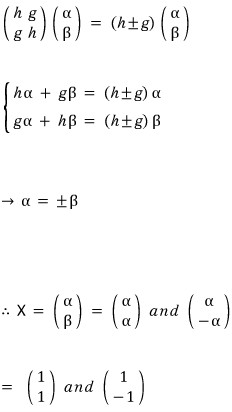
The eigenvectors for H came out to be (1,1), (1,-1), but the magnitudes aren’t 1.
If we make them orthonormal unit vectors with magnitude 1!!!
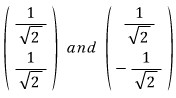
we can write them like this.
Since we said at t=0 it’s in state 1,
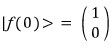
if we express this in terms of eigenvectors of energy
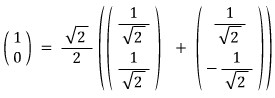
If we multiply a time-dependent term here, it becomes time-dependent!

<I was too lazy to write it out so I just called them e1 e2… that’s okayyy right?>
Comments
Discussion happens via GitHub Discussions. You'll need a GitHub account to comment.