The Schrödinger Equation in Spherical Coordinates (3D)
We bump quantum mechanics up to 3D for the hydrogen atom, watch Cartesian coordinates immediately implode, and brace ourselves for the spherical coordinate nightmare.

(unrelated image)
I’m so cooked.
※mental breakdown ahead — you have been warned※
OK. Here we go.
Honestly, looking back at everything we’ve covered so far… none of it was that wild? The real meat was basically Chapter 2. Chapters 1 and 3 feel, in retrospect, like warm-ups for Chapter 2???
And like — I think now is where we actually take our first baby steps.
(I’ve heard that in grad-level quantum mechanics, Chapter 1 of the textbook is literally the hydrogen atom. Chapter ONE.)
So: what we’re doing now is attacking the state of the electron in a hydrogen atom, quantum mechanically.
And to do that, we first have to bump the 1D quantum mechanics we’ve been playing with up to 3D.
The 3D Schrödinger equation!!!! Easy, right~
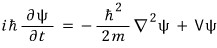
$$i\hbar \frac {\partial \psi}{\partial t}\quad =\quad -\frac {\hbar^{2}}{2m}\nabla^{2}\psi \quad +\quad V\psi$$The 1D total derivative just poofs into a Laplacian (partial derivatives), and that’s it. Done.
So in our beloved Cartesian coordinates,
$$i\hbar \frac {\partial \psi}{\partial t}\quad =\quad -\frac {\hbar^{2}}{2m}\left( \frac {\partial^{2}}{\partial x^{2}}+\frac {\partial^{2}}{\partial y^{2}}+\frac {\partial^{2}}{\partial z^{2}} \right) \psi \quad +\quad V\psi$$Cool. And since this chapter is all about the hydrogen atom~~
we just plug in the hydrogen atom’s potential for V, right?!?!
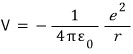
Hydrogen has 1 proton, so the electric potential is
$$V\quad =\quad -\frac {1}{4\pi \epsilon_{0}}\frac {e^{2}}{r}$$Plug it in ($e$ is the electron charge!!!):
$$i\hbar \frac {\partial \psi}{\partial t}\quad =\quad -\frac {\hbar^{2}}{2m}\left( \frac {\partial^{2}}{\partial x^{2}}+\frac {\partial^{2}}{\partial y^{2}}+\frac {\partial^{2}}{\partial z^{2}} \right) \psi \quad -\frac {1}{4\pi \epsilon_{0}}\frac {e^{2}}{r}\psi$$And that $r$ also needs to be in Cartesian, so:
$$i\hbar \frac {\partial \psi}{\partial t}\quad =\quad -\frac {\hbar^{2}}{2m}\left( \frac {\partial^{2}}{\partial x^{2}}+\frac {\partial^{2}}{\partial y^{2}}+\frac {\partial^{2}}{\partial z^{2}} \right) \psi \quad -\frac {1}{4\pi \epsilon_{0}}\frac {e^{2}}{\sqrt {x^{2}+y^{2}+z^{2}}}\psi$$Yeah………… hydrogen atom in Cartesian coordinates~~~ stops right here.
Look at that red piece. All lumped together under a square root. $x$, $y$, $z$ are completely tangled into each other. You cannot separate variables on that thing. The PDE will NOT solve.
So Cartesian is out.
Which leaves us with options like…
※heart attack warning※
Well, “options”… they say converting to spherical coordinates is at least the more convenient route…(?)
Convenient my ass.
It’s gonna be a hair-pulling disaster. lol lol lol lol lol lol
Just kidding. Anyway — spherical it is.
Converting the Laplacian to spherical… is not a small job. Proving the conversion here is totally doable but it would balloon into forever, so I’ll just attach a file. Check that for the derivation.
I’ll jump straight to the punchline. The Laplacian in spherical coordinates is
$$\nabla^{2}\quad =\quad \frac {1}{r^{2}}\frac {\partial}{\partial t}\left[ r^{2}\frac {\partial}{\partial r} \right] \quad +\quad \frac {1}{r^{2}sin\theta}\frac {\partial}{\partial \theta}\left[ sin\theta \frac {\partial}{\partial \theta} \right] \quad +\quad \frac {1}{r^{2}sin^{2}\theta}\frac {\partial^{2}}{\partial \Phi^{2}}$$Now we stuff this into the Schrödinger equation.
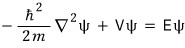
Oh — and we’re going straight to the time-independent version!!
$$-\frac {\hbar^{2}}{2m}\nabla^{2}\psi \quad +\quad V\psi \quad =\quad E\psi$$$$-\frac {\hbar^{2}}{2m}\left\{\frac {1}{r^{2}}\frac {\partial}{\partial t}\left[ r^{2}\frac {\partial \psi}{\partial r} \right] \quad +\quad \frac {1}{r^{2}sin\theta}\frac {\partial}{\partial \theta}\left[ sin\theta \frac {\partial \psi}{\partial \theta} \right] \quad +\quad \frac {1}{r^{2}sin^{2}\theta}\frac {\partial^{2}\psi}{\partial \Phi^{2}} \right\} \quad +\quad V\psi \quad =\quad E\psi$$A genuine monster lmao
lol lol lol lol lol lol lol lol lol lol lol lol lol lol
We just swapped coordinate systems like obedient students and this is the thing that came out… heh. hehehe. haha.
For exactly this kind of situation, the physics department has a Designated Emergency Maneuver!?!?!!!
“Let us assume it’s separable*^0^*”
Since $\psi$ now depends on $r$, $\theta$, $\Phi$ (not $x$, $y$, $z$), it’s $\psi(r, \theta, \Phi)$.
But we just decreed it separable, so
$$\psi (r,\theta ,\varphi )\quad =\quad R(r)\cdot \Theta (\theta )\cdot \Phi (\varphi )$$That’s what it looks like now. Plug it into the Schrödinger equation above.
<From here on I’m cribbing off of Beiser’s Modern Physics (6th ed.), not the quantum textbook.>
$$-\frac {\hbar^{2}}{2m}\left\{\frac {1}{r^{2}}\frac {\partial}{\partial t}\left[ r^{2}\frac {\partial \psi}{\partial r} \right] \quad +\quad \frac {1}{r^{2}sin\theta}\frac {\partial}{\partial \theta}\left[ sin\theta \frac {\partial \psi}{\partial \theta} \right] \quad +\quad \frac {1}{r^{2}sin^{2}\theta}\frac {\partial^{2}\psi}{\partial \Phi^{2}} \right\} \quad +\quad V\psi \quad =\quad E\psi$$$$-\frac {\hbar^{2}}{2m}\left\{\Theta \Phi \frac {1}{r^{2}}\frac {\partial}{\partial t}\left[ r^{2}\frac {\partial R}{\partial r} \right] \quad +\quad \frac {R\Phi}{r^{2}sin\theta}\frac {\partial}{\partial \theta}\left[ sin\theta \frac {\partial \Theta}{\partial \theta} \right] \quad +\quad \frac {R\Theta}{r^{2}sin^{2}\theta}\frac {\partial^{2}\Phi}{\partial \Phi^{2}} \right\} \quad +\quad V\left( R\Theta \Phi \right) \quad =\quad E\left( R\Theta \Phi \right)$$$$\text{Divide both sides by } 'R\Theta \Phi '.$$Oh, and at this point those partials really should be total derivatives — each piece depends on only one variable now. Let me clean up the notation:
$$-\frac {\hbar^{2}}{2m}\left\{\frac {1}{Rr^{2}}\frac {d}{dr}\left[ r^{2}\frac {dR}{dr} \right] \quad +\quad \frac {1}{\Theta r^{2}sin\theta}\frac {d}{d\theta}\left[ sin\theta \frac {d\Theta}{d\theta} \right] \quad +\quad \frac {1}{\Phi r^{2}sin^{2}\theta}\frac {d^{2}\Phi}{d\Phi^{2}} \right\} \quad +\quad V\quad =\quad E$$Now, to get the red piece to be purely a function of $\Phi$,
$$\text{multiply both sides by } r^{2}sin^{2}\theta.$$$$-\frac {\hbar^{2}}{2m}\left\{\frac {sin^{2}\theta}{R}\frac {d}{dr}\left[ r^{2}\frac {dR}{dr} \right] \quad +\quad \frac {sin\theta}{\Theta}\frac {d}{d\theta}\left[ sin\theta \frac {d\Theta}{d\theta} \right] \quad +\quad \frac {1}{\Phi}\frac {d^{2}\Phi}{d\Phi^{2}} \right\} \quad +\quad Vr^{2}sin^{2}\theta \quad =\quad Er^{2}sin^{2}\theta \\ \frac {sin^{2}\theta}{R}\frac {d}{dr}\left[ r^{2}\frac {dR}{dr} \right] \quad +\quad \frac {sin\theta}{\Theta}\frac {d}{d\theta}\left[ sin\theta \frac {d\Theta}{d\theta} \right] \quad +\quad \frac {1}{\Phi}\frac {d^{2}\Phi}{d\Phi^{2}}\quad -\frac {2m}{\hbar^{2}}\quad Vr^{2}sin^{2}\theta \quad =\quad -\frac {2m}{\hbar^{2}}Er^{2}sin^{2}\theta$$Now I’ll park just the red term on the right, and shove everything else aaalll the way to the left.
$$\frac {sin^{2}\theta}{R}\frac {d}{dr}\left[ r^{2}\frac {dR}{dr} \right] \quad +\quad \frac {sin\theta}{\Theta}\frac {d}{d\theta}\left[ sin\theta \frac {d\Theta}{d\theta} \right] \quad -\left( \frac {2m}{\hbar^{2}}r^{2}sin^{2}\theta \right) \left( V-E \right) \quad =\quad -\frac {1}{\Phi}\frac {d^{2}\Phi}{d\Phi^{2}}$$Now look:
Red: purely $\Phi$.
Blue: purely $r$ and $\theta$.
And for the equation to hold!!!!
“The two sides have to equal the same constant!!!!”
<Why does it have to be a constant… do I really need to spell that out?~?~~?!!!>
(To quote the professor verbatim: “If you can find me a case where two functions of totally different variables are equal without being constant, go ahead, bring it, lol, I’d love to see it lol.”)
OK so let’s call that constant $m^2$. Writing just the right side:
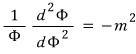
$$\frac {1}{\Phi}\frac {d^{2}\Phi}{d\Phi^{2}}\quad =\quad -m^{2}$$There.
Why the square? Because we’ve put no condition on $m$ — it could be positive, negative, even complex — and writing it as $m^2$ leaves allll those doors open. Apparently.
So let’s sub $m^2$ back into the main equation and keep playing:
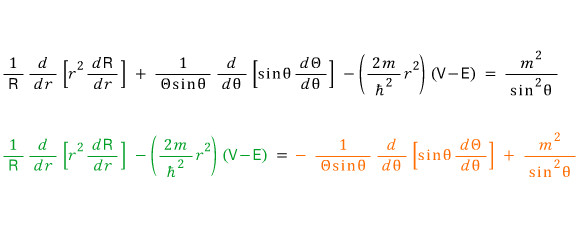
$$\frac {sin^{2}\theta}{R}\frac {d}{dr}\left[ r^{2}\frac {dR}{dr} \right] \quad +\quad \frac {sin\theta}{\Theta}\frac {d}{d\theta}\left[ sin\theta \frac {d\Theta}{d\theta} \right] \quad -\left( \frac {2m}{\hbar^{2}}r^{2}sin^{2}\theta \right) \left( V-E \right) \quad =\quad m^{2}$$$$\text{Divide both sides by } sin^{2}\theta.$$$$\frac {1}{R}\frac {d}{dr}\left[ r^{2}\frac {dR}{dr} \right] \quad +\quad \frac {1}{\Theta sin\theta}\frac {d}{d\theta}\left[ sin\theta \frac {d\Theta}{d\theta} \right] \quad -\left( \frac {2m}{\hbar^{2}}r^{2} \right) \left( V-E \right) \quad =\quad \frac {m^{2}}{sin^{2}\theta} \\ \frac {1}{R}\frac {d}{dr}\left[ r^{2}\frac {dR}{dr} \right] \quad -\left( \frac {2m}{\hbar^{2}}r^{2} \right) \left( V-E \right) \quad =\quad -\quad \frac {1}{\Theta sin\theta}\frac {d}{d\theta}\left[ sin\theta \frac {d\Theta}{d\theta} \right] \quad +\quad \frac {m^{2}}{sin^{2}\theta}$$Now:
Green green: purely $r$.
Orange orange: purely $\theta$.
And since $V$ in the hydrogen atom is a function of $r$ only, we really can say: left side is $f(r)$, right side is $g(\theta)$.
Different variables, two sides equal. For this to hold — same story as before — both sides must equal a constant!!!!! Oh ho!!!!
And we name that constant $\ell(\ell+1)$!!!!!!!!!!!!
(Why that particular form? Call it… ancestral wisdom. You could call the constant any old $C$ and it’d still work, but the result pops out so cleanly in the $\ell(\ell+1)$ parametrization that everyone just… takes it. It’s better for your mental health to not fight it… heh.)
OK, let me tally up what we have:
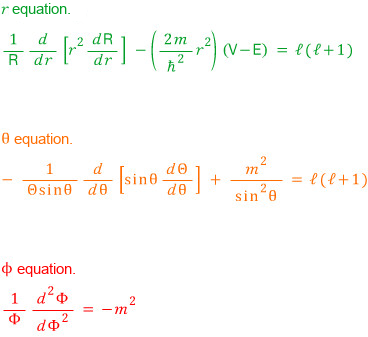
$$r\text{ equation.}\\ \frac {1}{R}\frac {d}{dr}\left[ r^{2}\frac {dR}{dr} \right] \quad -\left( \frac {2m}{\hbar^{2}}r^{2} \right) \left( V-E \right) \quad =\quad \ell (\ell +1) \\ \theta \text{ equation.}\\ -\quad \frac {1}{\Theta sin\theta}\frac {d}{d\theta}\left[ sin\theta \frac {d\Theta}{d\theta} \right] \quad +\quad \frac {m^{2}}{sin^{2}\theta}\quad =\quad \ell (\ell +1) \\ \varphi \text{ equation.}\\ \frac {1}{\Phi}\frac {d^{2}\Phi}{d\Phi^{2}}\quad =\quad -m^{2}$$Three equations, three variables decoupled. Let’s crack them one by one, easiest first — the $\Phi$ equation.
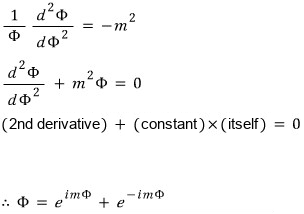
$$\frac {1}{\Phi}\frac {d^{2}\Phi}{d\Phi^{2}}\quad =\quad -m^{2}\\ \frac {d^{2}\Phi}{d\Phi^{2}}\quad +\quad m^{2}\Phi \quad =\quad 0\\ (\text{second derivative})\quad +\quad (\text{constant})\times (\text{itself})\quad =\quad 0 \\ \therefore \quad \Phi \quad =\quad e^{im\Phi}\quad +\quad e^{-im\Phi}$$Now — we’re not math majors, we’re physics majors~~~ Let’s look at the meaning, the meaning!!
Remember I said “$m$ has no condition on it”? No requirement that $m$ be positive, no requirement that $m$ be anything in particular. So: the $+m$ exponential and the $-m$ exponential are literally the same object under the label change $m \to -m$. There’s no point writing a “general solution” as a linear combination of them — linear-combining a thing with itself just gives you the thing back.
(Also, physically: $\Phi$ is the angle measured from the $x$-axis, so $(+)$ just means rotation in one direction and $(-)$ means rotation in the other. Pick one. Move on.)
$$\Phi \quad =\quad e^{im\Phi}$$That’s our $\Phi$.
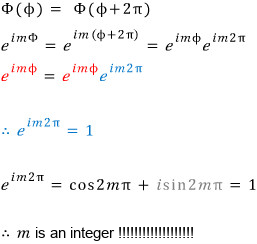
Also — since $\Phi$ is an angle — we must have
$$\Phi (\varphi )\quad =\quad \Phi (\varphi +2\pi )$$Rotate once, you’re back where you started. Apply that to our solution:
$$\Phi (\varphi )\quad =\quad \Phi (\varphi +2\pi )\\ e^{im\Phi}\quad =\quad e^{im\left( \varphi +2\pi \right)}\quad =\quad e^{im\varphi}e^{im2\pi}\\ e^{im\varphi}\quad =\quad e^{im\varphi}e^{im2\pi} \\ \therefore \quad e^{im2\pi}\quad =\quad 1 \\ e^{im2\pi}\quad =\quad cos2m\pi \quad +\quad isin2m\pi \quad =\quad 1 \\ \therefore \quad m\text{ is an integer}!!!!!!!!!!!!!!!!!!!$$WHOA!!!!! We even got $m$ must be an integer for free!!!
OK, on to the $\theta$ equation.
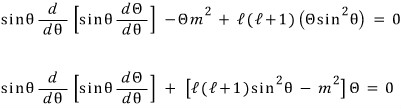
$$-\quad \frac {1}{\Theta sin\theta}\frac {d}{d\theta}\left[ sin\theta \frac {d\Theta}{d\theta} \right] \quad +\quad \frac {m^{2}}{sin^{2}\theta}\quad =\quad \ell (\ell +1)$$Multiply both sides by $\Theta \sin^2\theta$ and dump everything onto one side:
$$sin\theta \frac {d}{d\theta}\left[ sin\theta \frac {d\Theta}{d\theta} \right] \quad -\Theta m^{2}\quad +\quad \ell (\ell +1)\left( \Theta sin^{2}\theta \right) \quad =\quad 0 \\ sin\theta \frac {d}{d\theta}\left[ sin\theta \frac {d\Theta}{d\theta} \right] \quad +\quad \left[ \ell (\ell +1)sin^{2}\theta \quad -\quad m^{2} \right] \Theta \quad =\quad 0$$Ohhh… this is… a kind of differential equation…
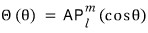
We need the $\Theta$ that satisfies it. And it turns out the equation above is the associated Legendre equation, so its solution is
$$\Theta \left( \theta \right) \quad =\quad AP_{l}^{m}\left( cos\theta \right)$$Apparently. Let me actually verify it’s the associated Legendre equation, though, rather than just taking someone’s word.
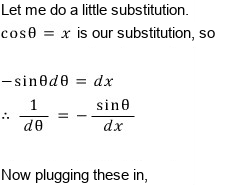
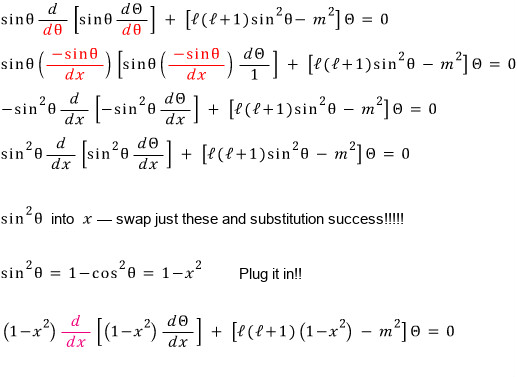
$$\text{Let's do some substitution.}\\ \text{If we substitute } cos\theta \quad =\quad x, \\ -sin\theta d\theta \quad =\quad dx\\ \therefore \quad \frac {1}{d\theta}\quad =\quad -\frac {sin\theta}{dx} \\ \text{Now plug it in,}$$$$sin\theta \frac {d}{d\theta}\left[ sin\theta \frac {d\Theta}{d\theta} \right] \quad +\quad \left[ \ell (\ell +1)sin^{2}\theta -\quad m^{2} \right] \Theta \quad =\quad 0\\ sin\theta \left( \frac {-sin\theta}{dx} \right) \left[ sin\theta \left( \frac {-sin\theta}{dx} \right) \frac {d\Theta}{1} \right] \quad +\quad \left[ \ell (\ell +1)sin^{2}\theta \quad -\quad m^{2} \right] \Theta \quad =\quad 0\\ -sin^{2}\theta \frac {d}{dx}\left[ -sin^{2}\theta \frac {d\Theta}{dx} \right] \quad +\quad \left[ \ell (\ell +1)sin^{2}\theta \quad -\quad m^{2} \right] \Theta \quad =\quad 0\\ sin^{2}\theta \frac {d}{dx}\left[ sin^{2}\theta \frac {d\Theta}{dx} \right] \quad +\quad \left[ \ell (\ell +1)sin^{2}\theta \quad -\quad m^{2} \right] \Theta \quad =\quad 0 \\ \text{If we substitute only the } sin^{2}\theta\text{ terms in terms of }x\text{, it clicks}!!!!! \\ \text{Plug in } sin^{2}\theta \quad =\quad 1-cos^{2}\theta \quad =\quad 1-x^{2}!! \\ \left( 1-x^{2} \right) \frac {d}{dx}\left[ \left( 1-x^{2} \right) \frac {d\Theta}{dx} \right] \quad +\quad \left[ \ell (\ell +1)\left( 1-x^{2} \right) \quad -\quad m^{2} \right] \Theta \quad =\quad 0$$Now let me do just the pink differentiation:
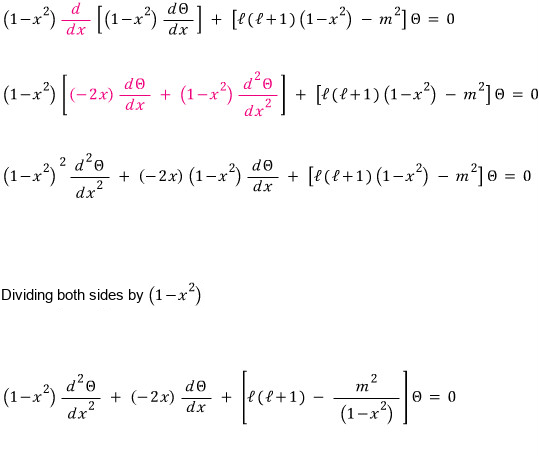
$$\left( 1-x^{2} \right) \frac {d}{dx}\left[ \left( 1-x^{2} \right) \frac {d\Theta}{dx} \right] \quad +\quad \left[ \ell (\ell +1)\left( 1-x^{2} \right) \quad -\quad m^{2} \right] \Theta \quad =\quad 0 \\ \left( 1-x^{2} \right) \left[ \left( -2x \right) \frac {d\Theta}{dx}\quad +\quad \left( 1-x^{2} \right) \frac {d^{2}\Theta}{dx^{2}} \right] \quad +\quad \left[ \ell (\ell +1)\left( 1-x^{2} \right) \quad -\quad m^{2} \right] \Theta \quad =\quad 0 \\ \left( 1-x^{2} \right)^{2}\frac {d^{2}\Theta}{dx^{2}}\quad +\quad \left( -2x \right) \left( 1-x^{2} \right) \frac {d\Theta}{dx}\quad +\quad \left[ \ell (\ell +1)\left( 1-x^{2} \right) \quad -\quad m^{2} \right] \Theta \quad =\quad 0 \\ \text{Divide both sides by }\left( 1-x^{2} \right), \\ \left( 1-x^{2} \right) \frac {d^{2}\Theta}{dx^{2}}\quad +\quad \left( -2x \right) \frac {d\Theta}{dx}\quad +\quad \left[ \ell (\ell +1)\quad -\quad \frac {m^{2}}{\left( 1-x^{2} \right)} \right] \Theta \quad =\quad 0$$For the matching form, go check Boas’s Mathematical Methods, p. 597, the associated Legendre section!!!
So indeed
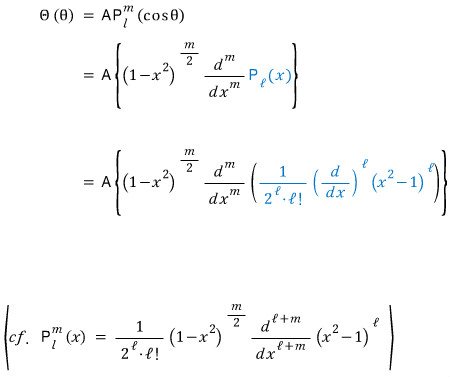
$$sin\theta \frac {d}{d\theta}\left[ sin\theta \frac {d\Theta}{d\theta} \right] \quad +\quad \left[ \ell (\ell +1)sin^{2}\theta \quad -\quad m^{2} \right] \Theta \quad =\quad 0$$has solution
$$\Theta \left( \theta \right) \quad =\quad AP_{l}^{m}\left( cos\theta \right) \Ealign \quad =\quad A\left\{\left( 1-x^{2} \right)^{\frac {m}{2}}\frac {d^{m}}{dx^{m}}P_{\ell}(x) \right\} \Ealign \quad \Ealign \quad =\quad A\left\{\left( 1-x^{2} \right)^{\frac {m}{2}}\frac {d^{m}}{dx^{m}}\left( \frac {1}{2^{\ell}\cdot \ell !}\left( \frac {d}{dx} \right)^{\ell}\left( x^{2}-1 \right)^{\ell} \right) \right\} \\ \left< cf.\quad P_{l}^{m}\left( x \right) \quad =\quad \frac {1}{2^{\ell}\cdot \ell !}\left( 1-x^{2} \right)^{\frac {m}{2}}\frac {d^{\ell +m}}{dx^{\ell +m}}\left( x^{2}-1 \right)^{\ell}\quad \right>$$Just trust me on this one……
Oh, and remember $x = \cos\theta$!
Now the thing to stare at is the blue blue blue part.
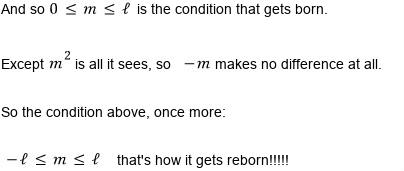
If $m > \ell$, that piece becomes zero. And if the whole thing is zero, there’s nothing to talk about — it’s meaningless.
$$\text{So the condition } 0\quad \le \quad m\quad \le \quad \ell \text{ is born.} \\ \text{But since it enters as }m^{2}\text{, swapping }m \to -m\text{ changes nothing.} \\ \text{So the condition upgrades to} \\ \quad -\ell \quad \le \quad m\quad \le \quad \ell \text{ — like that}!!!!!$$At this point let me reveal who $m$ and $\ell$ actually are.
That $\ell$ of ours? It’s the azimuthal quantum number. So:
$\ell = 0 \to$ s-orbital
$\ell = 1 \to$ p-orbital
$\ell = 2 \to$ d-orbital
…
It picks the orbital!!! (Why it ends up looking like an orbital specifically — try plotting it in MATLAB later… heh heh heh.)
And $m$? That’s the magnetic quantum number. It counts “how many of those orbitals there are~”.
($\ell=1$) s has 1
($\ell=2$) p has 3
…
($\ell=n$) has $2\ell+1$ of them
(Also, as we’ll see later — and as you probably already know — $m$ also corresponds to the direction of the $\vec L$ vector!??!?!)
OK, on to $R(r)$.
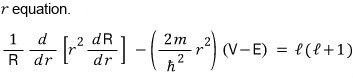
$$r\text{ equation.}\\ \frac {1}{R}\frac {d}{dr}\left[ r^{2}\frac {dR}{dr} \right] \quad -\left( \frac {2m}{\hbar^{2}}r^{2} \right) \left( V-E \right) \quad =\quad \ell (\ell +1)$$Here it is.
And since the electric potential in the hydrogen atom is a function of $r$, finally $V(r)$ shows up in the equation we’re actually working on!!! That’s why $V$ has basically been a silent passenger up until this point.
So how do we deal with this thing?
First, apparently substituting $rR(r) = u(r)$ makes the differential equation go down smoothly. (Borrowing ancestral wisdom again… heh heh.)
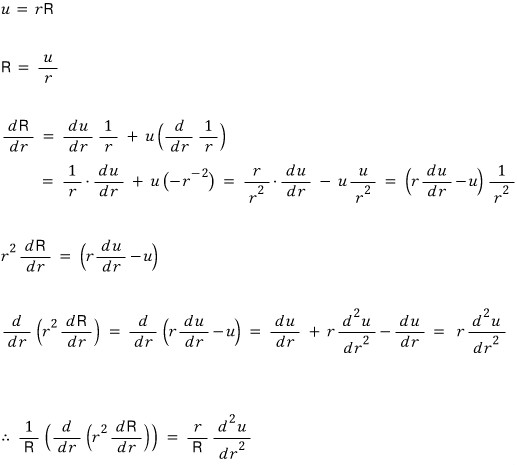
$$\text{We set }u(r)\quad =\quad rR(r)\text{, so the plan is: rewrite }\frac {1}{R}\frac {d}{dr}\left[ r^{2}\frac {dR}{dr} \right]\text{ in terms of }u.$$Let’s just chain the equations top to bottom until we’re there:
$$u\quad =\quad rR \\ R\quad =\quad \frac {u}{r} \\ \frac {dR}{dr}\quad =\quad \frac {du}{dr}\frac {1}{r}\quad +\quad u\left( \frac {d}{dr}\frac {1}{r} \right) \\ \quad =\quad \frac {1}{r}\cdot \frac {du}{dr}\quad +\quad u\left( -r^{-2} \right) \quad =\quad \frac {r}{r^{2}}\cdot \frac {du}{dr}\quad -\quad u\frac {u}{r^{2}}\quad =\quad \left( r\frac {du}{dr}-u \right) \frac {1}{r^{2}} \\ r^{2}\frac {dR}{dr}\quad =\quad \left( r\frac {du}{dr}-u \right) \\ \frac {d}{dr}\left( r^{2}\frac {dR}{dr} \right) \quad =\quad \frac {d}{dr}\left( r\frac {du}{dr}-u \right) \quad =\quad \frac {du}{dr}\quad +\quad r\frac {d^{2}u}{dr^{2}}-\frac {du}{dr}\quad =\quad r\frac {d^{2}u}{dr^{2}} \\ \therefore \quad \frac {1}{R}\left( \frac {d}{dr}\left( r^{2}\frac {dR}{dr} \right) \right) \quad =\quad \frac {r}{R}\frac {d^{2}u}{dr^{2}}$$Plug that back into the $r$ equation~~
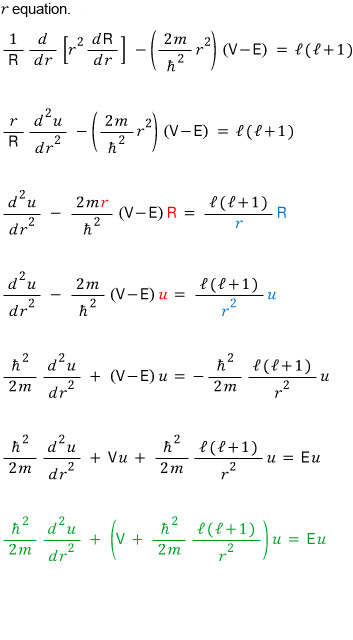
$$r\text{ equation.}\\ \frac {1}{R}\frac {d}{dr}\left[ r^{2}\frac {dR}{dr} \right] \quad -\left( \frac {2m}{\hbar^{2}}r^{2} \right) \left( V-E \right) \quad =\quad \ell (\ell +1) \\ \frac {r}{R}\frac {d^{2}u}{dr^{2}}\quad -\left( \frac {2m}{\hbar^{2}}r^{2} \right) \left( V-E \right) \quad =\quad \ell (\ell +1) \\ \frac {d^{2}u}{dr^{2}}\quad -\quad \frac {2mr}{\hbar^{2}}\left( V-E \right) R\quad =\quad \frac {\ell (\ell +1)}{r}R \\ \frac {d^{2}u}{dr^{2}}\quad -\quad \frac {2m}{\hbar^{2}}\left( V-E \right) u\quad =\quad \frac {\ell (\ell +1)}{r^{2}}u \\ \frac {\hbar^{2}}{2m}\frac {d^{2}u}{dr^{2}}\quad +\quad \left( V-E \right) u\quad =\quad -\frac {\hbar^{2}}{2m}\frac {\ell (\ell +1)}{r^{2}}u \\ \frac {\hbar^{2}}{2m}\frac {d^{2}u}{dr^{2}}\quad +\quad Vu\quad +\quad \frac {\hbar^{2}}{2m}\frac {\ell (\ell +1)}{r^{2}}u\quad =\quad Eu \\ \frac {\hbar^{2}}{2m}\frac {d^{2}u}{dr^{2}}\quad +\quad \left( V\quad +\quad \frac {\hbar^{2}}{2m}\frac {\ell (\ell +1)}{r^{2}} \right) u\quad =\quad Eu$$Hey hey hey — doesn’t this look hella familiar?!?! In Kepler’s problem back in classical mechanics — this looks exactly like the planetary orbit equation in $r$!!!
(Makes total sense. Gravity between two bodies, Coulomb pull inside an atom — lol the vibe is literally the same problem~?)
[It’s even called by the same name — that thing in parentheses is the effective potential!!!~~ All that classical mechanics grinding: worth it. heh heh]
Oh and — the reason we made the $rR = u$ substitution in the first place? That payoff is coming in a second…
Phew… this post is long… feels like I’ve been writing this thing for hours … (sob)
We’re rounding into the final stretch.
One more thing to handle:
Normalization.
Ha…… I’m cooked heh heh heh. I’ll finish this one thing and then go file my department transfer paperwork…
I want to live a long life… heh heh
What we’ve done so far: assumed
$$\psi (r,\theta ,\varphi )\quad =\quad R(r)\cdot \Theta (\theta )\cdot \Phi (\varphi )$$is separable, then cracked the three pieces one by one.
So now, like always,
$$\psi (r,\theta ,\varphi )$$this must be normalized!!!!
(So the statistical interpretation works!!!!!!!!! damn it.)
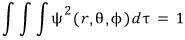
$$\int {\int {\int {\psi^{2}(r,\theta ,\varphi )d\tau}}}\quad =\quad 1$$You know the drill.
But $d\tau$ in Cartesian is
$$d\tau \quad =\quad dxdydz$$and in spherical it’s
$$d\tau \quad =\quad r^{2}sin\theta drd\theta d\varphi$$Why the $r^2\sin\theta$ pops out — you can see it instantly once you’ve seen the Jacobian (Jacobian, Jacobian) in mathematical methods, so I’ll wave my hands and move on like it’s obvious.
Doing the normalization:
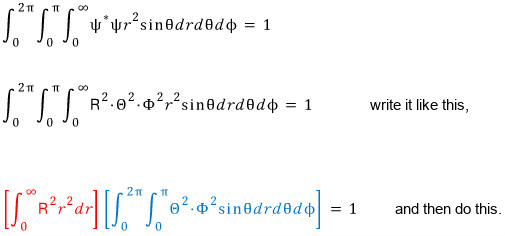
$$\int _{0}^{2\pi}{\int _{0}^{\pi}{\int _{0}^{\infty}{\psi^{*}\psi r^{2}sin\theta drd\theta d\varphi}}}\quad =\quad 1 \\ \int _{0}^{2\pi}{\int _{0}^{\pi}{\int _{0}^{\infty}{R^{2}\cdot \Theta^{2}\cdot \Phi^{2}r^{2}sin\theta drd\theta d\varphi}}}\quad =\quad 1\quad \text{rewritten as,} \\ \left[ \int _{0}^{\infty}{R^{2}r^{2}dr} \right] \left[ \int _{0}^{2\pi}{\int _{0}^{\pi}{\Theta^{2}\cdot \Phi^{2}}}sin\theta drd\theta d\varphi \right] \quad =\quad 1\quad \text{like so.}$$There are infinitely many ways red $\times$ blue could equal $+1$, sure, but…
“We’re told to make red $= 1$ and blue $= 1$ individually!!!!!”
“Whether they’re hiding the full story because it’s still early in quantum or because we’re just undergrads… idk. Sorry for constantly blaming ‘ancestral wisdom, ancestral wisdom’… I’ve asked around and I still haven’t gotten a satisfying answer on this one… (sob)”
OK, red first!!
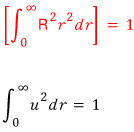
$$\left[ \int _{0}^{\infty}{R^{2}r^{2}dr} \right] \quad =\quad 1 \\ \int _{0}^{\infty}{u^{2}dr}\quad =\quad 1$$NOW you see why we substituted $Rr = u$… right? Right?? The integrand got so much cleaner!!!!
But with $V(r)$ unspecified, this is apparently as far as we can push. We’ll defer the concrete integration for the hydrogen atom until later!!! There’s still more to do than that!!!!
That’s everything we can squeeze out of the $r$ equation for now!!!!!!!!!!!!!!!!!!!!!! (Yay!)
Blue next!!!!
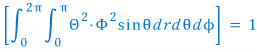
$$\left[ \int _{0}^{2\pi}{\int _{0}^{\pi}{\Theta^{2}\cdot \Phi^{2}}}sin\theta drd\theta d\varphi \right] \quad =\quad 1$$Before integrating, define
$$\text{(equation for }\theta\text{)}\quad \times \quad \text{(equation for }\varphi\text{)}\quad =\quad \text{(equation for }\theta\text{ and }\varphi\text{)} \\ \Theta (\theta )\cdot \Phi (\varphi )\quad =\quad Y(\theta ,\varphi )$$Yeah, just rename the product — exactly~~~ like that.
Why? Because then
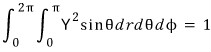
$$\int _{0}^{2\pi}{\int _{0}^{\pi}{Y^{2}}}sin\theta drd\theta d\varphi \quad =\quad 1$$we can define $Y$ to be exactly~~~ the thing that satisfies this. And that thing has a name: the spherical harmonics.
Anyway, its guts clearly have to be “some expression” involving the quantum numbers $m$ and $\ell$. Right?!?!
Since $Y$ is determined once you pick $m$ and $\ell$, we slap them on as a superscript and subscript~~!! and the spherical harmonics are
$$Y_{\ell}^{m}\left( \theta ,\varphi \right) \quad =\quad \epsilon \sqrt {\frac {2\ell +1}{4\pi}\cdot \frac {\left( \ell -\left| m \right| \right) !}{\left( \ell +\left| m \right| \right) !}}e^{im\varphi}\cdot P_{\ell}^{m}\left( cos\theta \right)$$(For the curious — $\epsilon$ is a little “gadget” that acts differently for $m > 0$ vs $m < 0$. Think of it as the device that makes the sign oscillate $+-+-+-$ for positive $m$ and just $++++++$ for negative $m$.)
Off to submit department transfer forms gogo gogo gogo gogo gogo gogo gogo gogo gogo gogo gogo
Ha…. lol lol lol lol lol lol lol lol lol lol lol lol lol lol lol lol lol lol


Originally written in Korean on my Naver blog (2015-08). Translated to English for gdpark.blog.