Addition of Angular Momenta

We finally look at *both* the proton's and electron's spin together — turns out adding angular momenta is a whole thing, and the uncoupled representation doesn't cut it.

OK, let me tell you.

We’re going to dig deeper into the spin of hydrogen.

Huh??????

??? What else is there to explore??

We never even looked at the proton before…

Right. The proton has spin too, and this time we want to take both into account. That’s the whole point.

<Don’t get confused here. When we were looking at what happens in a magnetic field, the reason we ignored the proton was that $\gamma$ — the gyromagnetic ratio, the proportionality constant between $S$ and $\mu$ — is inversely proportional to the particle’s mass. So that’s why we ignored it. But the spin itself? No way you ignore that, right?!?!?>

(Let me write those equations one more time just to be safe.)

$$\gamma \quad =\quad -\frac{e}{m}\quad \text{for the proton this is small}\\ \mu \quad =\quad \gamma S\quad \text{so the moment is also small}\\ \tau \quad =\quad \mu B\quad \text{so the torque is small, so we ignored it}$$

OK, that should be clear now.

So now we need to account for both the proton’s spin and the electron’s spin.

Which means today’s topic is: “Addition of angular momentum (spin).” heh heh heh

Fun times ahead, right?

?

?

hahahahahahahahahahahahahahaha

Heads up — we’ll be using arrow notation a lot here. First time seeing it can be a little disorienting, so get comfy with this before we move on!!!!!

$$f_{\frac{1}{2},\quad \frac{1}{2}}\quad =\quad |\quad \frac{1}{2},\quad \frac{1}{2}>\quad =\quad \left( \begin{matrix}{1}\\{0}\end{matrix} \right) \quad =\quad \chi_{+}\quad =\quad |\quad \uparrow \quad >\\ f_{\frac{1}{2},\quad -\frac{1}{2}}\quad =\quad |\quad \frac{1}{2},\quad -\frac{1}{2}>\quad =\quad \left( \begin{matrix}{0}\\{1}\end{matrix} \right) \quad =\quad \chi_{-}\quad =\quad |\quad \downarrow \quad >$$

That’s it!!! (from an earlier post.)

OK now let’s actually get into it.

We know both the proton and the electron are Fermions, and both have spin $s = 1/2$.

If we try to measure the spin of the hydrogen atom, the number of possible configurations is four.

$$\uparrow \uparrow \quad \to \quad |\frac{1}{2},\frac{1}{2}>|\frac{1}{2},\frac{1}{2}>\quad =\quad |\quad \uparrow \quad >|\quad \uparrow \quad >\\ \uparrow \downarrow \quad \to \quad |\frac{1}{2},\frac{1}{2}>|\frac{1}{2},-\frac{1}{2}>\quad =\quad |\quad \uparrow \quad >|\quad \downarrow \quad >\\ \downarrow \uparrow \quad \to \quad |\frac{1}{2},-\frac{1}{2}>|\frac{1}{2},\frac{1}{2}>\quad =\quad |\quad \downarrow \quad >|\quad \uparrow \quad >\\ \downarrow \downarrow \quad \to \quad |\frac{1}{2},-\frac{1}{2}>|\frac{1}{2},-\frac{1}{2}>\quad =\quad |\quad \downarrow \quad >|\quad \downarrow \quad >$$

cf.) This kind of notation apparently has a name — the uncoupled representation.

Buuut… there’s a problem.

When you actually run the experiment on hydrogen, the results don’t come out like that. Apparently.

In a word: we got hosed, everyone!!! hahaha seriously, is there ever a time when things just go smoothly? hahahahaha

Is this what life is?

Alright — so the total magnitude of the angular momentum of the system (proton + electron), built out of those four eigenstates?!?!?!

$$S^{2}$$

You get it by applying this operator — but it’s not the same $S^2$ as before.

Why? Because we’re measuring two things now.

So let me use subscripts to keep the meaning clear. (;_;)

$$S_{total}^{2}\quad =\quad \left( S_{1}\quad +\quad S_{2} \right)^{2}\quad =\quad \left( S_{1}\quad +\quad S_{2} \right) \left( S_{1}\quad +\quad S_{2} \right) \\ =\quad S_{1}^{2}\quad +\quad S_{2}^{2}\quad +2\left( S_{1_{x}}S_{2_{x}}+S_{1_{y}}S_{2_{y}}+S_{1_{z}}S_{2_{z}} \right)$$

There are gonna be a ton of typos from here on out, hahahahaha. I’m counting on you to point them out.

Anyway — an operator shaped like this is going to have eigenvectors like $\uparrow\uparrow, \uparrow\downarrow, \downarrow\uparrow, \downarrow\downarrow$~~~

(cf. $S_1$ measures the first (front) arrow. $S_2$ measures the second (rear) arrow.)

$$S_{1}^{2}$$

this one and

$$S_{2}^{2}$$

this one — we already worked out what those operators look like earlier.

Both have spin 1/2, so:

$$S_{j}^{2}\quad =\quad \frac{3}{4}\hbar^{2}\begin{pmatrix}{1}&{0}\\{0}&{1}\end{pmatrix}$$

we can write it like that. And $S_{x_j}, S_{y_j}, S_{z_j}$ — all already done!!

$$S_{x_{j}}\quad =\quad \frac{\hbar}{2}\begin{pmatrix}{0}&{1}\\{1}&{0}\end{pmatrix}\quad //\quad S_{y_{j}}\quad =\quad \frac{\hbar}{2}\begin{pmatrix}{0}&{-i}\\{i}&{0}\end{pmatrix}\quad //\quad S_{z_{j}}\quad =\quad \frac{\hbar}{2}\begin{pmatrix}{1}&{0}\\{0}&{-1}\end{pmatrix}$$

“But wait — $S_x$ and $S_y$ didn’t have $(1,0)$ or $(0,1)$ as eigenvectors, right?!?! So we’d better double-check this before moving on.”

Not sure that sentence makes sense yet. But once you see the calculation I do at the end below, you’ll see why I flagged it. So don’t stress.

What we need to check is — I’ll just lay it all out in a row.

$$S_{x}\text{ measuring up spin }|\quad \uparrow \quad >,\quad S_{x}\cdot |\quad \uparrow \quad >\quad =\quad \frac{\hbar}{2}\begin{pmatrix}{0}&{1}\\{1}&{0}\end{pmatrix}\left( \begin{matrix}{1}\\{0}\end{matrix} \right) \quad =\quad \frac{\hbar}{2}\left( \begin{matrix}{0}\\{1}\end{matrix} \right) \quad =\quad \frac{\hbar}{2}|\quad \downarrow \quad >$$$$S_{y}\text{ measuring up spin }|\quad \uparrow \quad >,\quad S_{y}\cdot |\quad \uparrow \quad >\quad =\quad \frac{\hbar}{2}\begin{pmatrix}{0}&{-i}\\{i}&{0}\end{pmatrix}\left( \begin{matrix}{1}\\{0}\end{matrix} \right) \quad =\quad \frac{\hbar}{2}\left( \begin{matrix}{0}\\{i}\end{matrix} \right) \quad =\quad \frac{i\hbar}{2}|\quad \downarrow \quad >$$$$S_{y}\text{ measuring down spin }|\quad \downarrow \quad >,\quad S_{y}\cdot |\quad \downarrow \quad >\quad =\quad \frac{\hbar}{2}\begin{pmatrix}{0}&{-i}\\{i}&{0}\end{pmatrix}\left( \begin{matrix}{0}\\{1}\end{matrix} \right) \quad =\quad \frac{\hbar}{2}\left( \begin{matrix}{-i}\\{0}\end{matrix} \right) \quad =\quad -\frac{i\hbar}{2}|\quad \uparrow \quad >$$

Ugh, forget it — let me just dump everything we’re going to need for the calculations.

$$S^{2}|\quad \uparrow \quad >\quad =\quad \frac{3}{4}\hbar^{2}\begin{pmatrix}{1}&{0}\\{0}&{1}\end{pmatrix}\left( \begin{matrix}{1}\\{0}\end{matrix} \right) \quad =\quad \frac{3}{4}\hbar^{2}\left( \begin{matrix}{1}\\{0}\end{matrix} \right) \quad =\quad \frac{3}{4}\hbar^{2}|\quad \uparrow \quad >\\ S^{2}|\quad \downarrow \quad >\quad =\quad \frac{3}{4}\hbar^{2}\begin{pmatrix}{1}&{0}\\{0}&{1}\end{pmatrix}\left( \begin{matrix}{0}\\{1}\end{matrix} \right) \quad =\quad \frac{3}{4}\hbar^{2}\left( \begin{matrix}{0}\\{1}\end{matrix} \right) \quad =\quad \frac{3}{4}\hbar^{2}|\quad \downarrow \quad >$$$$S_{z}|\quad \uparrow \quad >\quad =\quad \frac{\hbar}{2}\begin{pmatrix}{1}&{0}\\{0}&{-1}\end{pmatrix}\left( \begin{matrix}{1}\\{0}\end{matrix} \right) \quad =\quad \frac{\hbar}{2}\left( \begin{matrix}{1}\\{0}\end{matrix} \right) \quad =\quad \frac{\hbar}{2}|\quad \uparrow \quad >\\ S_{z}|\quad \downarrow \quad >\quad =\quad \frac{\hbar}{2}\begin{pmatrix}{1}&{0}\\{0}&{-1}\end{pmatrix}\left( \begin{matrix}{0}\\{1}\end{matrix} \right) \quad =\quad \frac{\hbar}{2}\left( \begin{matrix}{0}\\{1}\end{matrix} \right) \quad =\quad \frac{\hbar}{2}|\quad \downarrow \quad >$$

So we were thinking of $\uparrow\uparrow, \uparrow\downarrow, \downarrow\uparrow, \downarrow\downarrow$ as eigenvectors, right?

Some of them are. But some of them aren’t. Let’s see which.

$$S_{total}^{2}\quad =\quad S_{1}^{2}\quad +\quad S_{2}^{2}\quad +2\left( S_{1_{x}}S_{2_{x}}+S_{1_{y}}S_{2_{y}}+S_{1_{z}}S_{2_{z}} \right)$$

Let me measure them one at a time… hahahahaha seriously, don’t flinch.

I’ll try to use colors too so things don’t get tangled.

$$\left( S_{total}^{2} \right) \cdot \uparrow \uparrow \quad =\quad \left\{S_{1}^{2}\quad +\quad S_{2}^{2}\quad +2\left( S_{1_{x}}S_{2_{x}}+S_{1_{y}}S_{2_{y}}+S_{1_{z}}S_{2_{z}} \right) \right\} \cdot \uparrow \uparrow \\ \text{calculate the right-hand side, go go}\\ =\quad S_{1}^{2}\cdot \uparrow \uparrow \quad +\quad S_{2}^{2}\cdot \uparrow \uparrow \quad +2S_{1_{x}}S_{2_{x}}\cdot \uparrow \uparrow \quad +2S_{1_{y}}S_{2_{y}}\cdot \uparrow \uparrow \quad +\quad 2S_{1_{z}}S_{2_{z}}\cdot \uparrow \uparrow \\ =\quad \left( S_{1}^{2}\uparrow \right) \uparrow \quad +\quad \uparrow \left( S_{2}^{2}\cdot \uparrow \right) \quad +\quad 2\left( S_{1_{x}}\uparrow \right) \left( S_{2_{x}}\uparrow \right) \quad +\quad 2\left( S_{1_{y}}\uparrow \right) \left( S_{2_{y}}\uparrow \right) \quad +\quad 2\left( S_{1_{z}}\uparrow \right) \left( S_{2_{z}}\uparrow \right) \\ =\quad \left( \frac{3}{4}\hbar^{2}\uparrow \right) \uparrow \quad +\quad \uparrow \left( \frac{3}{4}\hbar^{2}\uparrow \right) \quad +\quad 2\left( \frac{\hbar}{2}\downarrow \right) \left( \frac{\hbar}{2}\downarrow \right) \quad +\quad 2\left( \frac{i\hbar}{2}\downarrow \right) \left( \frac{i\hbar}{2}\downarrow \right) \quad +\quad 2\left( \frac{\hbar}{2}\uparrow \right) \left( \frac{\hbar}{2}\uparrow \right) \\ =\quad \frac{3}{4}\hbar^{2}\uparrow \uparrow \quad +\quad \frac{3}{4}\hbar^{2}\uparrow \uparrow \quad +\quad \frac{\hbar^{2}}{2}\downarrow \downarrow \quad -\quad \frac{\hbar^{2}}{2}\downarrow \downarrow \quad +\quad \frac{\hbar^{2}}{2}\uparrow \uparrow \\ =\quad \frac{6+2}{4}\hbar^{2}\uparrow \uparrow \\ =\quad 2\hbar^{2}\uparrow \uparrow$$$$\therefore \quad \left( S_{total}^{2} \right) \cdot \uparrow \uparrow \quad =\quad 2\hbar^{2}\cdot \uparrow \uparrow$$

I’m going to grind through every one of these. The textbook doesn’t spell them out, so I’ll show as much detail as I can.

$$\left( S_{total}^{2} \right) \cdot \downarrow \downarrow \quad =\quad \left\{\quad S_{1}^{2}\quad +\quad S_{2}^{2}\quad +\quad 2\left( \quad S_{1x}\cdot \quad S_{2x}\quad +\quad S_{1y}\cdot \quad S_{2y}\quad +\quad S_{1z}\cdot \quad S_{2z} \right) \right\} \cdot \downarrow \downarrow \\ =\quad \left( S_{1}^{2}\downarrow \right) \downarrow \quad +\quad \downarrow \left( S_{2}^{2}\downarrow \right) \quad +\quad 2\left( S_{1x}\downarrow \right) \cdot \left( S_{2x}\downarrow \right) +\quad 2\left( S_{1y}\downarrow \right) \cdot \quad \left( S_{2y}\downarrow \right) \quad +\quad 2\left( S_{1z}\downarrow \right) \cdot \quad \left( S_{2z}\downarrow \right) \\ =\quad \left( \frac{3}{4}\hbar^{2}\downarrow \right) \downarrow \quad +\quad \downarrow \left( \frac{3}{4}\hbar^{2}\downarrow \right) \quad +\quad 2\left( \frac{\hbar}{2}\uparrow \right) \left( \frac{\hbar}{2}\uparrow \right) \quad +\quad 2\left( -\frac{i\hbar}{2}\uparrow \right) \left( -\frac{i\hbar}{2}\uparrow \right) \quad +\quad 2\left( -\frac{\hbar}{2}\downarrow \right) \left( -\frac{\hbar}{2}\downarrow \right) \\ =\quad \frac{3}{4}\hbar^{2}\downarrow \downarrow \quad +\quad \frac{3}{4}\hbar^{2}\downarrow \downarrow \quad +\quad \frac{\hbar^{2}}{2}\uparrow \uparrow \quad -\quad \frac{\hbar^{2}}{2}\uparrow \uparrow \quad +\quad \frac{\hbar^{2}}{2}\downarrow \downarrow \\ =\frac{3\quad +\quad 3\quad +\quad 2}{4}\hbar^{2}\downarrow \downarrow \\ =\frac{8}{4}\hbar^{2}\downarrow \downarrow \\ =2\hbar^{2}\downarrow \downarrow$$$$\left( S_{total}^{2} \right) \cdot \uparrow \downarrow \quad =\quad \left\{\quad S_{1}^{2}\quad +\quad S_{2}^{2}\quad +\quad 2\left( \quad S_{1x}\cdot \quad S_{2x}\quad +\quad S_{1y}\cdot \quad S_{2y}\quad +\quad S_{1z}\cdot \quad S_{2z} \right) \right\} \cdot \uparrow \downarrow \\ =\quad \left( S_{1}^{2}\uparrow \right) \downarrow \quad +\quad \uparrow \left( S_{2}^{2}\downarrow \right) \quad +\quad 2\left( S_{1x}\uparrow \right) \cdot \left( S_{2x}\downarrow \right) +\quad 2\left( S_{1y}\uparrow \right) \cdot \left( S_{2y}\downarrow \right) \quad +\quad 2\left( S_{1z}\uparrow \right) \cdot \left( S_{2z}\downarrow \right) \\ =\quad \left( \frac{3}{4}\hbar^{2}\uparrow \right) \downarrow \quad +\quad \uparrow \left( \frac{3}{4}\hbar^{2}\downarrow \right) \quad +\quad 2\left( \frac{\hbar}{2}\downarrow \right) \left( \frac{\hbar}{2}\uparrow \right) \quad +\quad 2\left( \frac{i\hbar}{2}\downarrow \right) \left( -\frac{i\hbar}{2}\uparrow \right) \quad +\quad 2\left( \frac{\hbar}{2}\uparrow \right) \left( -\frac{\hbar}{2}\downarrow \right) \\ =\quad \frac{3}{4}\hbar^{2}\uparrow \downarrow \quad +\quad \frac{3}{4}\hbar^{2}\uparrow \downarrow \quad +\quad \frac{\hbar^{2}}{2}\downarrow \uparrow \quad +\quad \frac{\hbar^{2}}{2}\downarrow \uparrow \quad -\quad \frac{\hbar^{2}}{2}\uparrow \downarrow \\ =\frac{3\quad +\quad 3\quad -\quad 2}{4}\hbar^{2}\uparrow \downarrow \quad +\quad \hbar^{2}\downarrow \uparrow \\ =\quad \hbar^{2}\uparrow \downarrow \quad +\quad \hbar^{2}\downarrow \uparrow$$$$\left( S_{total}^{2} \right) \cdot \downarrow \uparrow$$

is symmetric with the one above, so same answer:

$$=\quad \hbar^{2}\uparrow \downarrow \quad +\quad \hbar^{2}\downarrow \uparrow$$

Now I’ll write $S_\text{total}^2$ as a matrix using those results.

Column vector ① and column vector ②… they are not orthogonal to each other!!

Translation: they’re not linearly independent!!!

So $\uparrow\uparrow$ and $\downarrow\downarrow$ are eigenvectors of $S_\text{total}^2$, but…

$\uparrow\downarrow$ and $\downarrow\uparrow$ are not. :(

How do we fix this? We need eigenvectors like yesterday… (;;)(;;)(;_;)

The key move is the thing called “block diagonalization.”

That sounds very grand and mathematical, but honestly all it means is: find a new basis and do a change of basis. The new basis vectors are linear combinations of the old ones.

I’ll cover block diagonalization more rigorously in my linear algebra study posts. Here… heh heh heh, no helping it. If I tried to really get into block diagonalization I’d need like 20 posts just on that… heh. Let’s just keep moving.

This bit — namely

$$\hbar^{2}\begin{pmatrix}{1}&{1}\\{1}&{1}\end{pmatrix}$$

— is what we need to diagonalize.

Solving the eigen equation right now:

$$\left| \begin{matrix}{\hbar^{2}-\lambda}&{\hbar^{2}}\\{\hbar^{2}}&{\hbar^{2}-\lambda}\end{matrix} \right| \quad =\quad 0 \\ \left( \hbar^{2}-\lambda \right) \left( \hbar^{2}-\lambda \right) -\hbar^{2}\hbar^{2}\quad =\quad 0\\ \lambda^{2}\quad -\quad 2\hbar^{2}\lambda \quad =\quad 0\\ \lambda \left( \lambda -2\hbar^{2} \right) \quad =\quad 0 \\ \lambda \quad =\quad 0,\quad \lambda \quad =\quad 2\hbar^{2}$$$$\lambda \quad =\quad 2\hbar^{2}\quad \text{when, what is the eigen vector?}\\ \text{I'll skip the steps.} \\ \quad \text{eigen vector} \quad =\quad \left( \begin{matrix}{1}\\{1}\end{matrix} \right)$$$$\lambda \quad =\quad 0\quad \text{when, what is the eigen vector?}\\ \text{I'll skip the steps.} \\ \quad \text{eigen vector} \quad =\quad \left( \begin{matrix}{1}\\{-1}\end{matrix} \right)$$

What does that mean?

$\uparrow\downarrow$ wasn’t a basis vector on its own —

$$\left( \begin{matrix}{1}\\{1}\end{matrix} \right)$$

— the actual basis vector is something like $(\uparrow\downarrow + \downarrow\uparrow)$.

Same deal, $\downarrow\uparrow$ isn’t a basis vector on its own either —

$$\left( \begin{matrix}{1}\\{-1}\end{matrix} \right)$$

— the basis vector is $(\uparrow\downarrow - \downarrow\uparrow)$.

With eigenvalues $2\hbar^2$ and $0$ respectively. Those!!

So let me rewrite the matrix for $S_\text{total}^2$!!

$$S_{total}^{2}\quad =\quad \left( \begin{matrix}{2\hbar^{2}}&{0}&{0}&{0}\\{0}&{2\hbar^{2}}&{0}&{0}\\{0}&{0}&{0}&{0}\\{0}&{0}&{0}&{2\hbar^{2}}\end{matrix} \right)$$

Written this way, the eigenvalues are in the right spots, yes??

Same as before, let me also write out the eigenvectors:

These are the re-established eigenvectors!!

$$\frac{1}{\sqrt{2}}\left( \uparrow \downarrow \quad +\quad \downarrow \uparrow \right) \\ \frac{1}{\sqrt{2}}\left( \uparrow \downarrow \quad -\quad \downarrow \uparrow \right)$$

The $1/\sqrt{2}$ out front is just the normalization constant! (The thing that makes the magnitude 1.)

At this point you might be thinking: what on earth does any of this actually mean??????

I was thinking exactly that. If you’re not, then you’ve got a better head on your shoulders than me… (;_;) I envy you.

This is something I had to sit with for a while… (;_;)

Hang tight — if you stick with me a bit longer, it’ll click what it means. Just bear with me a little more… (;;)(;;)

$S_\text{total}^2$ is the operator that measures the total ~~~~ total spin of the hydrogen atom!

Its eigenvectors are

$$\uparrow \uparrow ,\quad \frac{1}{\sqrt{2}}\left( \uparrow \downarrow \quad +\quad \downarrow \uparrow \right) ,\quad \frac{1}{\sqrt{2}}\left( \uparrow \downarrow \quad -\quad \downarrow \uparrow \right) ,\quad \downarrow \downarrow$$

— 4 of ’em, like that.

Now, using those confirmed eigenvectors, I’ll run the whole thing for $S_z$ too~~~! And I want to represent the operator that computes the total $S_z$ as a matrix.

Since we’ve already got a feel for the mechanics from before, I’ll skip the color-coding this time!!

$$S_{z}\uparrow \uparrow \quad =\quad \left( S_{z}\uparrow \right) \uparrow \quad +\quad \uparrow \left( S_{z}\uparrow \right) \quad =\quad \left( \frac{\hbar}{2}\uparrow \right) \quad \uparrow \quad +\quad \uparrow \left( \frac{\hbar}{2}\uparrow \right) \quad =\quad \hbar \uparrow \uparrow$$$$S_{z}\left( \frac{1}{\sqrt{2}}\left( \uparrow \downarrow \quad +\quad \downarrow \uparrow \right) \right) \quad =\quad \frac{1}{\sqrt{2}}\left\{\left( S_{z}\uparrow \right) \downarrow \quad +\quad \uparrow \left( S_{z}\downarrow \right) \quad +\quad \left( S_{z}\downarrow \right) \uparrow \quad +\quad \downarrow \left( S_{z}\uparrow \right) \right\} \\ \\ =\quad \frac{1}{\sqrt{2}}\left\{\left( \frac{\hbar}{\sqrt{2}}\uparrow \right) \downarrow \quad +\quad \uparrow \left( \frac{-\hbar}{\sqrt{2}}\downarrow \right) \quad +\quad \left( \frac{-\hbar}{\sqrt{2}}\downarrow \right) \uparrow \quad +\quad \downarrow \left( \frac{\hbar}{\sqrt{2}}\uparrow \right) \right\} \\ =\quad \frac{1}{2}\left\{\quad 0\quad \right\} =\quad 0$$$$S_{z}\left( \frac{1}{\sqrt{2}}\left( \uparrow \downarrow \quad -\quad \downarrow \uparrow \right) \right) \quad =\quad \frac{1}{\sqrt{2}}\left\{\left( S_{z}\uparrow \right) \downarrow \quad +\quad \uparrow \left( S_{z}\downarrow \right) \quad -\quad \left( S_{z}\downarrow \right) \uparrow \quad -\quad \downarrow \left( S_{z}\uparrow \right) \right\} \\ \\ =\quad \frac{1}{\sqrt{2}}\left\{\left( \frac{\hbar}{\sqrt{2}}\uparrow \right) \downarrow \quad +\quad \uparrow \left( \frac{-\hbar}{\sqrt{2}}\downarrow \right) \quad -\quad \left( \frac{-\hbar}{\sqrt{2}}\downarrow \right) \uparrow \quad -\quad \downarrow \left( \frac{\hbar}{\sqrt{2}}\uparrow \right) \right\} \\ =\quad \frac{1}{2}\left\{\quad 0\quad \right\} \\ =\quad 0$$$$S_{z}\downarrow \downarrow \quad =\quad \left( S_{z}\downarrow \right) \downarrow \quad +\quad \downarrow \left( S_{z}\downarrow \right) \quad =\quad \left( -\frac{\hbar}{2}\downarrow \right) \quad \downarrow \quad +\quad \downarrow \left( -\frac{\hbar}{2}\downarrow \right) \quad =\quad -\hbar \downarrow \downarrow$$$$S_{z_{total}}\quad =\quad \left( \begin{matrix}{\hbar}&{0}&{0}&{0}\\{0}&{0}&{0}&{0}\\{0}&{0}&{0}&{0}\\{0}&{0}&{0}&{\hbar}\end{matrix} \right)$$

Not sure if I’ve managed to dial down your confusion even a little~~ but let me try. Let me recap what we’ve been doing up to around this point in my own words.

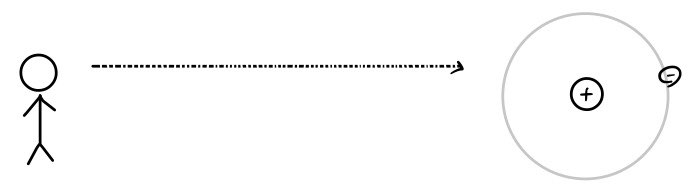
Earlier, we were looking at just the electron:

But now — we’re not looking at the electron. We’re looking at hydrogen. We’re treating the proton and electron together as one thing.

So it doesn’t look like the picture above anymore.

It looks like a fluffy, cloudy lump of question marks.

And then the question — what state is this thing actually in?? — is what pushed us to hunt down the eigenvectors. If the world had played nice, it would’ve looked like we had 4 states: $\uparrow\uparrow, \uparrow\downarrow, \downarrow\uparrow, \downarrow\downarrow$. But you can’t measure with those, so we had to build eigenvectors out of them…

Through a method called block diagonalization, we expressed the eigenvectors as linear combinations of those:

$$\uparrow \uparrow ,\quad \frac{1}{\sqrt{2}}\left( \uparrow \downarrow \quad +\quad \downarrow \uparrow \right) ,\quad \frac{1}{\sqrt{2}}\left( \uparrow \downarrow \quad -\quad \downarrow \uparrow \right) ,\quad \downarrow \downarrow$$

4 of them. That’s the recap.

How you feeling?? Is there still a nuclear war going on inside your head??

Let’s keep pushing hahahahahahahahahahahahahahahahaha hahahahahahahahaha

I promise, after this next part, it’ll start to click.

Before,

$$s=\frac{1}{2},\quad m_{s}=\frac{1}{2}\quad \text{was written as}\quad |\quad \uparrow \quad >,\\ s=\frac{1}{2},\quad m_{s}=-\frac{1}{2}\quad \text{was written as}\quad |\quad \downarrow \quad >.$$

(The reason there were 2 vectors is because we were dealing with a spin-1/2 particle among Fermions?!?!)

But now we’re grouping the two together and treating $\uparrow\uparrow$ as a single vector.

$$\uparrow \uparrow \quad =\quad |\quad \frac{1}{2},\quad \frac{1}{2}\quad >|\quad \frac{1}{2},\quad \frac{1}{2}\quad >$$

That’s how we wrote it. The point I want to make: this is a vector representing one state!!

So instead of writing two vectors side by side like above,

$$\uparrow \uparrow \quad =\quad |\quad \%\%\quad ,\quad \#\#\quad >$$

we want notation that describes it as a single vector like this.

So let me now express each of the 4 eigenvectors in Dirac notation as a single vector. Let’s think about what goes in the $\%\%$ and $\#\#$ slots for each of the 4.

$\uparrow\downarrow$: I won’t belabor it. $S_\text{total} = 1$, $m_s = 0$, so $\uparrow\downarrow = |1, 0>$.

$\downarrow\uparrow$: $S_\text{total} = 1$, $m_s = 0$, so $\downarrow\uparrow = |1, 0>$.

But what we actually needed wasn’t $\uparrow\downarrow$ and $\downarrow\uparrow$ on their own — it was the linear combinations, right? These:

$$\frac{1}{\sqrt{2}}\left( \uparrow \downarrow \quad +\quad \downarrow \uparrow \right) \quad :\quad |\quad 1,\quad 0\quad >\\ \quad \\ \text{There are 2 things with }S_{total}\text{ of 1. So }\sqrt{2}.\\ \text{So }S_{total}\text{ above }=1.\\ m_{s_{total}}\text{ of 0 — there are 2 of them. So }m_{s_{total}}\quad =\quad 0$$$$\frac{1}{\sqrt{2}}\left( \uparrow \downarrow \quad -\quad \downarrow \uparrow \right) \quad :\quad |\quad 0,\quad 0\quad > \\ \text{No need to spell this one out, right?}$$

When we look at the proton and electron of hydrogen as one package, there are 3 slots with $S = 1$ and 1 slot with $S = 0$.

(The difference between the two we’ll learn about in detail in chapter 5.)

$$s=1\quad \cdots \begin{cases}{|\quad 1,\quad 1\quad >\quad =\quad \uparrow \uparrow}\\{|\quad 1,\quad 0\quad >\quad =\quad \frac{1}{\sqrt{2}}\left( \uparrow \downarrow \quad +\quad \downarrow \uparrow \right)}\\{|1,\quad -1\quad >\quad =\quad \downarrow \downarrow}\end{cases}\quad s=1\text{, these are called the triplet (triple state).} \\ s=0\quad \cdots \quad |\quad 0,\quad 0\quad >\quad =\quad \frac{1}{\sqrt{2}}\left( \uparrow \downarrow \quad -\quad \downarrow \uparrow \right) \quad s=0\text{, this is called the singlet (single state).}$$

**

(What you can see here is that when $m_s$ values are the same —

$$\frac{1}{\sqrt{2}}\left( \uparrow \downarrow \quad +\quad \downarrow \uparrow \right) ,\quad \frac{1}{\sqrt{2}}\left( \uparrow \downarrow \quad -\quad \downarrow \uparrow \right)$$

— these two are orthogonal to each other (because basis vectors are orthogonal to each other!!).

That is, the thing with $m_s = 0$ is either the eigenvalue of

$$\frac{1}{\sqrt{2}}\left( \uparrow \downarrow \quad +\quad \downarrow \uparrow \right)$$

or the eigenvalue of

$$\frac{1}{\sqrt{2}}\left( \uparrow \downarrow \quad -\quad \downarrow \uparrow \right)$$

— which is orthogonal to it.

Keep this in the back of your head!!!! This concept gets used in chapter 5.)

OK so we just learned about the addition of angular momentum for the hydrogen atom, and even though we really shouldn’t do it here, it feels a little premature, but apparently we’re about to generalize the addition of two angular momenta and move on. (-_-)

(Who decided that (--)… but if the book says we do it, I guess we do it. (;;)(;;)(;;))

$$\text{Addition of angular momentum : }\\ \text{possible }S_{total}\text{ from }S_{1}\quad +\quad S_{2}\\ S_{total}\quad =\quad S_{1}\quad +\quad S_{2},\quad S_{1}\quad +\quad S_{2}-1,\quad S_{1}\quad +\quad S_{2}-2,\quad \ldots \ldots \quad \left| S_{1}\quad -\quad S_{2} \right| \quad \text{are all possible}$$

Those are the allowed values.

Since we did it with an electron and a proton — $S_1 = 1/2$, $S_2 = 1/2$ — $S_\text{total}$ could be 0 or 1… (;;)(;;)(;;)(;;)

And for the total $z$-component, same deal — everything from $-s$ to $+s$ in steps of $+1$ is allowed!!!~~

I’m not really sure what the author’s intention is in making us just accept this at the moment we’re at… Let’s accept it anyway.. (;;)(;;)(;_;)

Anyway, as an example!!!

For a Fermion and a Boson with $S_1 = 3/2$, $S_2 = 2$, the possible values of the total angular momentum are

$7/2, 5/2, 3/2, 1/2$ — 4 possibilities.

And for each $s$, $m_s$ can run from $-s$, in steps of $+1$, up to $+s$!

That’s a LOT of possibilities, huh?

But wait — does that mean that every time you run into one of these in the lab, you have to grind through all these calculations by hand?!?!

Apparently not.

Apparently there’s a Table — a formula table — that generalizes all of this content to the max. And that’s exactly the Clebsch–Gordan coefficients!!!

We gotta learn those!!!

The Clebsch–Gordan coefficients, and actually doing some problems, will be in the next post.

This one got way longer than I intended…

This is a place I personally struggled with a lot, so it seems like I ended up pouring a bunch of effort in. (;;)(;;)(;;) Sorry about that. Please go easy on me. (;;)(;_;) heh heh


Originally written in Korean on my Naver blog (2015-12). Translated to English for gdpark.blog.