Clebsch-Gordan Coefficients
A casual walkthrough of how to read Clebsch-Gordan coefficient tables — because thankfully some genius already worked out all those messy spin-coupling combos for us.
This post continues directly from post #24.
So, let’s dive right in.
For a single particle,
if s = k, the possible values of m(s) are -k, -k+1, -k+2, …, k-1, and k.
Now here is the question.
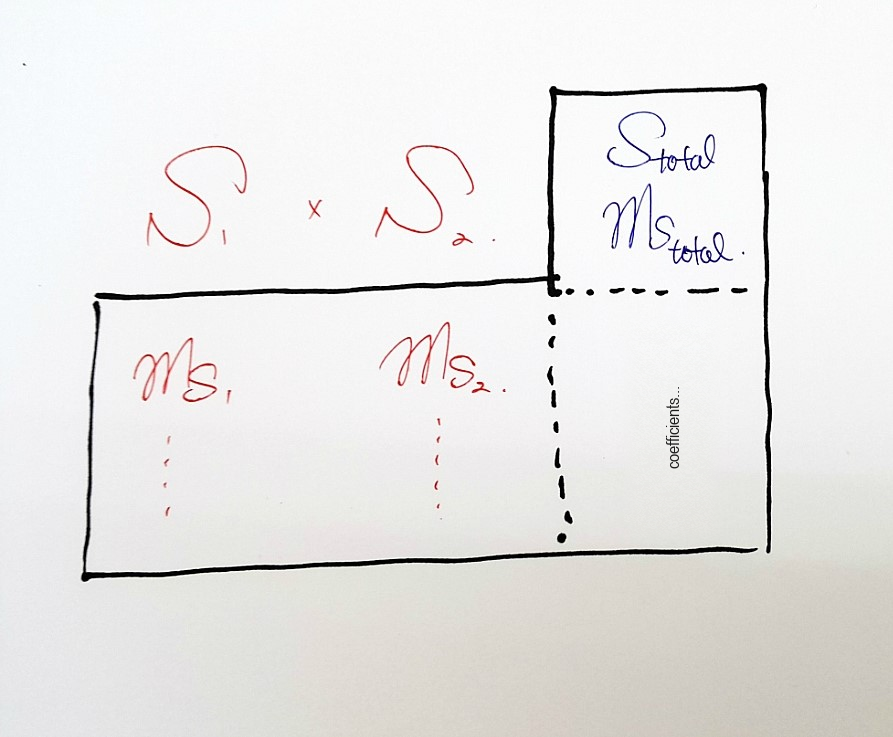
Doesn’t that make your brain feel as though it is about to cramp up?
We take “some coupled object”
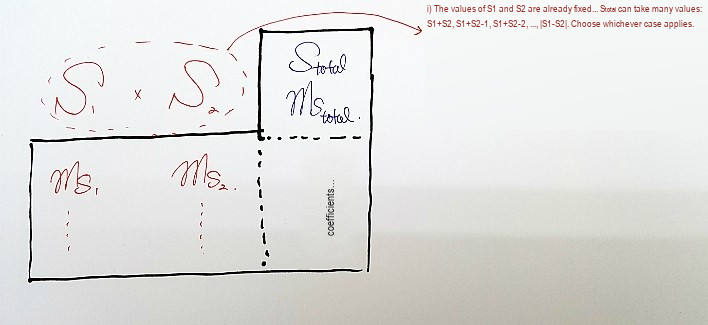
like this,
and express it in the following form:
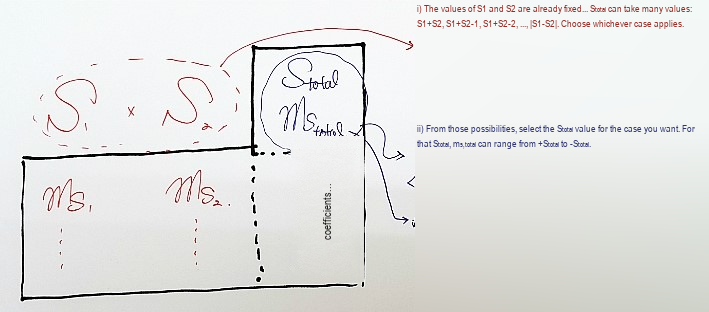
It should be a linear combination of several vectors like these, right?
But seriously—how are we supposed to calculate every one of those coefficients by hand?!
No need to panic.
Thankfully, someone has already worked them all out and tabulated the coefficients, rather like the entries in an integration table.
They are called Clebsch-Gordan coefficients.
All we have to do is look up the appropriate entries in the table and match the coefficients to the states we need.
So the next step is simply learning how to read the table.
The professor said there would definitely be a problem on this,
so I studied it very carefully!
That means this explanation should be especially thorough too.
Let me show you how to read it.
The basic template looks like this:
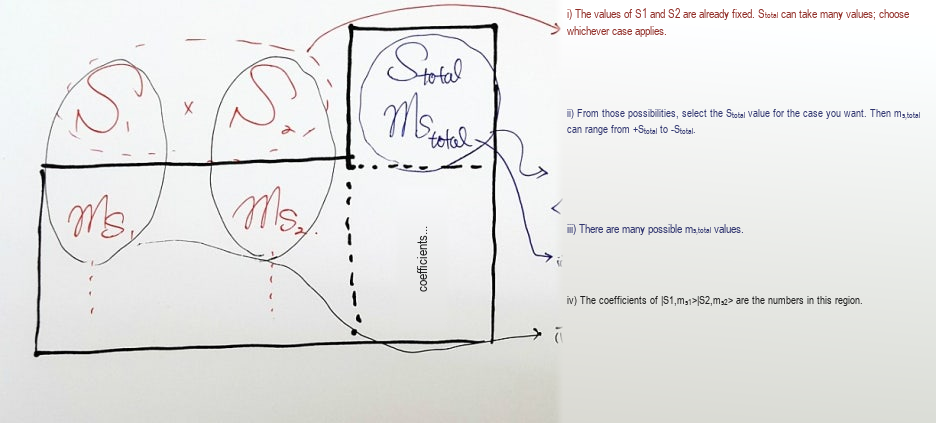
The numbers in each position have the following meanings.
We have been using this notation throughout, so by now it should look familiar.
Let’s go through the table step by step.
First, read this part.
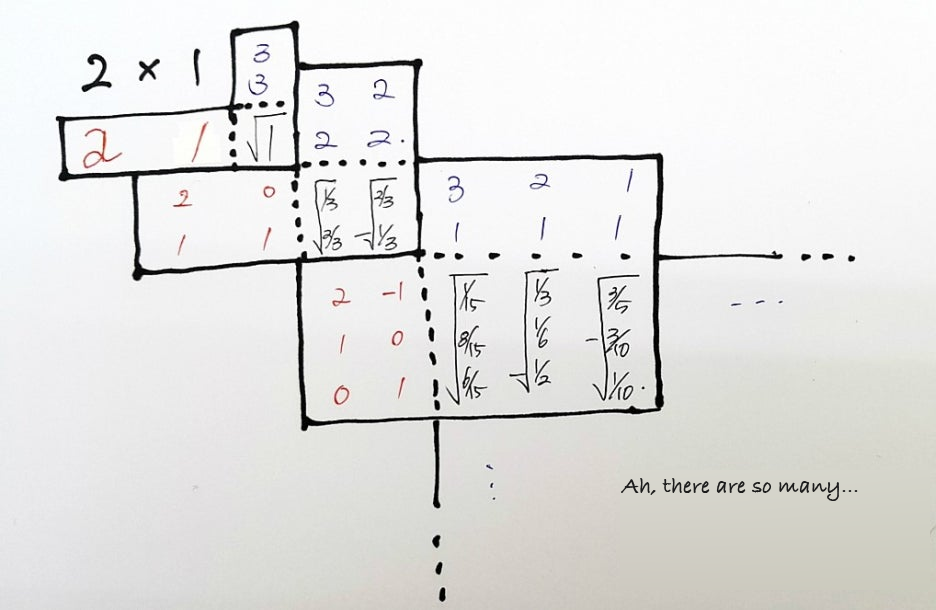
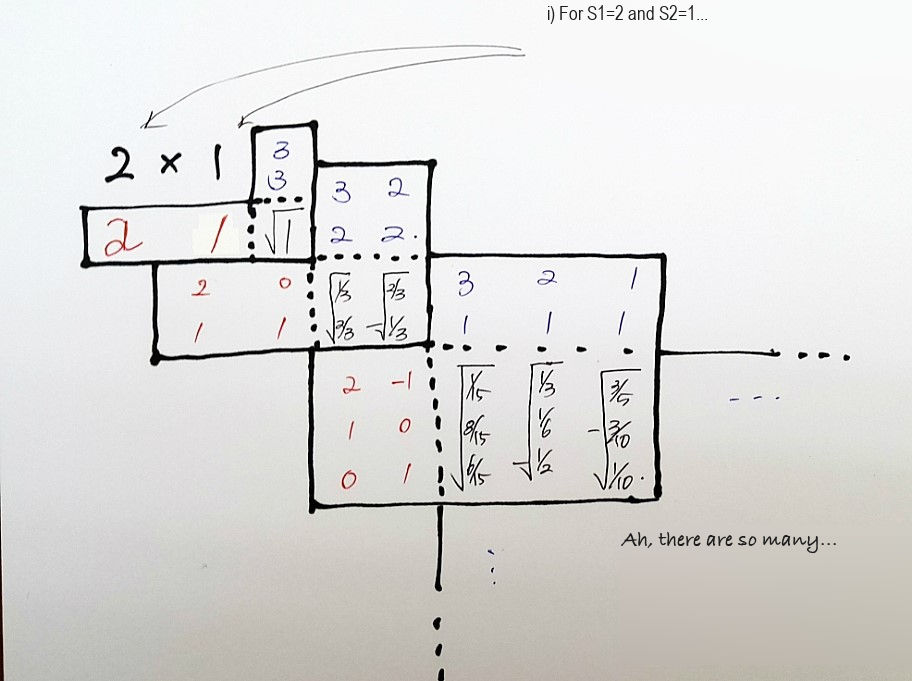
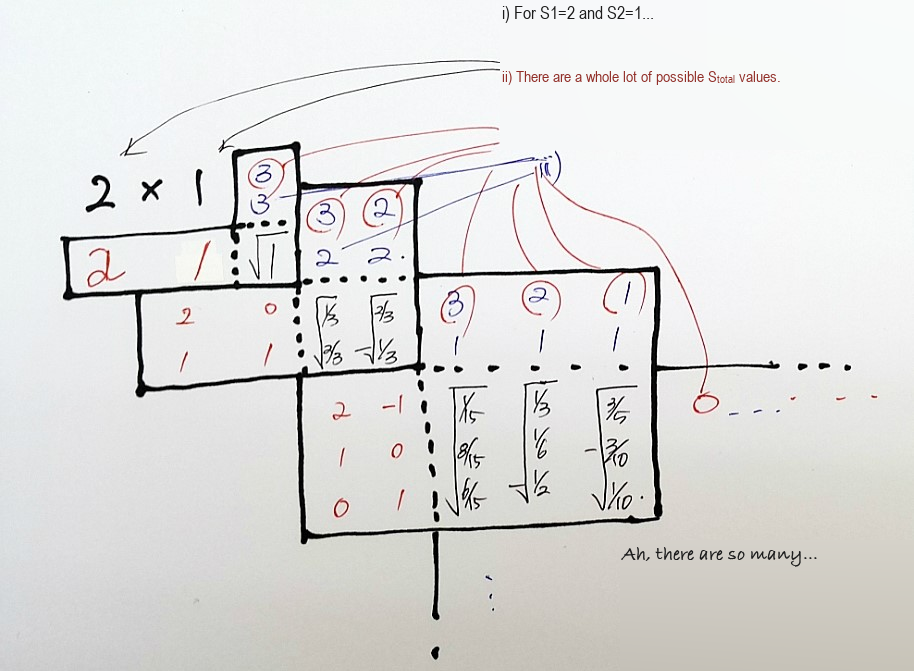
I have written out what the numbers in the L-shaped box represent.
Now let’s use the table directly and see how it works in practice.
Consider the case S1 = 2 and S2 = 1.
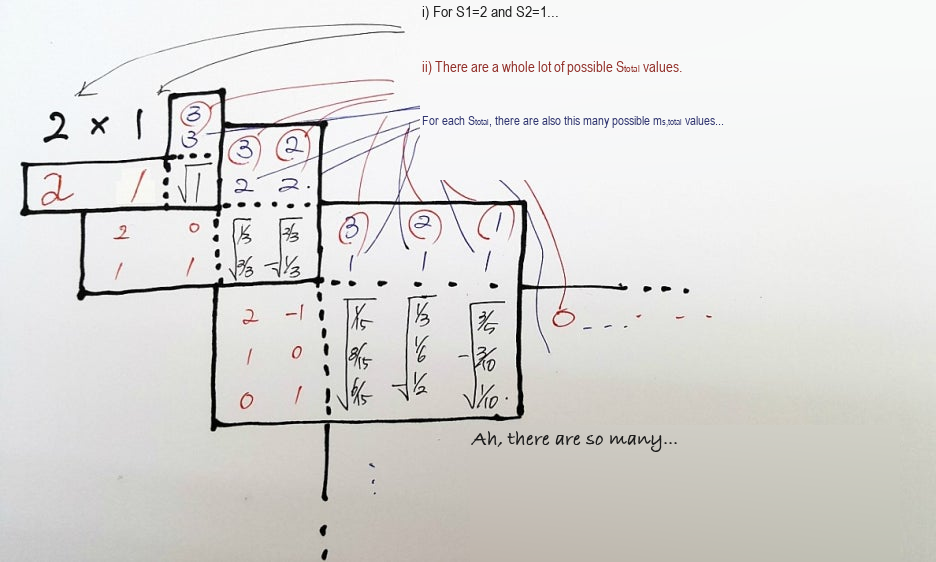
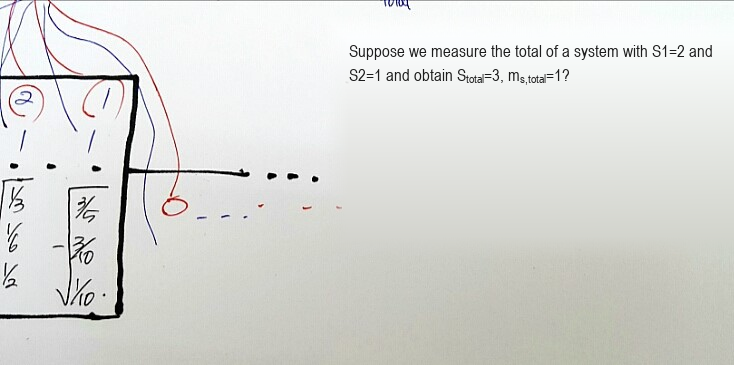
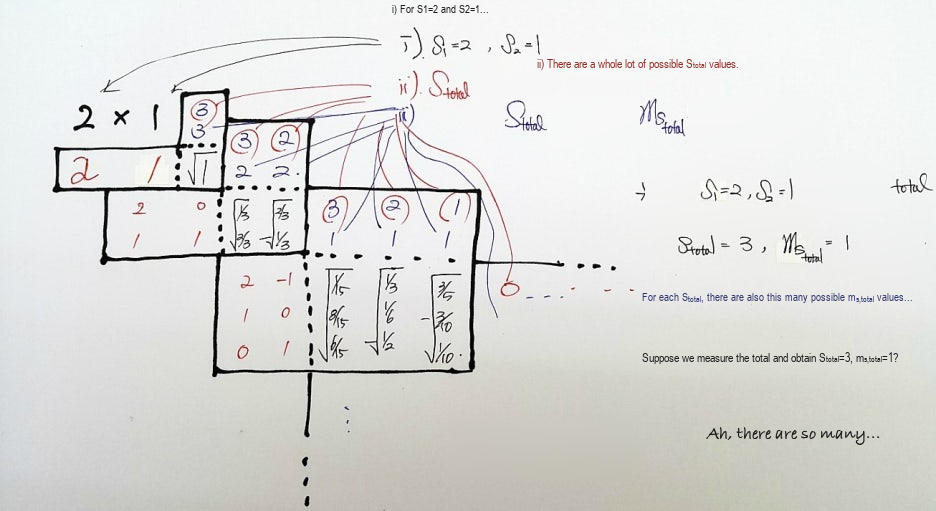
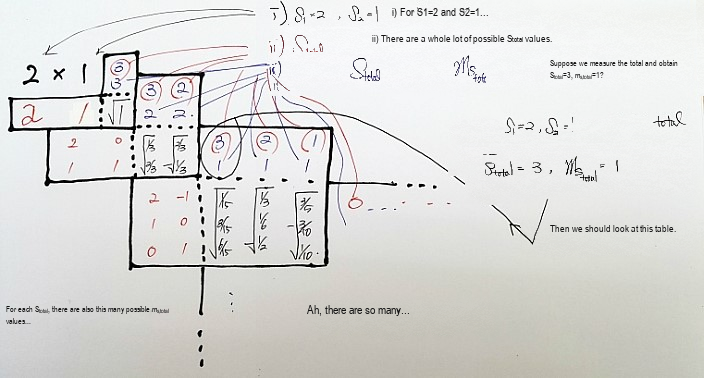
Then, if
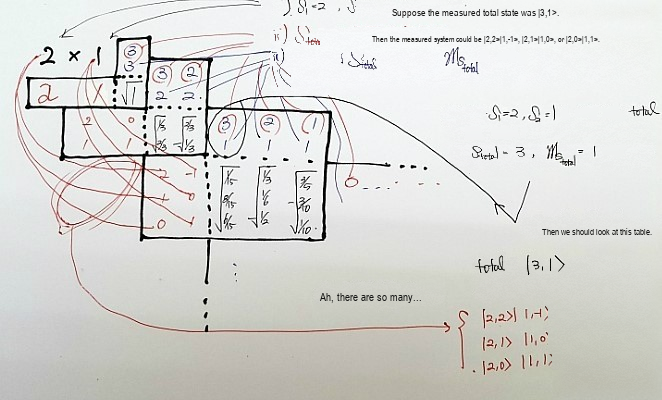
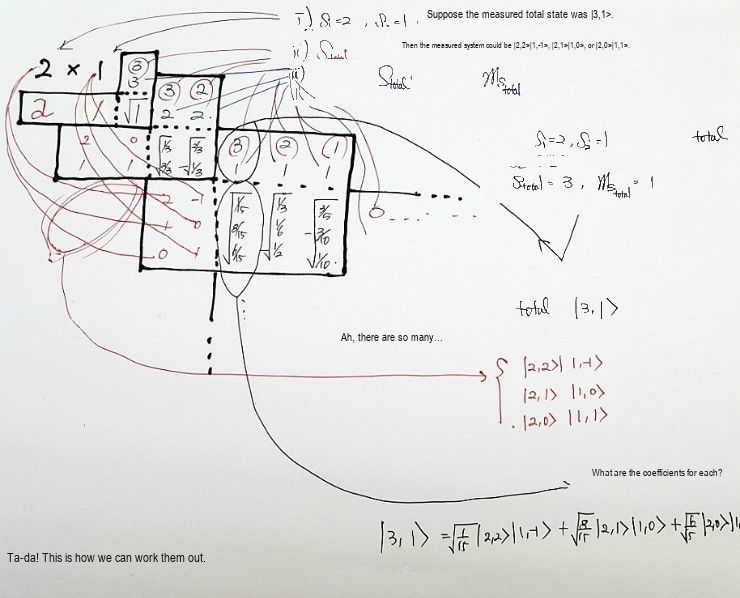
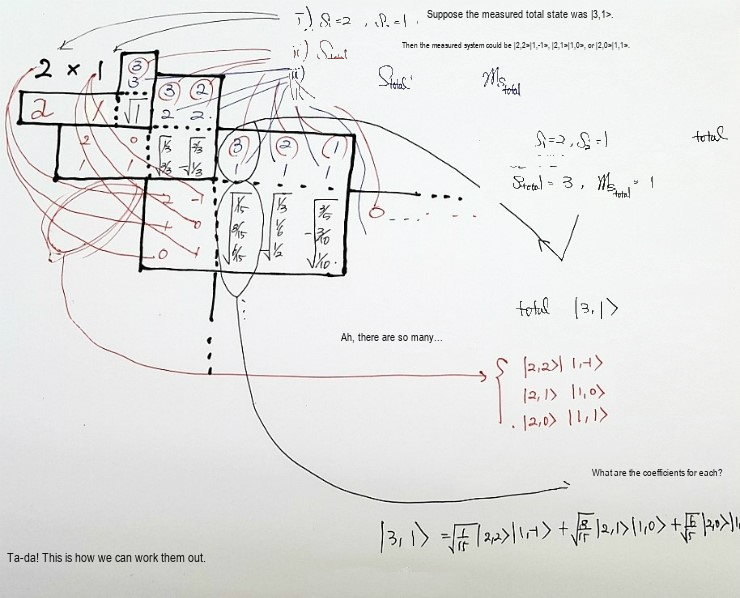
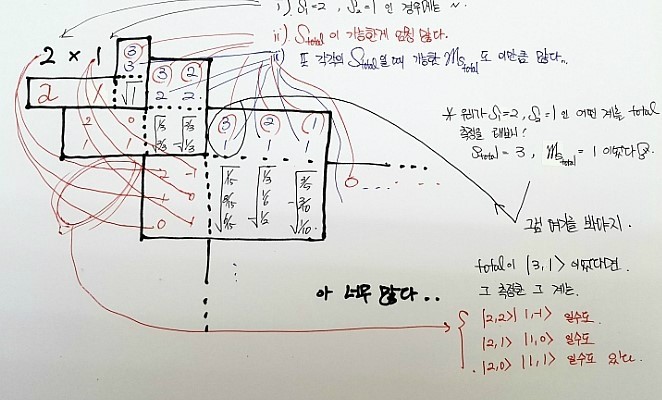
we can finish the lookup with the final row:
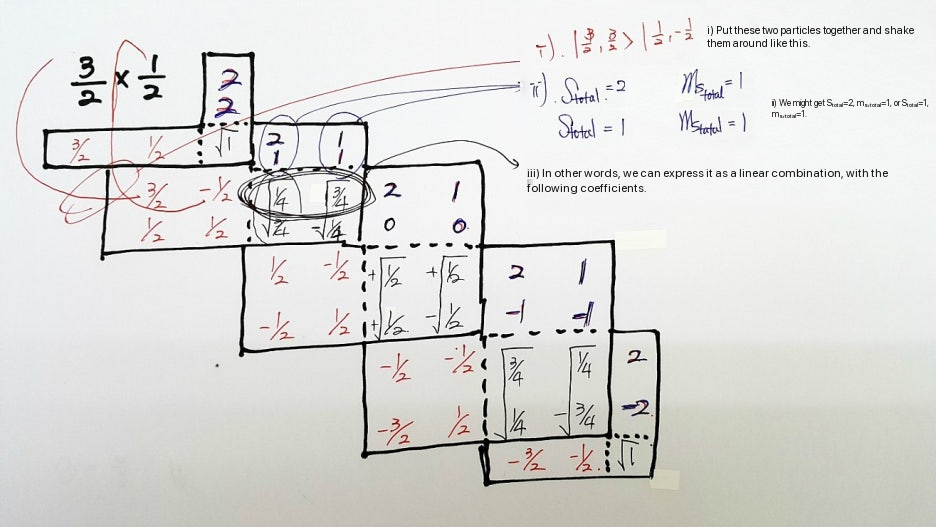
I followed the table downward one line at a time, and it was not too bad. I think I’ve got it!
Or am I the only one who thinks so? T_T T_T T_T T_T
Now let’s look a little more closely at what these coefficients mean.
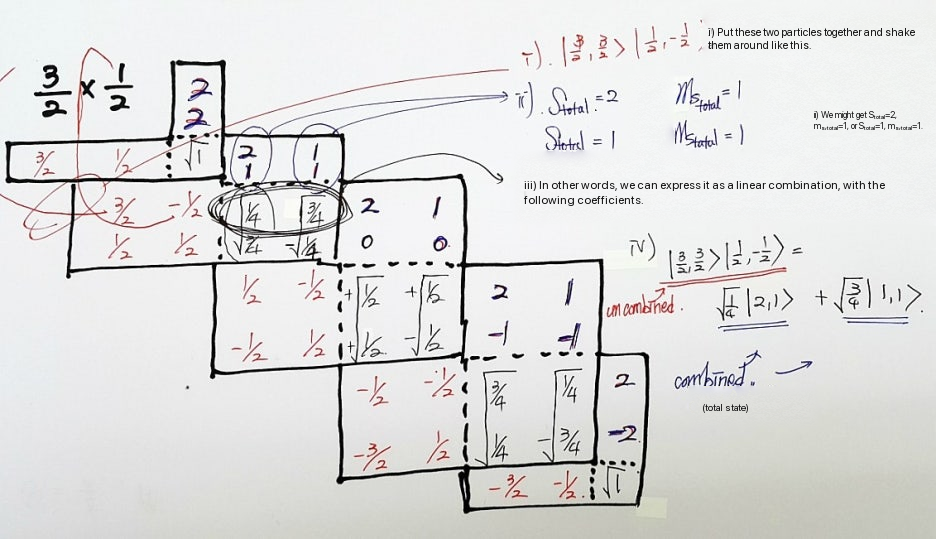
Suppose we have a system like this and know which kinds of particles make up the system.
If we measure total S squared and total Sz,
and obtain | 3, 1 >, then the system is
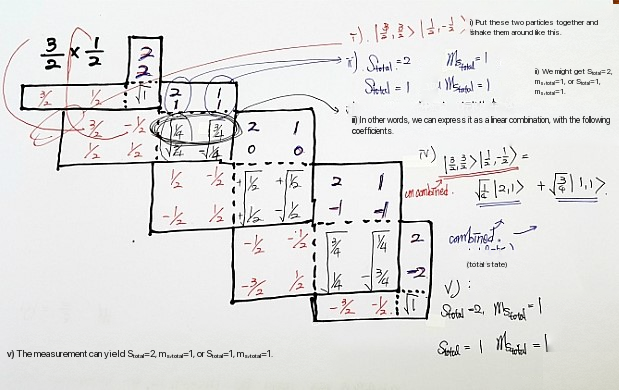
described in this way. In other words,

that is what the result means.
But the Clebsch-Gordan coefficients do more than this.
They also work in the opposite direction.
So far, we have used them to resolve a coupled state into uncoupled states.
Now I will show that we can also expand an uncoupled state in terms of coupled states.
The real significance of the Clebsch-Gordan coefficients is that they connect the two descriptions in both directions.
In short: coupled state ↔ link ↔ uncoupled state.
That is how I like to express it.
Now let’s use numbers different from those in the book.
This time, we are going from the uncoupled basis to the coupled basis.
The key point is this:
Earlier, we read the coefficient section vertically; this time, we read it horizontally.
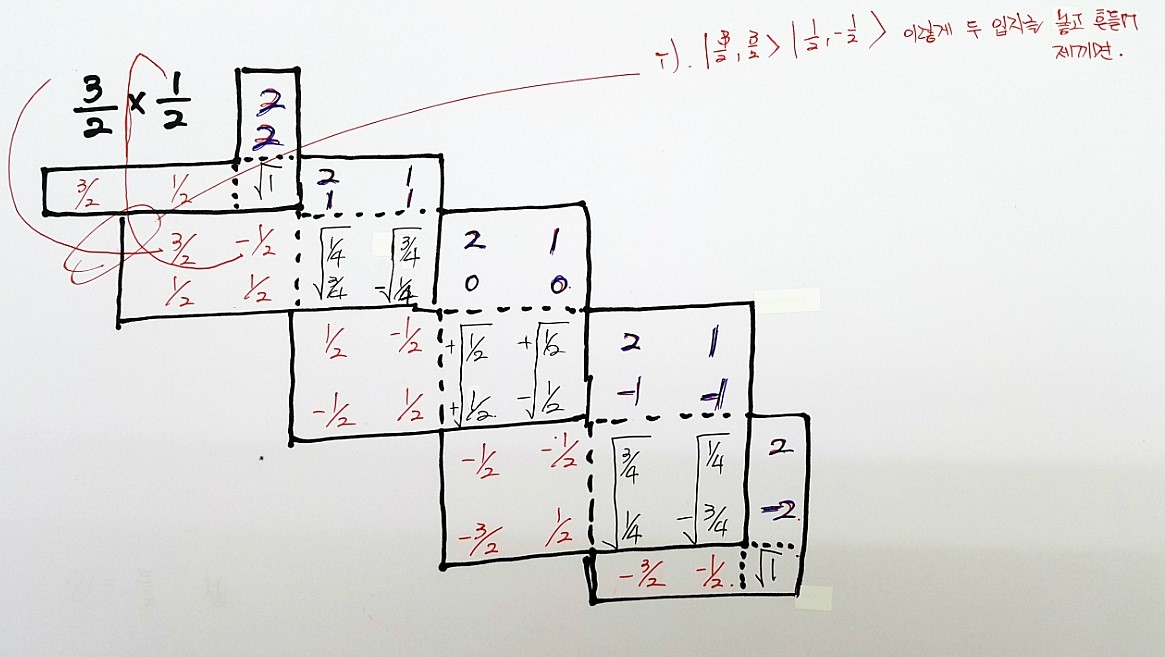
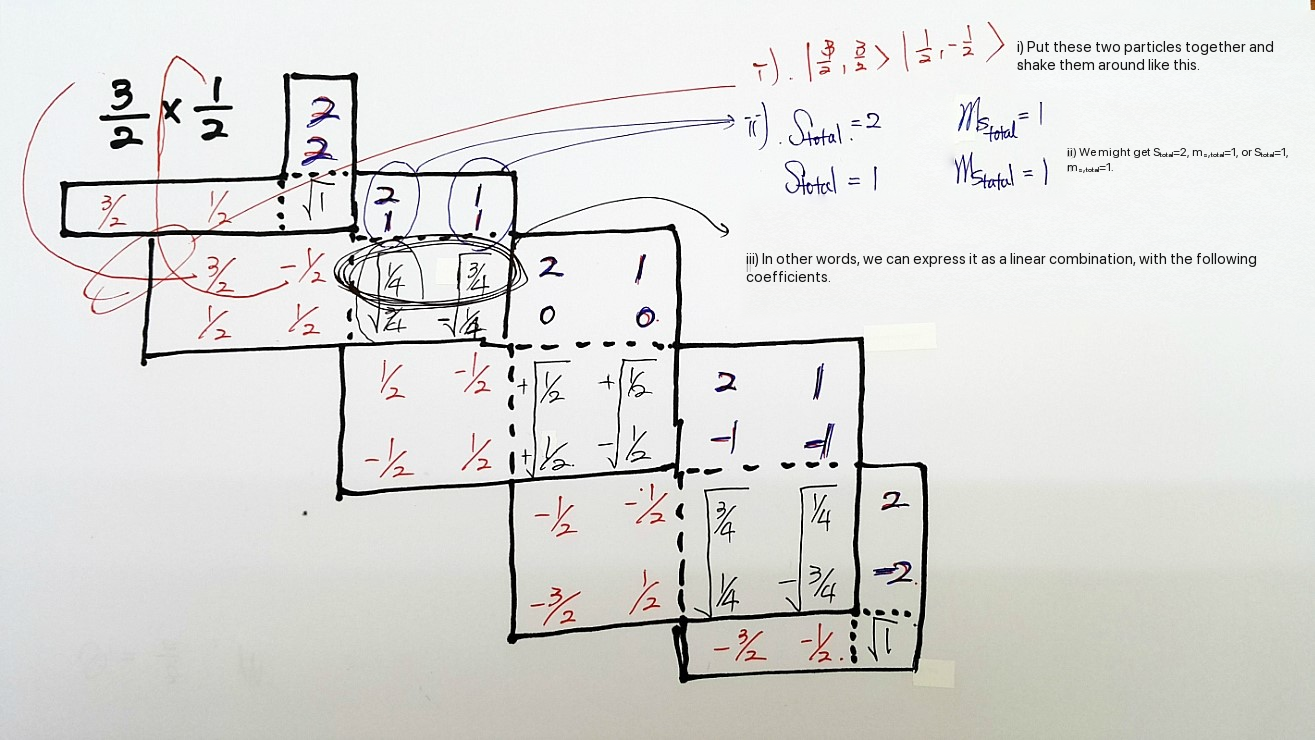
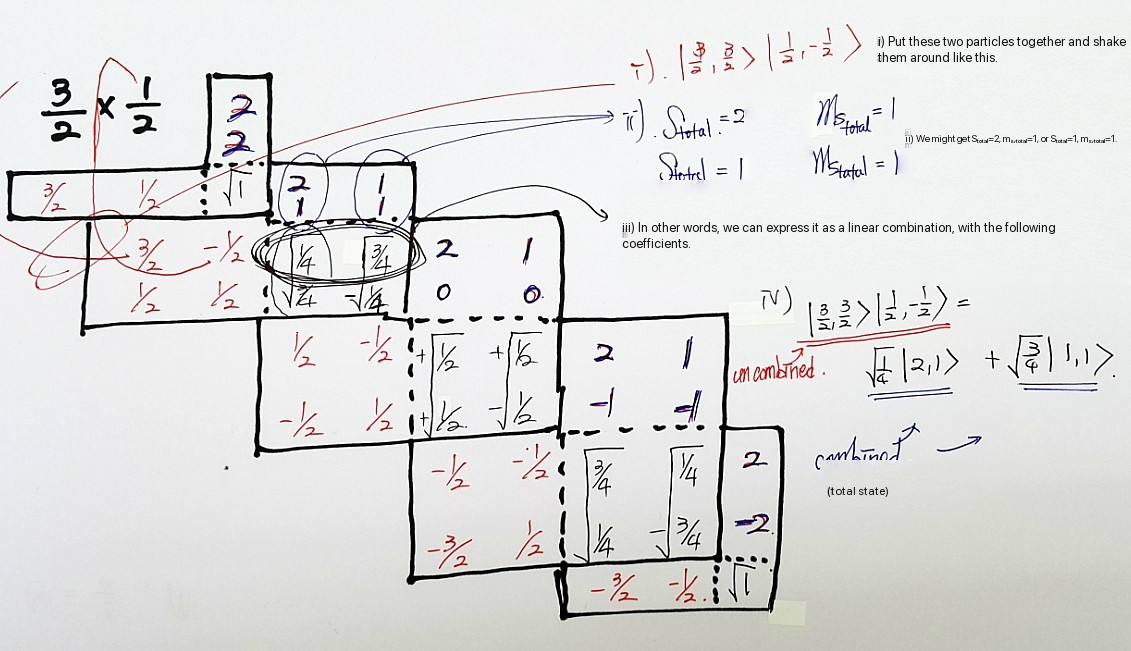
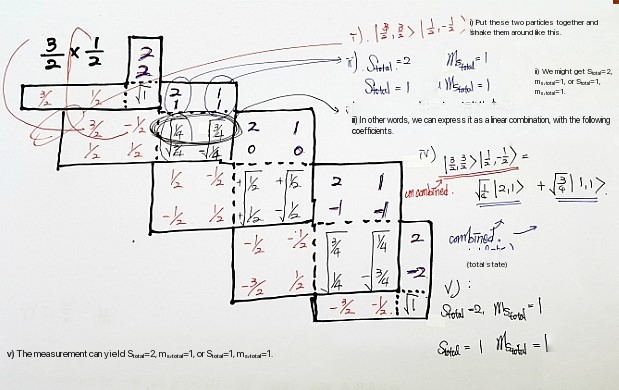
See how it works?
Let me also talk through the example from the book once.
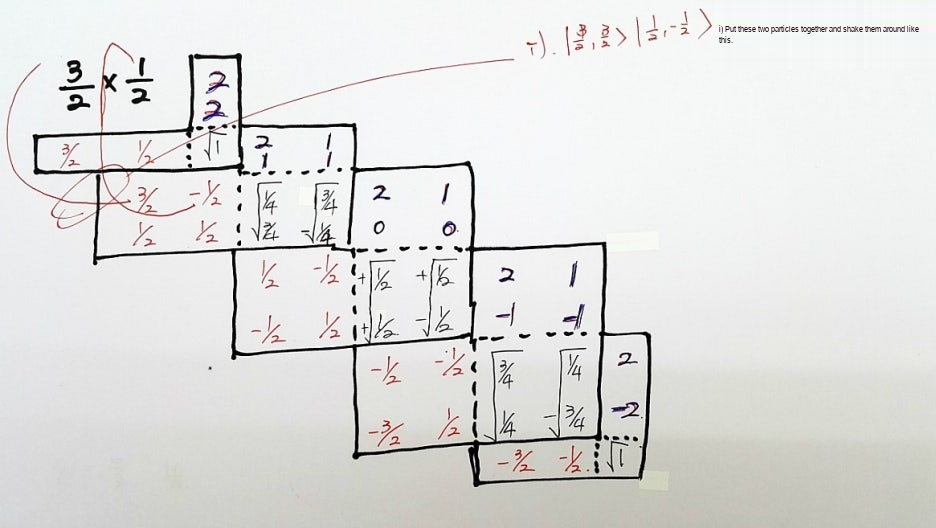
If we use the table to expand | 3/2, 1/2 >| 1, 0 >,

Let me restate the meaning of this equation one more time.
Take particle 1 in the state
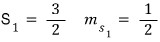
and particle 2 in the state
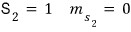
and consider their uncoupled product state.
As a visual mnemonic, imagine the two constituent spin states as puffy little clouds.

Putting the drawings together and “shaking” them does not physically change the state; it is only a mnemonic for re-expressing the same uncoupled product state in the coupled basis.

The expansion contains coupled states with fixed $M=1/2$ and $J=5/2$, $3/2$, or $1/2$.
Therefore, a measurement of total $S^2$ yields those three $J$ values with probabilities $3/5$, $1/15$, and $1/3$, respectively:
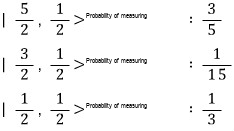
That is the physical meaning of the basis expansion.
At last, the long, long Chapter 4 is finally coming to an end.
I’ll solve a few problems to put the finishing touch on the chapter.
Problem 4.34
Apply S- to | 1, 0 > in equation (4.177),
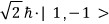
and verify that the following result is obtained.

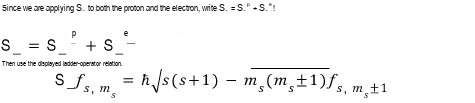
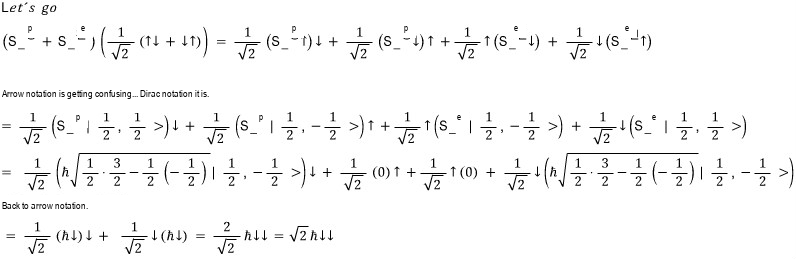
Great—it checks out.
b) Apply both total ladder operators $S_+$ and $S_-$ to the singlet $|0,0\rangle$ and verify that each gives zero.
Let’s see.
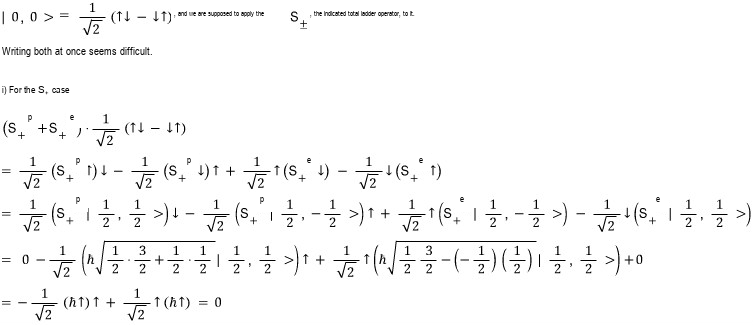
Yes, both $S_+$ and $S_-$ annihilate $|0,0\rangle$.
Part c) follows exactly the same argument I proved earlier in the preceding post, so I will skip it here.
Problem 4.35
Quarks have spin 1/2.
Three quarks combine to form a baryon, such as a proton or neutron.
Two constituents—more precisely, a quark and an antiquark—combine to form a meson, such as a pion ($\pi$) or kaon ($K$).
Assume here that the quarks are in their ground state. In other words, their orbital angular momentum is zero.
b) What spin values can a meson have?
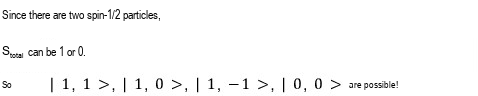
a) What spin values can a baryon have?
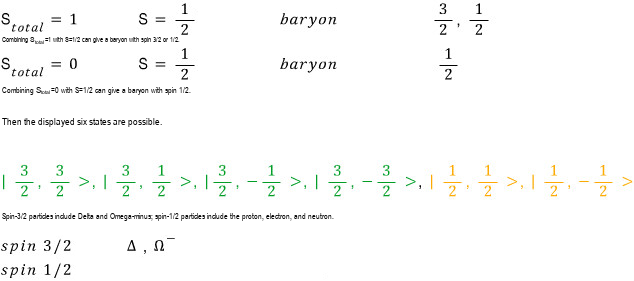
The proton and neutron are the relevant spin-$1/2$ baryons here. The electron also has spin $1/2$, but it is a lepton, not a baryon; its appearance in the diagram is only a spin comparison.
Problem 4.36
Suppose a spin-1 particle and a spin-2 particle are coupled to a total spin of 3,
with a z-component equal to ħ.
When the z-component of the spin-2 particle’s angular momentum is measured,
what values can be obtained, and what is the probability of each value?
My friends… I am your eternal brother… T_T T_T T_T
If I ever get lonely…
Sorry—the problem kept saying “you guys,” and the phrase sent me off on a tangent.
I do not think I need to draw any more pictures for this one,
so please consult the Clebsch-Gordan coefficient table and write out the equations yourself.
Because the system couples spins s = 1 and s = 2, we need the 2 × 1 table.
Since the total state has $J=3$ and $M=1$,
the problem asks us to resolve a coupled state into uncoupled states:
$$ \begin{aligned} |3,1\rangle &=\sqrt{\frac{1}{15}}\,|2,2\rangle|1,-1\rangle +\sqrt{\frac{8}{15}}\,|2,1\rangle|1,0\rangle +\sqrt{\frac{6}{15}}\,|2,0\rangle|1,1\rangle. \end{aligned} $$Thus a measurement of the spin-2 constituent’s z component yields $2\hbar$, $\hbar$, or $0$ with probabilities $1/15$, $8/15$, or $6/15$, respectively.
Comments
Discussion happens via GitHub Discussions. You'll need a GitHub account to comment.