The Feynman-Hellmann Theorem
Working through three practice problems on commutators and the virial theorem to nail down the Feynman-Hellmann theorem before diving into hydrogen's fine structure.

(A new uncle enters — heh, hi.)
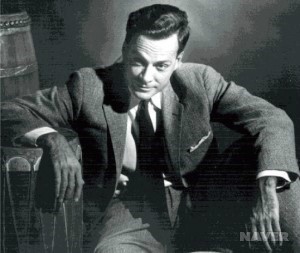
Richard Feynman uncle~~
(Richard P. Feynman)
So technically the next stop should be the fine structure of hydrogen. But there’s a formula we’re gonna need when we get there, and I want to knock out the practice problems that prove it before we actually walk into fine structure.
Exactly 3 practice problems. Then fine structure. Let’s go.
Prob 6.12
Using the virial theorem (Prob 4.40), prove equation 6.55:
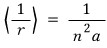
$$\left< \frac{1}{r} \right> = \frac{1}{n^{2}a}$$OK, let’s go check. Looks like I need to go flip to problem 4.40…
Prob 4.40
Prove the 3-dimensional virial theorem (for stationary states):
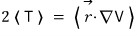
$$2\left< T \right> = \left< \overrightarrow{r} \cdot \nabla V \right>$$Hint: refer to Prob 3.31.
Ugh. Guess I need to flip to 3.31 too…
Prob 3.31
Using equation 3.71:
$$\frac{d}{dt}\left< Q \right> = \frac{i}{\hbar}\left< \left[ \hat{H}, \hat{Q} \right] \right> + \left< \frac{\partial Q}{\partial t} \right>$$show that
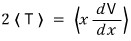
$$\frac{d}{dt}\left< xp \right> = 2\left< T \right> - \left< x\frac{dV}{dx} \right>$$Here $T$ is kinetic energy ($H = T + V$). In a stationary state the left side is 0, so
$$2\left< T \right> = \left< x\frac{dV}{dx} \right>$$This is the Virial Theorem. Use it to prove that $\langle T \rangle = \langle E \rangle$ for stationary states.
Sol — let’s GO.
$$\frac{d}{dt}\left< Q \right> = \frac{i}{\hbar}\left< \left[ \hat{H}, \hat{Q} \right] \right> + \left< \frac{\partial Q}{\partial t} \right>$$Plug in $Q = xp$ and see what falls out.
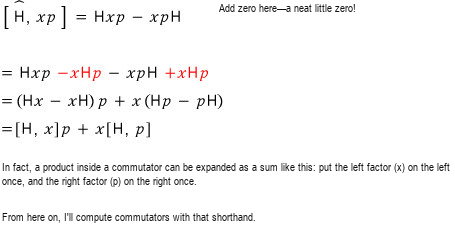
$$\frac{d}{dt}\left< xp \right> = \frac{i}{\hbar}\left< \left[ \hat{H}, xp \right] \right> + \left< \frac{\partial}{\partial t}xp \right>$$First let’s unpack the commutator piece.
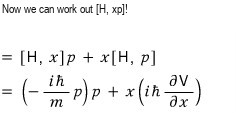
$$\left[ \hat{H}, xp \right] = Hxp - xpH \quad \text{add a sneaky zero here} \\ = Hxp - xHp - xpH + xHp \\ = \left( Hx - xH \right)p + x\left( Hp - pH \right) \\ = [H, x]p + x[H, p]$$General move: when you have a product inside a commutator, you can split it as — the left factor ($x$) slides out to the left, the right factor ($p$) slides out to the right. From now on I’ll just do commutator-with-a-product expansions this way, no more re-deriving it.
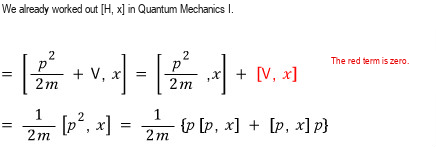
$$\text{For } [H, x], \text{ we did this back in Quantum Mechanics 1:} \\ = \left[ \frac{p^{2}}{2m} + V, x \right] = \left[ \frac{p^{2}}{2m}, x \right] + \left[ V, x \right] \quad \text{(that red one — zero, } V \text{ and } x \text{ both act by multiplication)} \\ = \frac{1}{2m}\left[ p^{2}, x \right] = \frac{1}{2m}\left\{ p[p, x] + [p, x]p \right\}$$And $[p,x]$ — we grinded through this with a test function before:
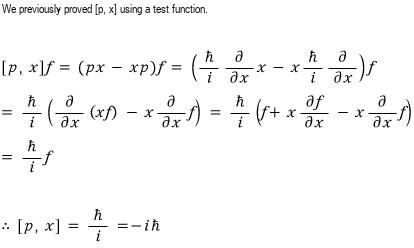
$$[p, x]f = (px - xp)f = \left( \frac{\hbar}{i}\frac{\partial}{\partial x}x - x\frac{\hbar}{i}\frac{\partial}{\partial x} \right)f \\ = \frac{\hbar}{i}\left( \frac{\partial}{\partial x}(xf) - x\frac{\partial f}{\partial x} \right) = \frac{\hbar}{i}\left( f + x\frac{\partial f}{\partial x} - x\frac{\partial f}{\partial x} \right) \\ = \frac{\hbar}{i}f \\ \therefore \quad [p, x] = \frac{\hbar}{i} = -i\hbar$$So:
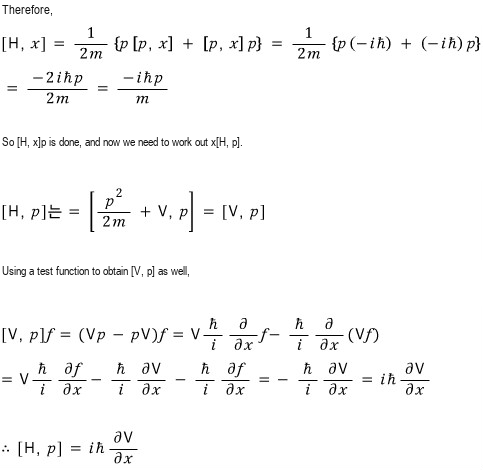
$$[H, x] = \frac{1}{2m}\left\{ p(-i\hbar) + (-i\hbar)p \right\} = \frac{-2i\hbar p}{2m} = \frac{-i\hbar p}{m}$$OK that handles $[H,x]p$. Now the other half, $x[H,p]$:
$$[H, p] = \left[ \frac{p^{2}}{2m} + V, p \right] = [V, p]$$Test function again:
$$[V, p]f = (Vp - pV)f = V\frac{\hbar}{i}\frac{\partial f}{\partial x} - \frac{\hbar}{i}\frac{\partial}{\partial x}(Vf) \\ = V\frac{\hbar}{i}\frac{\partial f}{\partial x} - \frac{\hbar}{i}\frac{\partial V}{\partial x}f - V\frac{\hbar}{i}\frac{\partial f}{\partial x} = -\frac{\hbar}{i}\frac{\partial V}{\partial x}f = i\hbar\frac{\partial V}{\partial x}f \\ \therefore \quad [H, p] = i\hbar\frac{\partial V}{\partial x}$$Now we can assemble $[H, xp]$:
$$[H, xp] = [H, x]p + x[H, p] = \left( -\frac{i\hbar}{m}p \right)p + x\left( i\hbar\frac{\partial V}{\partial x} \right)$$Fi-nal-ly.
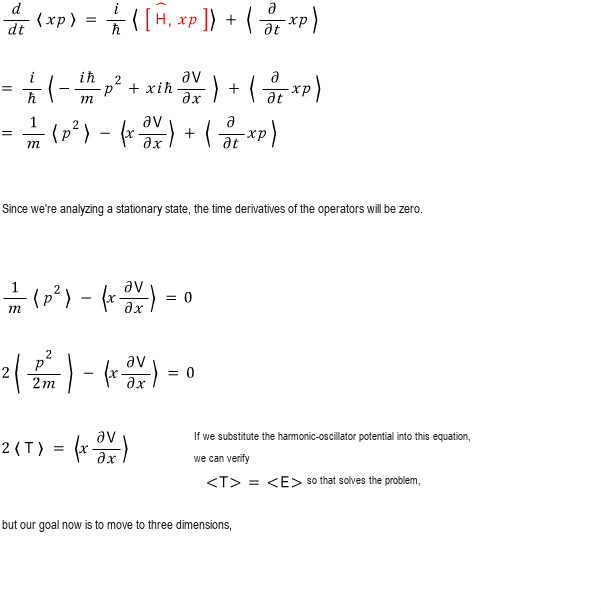
$$\frac{d}{dt}\left< xp \right> = \frac{i}{\hbar}\left< \left[ \hat{H}, xp \right] \right> + \left< \frac{\partial}{\partial t}xp \right> \\ = \frac{i}{\hbar}\left< -\frac{i\hbar}{m}p^{2} + xi\hbar\frac{\partial V}{\partial x} \right> + \left< \frac{\partial}{\partial t}xp \right> \\ = \frac{1}{m}\left< p^{2} \right> - \left< x\frac{\partial V}{\partial x} \right> + \left< \frac{\partial}{\partial t}xp \right>$$We’re working in stationary states, so the operator’s explicit time derivative is 0:
$$\frac{1}{m}\left< p^{2} \right> - \left< x\frac{\partial V}{\partial x} \right> = 0 \\ 2\left< \frac{p^{2}}{2m} \right> - \left< x\frac{\partial V}{\partial x} \right> = 0 \\ 2\left< T \right> = \left< x\frac{\partial V}{\partial x} \right>$$Sub in the harmonic oscillator potential here and you can verify $\langle T \rangle = \langle E \rangle$ — that settles the original problem. But our goal is to lift this to 3D, so onward.
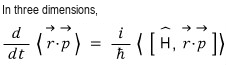
In 3D, the setup is:
$$\frac{d}{dt}\left< \overrightarrow{r} \cdot \overrightarrow{p} \right> = \frac{i}{\hbar}\left< \left[ \hat{H}, \overrightarrow{r} \cdot \overrightarrow{p} \right] \right>$$Why are we setting it up this way? The old uncertainty-principle post will help — specifically the very bottom of it.
(http://gdpresent.blog.me/220454555980)

Quantum Mechanics I Studied #17. Uncertainty Principle
The uncertainty principle: what this equation means is “measuring both accurately at the same time…
blog.naver.com
Alright — same play as 1D. Crack open $[H, \vec r \cdot \vec p]$ inside the expectation value.
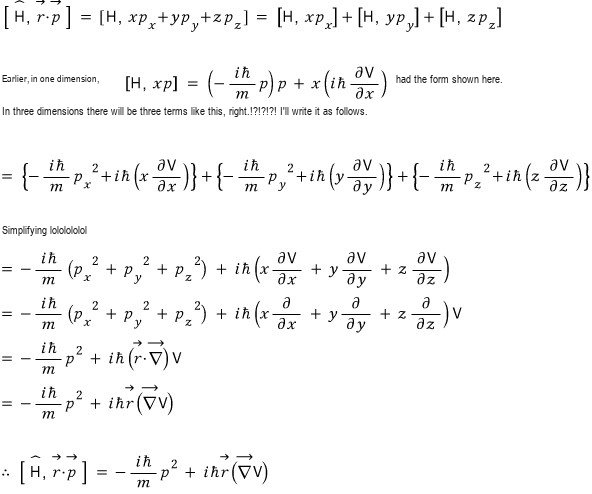
$$\left[ \hat{H}, \overrightarrow{r} \cdot \overrightarrow{p} \right] = [H, xp_{x} + yp_{y} + zp_{z}] = [H, xp_{x}] + [H, yp_{y}] + [H, zp_{z}]$$From the 1D work, $[H, xp] = \left(-\frac{i\hbar}{m}p\right)p + x\left(i\hbar\frac{\partial V}{\partial x}\right)$. In 3D we get three copies of that. Let’s write it all out:
$$= \left\{ -\frac{i\hbar}{m}p_{x}^{2} + i\hbar\left( x\frac{\partial V}{\partial x} \right) \right\} + \left\{ -\frac{i\hbar}{m}p_{y}^{2} + i\hbar\left( y\frac{\partial V}{\partial y} \right) \right\} + \left\{ -\frac{i\hbar}{m}p_{z}^{2} + i\hbar\left( z\frac{\partial V}{\partial z} \right) \right\}$$Cleaning up:
$$= -\frac{i\hbar}{m}\left( p_{x}^{2} + p_{y}^{2} + p_{z}^{2} \right) + i\hbar\left( x\frac{\partial V}{\partial x} + y\frac{\partial V}{\partial y} + z\frac{\partial V}{\partial z} \right) \\ = -\frac{i\hbar}{m}\left( p_{x}^{2} + p_{y}^{2} + p_{z}^{2} \right) + i\hbar\left( x\frac{\partial}{\partial x} + y\frac{\partial}{\partial y} + z\frac{\partial}{\partial z} \right)V \\ = -\frac{i\hbar}{m}p^{2} + i\hbar\left( \overrightarrow{r} \cdot \overrightarrow{\nabla} \right)V \\ = -\frac{i\hbar}{m}p^{2} + i\hbar\,\overrightarrow{r} \cdot \left( \overrightarrow{\nabla}V \right) \\ \therefore \quad \left[ \hat{H}, \overrightarrow{r} \cdot \overrightarrow{p} \right] = -\frac{i\hbar}{m}p^{2} + i\hbar\,\overrightarrow{r} \cdot \left( \overrightarrow{\nabla}V \right)$$Shove this into
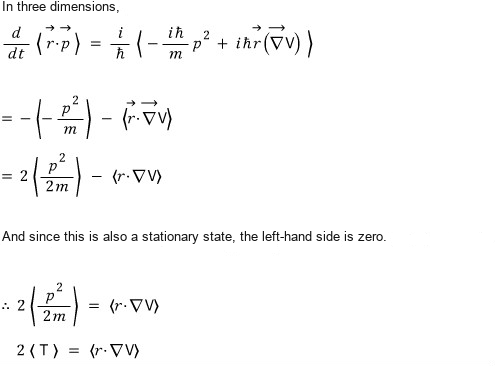
$$\frac{d}{dt}\left< \overrightarrow{r} \cdot \overrightarrow{p} \right> = \frac{i}{\hbar}\left< \left[ \hat{H}, \overrightarrow{r} \cdot \overrightarrow{p} \right] \right>$$and:
$$\frac{d}{dt}\left< \overrightarrow{r} \cdot \overrightarrow{p} \right> = \frac{i}{\hbar}\left< -\frac{i\hbar}{m}p^{2} + i\hbar\,\overrightarrow{r} \cdot \left( \overrightarrow{\nabla}V \right) \right> \\ = \frac{1}{m}\left< p^{2} \right> - \left< \overrightarrow{r} \cdot \overrightarrow{\nabla}V \right> \\ = 2\left< \frac{p^{2}}{2m} \right> - \left< r \cdot \nabla V \right>$$Stationary state again, so the left side is 0:
$$2\left< \frac{p^{2}}{2m} \right> = \left< r \cdot \nabla V \right> \\ 2\left< T \right> = \left< r \cdot \nabla V \right>$$With this virial theorem in hand, we can finally compute $\langle 1/r \rangle$ for hydrogen!!!
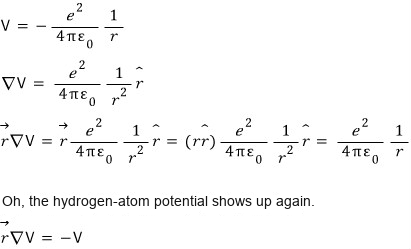
Plug the hydrogen potential — plain old Coulomb — into the RHS. We need $\nabla V$, and since $V$ depends only on $r$, we’re just differentiating with respect to $r$:
$$V = -\frac{e^{2}}{4\pi\epsilon_{0}}\frac{1}{r} \\ \nabla V = \frac{e^{2}}{4\pi\epsilon_{0}}\frac{1}{r^{2}}\hat{r} \\ \overrightarrow{r} \cdot \nabla V = (r\hat{r}) \cdot \frac{e^{2}}{4\pi\epsilon_{0}}\frac{1}{r^{2}}\hat{r} = \frac{e^{2}}{4\pi\epsilon_{0}}\frac{1}{r}$$Oh hey — the hydrogen potential just came back out. With a sign flip:
$$\overrightarrow{r} \cdot \nabla V = -V$$So:
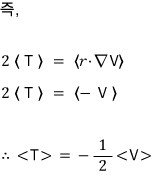
$$2\left< T \right> = \left< r \cdot \nabla V \right> \\ 2\left< T \right> = \left< -V \right> \\ \therefore \quad \langle T \rangle = -\frac{1}{2}\langle V \rangle$$(Quick status check. What we’re doing right now is specifically for the hydrogen atom! This isn’t a general result — we’re riding the specific Coulomb form. Don’t forget that.)
The hydrogen Hamiltonian gives:
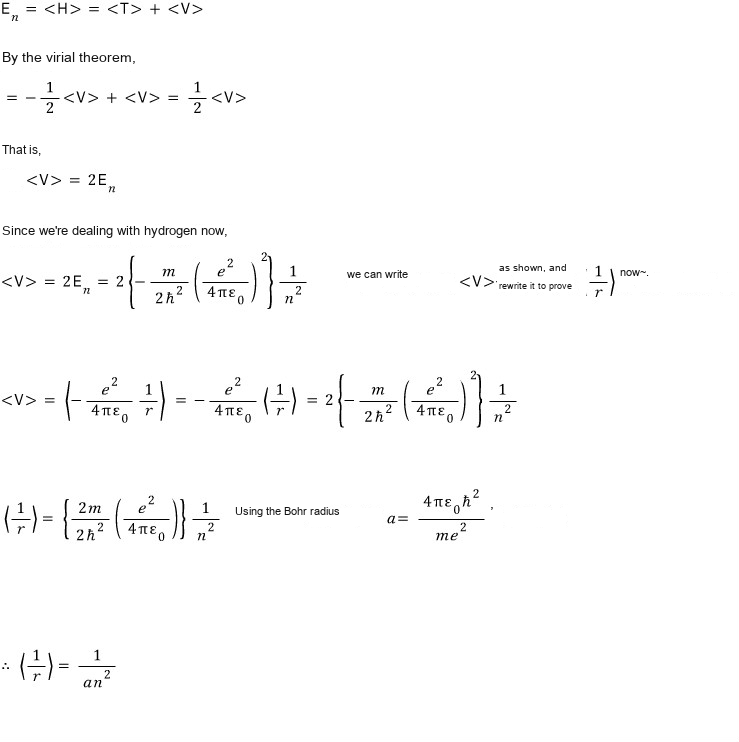
$$E_{n} = \langle H \rangle = \langle T \rangle + \langle V \rangle$$And by the virial theorem:
$$= -\frac{1}{2}\langle V \rangle + \langle V \rangle = \frac{1}{2}\langle V \rangle$$So $\langle V \rangle = 2E_n$. And since we are doing hydrogen:
$$\langle V \rangle = 2E_{n} = 2\left\{ -\frac{m}{2\hbar^{2}}\left( \frac{e^{2}}{4\pi\epsilon_{0}} \right)^{2} \right\}\frac{1}{n^{2}}$$Now rewrite $\langle V \rangle$ directly and pull out $\langle 1/r \rangle$:
$$\langle V \rangle = \left< -\frac{e^{2}}{4\pi\epsilon_{0}}\frac{1}{r} \right> = -\frac{e^{2}}{4\pi\epsilon_{0}}\left< \frac{1}{r} \right> = 2\left\{ -\frac{m}{2\hbar^{2}}\left( \frac{e^{2}}{4\pi\epsilon_{0}} \right)^{2} \right\}\frac{1}{n^{2}} \\ \left< \frac{1}{r} \right> = \left\{ \frac{2m}{2\hbar^{2}}\left( \frac{e^{2}}{4\pi\epsilon_{0}} \right) \right\}\frac{1}{n^{2}}$$Then using the Bohr radius $a = \frac{4\pi\epsilon_{0}\hbar^{2}}{me^{2}}$:
$$\therefore \quad \left< \frac{1}{r} \right> = \frac{1}{an^{2}}$$Second problem — let’s go.
Prob 6.32
The Hamiltonian $H$ for some quantum system is a function of a parameter $\lambda$. Let
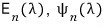
$$E_{n}(\lambda), \quad \psi_{n}(\lambda)$$be the eigenvalues and eigenfunctions of $H(\lambda)$. The Feynman–Hellmann theorem says:
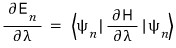
$$\frac{\partial E_{n}}{\partial\lambda} = \left< \psi_{n} \middle| \frac{\partial H}{\partial\lambda} \middle| \psi_{n} \right>$$(Whether $E$ is degenerate or not, the $\psi_n$’s are good linear combinations of the degenerate eigenfunctions.)
a) Prove the Feynman–Hellmann theorem.
Fun note: Feynman derived this in his undergrad thesis at MIT. Hellmann, meanwhile, had published the same thing in some obscure Russian journal four years earlier. Rough.
OK. $H$ is a function of $\lambda$. The unperturbed system is $H(\lambda_0)$ — plug in $\lambda_0$, that’s your baseline.
The perturbed system is something ever so slightly nudged off $\lambda_0$. So it’s whatever you get from the same function $H(\lambda)$ but at $\lambda_0 + d\lambda$. Call it $H(\lambda_0 + d\lambda)$.
Then the perturbation on the unperturbed — the perturbation is the difference:
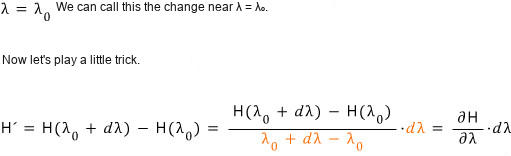
$$H' = H(\lambda_{0} + d\lambda) - H(\lambda_{0})$$Which is the change near $\lambda = \lambda_0$. Now I’m gonna play a little algebra game:
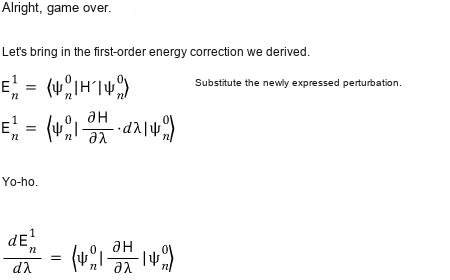
$$H' = H(\lambda_{0} + d\lambda) - H(\lambda_{0}) = \frac{H(\lambda_{0} + d\lambda) - H(\lambda_{0})}{\lambda_{0} + d\lambda - \lambda_{0}} \cdot d\lambda = \frac{\partial H}{\partial\lambda} \cdot d\lambda$$OK, game over. Pull out the first-order energy correction formula we derived:
$$E_{n}^{1} = \left< \psi_{n}^{0} \middle| H' \middle| \psi_{n}^{0} \right>$$and sub in the new-look perturbation:
$$E_{n}^{1} = \left< \psi_{n}^{0} \middle| \frac{\partial H}{\partial\lambda} \cdot d\lambda \middle| \psi_{n}^{0} \right>$$Yoho.
$$\frac{dE_{n}^{1}}{d\lambda} = \left< \psi_{n}^{0} \middle| \frac{\partial H}{\partial\lambda} \middle| \psi_{n}^{0} \right>$$b) Apply this to the 1D harmonic oscillator for the following cases.
① $\lambda = \omega$ (gives a formula for $\langle V \rangle$) ② $\lambda = \hbar$ (gives $\langle T \rangle = \cdots$)
①
So $\lambda$ is $\omega$. The variable is… omega?? Yep — they said 1D harmonic oscillator, so of course that’s the handle to turn.
Energy and Hamiltonian of the SHO — both have $\omega$ in them:
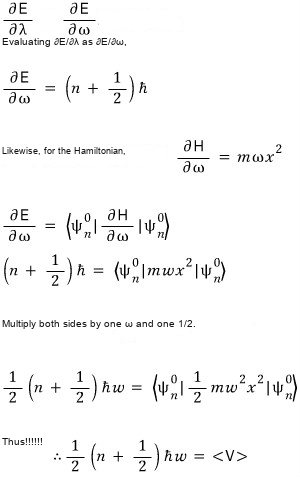
$$E_{n} = \left( n + \frac{1}{2} \right)\hbar\omega \quad // \quad H = -\frac{\hbar^{2}}{2m}\frac{d^{2}}{dx^{2}} + \frac{1}{2}m\omega^{2}x^{2}$$This is the unperturbed system. Let’s just send it:
$$\frac{\partial E}{\partial\omega} = \left( n + \frac{1}{2} \right)\hbar$$Same for $H$:
$$\frac{\partial H}{\partial\omega} = m\omega x^{2}$$F-H theorem:
$$\frac{\partial E}{\partial\omega} = \left< \psi_{n}^{0} \middle| \frac{\partial H}{\partial\omega} \middle| \psi_{n}^{0} \right> \\ \left( n + \frac{1}{2} \right)\hbar = \left< \psi_{n}^{0} \middle| m\omega x^{2} \middle| \psi_{n}^{0} \right>$$Multiply both sides by $\omega$ and by $1/2$:
$$\frac{1}{2}\left( n + \frac{1}{2} \right)\hbar\omega = \left< \psi_{n}^{0} \middle| \frac{1}{2}m\omega^{2}x^{2} \middle| \psi_{n}^{0} \right>$$That is!!!!!!
$$\therefore \frac{1}{2}\left( n + \frac{1}{2} \right)\hbar\omega = \langle V \rangle$$F-H nails the SHO property dead-on:
$$E_{n} = \langle K \rangle + \langle V \rangle \quad \text{and} \quad \langle K \rangle = \langle V \rangle$$Clean.
②
Now $\lambda = \hbar$:
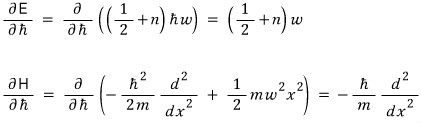
$$\frac{\partial E}{\partial\hbar} = \frac{\partial}{\partial\hbar}\left( \left( \frac{1}{2} + n \right)\hbar\omega \right) = \left( \frac{1}{2} + n \right)\omega \\ \frac{\partial H}{\partial\hbar} = \frac{\partial}{\partial\hbar}\left( -\frac{\hbar^{2}}{2m}\frac{d^{2}}{dx^{2}} + \frac{1}{2}m\omega^{2}x^{2} \right) = -\frac{\hbar}{m}\frac{d^{2}}{dx^{2}}$$Into F-H:
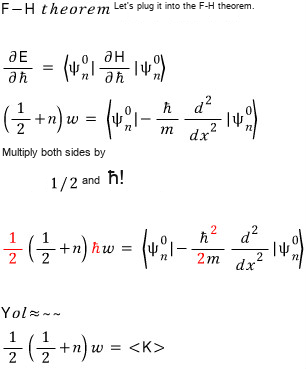
$$\frac{\partial E}{\partial\hbar} = \left< \psi_{n}^{0} \middle| \frac{\partial H}{\partial\hbar} \middle| \psi_{n}^{0} \right> \\ \left( \frac{1}{2} + n \right)\omega = \left< \psi_{n}^{0} \middle| -\frac{\hbar}{m}\frac{d^{2}}{dx^{2}} \middle| \psi_{n}^{0} \right>$$Multiply both sides by $1/2$ and by $\hbar$:
$$\frac{1}{2}\left( \frac{1}{2} + n \right)\hbar\omega = \left< \psi_{n}^{0} \middle| -\frac{\hbar^{2}}{2m}\frac{d^{2}}{dx^{2}} \middle| \psi_{n}^{0} \right>$$And — ta-da —
$$\frac{1}{2}\left( \frac{1}{2} + n \right)\hbar\omega = \langle K \rangle$$Exact same number as ①. Ta-daaa.
Prob 6.33
The Feynman–Hellmann theorem can be used to pin down $\langle 1/r \rangle$ and $\langle 1/r^2 \rangle$ for hydrogen. The effective Hamiltonian for the radial wave functions is:
$$H = -\frac{\hbar^{2}}{2m}\frac{d^{2}}{dr^{2}} + \frac{\hbar^{2}}{2m}\frac{\ell(\ell+1)}{r^{2}} - \frac{e^{2}}{4\pi\epsilon_{0}}\frac{1}{r}$$Eigenvalues:
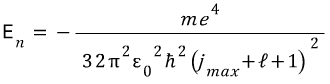
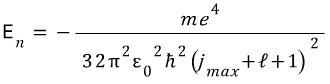
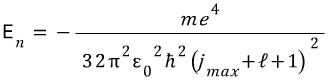
$$E_{n} = -\frac{me^{4}}{32\pi^{2}\epsilon_{0}^{2}\hbar^{2}(j_{max}+\ell+1)^{2}}$$a) Using $\lambda = e$ in the Feynman–Hellmann theorem, obtain $\langle 1/r \rangle$.
Before we charge in: let’s take a sec to remember why the effective radial Hamiltonian looks like that, and why its eigenvalue has that specific form. Flip way back to p. 136.
Look at equation 4.37:
$$-\frac{\hbar^{2}}{2m}\frac{d^{2}u}{dr^{2}} + \left\{ V + \frac{\hbar^{2}}{2m}\frac{\ell(\ell+1)}{r^{2}} \right\}u = Eu$$That was the radial equation. And
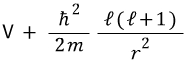
$$V + \frac{\hbar^{2}}{2m}\frac{\ell(\ell+1)}{r^{2}}$$is the effective potential — we flagged it back then and said “yeah, we met this thing when we did Kepler in classical mechanics.”
It comes from the substitution $rR = u$, where the actual radial wave function is $R$. But after subbing, we don’t solve for $R$ — we solve for $u$, and the eigenvalue-for-$u$ is the energy $E$. And the fact that it’s an eigenvalue $E$ means
$$\left\{ -\frac{\hbar^{2}}{2m}\frac{d^{2}}{dr^{2}} + V + \frac{\hbar^{2}}{2m}\frac{\ell(\ell+1)}{r^{2}} \right\}u = Eu$$the whole braced thing is just the Hamiltonian~~~ But it’s a Hamiltonian built with effective $V$ instead of plain $V$, so we call it the effective Hamiltonian.
(Aside: “effective.” Little English trivia — the flavor of “effective” vs “effect” is worth noticing as you read physics in English. Something to chew on.)
Our target is hydrogen, so plug in hydrogen’s $V$:
$$\left\{ -\frac{\hbar^{2}}{2m}\frac{d^{2}}{dr^{2}} - \frac{e^{2}}{4\pi\epsilon_{0}}\frac{1}{r} + \frac{\hbar^{2}}{2m}\frac{\ell(\ell+1)}{r^{2}} \right\}u = Eu$$And solving that was… how did it go?
Right. It was painful, wasn’t it.
lol (kidding, kidding.)
(We’re not re-solving it here. I’m just doing a memory-refresh sweep. If you want the full treatment:
http://gdpresent.blog.me/220455564468
— it’s all there!)
Quantum Mechanics I Studied #20. Hydrogen Atom (H-atom)
(image unrelated) In the previous postings, we kept saying hydrogen hydrogen, and yet we just wrote the potential V as ‘V’ and moved on…
blog.naver.com
We subbed in $\rho$ and $K$:
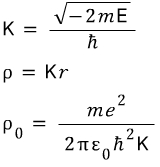
$$K = \frac{\sqrt{-2mE}}{\hbar} \\ \rho = Kr \\ \rho_{0} = \frac{me^{2}}{2\pi\epsilon_{0}\hbar^{2}K}$$and beat the recurrence relation:
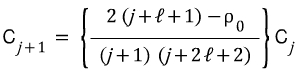
$$C_{j+1} = \left\{ \frac{2(j+\ell+1) - \rho_{0}}{(j+1)(j+2\ell+2)} \right\}C_{j}$$Then “the series has to terminate~”, so
$$n \equiv j_{max} + \ell + 1, \quad \rho_{0} = 2n$$and the long-awaited eigenvalue fell out:
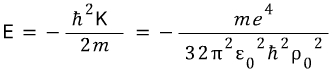
$$E = -\frac{\hbar^{2}K^{2}}{2m} = -\frac{me^{4}}{32\pi^{2}\epsilon_{0}^{2}\hbar^{2}\rho_{0}^{2}}$$Subbing $\rho_0^2 = (2n)^2 = 4(j_{max}+\ell+1)^2$:
$$E_{n} = -\frac{me^{4}}{32\pi^{2}\epsilon_{0}^{2}\hbar^{2}(j_{max}+\ell+1)^{2}}$$The reason we’re writing $E_n$ in this weird-looking form instead of the friendly
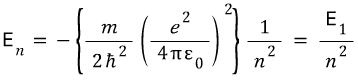
$$E_{n} = -\left\{ \frac{m}{2\hbar^{2}}\left( \frac{e^{2}}{4\pi\epsilon_{0}} \right)^{2} \right\}\frac{1}{n^{2}} = \frac{E_{1}}{n^{2}}$$will become obvious in part (b).
Phew. OK that was all just “understanding the problem.” The actual thing-to-do is: take the $H$ and $E$ the problem handed us and run them through F-H. That was the original goal. But after reading the problem something felt foggy so I ended up flipping all the way back to Chapter 4. T_T sigh. lol.
Anyway. F-H with $\lambda = e$:
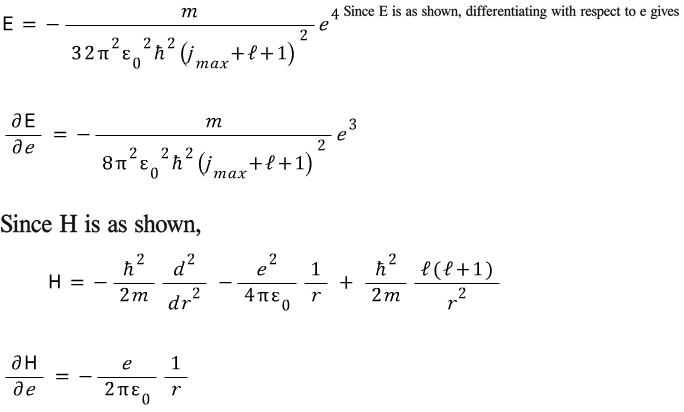
$$E = -\frac{m}{32\pi^{2}\epsilon_{0}^{2}\hbar^{2}(j_{max}+\ell+1)^{2}}e^{4} \\ \frac{\partial E}{\partial e} = -\frac{m}{8\pi^{2}\epsilon_{0}^{2}\hbar^{2}(j_{max}+\ell+1)^{2}}e^{3}$$And
$$H = -\frac{\hbar^{2}}{2m}\frac{d^{2}}{dr^{2}} - \frac{e^{2}}{4\pi\epsilon_{0}}\frac{1}{r} + \frac{\hbar^{2}}{2m}\frac{\ell(\ell+1)}{r^{2}} \\ \frac{\partial H}{\partial e} = -\frac{e}{2\pi\epsilon_{0}}\frac{1}{r}$$Plug into F-H:
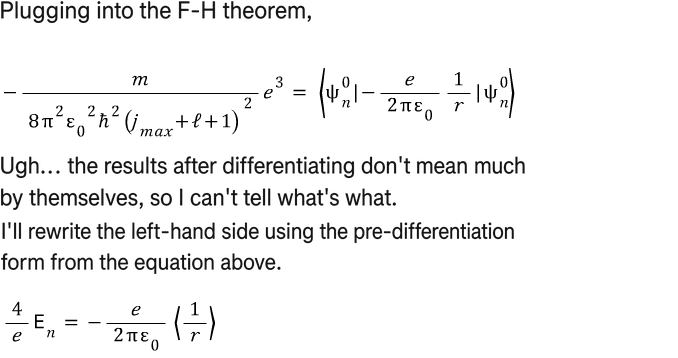
$$-\frac{m}{8\pi^{2}\epsilon_{0}^{2}\hbar^{2}(j_{max}+\ell+1)^{2}}e^{3} = \left< \psi_{n}^{0} \middle| -\frac{e}{2\pi\epsilon_{0}}\frac{1}{r} \middle| \psi_{n}^{0} \right>$$Ugh. After you differentiate, the raw numbers don’t really “mean” anything on their own — hard to see what’s what. Let’s rewrite the left side back in the form it had before differentiation:
$$\frac{4}{e}E_{n} = -\frac{e}{2\pi\epsilon_{0}}\left< \frac{1}{r} \right>$$Now rewrite $E_n$ too:
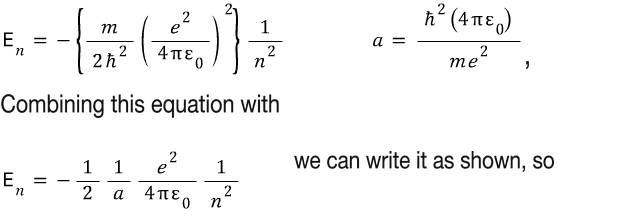
$$E_{n} = -\left\{ \frac{m}{2\hbar^{2}}\left( \frac{e^{2}}{4\pi\epsilon_{0}} \right)^{2} \right\}\frac{1}{n^{2}}$$and mix in $a = \frac{\hbar^{2}(4\pi\epsilon_{0})}{me^{2}}$ to get
$$E_{n} = -\frac{1}{2}\frac{1}{a}\frac{e^{2}}{4\pi\epsilon_{0}}\frac{1}{n^{2}}$$So:
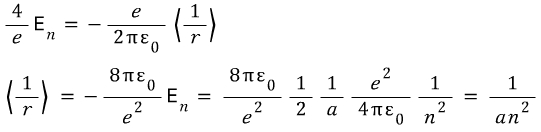
$$\frac{4}{e}E_{n} = -\frac{e}{2\pi\epsilon_{0}}\left< \frac{1}{r} \right> \\ \left< \frac{1}{r} \right> = -\frac{8\pi\epsilon_{0}}{e^{2}}E_{n} = \frac{8\pi\epsilon_{0}}{e^{2}} \cdot \frac{1}{2}\frac{1}{a}\frac{e^{2}}{4\pi\epsilon_{0}}\frac{1}{n^{2}} = \frac{1}{an^{2}}$$b) Using $\lambda = \ell$, obtain $\langle 1/r^2 \rangle$.
Now you see why we kept hydrogen’s energy in the ugly form
$$E_{n} = -\frac{me^{4}}{32\pi^{2}\epsilon_{0}^{2}\hbar^{2}(j_{max}+\ell+1)^{2}}$$instead of the clean $1/n^2$ one. We need to differentiate with respect to $\ell$ — we want $E_n$ explicitly as a function of $\ell$, so we can run F-H at $\lambda = \ell$ to pry out $\langle 1/r^2 \rangle$.
Partial with respect to $\ell$:
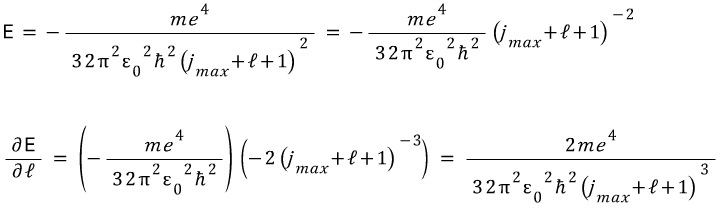
$$E = -\frac{me^{4}}{32\pi^{2}\epsilon_{0}^{2}\hbar^{2}}(j_{max}+\ell+1)^{-2} \\ \frac{\partial E}{\partial\ell} = \left( -\frac{me^{4}}{32\pi^{2}\epsilon_{0}^{2}\hbar^{2}} \right)\left( -2(j_{max}+\ell+1)^{-3} \right) = \frac{2me^{4}}{32\pi^{2}\epsilon_{0}^{2}\hbar^{2}(j_{max}+\ell+1)^{3}}$$And for $H$:
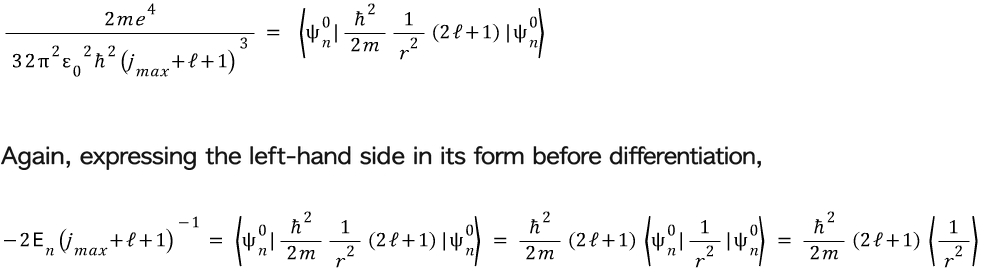
$$H = -\frac{\hbar^{2}}{2m}\frac{d^{2}}{dr^{2}} + \frac{\hbar^{2}}{2m}\frac{1}{r^{2}}\left( \ell^{2}+\ell \right) - \frac{e^{2}}{4\pi\epsilon_{0}}\frac{1}{r} \\ \frac{\partial H}{\partial\ell} = \frac{\hbar^{2}}{2m}\frac{1}{r^{2}}(2\ell+1)$$Into F-H:
$$\frac{2me^{4}}{32\pi^{2}\epsilon_{0}^{2}\hbar^{2}(j_{max}+\ell+1)^{3}} = \left< \psi_{n}^{0} \middle| \frac{\hbar^{2}}{2m}\frac{1}{r^{2}}(2\ell+1) \middle| \psi_{n}^{0} \right>$$Same trick — rewrite the left side in pre-differentiation form:
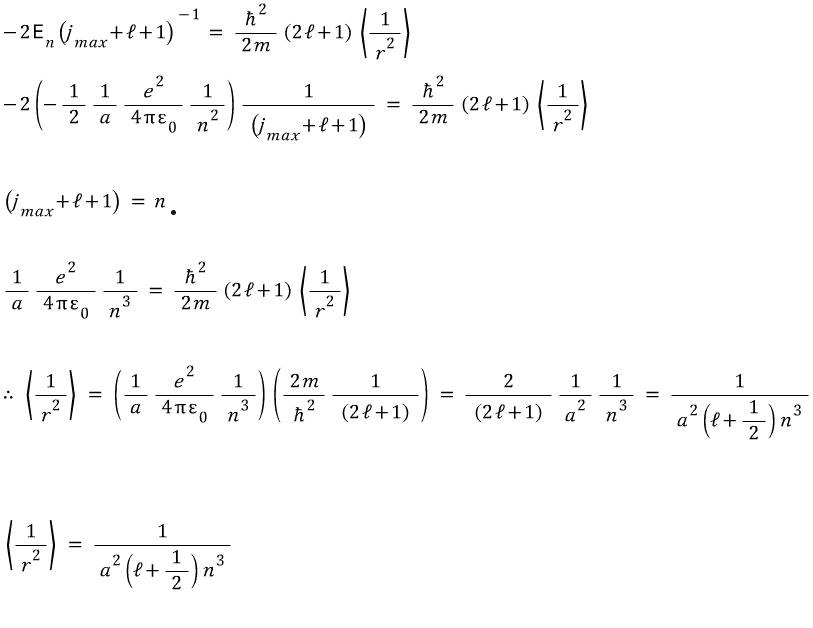
$$-2E_{n}(j_{max}+\ell+1)^{-1} = \frac{\hbar^{2}}{2m}(2\ell+1)\left< \frac{1}{r^{2}} \right>$$Switch $E$ to the Bohr-radius form:
$$-2\left( -\frac{1}{2}\frac{1}{a}\frac{e^{2}}{4\pi\epsilon_{0}}\frac{1}{n^{2}} \right)\frac{1}{(j_{max}+\ell+1)} = \frac{\hbar^{2}}{2m}(2\ell+1)\left< \frac{1}{r^{2}} \right>$$Recall $(j_{max}+\ell+1) = n$:
$$\frac{1}{a}\frac{e^{2}}{4\pi\epsilon_{0}}\frac{1}{n^{3}} = \frac{\hbar^{2}}{2m}(2\ell+1)\left< \frac{1}{r^{2}} \right>$$Solve:
$$\therefore \quad \left< \frac{1}{r^{2}} \right> = \left( \frac{1}{a}\frac{e^{2}}{4\pi\epsilon_{0}}\frac{1}{n^{3}} \right)\left( \frac{2m}{\hbar^{2}}\frac{1}{(2\ell+1)} \right) = \frac{2}{(2\ell+1)}\frac{1}{a^{2}}\frac{1}{n^{3}} = \frac{1}{a^{2}\left( \ell+\frac{1}{2} \right)n^{3}}$$$$\left< \frac{1}{r^{2}} \right> = \frac{1}{a^{2}\left( \ell+\frac{1}{2} \right)n^{3}}$$So via Feynman–Hellmann, we’ve got
$$\left< \frac{1}{r} \right>, \quad \left< \frac{1}{r^{2}} \right>$$locked in!!!!!!
Next post: the Kramers relation. And using Kramers,
$$\left< \frac{1}{r^{3}} \right>$$gets proven!!!! >_<

Originally written in Korean on my Naver blog (2015-12). Translated to English for gdpark.blog.