Kramers' Relation
Proving ⟨1/r³⟩ for the hydrogen atom using Kramers' relation — brutal-looking but apparently the least painful option, thanks Uncle Griffiths T_T
The integrals are back, so Isaac Newton is back in the firing line too. I am joking, of course—but this is one of those derivations that makes the invention of calculus feel personal.
In the previous post on the Feynman–Hellmann theorem, I obtained the first two inverse-power expectation values for hydrogen:

Here the target is the next member of the sequence:

Kramers’ relation gives the cleanest route to that result. Unfortunately, getting the relation itself is the long part.
1. Kramers’ relation
Problem 6.34
For an electron in the hydrogen eigenstate $\psi_{n\ell m}$,

prove
$$ \boxed{ \frac{s+1}{n^2}\langle r^s\rangle -(2s+1)a\langle r^{s-1}\rangle {}+\frac{s}{4}\left[(2\ell+1)^2-s^2\right]a^2 \langle r^{s-2}\rangle=0 }. $$The state is labeled in the usual way:

The hint introduces the three moments
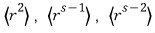
and asks us to evaluate a radial integral involving $u''$ in two ways.
Source-image correction. The preserved source image below fixes the power at $r^2$, but the recurrence needs an arbitrary real power $r^s$. The equation used in this proof is the native equation immediately below the image.
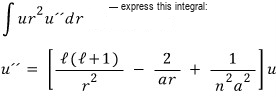
It looks brutal, but it is still the least painful way to reach

for the hydrogen atom.
2. Start from the reduced radial equation
Write
$$ \psi_{n\ell m}(r,\Omega)=\frac{u_{n\ell}(r)}{r}Y_{\ell m}(\Omega), \qquad \int |Y_{\ell m}|^2\,d\Omega=1. $$The bound-state radial function may be chosen real, and I make that choice throughout. Then
$$ \int_0^\infty |u|^2\,dr=1, \qquad M_q\equiv\langle r^q\rangle =\int_0^\infty |u(r)|^2r^q\,dr. $$For a finite-mass electron–proton system, let $\mu$ be the reduced mass and define
$$ a=\frac{4\pi\epsilon_0\hbar^2}{\mu e^2}, \qquad E_n=-\frac{\hbar^2}{2\mu a^2n^2}. $$The fixed-proton approximation is recovered by taking $\mu\approx m_e$. The same mass convention must be used in both $a$ and the radial Hamiltonian.
Source-image correction. The preserved source equation below prints the centrifugal denominator as $r$. It must be $r^2$.

Source-image correction. The following rearrangement inherits that same $r$-instead-of-$r^2$ error. The corrected reduced equation is given natively after it.
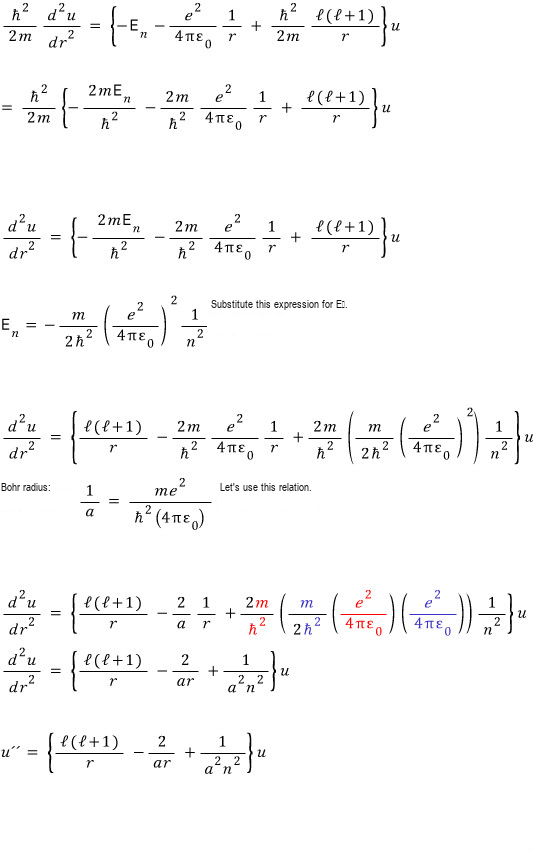
The notation $u''$ means the second derivative of $u$ with respect to $r$:

The dimensionally consistent reduced equation used below is
$$ u''(r)=\left[ \frac{\ell(\ell+1)}{r^2} -\frac{2}{ar} {}+\frac{1}{a^2n^2} \right]u(r). $$Source-image correction. The preserved multiplication step below again prints $\ell(\ell+1)/r$ even though its next line uses the $M_{s-2}$ moment. Replace that denominator by $r^2$ as in the native calculation that follows.
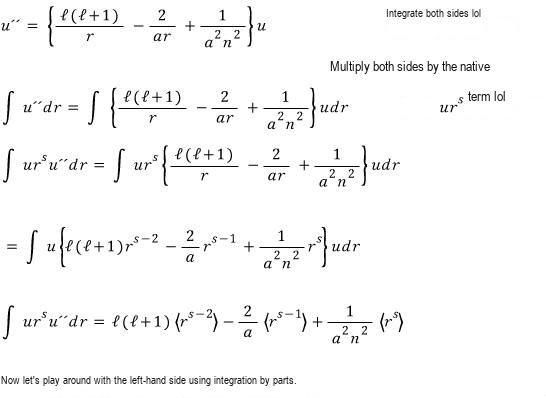
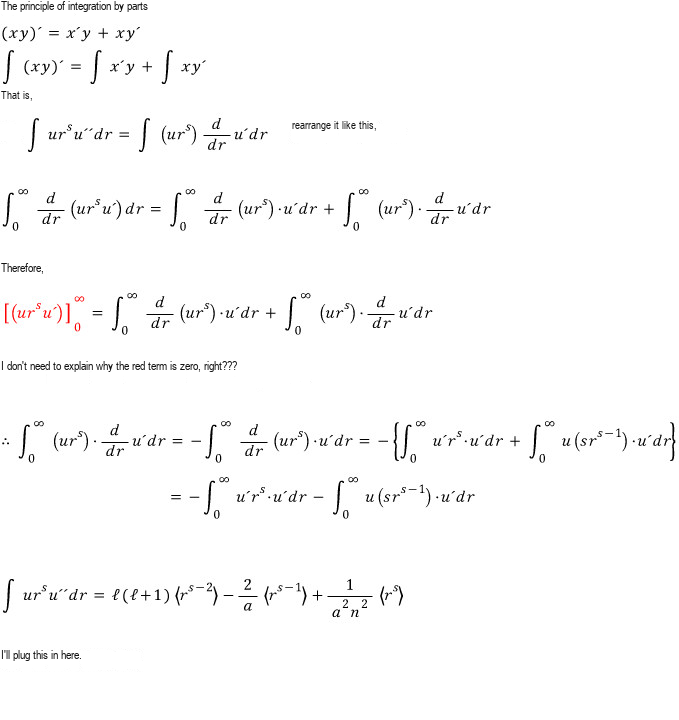
Multiplying the corrected radial equation by $u r^s$ and integrating gives the first evaluation:
$$ \begin{aligned} I_s &=\int_0^\infty u r^s \left[\frac{\ell(\ell+1)}{r^2}-\frac{2}{ar} {}+\frac{1}{a^2n^2}\right]u\,dr\\ &=\ell(\ell+1)M_{s-2} -\frac{2}{a}M_{s-1} {}+\frac{1}{a^2n^2}M_s. \end{aligned} $$Boundary conditions and domain
For a regular hydrogen bound state,
$$ u(r)\sim r^{\ell+1},\qquad u'(r)\sim r^\ell \quad (r\to0), $$while $u$ and $u'$ decay exponentially as $r\to\infty$. Thus the moments, derivative integral, and all origin boundary terms used below converge and vanish for
$$ s>-2\ell-1. $$The intermediate calculation of $K_s$ divides by $s+1$, so the derivation at first also assumes $s\ne-1$. We will recover $s=-1$ for $\ell\ge1$ by a limit after proving the recurrence on this domain.
First integration by parts
The preserved source image records the first integration-by-parts step:

Its complete native form is
$$ \begin{aligned} I_s &=\left[u r^s u'\right]_0^\infty -\int_0^\infty r^s(u')^2\,dr -s\int_0^\infty u r^{s-1}u'\,dr\\ &=-K_s-s\int_0^\infty u r^{s-1}u'\,dr, \qquad K_s\equiv\int_0^\infty r^s(u')^2\,dr. \end{aligned} $$For any needed power $p$, a second elementary integration by parts gives
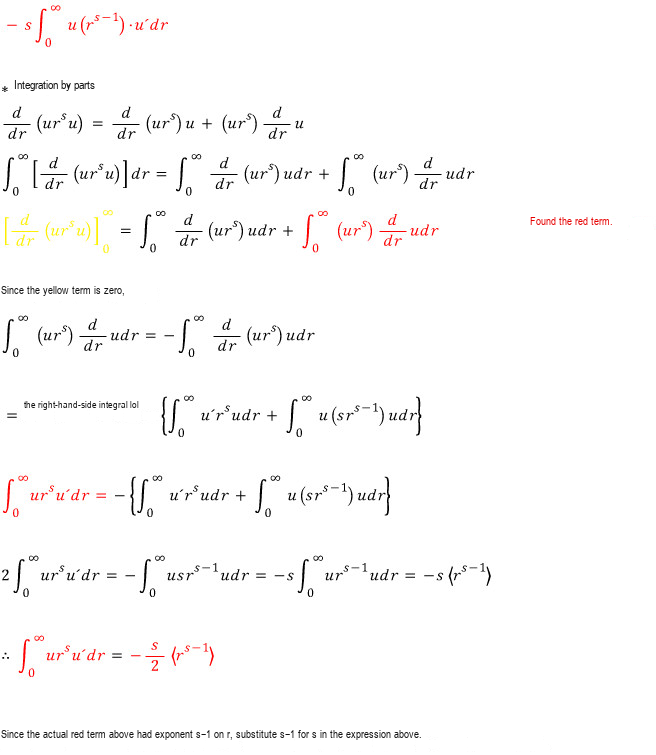
In particular,
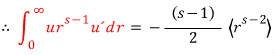
and therefore
$$ I_s=-K_s+\frac{s(s-1)}{2}M_{s-2}. $$The remaining derivative integral
The next preserved image encodes the derivative identity for $K_s$:
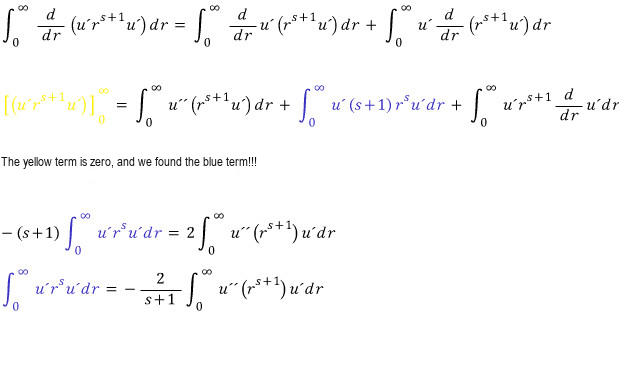
Written completely in native form,
$$ \begin{aligned} 0 &=\int_0^\infty\frac{d}{dr}\left[r^{s+1}(u')^2\right]dr\\ &=(s+1)\int_0^\infty r^s(u')^2\,dr {}+2\int_0^\infty r^{s+1}u'u''\,dr, \end{aligned} $$so, for $s\ne-1$,
$$ K_s=-\frac{2}{s+1}\int_0^\infty r^{s+1}u'u''\,dr. $$Source-image correction. This preserved substitution image prints the centrifugal denominator as $r$; the required denominator is $r^2$.
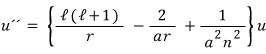
Source-image correction. The next preserved image also prints that denominator as $r$ and consequently writes $r^{s+1}$ in the centrifugal derivative integral. With $1/r^2$, the correct power is $r^{s-1}$. The complete corrected substitution is below.
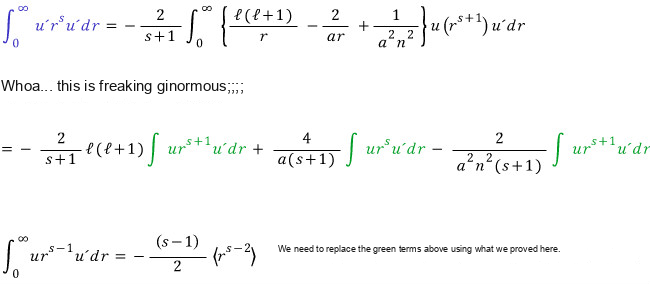
Source-image correction. The preserved evaluated image gives the $M_s/(a^2n^2)$ term the wrong negative sign. Applying the identity above to all three integrals gives a positive sign:
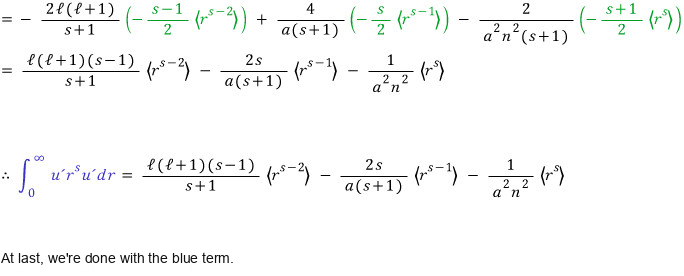
The earlier integration-by-parts equation was

and the corrected substitution gives
$$ \begin{aligned} I_s &=-K_s+\frac{s(s-1)}{2}M_{s-2}\\ &=\left[ \frac{s(s-1)}{2} -\frac{\ell(\ell+1)(s-1)}{s+1} \right]M_{s-2} {}+\frac{2s}{a(s+1)}M_{s-1} -\frac{1}{a^2n^2}M_s. \end{aligned} $$Source-image correction. The preserved combination below carries the wrong negative sign from the preceding source step and then distributes the outer minus inconsistently. Those two errors compensate. The proof instead equates the two internally consistent native expressions above.
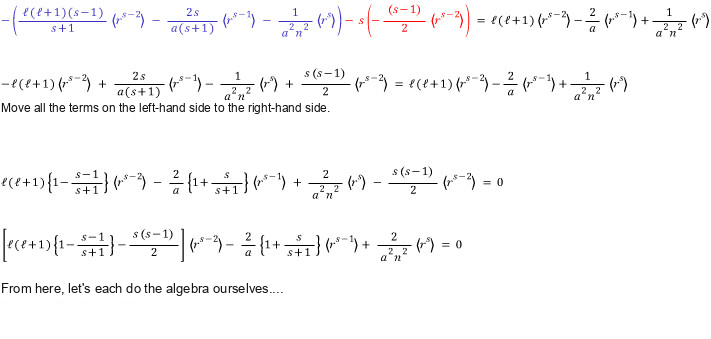
Equating the radial-equation evaluation of $I_s$ to the integration-by-parts evaluation and multiplying by $2(s+1)$ gives
$$ \begin{aligned} 0={}& \left\{2(s+1)\ell(\ell+1) -(s-1)\left[s(s+1)-2\ell(\ell+1)\right]\right\}M_{s-2}\\ &-\frac{4(2s+1)}{a}M_{s-1} {}+\frac{4(s+1)}{a^2n^2}M_s\\ ={}& s\left[(2\ell+1)^2-s^2\right]M_{s-2} -\frac{4(2s+1)}{a}M_{s-1} {}+\frac{4(s+1)}{a^2n^2}M_s. \end{aligned} $$Multiplying by $a^2/4$ produces the claimed recurrence:

That is Kramers’ relation for $s>-2\ell-1$ and $s\ne-1$ as derived above. Where the moments remain finite, the recurrence itself extends to $s=-1$ by continuity.
3. Useful special cases
Problem 6.35(a)
The immediate goal is still

but first the exercise proposes $s=0,1,2,3$ in

I evaluate $s=0$ and $s=1$ here because they supply the moments used in this post. The $s=2$ and $s=3$ cases are intentionally skipped; they generate higher positive moments but are not needed for the inverse-cube result.
At $s=0$, normalization gives $M_0=1$, so
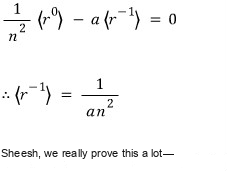
and therefore

At $s=1$,
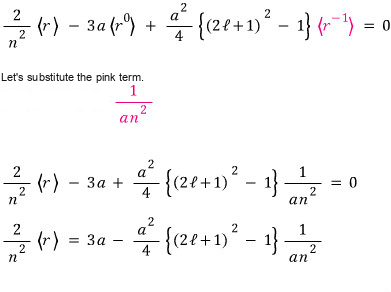
the recurrence gives
$$ \frac{2}{n^2}\langle r\rangle-3a {}+a^2\ell(\ell+1)\left\langle r^{-1}\right\rangle=0. $$Source-image correction. In the preserved handwritten simplification below, $-(4\ell^2+4\ell)$ is incorrectly changed to $-4\ell^2+4\ell$, leading temporarily to $\ell(\ell-1)$. The correct factor is $\ell(\ell+1)$, as shown by the native calculation.
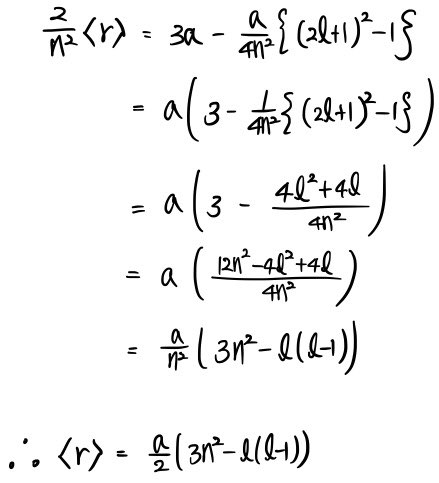
Using $\langle r^{-1}\rangle=1/(an^2)$,
$$ \begin{aligned} 2\langle r\rangle-3an^2+a\ell(\ell+1)&=0,\\ \therefore\qquad \boxed{\langle r\rangle =\frac{a}{2}\left[3n^2-\ell(\ell+1)\right]}. \end{aligned} $$The inverse-cube result requires a different value, so let us return to

in the recurrence

and now take $s\to-1$. This is not direct substitution into the intermediate $K_s$ equation, which divided by $s+1$. For $\ell\ge1$, an open interval around $s=-1$ lies inside $s>-2\ell-1$, and the convergent moments $M_s$, $M_{s-1}$, and $M_{s-2}$ are continuous—indeed analytic—in $s$ there. We may therefore take the limit of the already-proved recurrence. The first term tends to zero, leaving
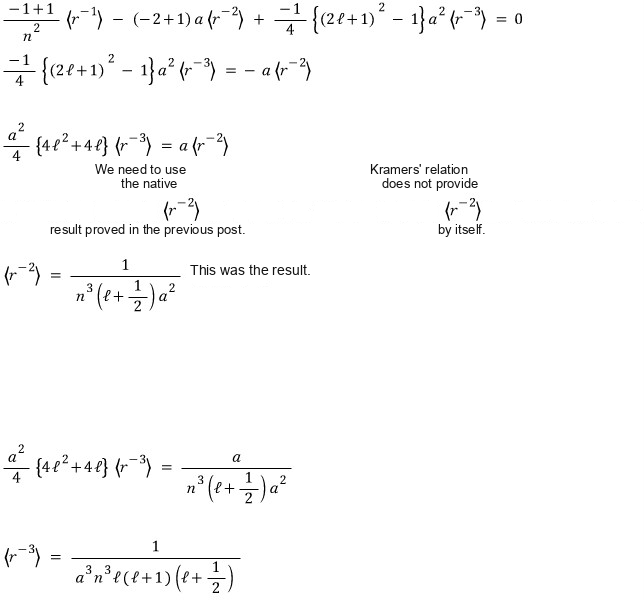
Using the previous post’s result
$$ \left\langle r^{-2}\right\rangle =\frac{1}{a^2n^3\left(\ell+\tfrac12\right)}, $$we finally obtain
$$ \boxed{ \left\langle\frac{1}{r^3}\right\rangle =\frac{1}{a^3n^3\ell(\ell+1)\left(\ell+\tfrac12\right)} },\qquad \ell\ne0. $$The restriction $\ell\ne0$ matters. For an $s$ state, $u(r)\sim r$ near the origin, so the integrand $|u|^2r^{-3}\sim r^{-1}$ and $\langle r^{-3}\rangle$ diverges logarithmically. For $\ell\ge1$, the limit above is valid and the boxed result is finite.
After a semester full of integrals, I think an Isaac Toast is the appropriate way to call it a day.
Comments
Discussion happens via GitHub Discussions. You'll need a GitHub account to comment.