Relativistic Correction and the Fine Structure of Hydrogen
We're back to hydrogen again?! Using perturbation theory, we dig into fine structure — relativistic corrections, spin-orbit coupling, and the Lamb shift.
Now that perturbation theory is available, it is time to return to the hydrogen atom. The familiar nonrelativistic model is extraordinarily successful, but it is not exact. Several small effects shift its energy levels:
- the relativistic correction to the electron’s kinetic energy;
- spin–orbit coupling between the electron’s orbital and spin angular momenta;
- the Lamb shift, produced by the interaction of the electron with the quantized electromagnetic field; and
- hyperfine structure, associated with the magnetic interaction between the electron and the nucleus.
The first two contributions are usually discussed together under the heading fine structure. Their scale is tiny—roughly of relative order $10^{-4}$ in hydrogen—but measuring and explaining such small discrepancies is part of how physical theory becomes more precise. The Lamb shift is smaller still and requires quantum electrodynamics, while hyperfine structure belongs to another layer of the spectrum.
This post concentrates on the first item: the leading relativistic correction to the kinetic energy. Spin–orbit coupling comes next.
1. Why the nonrelativistic kinetic energy needs a correction
In the Bohr picture, the characteristic speed of the ground-state electron is of order $\alpha c$, approximately $c/137$. That is slow enough for a nonrelativistic treatment to work well, but fast enough for the first relativistic term to leave a measurable trace.
The Schrödinger Hamiltonian uses the classical expression

or, in momentum form, $T=p^2/(2m_0)$. Relativistically, however, momentum is
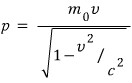
as reviewed in Modern Physics #5: Relativistic Mass, Momentum, and Energy. The exact kinetic energy is the total energy minus the rest energy:
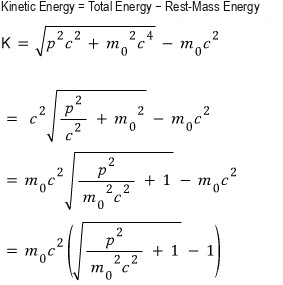
Thus
$$ T_{\mathrm{rel}}=\sqrt{p^2c^2+m_0^2c^4}-m_0c^2 =m_0c^2\left[\sqrt{1+\frac{p^2}{m_0^2c^2}}-1\right]. $$The low-momentum expansion
For $p/(m_0c)\ll1$, expand the square root in a Taylor series:
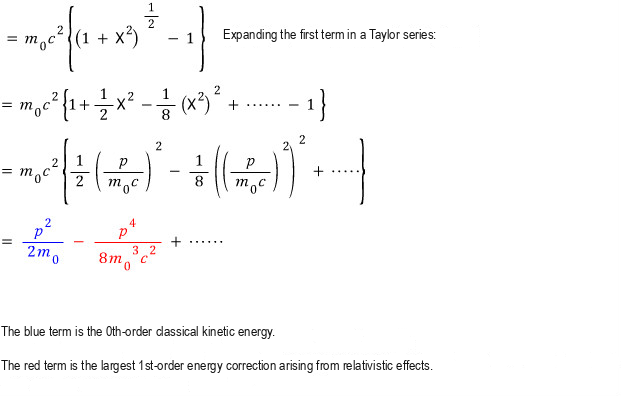
Equivalently,
$$ T_{\mathrm{rel}} =\frac{p^2}{2m_0}-\frac{p^4}{8m_0^3c^2}+O\!\left(\frac{p^6}{m_0^5c^4}\right). $$The first term is the ordinary nonrelativistic kinetic energy. The next term is therefore the leading perturbation:
$$ H'_{\mathrm{rel}}=-\frac{p^4}{8m_0^3c^2}. $$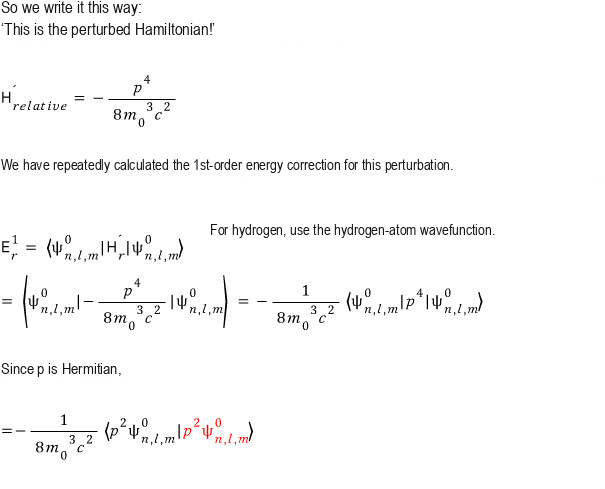
For an unperturbed hydrogen eigenstate $|n,\ell,m\rangle$, first-order perturbation theory gives
$$ E_{\mathrm r}^{(1)} =\left\langle n,\ell,m\middle|H'_{\mathrm{rel}}\middle|n,\ell,m\right\rangle =-\frac{1}{8m_0^3c^2}\left\langle p^4\right\rangle. $$2. Rewriting the momentum operator with the Schrödinger equation
The fourth power of momentum looks awkward, but the time-independent Schrödinger equation supplies the useful identity
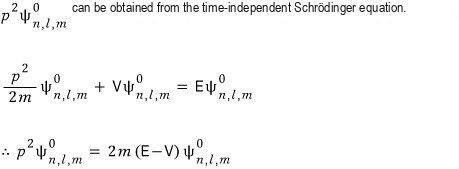
that is,
$$ p^2|n,\ell,m\rangle=2m_0(E_n-V)|n,\ell,m\rangle. $$Using the Hermiticity of $p^2$ on the hydrogen bound-state domain, we can apply this relation to both sides of the expectation value:
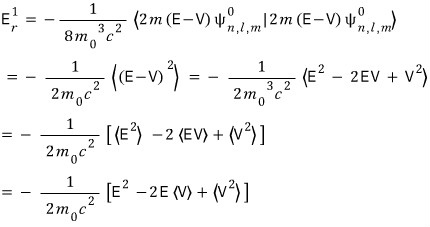
Therefore
$$ E_{\mathrm r}^{(1)} =-\frac{1}{2m_0c^2}\left\langle(E_n-V)^2\right\rangle =-\frac{1}{2m_0c^2} \left[E_n^2-2E_n\langle V\rangle+\langle V^2\rangle\right]. $$Because $E_n$ is a number—not an operator—it passes straight through the expectation value.
Coulomb expectation values
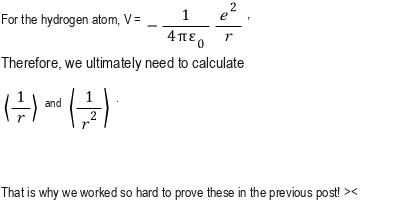
For hydrogen,
$$ V(r)=-\frac{e^2}{4\pi\varepsilon_0r}. $$The remaining ingredients are consequently $\langle r^{-1}\rangle$ and $\langle r^{-2}\rangle$:
The previous post on Kramers’ relation established
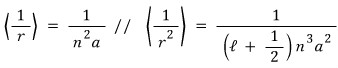
or
$$ \left\langle\frac1r\right\rangle=\frac{1}{n^2a}, \qquad \left\langle\frac1{r^2}\right\rangle =\frac{1}{(\ell+\tfrac12)n^3a^2}, $$where $a$ is the Bohr radius.
3. The first-order relativistic energy shift
Insert the Coulomb potential and the two expectation values into the perturbative expression:
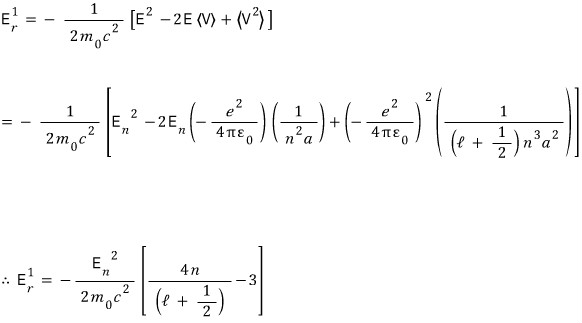
After simplifying with the hydrogen energy $E_n$, the result is
$$ \boxed{ E_{\mathrm r}^{(1)} =-\frac{E_n^2}{2m_0c^2} \left(\frac{4n}{\ell+\tfrac12}-3\right) }. $$The numerator that appears here is

so the relative scale of the correction is set by $|E_n|/(m_0c^2)$, of order $\alpha^2$ for low-lying hydrogen states. This explains why the correction is often summarized as being around one part in ten thousand, although its exact size depends on $n$ and $\ell$.
Most importantly, the unperturbed Coulomb energy depends only on $n$, whereas this correction also depends on $\ell$. The relevant first-order shift is

and its $\ell$ dependence begins to lift the accidental degeneracy of the nonrelativistic hydrogen spectrum. This is one of the ingredients of fine structure; combining it consistently with spin-dependent and contact terms requires the next stage of the analysis.
Comments
Discussion happens via GitHub Discussions. You'll need a GitHub account to comment.